3 'Hello's and You're Out of Quota: Where Did Your Claude Code Allowance Go? A 28-Day Cache Bug and an Official Response Telling You to 'Use It Sparingly'

marsbitDipublikasikan tanggal 2026-04-03Terakhir diperbarui pada 2026-04-03

Abstrak

Over the past month, Claude Code experienced a critical caching bug that caused prompt cache read rates to drop to 4–17%, far below the typical 97–99%. This meant users were charged 10–20 times more than normal when resuming conversations, as the system reprocessed entire contexts instead of reusing cached content. The bug persisted across 20 versions from March 4 to April 1. User complaints surged after a promotional period ended, revealing the severity of the issue. Anthropic responded by tightening usage limits and offering user advice—such as downgrading models or reducing context windows—but did not issue refunds or reset quotas. Despite confirming and fixing a caching regression bug, the company maintained that no overcharging occurred. The response contrasts with OpenAI’s approach of compensating users during similar incidents. Subscribers reported extreme consumption rates, with some exhausting their monthly quotas in minutes.

4-17%. This was the prompt cache read rate for Claude Code over the past month. The normal level is 97-99%.

This means that when you resumed a previous session, Claude Code did not reuse the context that had already been processed, but instead processed the entire content from scratch each time, consuming 10 to 20 times the normal amount of allowance. You thought you were continuing a conversation, but in reality, you were starting a brand new, full-price conversation every time.

This number comes from independent developer ArkNill's proxy monitoring tests. By setting up a transparent proxy, he recorded every request between Claude Code and the Anthropic API, discovering at least two client-side cache bugs that prevented the API server from matching cached conversation prefixes, forcing a full token rebuild every round.
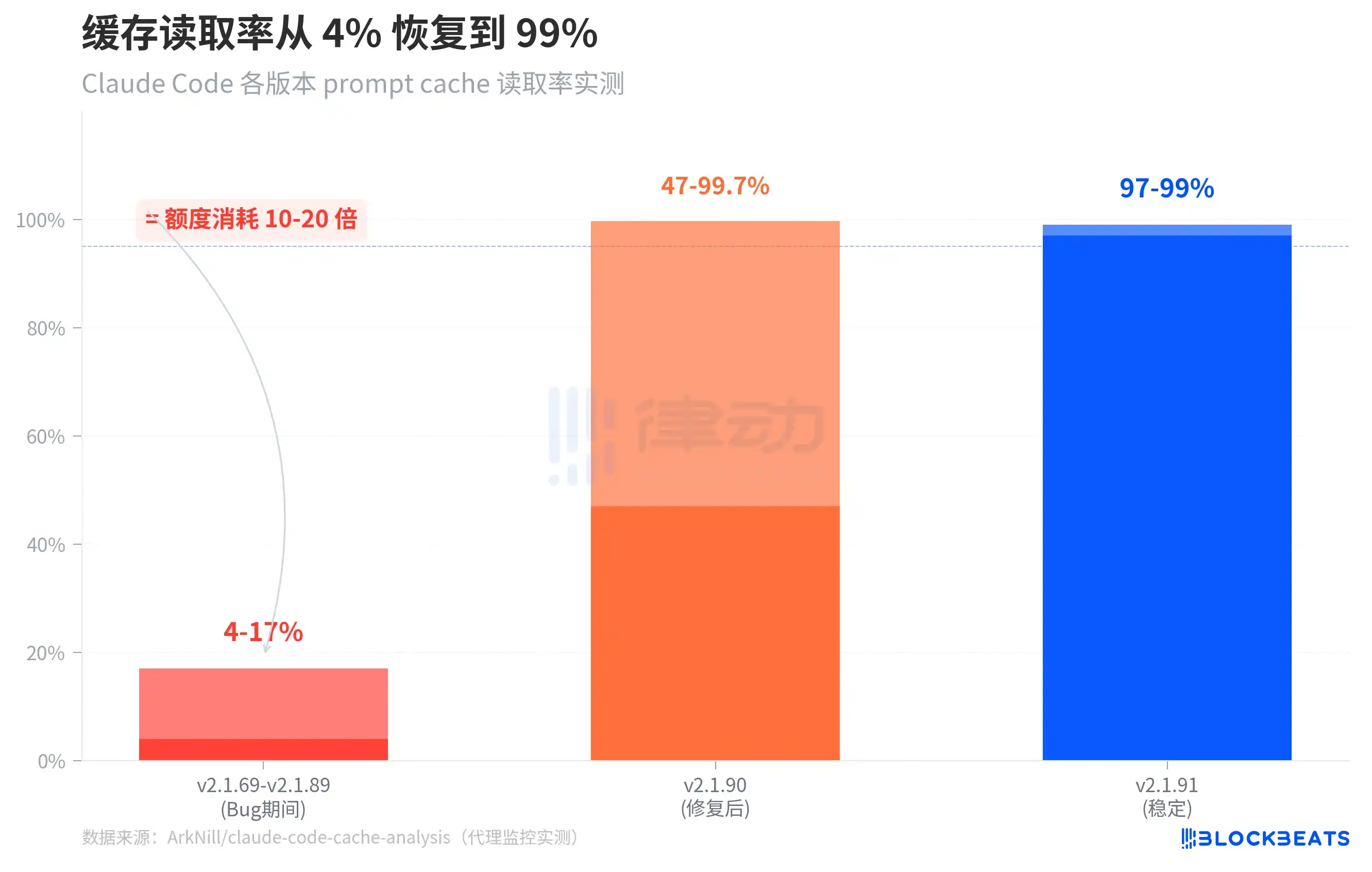
The chart above shows a comparison of cache read rates across three phases. During the period from v2.1.69 to v2.1.89 (i.e., the bug period), the cache read rate for the standalone version was only 4-17%. After v2.1.90 fixed one of the critical bugs, the cold-start cache read rate returned to 47-99.7%. By v2.1.91, the stable running cache read rate recovered to 97-99%.

Notably, a detail in the chart: the range for v2.1.90 is very wide (47% to 99.7%). This is because when a session is first resumed, it still needs to "warm up" the cache; the hit rate for the first few rounds is relatively low but quickly returns to normal levels. In the buggy version, this warm-up never happened—the cache read permanently stalled at the 14,500 tokens of the system prompt, and the entire conversation history was billed at full price every time.

28 Days, 20 Versions

This bug wasn't the kind introduced in one update and fixed in the next. According to npm registry release records, the bug-introducing v2.1.69 was released on March 4th, and the bug-fixing v2.1.90 was released on April 1st. This spans 28 days and 20 versions.
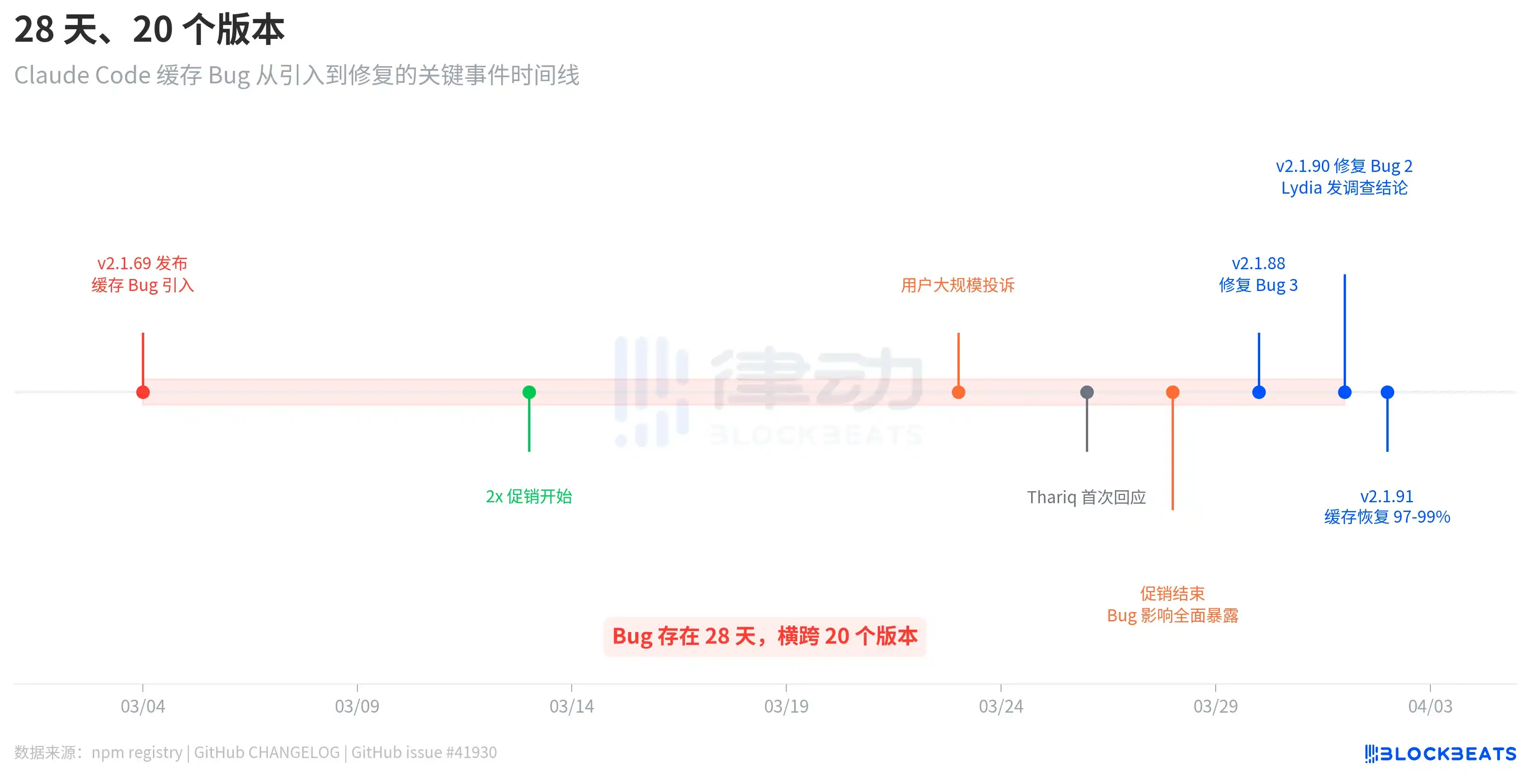
The timeline reveals an intriguing detail. After the bug was introduced on March 4th, users did not immediately complain on a large scale. Complaints only exploded around March 23rd, nearly three weeks later. The reason, as梳理ed in GitHub issue #41930, is that Anthropic ran a 2x allowance promotion (doubling during off-peak hours) from March 13th to 28th, which objectively masked the bug's impact. After the promotion ended, the consumption from the cache bug returned to the normal billing baseline, and users' allowances instantly "evaporated".

Anthropic's response was not swift. On March 26th, three days after user complaints exploded, engineer Thariq Shihipar announced on his personal X account that peak hour (weekdays 5am-11am PT) limits had been tightened. On March 30th, Anthropic acknowledged on Reddit that "users are hitting their limits much faster than expected," calling it the team's highest priority. It wasn't until April 1st that team member Lydia Hallie published the formal investigation conclusion.

Throughout this process, Anthropic did not publish any blog posts, send email notifications, or update their status page. All official communication was done solely through engineers' personal social media posts and a few Reddit comments.

How Much Did You Pay, How Long Could You Use It?

GitHub issue #41930 gathered hundreds of user reports. The most extreme case was a Max 20x subscriber ($200/month) whose 5-hour rolling window was completely exhausted in 19 minutes. Max 5x users ($100/month) reported their 5-hour window being used up within 90 minutes. According to The Letter Two, some users claimed a simple "hello" consumed 13% of their session quota. A Pro user ($20/month) said on Discord their allowance was "used up by Monday, reset on Saturday," meaning they could only use it normally for 12 out of 30 days.
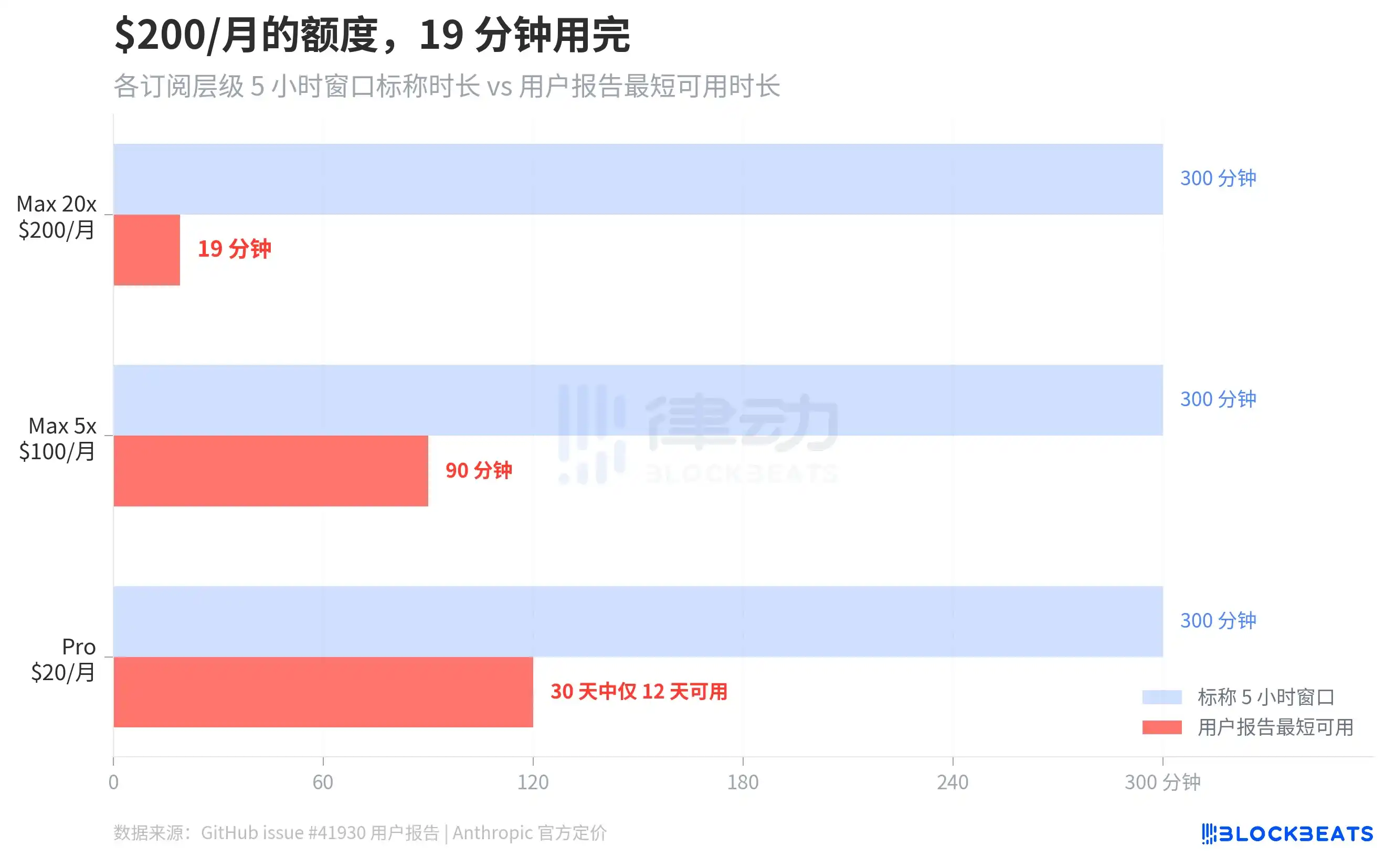
Based on ArkNill's benchmark tests, on the buggy version v2.1.89, the 100% quota of the Max 20x plan would be exhausted in about 70 minutes. He also calculated the allowance cost of a single --resume operation on a 500K token context session to be approximately $0.15, because the system would fully replay the entire context.

"You're Holding It Wrong"

Lydia Hallie's investigation conclusion confirmed two things: first, peak hour limits had indeed been tightened, and second, sessions with 1 million token contexts consumed more. She stated the team had fixed some bugs but emphasized that "none of these bugs resulted in overcharging."

She then offered four suggestions for saving usage:
1. Use Sonnet 4.6 instead of Opus (Opus consumes about twice as much);

2. Reduce reasoning strength or turn off extended thinking when deep reasoning isn't needed;

3. Don't resume long sessions idle for over an hour, start a new one instead;

4. Set the environment variable CLAUDE_CODE_AUTO_COMPACT_WINDOW=200000 to limit the context window size.

There was no mention of any form of quota reset or compensation.

AI podcast host Alex Volkov summarized this response as "You're holding it wrong," pointing out that Anthropic itself set the 1 million token context as the default, promoted Opus as the flagship model, and marketed extended thinking as a selling point, but is now advising paying users not to use these features.

The claim of "no overcharging" also creates tension with Claude Code's own update records. Just the day before Lydia's response, v2.1.90 fixed a cache regression bug that had existed since v2.1.69: when using --resume to restore a session, requests that should have hit the cache triggered a full prompt cache miss, billed at full price. Lydia's response did not mention this confirmed billing anomaly.
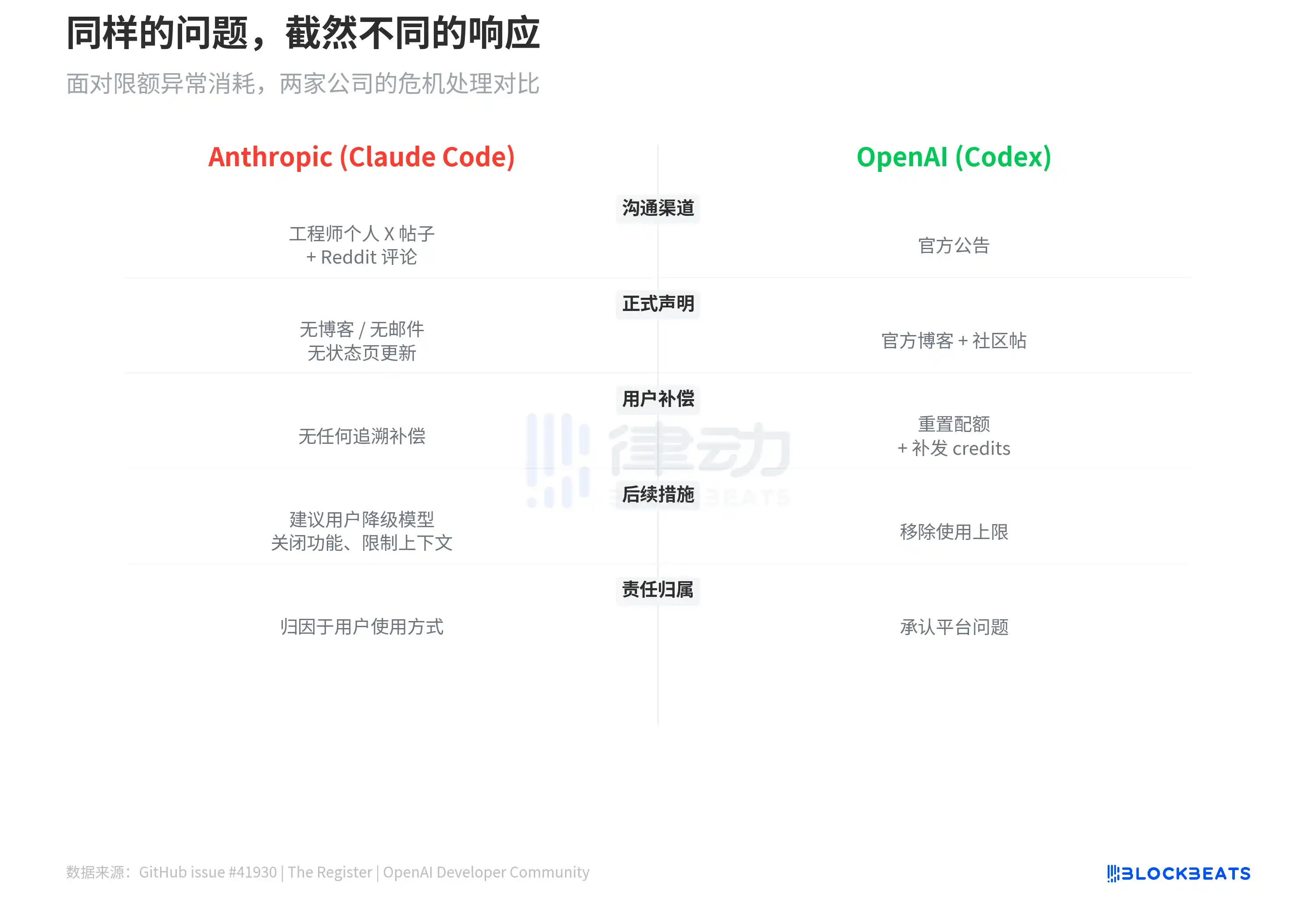
As a comparison, OpenAI's Codex previously had a similar issue of abnormal quota consumption. OpenAI's approach was to reset user quotas, issue credit补偿, and in March announce the removal of Codex usage caps. Anthropic's approach was to advise users to downgrade models, turn off features, limit context, and attribute responsibility to user usage patterns.

Anthropic sells subscriptions for the "strongest model + largest context + highest reasoning ability" and charges $20 to $200 per month. A 28-day cache bug caused paying users' allowances to evaporate at 10-20 times the normal rate, and the official response is to tell you to use it sparingly.


Kripto yang Sedang Tren

Pertanyaan Terkait

QWhat was the prompt cache read rate for Claude Code during the bug period, and what is the normal range?

AThe prompt cache read rate was 4-17% during the bug period, while the normal range is 97-99%.

QHow long did the caching bug persist across versions, and which versions were affected?

AThe bug persisted for 28 days, from version v2.1.69 (released March 4) to v2.1.90 (released April 1), spanning 20 versions.

QWhat was the response from Anthropic regarding the bug and its impact on user quotas?

AAnthropic acknowledged the issue on Reddit, stated it was their highest priority, and later provided user recommendations to conserve usage. They claimed 'no overcharging occurred' and did not offer quota resets or compensation.

QWhat were some of the extreme user reports regarding quota consumption during the bug?

AExtreme reports included a Max 20x user exhausting their 5-hour rolling window in 19 minutes, a Pro user depleting their weekly quota by Monday with a reset on Saturday, and a user claiming a simple 'hello' message consumed 13% of their session quota.

QWhat recommendations did Anthropic engineer Lydia Hallie give to users to reduce their token consumption?

AThe recommendations were: 1) Use Sonnet 4.6 instead of Opus, 2) Reduce reasoning strength or turn off extended thinking, 3) Start a new session instead of resuming one idle for over an hour, and 4) Set an environment variable to limit context window size.

Bacaan Terkait

Model Generatif Bisa Dilatih End-to-End? Intinya Hanya Sebuah For Loop

Model generatif seperti model difusi atau autoregresif yang dominan saat ini biasanya tidak melatih seluruh proses generasi secara end-to-end. Mereka dilatih hanya untuk memprediksi satu "langkah kecil" dalam proses, namun saat inferensi, langkah ini harus diulang ratusan atau ribuan kali. Ketidaksesuaian ini menyebabkan masalah "exposure bias," di mana kesalahan menumpuk seiring waktu. Makalah terbaru dari UIUC dan Harvard memperkenalkan paradigma baru bernama **Explorative Modeling (XM)**. Inti dari metode ini sangat sederhana: alih-alih menghasilkan satu sampel, model menghasilkan **K kandidat** dalam setiap langkah pelatihan. Kemudian, hanya kandidat yang paling dekat dengan data target yang dipilih untuk menghitung gradien dan memperbarui model. Mengapa ini berhasil? Dalam tugas generatif, satu input bisa memiliki banyak output yang valid (mode). Fungsi kerugian rekonstruksi tradisional cenderung menyebabkan "mode blurring," di mana model hanya mempelajari rata-rata dari semua mode, menghasilkan output yang tidak realistis. Dengan menghasilkan beberapa kandidat, model dapat "mengeksplorasi" dan menangkap beberapa mode yang berbeda sekaligus, sehingga menghindari rata-rata yang kabur. Penelitian ini menunjukkan bahwa **"eksplorasi" (K) bertindak sebagai sumbu penskalaan ketiga** yang efektif, selain parameter dan data. Eksperimen pada gambar, video, dan bahasa menunjukkan peningkatan kinerja yang monoton dengan peningkatan K, dengan keuntungan yang lebih besar pada skala yang lebih besar. XM dapat meningkatkan efisiensi FLOP hingga 4.1x dan efisiensi sampel hingga 6.2x. Yang lebih menarik, ketika diterapkan secara ekstrem, XM memungkinkan **pelatihan generatif yang benar-benar end-to-end**. Dalam tugas kontrol robot, "Explorative Policy" berbasis XM mencapai kinerja yang setara dengan "Diffusion Policy" yang membutuhkan 100 langkah inferensi, sementara hanya membutuhkan satu langkah inferensi maju. Ini membuktikan bahwa kompleksitas untuk menangani banyak mode dapat dipindahkan dari inferensi ke pelatihan. Meskipun ide "best-of-K" bukan hal baru, kontribusi utama makalah ini adalah penjelasan teoritis bahwa mekanisme ini secara langsung meningkatkan **ekspresivitas generatif** model. Dengan demikian, ini menawarkan cara baru yang ampuh untuk mengatasi tantangan mendasar dalam pemodelan generatif.

marsbit45m yang lalu

Model Generatif Bisa Dilatih End-to-End? Intinya Hanya Sebuah For Loop

marsbit45m yang lalu

OpenAI Tidak Lagi Mengandalkan Model Termahal untuk Menghasilkan Uang

OpenAI tidak lagi mengandalkan model termahal untuk menghasilkan uang. Pada 30 Juli, perusahaan mengumumkan penyesuaian harga, menurunkan harga model GPT-5.6 Luna sebesar 80% dan Terra sebesar 20%. Yang lebih penting dari angka penurunan harga adalah pesan intinya: untuk banyak tugas, model terkuat (seperti Sol) tidak selalu diperlukan. OpenAI secara eksplisit merekomendasikan strategi di mana model mahal (Sol) menangani perencanaan dan analisis kompleks, sementara model yang lebih terjangkau (Luna) mengeksekusi tugas, menulis kode, dan menjalankan pengujian. Pergeseran ini mencerminkan perubahan industri AI dari hanya mengejar kecerdasan tertinggi menuju optimisasi biaya dan efisiensi untuk penggunaan skala besar. Anthropic juga mengikuti pola serupa dengan meluncurkan Claude Opus 5 dengan harga setengah dari model andalannya, Fable 5. Kedua raksasa Silicon Valley ini menunjukkan bahwa model flagship kini berfungsi lebih untuk nilai merek dan pembuktian teknologi, sementara model "kendaraan massal" yang lebih murah (seperti Luna, Terra, Opus) yang akan mendorong adopsi komersial luas dan menghasilkan pendapatan utama. OpenAI mengungkapkan bahwa penurunan biaya ini sebagian didorong oleh model AI (Sol) yang mengoptimalkan kode produksi dan alur kerjanya sendiri, menciptakan siklus peningkatan efisiensi yang dapat mempercepat penurunan biaya di masa depan. Intinya, kompetisi AI bergeser dari "siapa yang paling pintar" menjadi "mana yang paling bernilai". Perusahaan tidak lagi membeli satu model tunggal, tetapi merancang sistem dengan beberapa model yang cocok untuk tugas yang berbeda—mirip dengan arsitektur komputasi awan. Tujuan akhir OpenAI adalah membangun ekosistem yang mengunci alur kerja pengembang melalui volume panggilan API yang sangat besar dan biaya yang sangat rendah, sehingga menciptakan daya tarik yang kuat. Ketika AI menjadi murah dan tersebar luas seperti listrik, tertanam dalam setiap proses tanpa diperdebatkan, era sesungguhnya baru dimulai.

marsbit2j yang lalu

OpenAI Tidak Lagi Mengandalkan Model Termahal untuk Menghasilkan Uang

marsbit2j yang lalu

Trading

Spot
活动图片