Ripple Vs. SEC Case Sees Unexpected Action With New Amicus Filing

bitcoinistDipublikasikan tanggal 2025-01-23Terakhir diperbarui pada 2025-01-23

Abstrak

The legal dispute between Ripple Labs, Inc. and the US Securities and Exchange Commission (SEC) witnessed a surprising development as...

The legal dispute between Ripple Labs, Inc. and the US Securities and Exchange Commission (SEC) witnessed a surprising development as Better Markets, Inc., a prominent nonprofit dedicated to promoting public interest in financial markets, filed an amicus curiae brief on January 22. This latest submission to the United States Court of Appeals for the Second Circuit vehemently supports the SEC’s appeal against a prior district court decision, which narrowly defined the term “investment contract” and its applicability to XRP.

In the brief, Better Markets criticizes the district court’s interpretation of the Howey test, traditionally used to determine whether a transaction qualifies as an investment contract and thus a security. According to Better Markets, the lower court’s ruling improperly excluded XRP tokens sold through secondary markets from securities regulation, focusing narrowly on the direct purchase from the issuer as a criterion for classification.

A Last Call Against Ripple And XRP

The brief from Better Markets asserts, “The district court dramatically narrowed the definition of an ‘investment contract,’ removing a vast number of crypto offerings and potentially many other investments from the reach of the securities laws.” They argue that this interpretation contradicts longstanding legal principles that aim to adapt to evolving financial practices and protect investors from emerging risks.

Highlighting a critical error, the brief points out, “The court’s ruling on the status of these secondary sales or ‘Programmatic’ transactions under Howey was erroneous.” Better Markets emphasizes that the nature of an investor’s acquisition does not change the fundamental expectation of profits derived from the efforts of others, a cornerstone of the Howey test.

Better Markets challenges the district court’s understanding of the economic realities surrounding Ripple’s token sales, particularly the influence of Ripple’s marketing and promotional efforts on investor expectations. The brief notes, “Ripple conducted a sales campaign through a wide variety of primers, brochures, market reports, public interviews, press conferences, and social media platforms…Most were publicly disseminated or publicly available.”

The organization also criticizes the district court’s assumption about the sophistication of retail investors, stating, “The district court’s dim view of retail investors ignores modern day economic realities…Many retail investors are exposed to new investment offerings and trends through social media platforms that promoters increasingly rely on to attract investors’ funds.”

The brief starkly warns of the implications for investor protection if the district court’s decision stands, highlighting the potential for widespread predation in the crypto securities market, which would disproportionately affect less sophisticated retail investors. Better Markets argues, “Without jurisdiction over these types of securities, the SEC will lose its ability to protect these two classes of investors—those who trade on exchanges and those who lack sophistication—from the widespread predations in the crypto securities markets.”

However, it is highly questionable whether the letter will have any significance at all. Mark Uyeda’s recent appointment as the acting Chair of the US Securities and Exchange Commission (SEC) has sparked speculation about a potential resolution to the SEC’s lawsuit against Ripple under Uyeda’s interim leadership.

Notably, the SEC has scheduled a closed-door meeting under Uyeda’s leadership for today, January 23 which further fueled speculation on the future of Ripple’s legal case. Rumors suggest that the SEC’s upcoming meetings could address settlement possibilities, potentially impacting Ripple’s legal trajectory.

At press time, XRP traded at $3.14.
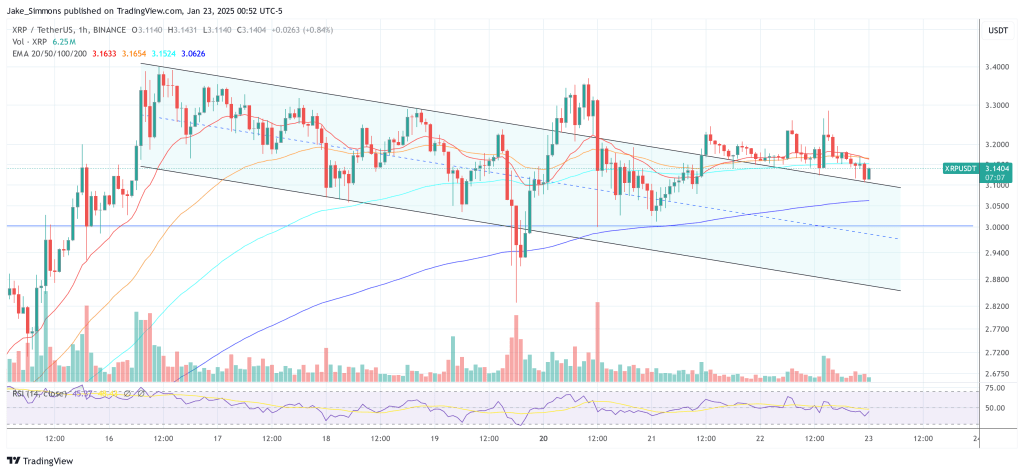
XRP price
XRP price, 1-hour chart | Source: XRPUSDT on TradingView.com
Featured image created with DALL.E, chart from TradingView.com
Jake Simmons

Jake Simmons

Jake Simmons has been a Bitcoin enthusiast since 2016. Ever since he heard about Bitcoin, he has been studying the topic every day and trying to share his knowledge with others. His goal is to contribute to Bitcoin's financial revolution, which will replace the fiat money system. Besides BTC and crypto, Jake studied Business Informatics at a university. After graduation in 2017, he has been working in the blockchain and crypto sector. You can follow Jake on Twitter at @realJakeSimmons.

Bacaan Terkait

Stablecoin Adalah 'Kaum Loyalis' Dunia Kripto: Open USD Membuat Sistem Moneter Lama Turun Langsung

**Ringkasan: Stablecoin Adalah "Pro-Kerajaan" dalam Dunia Kripto: Open USD Menarik Sistem Moneter Lama Turun Langsung** Munculnya Open USD, stablecoin dolar yang didukung oleh aliansi lebih dari 140 institusi seperti Visa, Mastercard, BlackRock, Google, dan Coinbase, menandai pergeseran persaingan stablecoin. Menurut cendekiawan Hu Yilin, ini bukan sekadar persaingan produk, melainkan perebutan infrastruktur dasar yang melibatkan keuangan tradisional, jaringan pembayaran, dan ekosistem blockchain. Hu Yilin berargumen bahwa stablecoin bukanlah "kaum moderat" dalam revolusi kripto, melainkan lebih mirip "reformis pro-kerajaan" di dalam sistem moneter lama. Mereka mengadopsi efisiensi blockchain namun tetap mempertahankan posisi sentral dolar AS dan Federal Reserve. Dengan demikian, stablecoin seperti Open USD tidak menantang hegemoni dolar, melainkan memperkuatnya dengan "paket peningkatan blockchain", menjadikan sistem dolar lebih efisien dan global. Dengan keterlibatan langsung raksasa keuangan tradisional, narasi awal stablecoin tentang mendisrupsi sistem lama menjadi bermasalah. Jika misinya hanya meningkatkan efisiensi, maka ketika sistem lama mengadopsi stablecoin sendiri, proyek asli kripto seperti Circle (penerbit USDC) kehilangan keunggulan revolusionernya. Hu Yilin membedakan antara jalur "moderat" seperti Michael Saylor (yang mempertahankan inti revolusioner "bitcoin standard") dan jalur "pro-kerajaan" stablecoin. Ia menegaskan bahwa revolusi kripto sejati, seperti revolusi Copernican dalam astronomi, memerlukan pergeseran paradigma mendasar: keyakinan bahwa tatanan moneter dan aktivitas ekonomi pasar tidak memerlukan bank sentral sebagai pusat tetap. Sementara stablecoin berguna sebagai alat transisi, jika dunia *on-chain* akhirnya tetap menggunakan dolar sebagai patokan, maka "revolusi blockchain" hanyalah alat tambahan (*add-on*) untuk sistem dolar.

marsbit1j yang lalu

Stablecoin Adalah 'Kaum Loyalis' Dunia Kripto: Open USD Membuat Sistem Moneter Lama Turun Langsung

marsbit1j yang lalu

Stablecoin Adalah 'Pihak Pro-Kerajaan' di Dunia Kripto: Open USD Membuat Sistem Moneter Lama Turun Tangan Sendiri

Stabil Open USD muncul, persaingan stablecoin berkembang dari perebutan pasar oleh startup kripto menjadi perang infrastruktur yang melibatkan keuangan tradisional, jaringan pembayaran, platform teknologi, dan ekosistem blockchain. Menurut cendekiawan Hu Yilin, stablecoin bukanlah "faksi moderat" dalam revolusi kripto, melainkan lebih seperti "reformis loyalis" di dalam sistem moneter lama: warisi efisiensi blockchain, tetapi pertahankan status sentral dolar AS dan Federal Reserve. Open USD, diluncurkan oleh 140+ lembaga seperti Visa, Stripe, BlackRock, dan Google, mewakili pergeseran signifikan. Alih-alih menantang hegemoni dolar, stablecoin seperti ini justru memperkuat dan membuat sistem dolar lebih efisien dengan teknologi blockchain. Hu Yilin mengibaratkannya dengan sistem Tychonic dalam revolusi Copernican—mengadopsi keunggulan teknis baru tetapi menolak inti revolusi dengan menjaga "Bumi (dolar)" tetap tak bergerak di pusat. Hal ini menciptakan dilema bagi perusahaan stablecoin asli seperti Circle (penerbit USDC). Jika misi mereka hanya meningkatkan efisiensi sistem lama, maka ketika raksasa tradisional seperti Visa meluncurkan stablecoin mereka sendiri, pembenaran revolusioner perusahaan asli memudar. Untuk tetap relevan, inovator kripto perlu mempertahankan elemen "pembangkangan" yang sejati, seperti menjunjung standard kripto asli (seperti Bitcoin), desentralisasi, atau resistensi sensor. Kesuksesan stablecoin berbasis dolar justru dapat memperkuat hegemoni dolar, di mana aktivitas on-chain yang berkembang menguntungkan aset dolar off-chain. Bagi aset kripto seperti Ethereum yang bercita-cita tinggi, bergantung pada narasi "bahan bakar" atau biaya transaksi saja tidak cukup; mereka harus berani mengusung narasi revolusi moneter yang mendasar. Inti revolusi kripto, analog dengan momen Copernican, adalah meyakinkan pasar bahwa tatanan moneter yang stabil tidak memerlukan bank sentral tetap sebagai pusatnya. Stablecoin adalah alat transisi yang bermanfaat, tetapi revolusi sejati terjadi ketika pasar percaya bahwa uang dapat ditentukan secara desentralisasi oleh aktivitas pasar itu sendiri, bukan oleh otoritas pusat. Open USD mungkin merupakan langkah kooptasi oleh sistem lama, sementara revolusi sesungguhnya menuntut pergeseran paradigma yang lebih radikal.

链捕手1j yang lalu

Stablecoin Adalah 'Pihak Pro-Kerajaan' di Dunia Kripto: Open USD Membuat Sistem Moneter Lama Turun Tangan Sendiri

链捕手1j yang lalu

Trading

Spot
活动图片