Bitcoin Makes The Cut As Brazil’s Largest Private Bank Issues 2026 Guidance

bitcoinistPublished on 2025-12-15Last updated on 2025-12-15

According to Itaú Asset Management, Brazil’s largest private bank, investors should consider holding 1%–3% of their portfolios in Bitcoin starting in 2026. The recommendation came in a research outlook released this week and frames Bitcoin as a small, complementary holding rather than a main bet.

Itaú Backs Small Bitcoin Positions

The bank’s note points to Bitcoin’s low correlation with many traditional assets and to currency risks that hit local investors hard this year. Itaú also moved to build the infrastructure behind that view: in September 2025 it created a dedicated crypto division and named former Hashdex executive João Marco Braga da Cunha to lead the team. That new unit sits alongside the bank’s existing products and is meant to help clients access regulated crypto tools.

Access Through Local Products

Brazilian savers can already reach Bitcoin via products tied to Itaú. The bank is part of the team that launched the IT Now Bloomberg Galaxy Bitcoin ETF, known by its ticker BITI11, which began trading on November 10, 2022. The ETF gives investors a spot-like route to Bitcoin inside the local market, and it sits alongside unit trusts and pension products that offer crypto exposure.
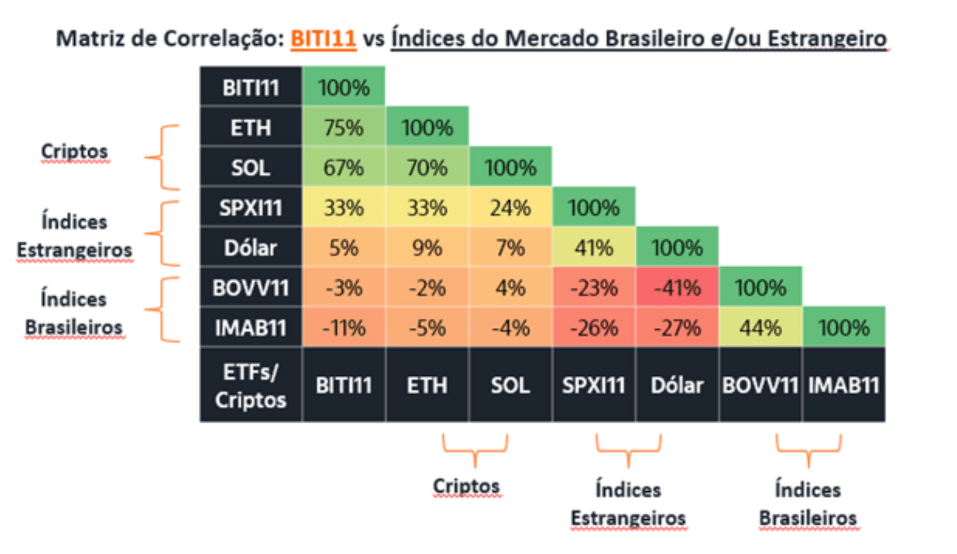
A correlation matrix showing how BITI11, a Bitcoin ETF, moves in relation to major Brazilian and global market indices, according to data from Itaú.

Small But Existing Crypto Footprint

Itaú says its regulated crypto suite manages roughly R$850 million across several funds and ETFs, a modest amount compared with its wider business but still a clear signal of product readiness. The bank’s asset arm is large: it manages more than 1 trillion reais for clients, which helps explain why its guidance on allocations draws wide attention.

BTCUSD currently trading at $89,003. Chart: TradingView

Market Context And Timing

Itaú’s move arrives after a year in which currency swings amplified losses for some Brazilian holders of foreign assets. That reality appears to be part of the math behind recommending a 1%–3% position — a small buffer for those worried about local-currency shocks, not a bet meant to replace stocks or bonds. The bank frames the position as a disciplined, long-term allocation, not a short-term trade.

What This Means For Investors

For ordinary investors the guidance is simple to read: keep exposure small and controlled. A 1% position will hardly change a diversified portfolio on its own, while 3% is still within what many institutions have called a “satellite” slot. Based on reports, Itaú expects to offer more choices — from low-volatility wrappers to riskier strategies — through the new unit as demand grows.

Featured image from La Nación, chart from TradingView

Related Reads

2026 New Policy Interpretation: The "Mutual Pursuit" of Intelligent Agents and AI Terminals, and the Three Major Value Reconstructions in the AIoT Industry

In May 2026, China's national ministries released two pivotal policy documents that jointly establish a strategic "dual-track" framework for the AIoT industry. The "Intelligent Agent Standardized Application and Innovation Development Implementation Opinions" defines the "soul"—positioning intelligent agents as core AI products. The "Artificial Intelligence Terminal Intelligence Grading" national standard defines the "body"—establishing a four-tier capability ladder (L1 to L4) for AI hardware. This synchronized policy approach is globally unique, moving beyond market-led (US) or risk-focused (EU) models. It frames AIoT as a new type of "intelligent infrastructure," comparable to electricity or the internet in historical significance. The core analysis identifies a value evolution from IoT 1.0 (connection) to AIoT 4.0 (collaboration, represented by the forward-looking L4 level). This "L4" signifies a paradigm shift: from users operating tools to delegating tasks to agent-like devices ("Intelligent Action of All Things"). The article outlines three strategic paths for companies: becoming Standard Definers, Scenario Integrators (focusing on 19 specified application areas), or Infrastructure Builders. A critical 18-24 month window is identified for strategic positioning. A "Four Levers" strategy is proposed: leveraging Standards (L-level certification), leveraging Scenarios (deep vertical focus), leveraging Open Source (for cost reduction and ecosystem influence), and leveraging Momentum (engaging in global protocol ecosystems). In conclusion, these policies are a starting gun for a decade-long industrial transformation, shifting the industry narrative from "Intelligent Connection of All Things" to "Intelligent Action of All Things," with companies needing to choose their赛道and execution strategy decisively.

marsbit13m ago

2026 New Policy Interpretation: The "Mutual Pursuit" of Intelligent Agents and AI Terminals, and the Three Major Value Reconstructions in the AIoT Industry

marsbit13m ago

Splashing Out 27 Billion Yuan, OpenAI Establishes New Company to Accelerate AI Deployment

On May 11th, OpenAI announced the formation of a new company, "OpenAI Deployment Company," with an initial investment of over $4 billion (approximately 27.2 billion RMB). This venture aims to help businesses build and deploy AI solutions. OpenAI is also acquiring the AI consulting firm Toromo to rapidly scale the deployment company's capabilities. This new entity, majority-owned by OpenAI, brings together 19 investment, consulting, and system integration partners, led by TPG with co-lead founding partners including Advent International, Bain Capital, and Brookfield. OpenAI's Chief Revenue Officer, Denise Dresser, stated that while AI is becoming increasingly capable, the current challenge lies in integrating these systems into core business infrastructure and workflows. The deployment company is designed to bridge this gap and translate AI capabilities into operational impact. This move comes as OpenAI emphasizes the next competitive phase will depend on the efficiency of deploying AI in real business scenarios. The company reports over 1 million businesses already use its products and APIs. OpenAI is significantly increasing its investments in computing power, with co-founder Greg Brockman stating the company expects to spend $50 billion on compute this year, a dramatic increase from $3 million in 2017. The announcement follows OpenAI's recent completion of a record $122 billion funding round in late March, led by Amazon, Nvidia, and SoftBank, valuing the company at $852 billion post-money. Major strategic investors committed $110 billion as a base for this round. Concurrently, OpenAI is advancing its core model development. It has shifted focus from its Sora video generator to developing advanced robotics and AI models that interact with the physical world. It has also begun allowing select users access to a new model specialized in identifying software vulnerabilities and is reportedly preparing to launch an enhanced image generation model in the coming weeks. According to reports citing founder Sam Altman, OpenAI is considering an IPO as early as 2027, with a potential valuation around $1 trillion.

marsbit29m ago

Splashing Out 27 Billion Yuan, OpenAI Establishes New Company to Accelerate AI Deployment

marsbit29m ago

Trading

Spot
Futures

Hot Articles

Discussions

Welcome to the HTX Community. Here, you can stay informed about the latest platform developments and gain access to professional market insights. Users' opinions on the price of S (S) are presented below.

活动图片