X Tightens Promotion Rules: Is the Wild West Era of Crypto Twitter Marketing Over?

marsbitPublié le 2026-02-25Dernière mise à jour le 2026-02-25

Résumé

X, the platform formerly known as Twitter, is systematically tightening its rules on promotional content and automated activity, particularly targeting the crypto community. Over the past five months, it has implemented six major policy changes. These include removing 1.7 million spam bots, banning "InfoFi" applications that reward users for posting, cracking down on accounts using automation/AI, and introducing a mandatory "Paid Promotion" disclosure label for sponsored content. It has specifically prohibited undisclosed ads for prediction markets and restricted automated API replies. These actions dismantle key, previously free, marketing channels for crypto: incentivized posting, undisclosed influencer promotions, and automated engagement. Consequently, user acquisition costs are expected to rise as organic reach diminishes. The platform is simultaneously favoring paid advertising, having relaxed its policies for crypto ads in many regions. This shift forces a recalibration of the crypto influencer economy, moving from hidden endorsements to transparent, performance-based advertising. While this may lead to a cleaner information environment for users, it signals the end of an era of unregulated "wild" marketing on the platform, making visibility a paid privilege.

Author: David, Deep Tide TechFlow

On February 21, X's product lead Nikita Bier publicly demanded in a post that the poster add a disclaimer stating it was a paid promotion, otherwise the account would be suspended.

This post came from the account @infodexx, with content ranking the "Most Valuable Startups in 2025," placing the prediction market platform Kalshi second with an $11 billion valuation.

The post garnered over 420,000 views, but the poster's bio stated "Kalshi partner," and the post itself initially had no paid promotion label.
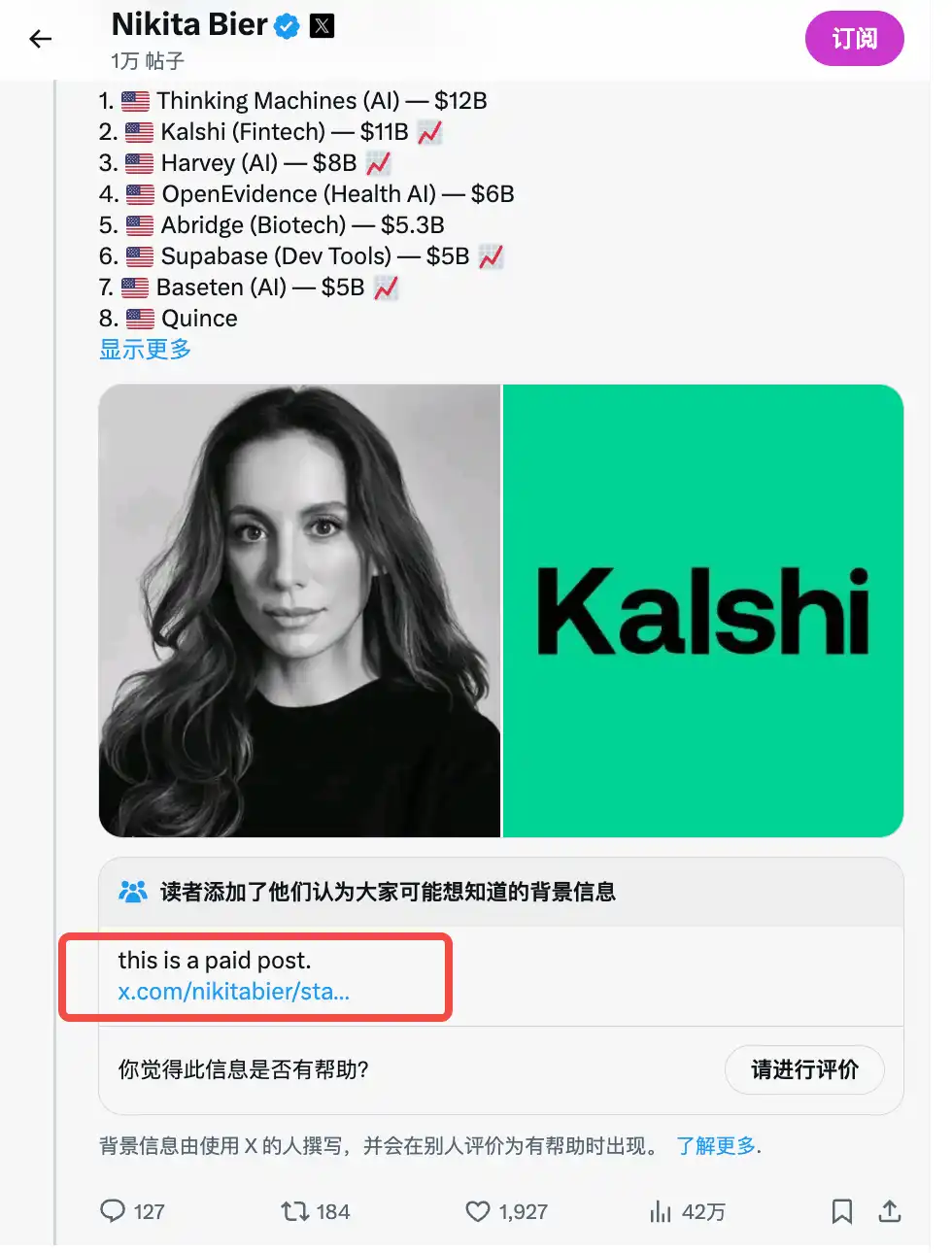
Subsequently, a user flagged it as commercial promotion content—essentially an ad—through X's Community Notes feature (a user-collaborative fact-checking mechanism where approved notes are displayed directly below the post).

Bier then announced that X would launch a set of paid promotion disclosure features the following week, requiring all posts with paid partnerships to be labeled, with violators facing account suspension.

The poster later added a context note to the original post, indicating it was a paid promotion.

Mandatory disclosure is just the latest step in this round of adjustments.

Over the past five months, X has successively cleaned up 1.7 million spam bot accounts, banned API access for InfoFi-type applications, launched anti-automation detection mechanisms, and restricted programmatic reply interfaces...

Although these actions occurred at different points in time, when pieced together, they form a clear timeline.

The wild marketing era on Crypto Twitter is perhaps being ended by the platform itself.

6 Major Cuts in 5 Months, Hitting the Artery of Crypto Marketing

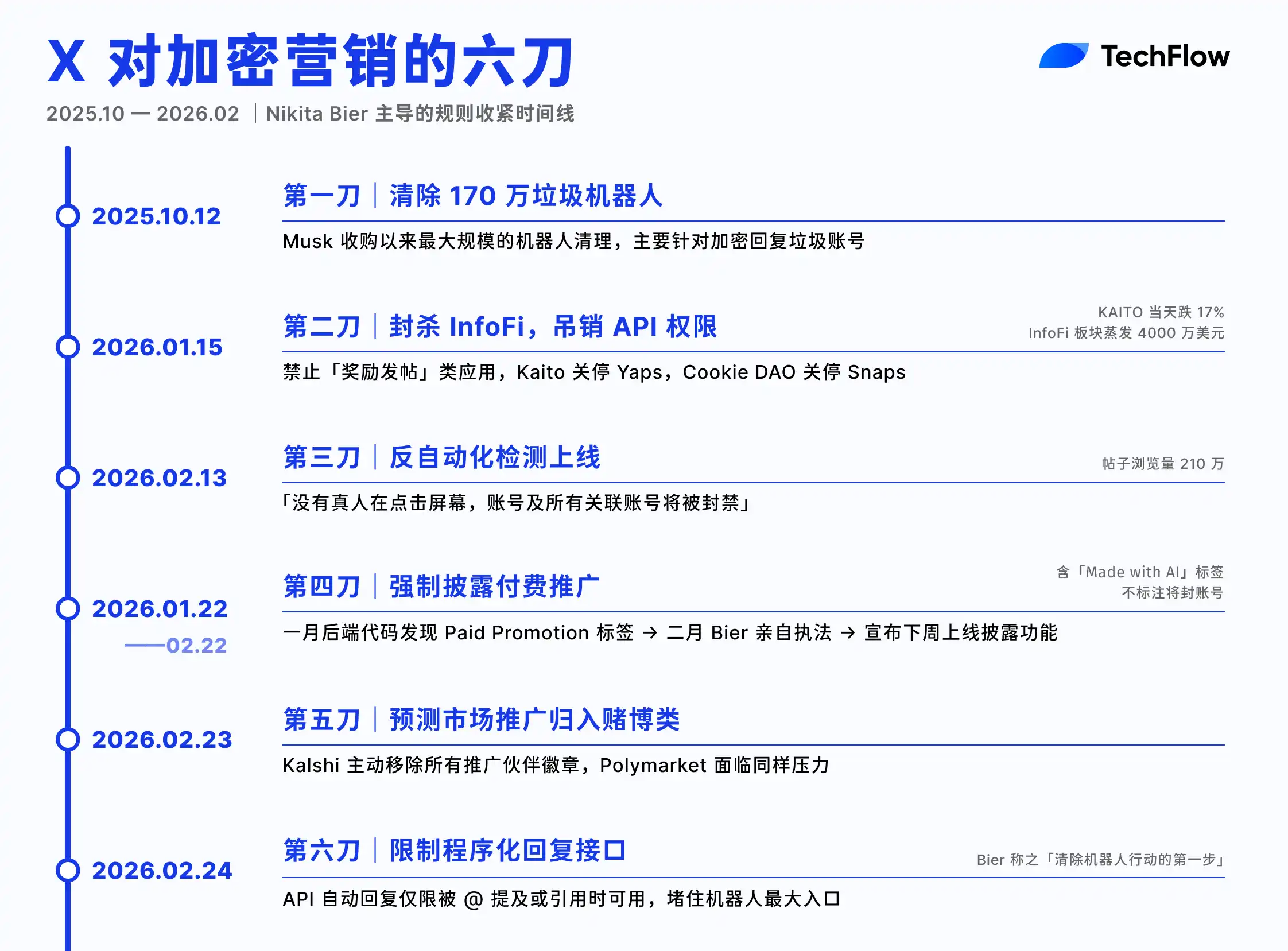
X's changes to marketing rules have delivered six significant, overt blows over the past 5 months. We have compiled the key timeline and major events of these rule changes as follows:
First Cut: Spam Bots

In October 2025, Bier announced that X had removed 1.7 million reply spam bots in one week, the largest cleanup since Musk's acquisition. The primary targets were crypto-related automated accounts, familiar to anyone who has scrolled through crypto posts on X:

Scam links instantly replying under popular posts, fake accounts impersonating Elon Musk, and repetitive "gm" bots.

Removing 1.7 million was just the first step; the underlying issue was much larger.

Second Cut: InfoFi and the "Post-to-Earn" Model

The proliferation of these bots was largely due to InfoFi.

Third-party platforms tracked users' posts and interactions on X and rewarded them with tokens or points. The original intent was to incentivize valuable information production, but when posting itself could earn money, it evolved into quantity over quality. Bot farms and AI-generated批量 replies quickly dominated the leaderboards.

At its peak, the largest project, Kaito, had over 157,000 active users on its Yaps product. By January 9, 2026, CryptoQuant detected 7.75 million crypto-related posts on X in a single day, 12 times the normal level.

On January 15, 2026, Bier announced changes to the developer API policy, prohibiting all applications that "reward users for posting on X," immediately revoking relevant API access.

Kaito subsequently shut down Yaps, its token KAITO fell about 17% that day; Cookie DAO shut down a similar product, Snaps; the entire InfoFi sector lost approximately $40 million in market cap in one day.

(Reference reading: X Pulls the Rug, the Era of 'Farming with Your Mouth' Ends)

Third Cut: Accounts Simulating Human Operations

On February 13, Bier announced the launch of a new round of automation detection.

If no real person is clicking the screen, the account and all associated accounts may be banned. This cut is aimed not just at traditional bots, but at all accounts operated via scripts, automation tools, or AI agents.

Bier stated that X would support compliant agent use cases in the future, but recommended developers pause integrations until rules are clear, using the official API if necessary.

Fourth Cut: Stealth Ads

The first three cuts dealt with automation and spam. The fourth cut targeted a larger gray area: paid promotions without disclosure.

Anyone familiar with Crypto Twitter knows this has been an industry standard in the crypto space.

In September 2025, on-chain investigator ZachXBT publicly released a spreadsheet listing the promotion rates and receiving wallet addresses of over 200 crypto KOLs. About 160 had accepted promotions, but fewer than 5 had labeled their posts as "ad."
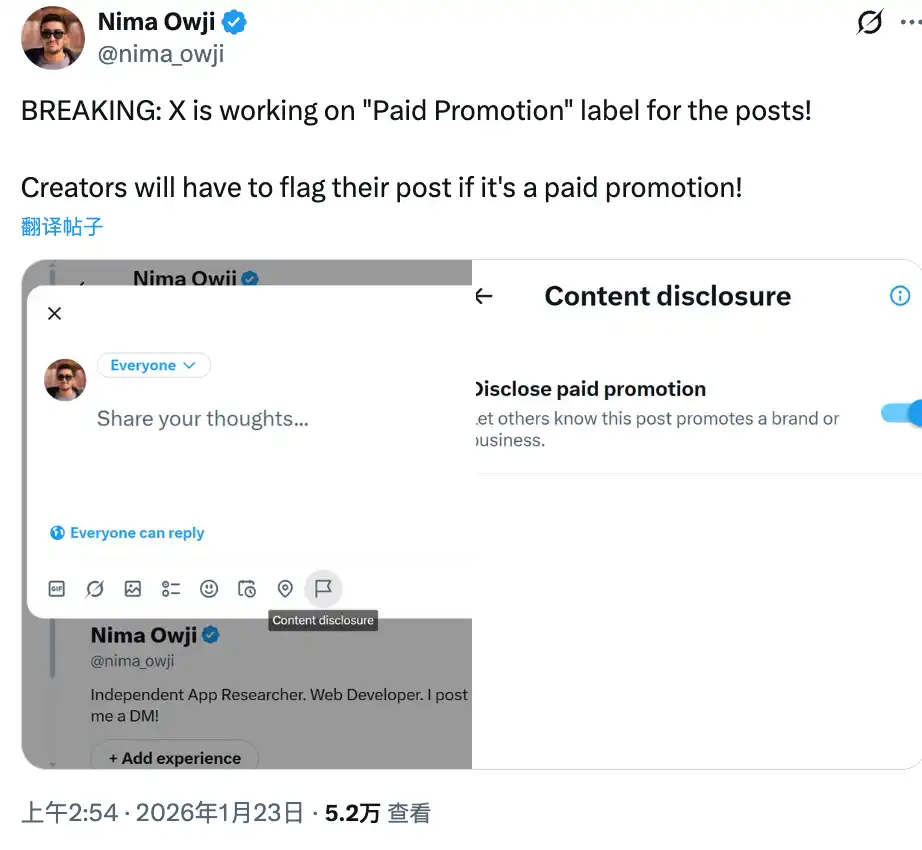
On January 22, app researcher Nima Owji discovered a Paid Promotion label feature under development in X's backend code. Creators would need to check if a post was a paid promotion when posting, and the label would be displayed directly on the post.

By February 21, when Bier personally intervened in the Kalshi post, this feature was ready for launch. He also announced a "Made with AI" label, requiring AI-generated content to be labeled.

Fifth Cut: Prediction Market Promotion

Following the disclosure feature announcement, X updated its paid partnership policy, explicitly categorizing prediction markets (like Kalshi and Polymarket) as gambling products, and comprehensively banning undisclosed related advertising.

Kalshi proactively removed its promotion partner badge on X on February 23, its spokesperson stating the enforcement was too difficult, as users easily misinterpreted accounts with the badge as being officially endorsed by Kalshi.

Sixth Cut: Programmatic Replies

The final cut landed on February 24. The X developer platform announced restrictions on automated replies sent via API.

Programmatic replies are only permitted if the original post @mentions or quotes the account. Product lead Bier called this the first step in clearing out bots, first plugging the biggest entry point.

After these six cuts—targeting bots, incentive mechanisms, automation tools, stealth ads, specific category promotions, and programmatic interfaces—X's control over crypto content has progressed layer by layer.

Combined, the entire marketing infrastructure that Crypto Twitter has relied on for operation over the past few years has been systematically dismantled.

X Rejects Free Riders, Welcomes Paying Customers

These rule changes combined are altering the cost structure of crypto marketing. In recent years, the main ways crypto projects acquired customers on X were through three free channels:

  1. InfoFi platforms incentivizing users to post for visibility,
  2. KOLs accepting stealth promotions without ad labels,
  3. Automation tools批量引流 under hot posts.

Now, all three channels are restricted or closed. Meanwhile, X's algorithm is widening the visibility gap between paid and free accounts.

Premium users receive a 2x to 4x weighting boost in the For You feed and reply排序. Some creators testing found that after March 2025, the median interaction for non-Premium accounts posting links had dropped to nearly zero.

The organic reach of crypto content萎缩 earlier. Crypto trader Lisa Edwards posted an analysis in December 2025 stating that after an algorithm update that month, the reach rate of posts containing symbols like BTC and ETH dropped by about 80%.

Simultaneously, as free channels are blocked, paid channels are opening.

X's policy on crypto ads has actually been loosening. According to X's official ad policy update log, since 2024, DeFi product ads have been approved, blockchain game ads opened in the US and Brazil, and the applicable markets for crypto exchange and wallet ads expanded from over a dozen original countries to include Denmark, Israel, Netherlands, Portugal, Ghana, Kenya, etc.

According to AWISEE statistics, X's crypto ad approval rate is about 60%, the highest among major platforms; Meta's is about 50%, and Google's is lower and explicitly bans DeFi ads.

On one side, free distribution is being systematically compressed; on the other, paid advertising categories and markets are continuously expanding. This is the monetization path all content platforms have taken:

First, cultivate a free content ecosystem to attract users and creators. Once network effects are established and creators become dependent on the platform, gradually tighten organic distribution, directing traffic to paid channels.

Facebook did the exact same thing to brand pages in 2014, with organic reach plummeting from double digits to single digits, forcing brands to shift from content operations to ad spending.

What X is doing to crypto content is essentially the same playbook.

Who Pays the Bill? Who Gets Eliminated?

With free channels cut, the bill will ultimately be分摊 across every role in the industry. This has at least three layers of impact on crypto marketing.

First, customer acquisition costs rise.

Before, a crypto project could rely on InfoFi points to incentivize tens of thousands of people to create buzz for it on X. Now that path is gone.

Formal KOL promotions will become more transparent with the disclosure feature, but posts labeled "ad" will have lower trust and engagement rates. Project teams will either increase budgets to compensate or accept reduced effectiveness.

Second, the KOL economy is repriced.

Data exposed by ZachXBT last year showed over 160 KOLs accepted promotions but almost none disclosed, with single post rates ranging from hundreds to $60,000. After mandatory disclosure, the room for operations that "look like organic content but are actually ads" is compressed. KOL pricing logic will shift from "I can help you伪装成 organic content" to "How much conversion can my labeled ad still drive?".

The former is priced on information asymmetry, the latter on performance.

For the industry, this might not be a bad thing, but短期内 a batch of KOLs and agencies surviving in the gray area will be eliminated.

Third, platform dependency risk is repriced.

Bier's exact words when banning InfoFi were,建议被封的开发者 "go to Threads and Bluesky to pivot."

A platform's product lead openly advising developers to go to competitors indicates X doesn't mind crypto projects分流, and might even be actively pushing them. After this round of changes, for project teams and KOLs, putting all social assets on X alone is no longer conservative, but risky.

For ordinary users, this isn't all bad news.

Before, scrolling through Crypto Twitter, six out of ten posts might have been paid for, but none would tell you. After the disclosure feature launches, users can at least distinguish between promotions and genuine opinions. The information environment becomes cleaner, and the cost of judgment decreases.

Of course, the timing of the rule tightening also coincides with a bear market.

Bear markets themselves compress marketing budgets; fewer projects are willing to spend on promotion, so the information flow naturally quiets down. Whether the clean environment is due to the rules or the冷清 will only be truly tested when the bull market returns.

Regardless, whether for project teams, KOLs, or ordinary creators, the price of admission to be seen on Crypto Twitter is now rising.

The logic of this business was "whoever is loudest wins"; in the future, it will become "whoever is willing to pay gets a voice."


Cryptos en tendance

Questions liées

QWhat major actions has X taken in the past five months to tighten its promotion rules, particularly affecting crypto marketing?

AX has implemented six key changes: 1) Cleared 1.7 million spam bot accounts in October 2025; 2) Banned 'earn-to-post' applications (InfoFi) by revoking their access in January 2026; 3) Introduced new automation detection targeting scripted or AI-operated accounts in February 2026; 4) Enforced mandatory disclosure for paid promotions; 5) Classified prediction markets as gambling and banned undisclosed ads for them; 6) Restricted automated API replies unless the original post mentions the account.

QHow did the crackdown on InfoFi applications impact the crypto market?

AThe ban on InfoFi applications, which rewarded users for content creation with tokens or points, led to the shutdown of major platforms like Kaito's Yaps and Cookie DAO's Snaps. The entire InfoFi sector lost approximately $40 million in market capitalization in a single day, with Kaito's token (KAITO) dropping around 17%.

QWhat is the new requirement for paid promotions on X, and what are the consequences for non-compliance?

AX now requires all posts involving paid partnerships to be clearly labeled as 'Paid Promotion.' Failure to disclose such partnerships will result in account suspension. This policy aims to increase transparency and reduce undisclosed advertising, particularly prevalent in crypto marketing.

QHow has X's algorithm change affected the visibility of free versus paid accounts?

AX's algorithm now gives Premium accounts a 2 to 4 times weighting boost in the 'For You' feed and reply rankings. Non-Premium accounts posting links have seen their median engagement drop to nearly zero since March 2025. Additionally, posts containing crypto symbols like BTC or ETH experienced an 80% decrease in organic reach after a December 2025 algorithm update.

QWhat broader implications do these rule changes have for crypto marketers and KOLs?

AThe changes are increasing customer acquisition costs by closing free marketing channels like InfoFi and undisclosed KOL promotions. KOLs must now shift from pricing based on disguising ads as organic content to pricing based on measurable conversion rates. This transparency may push out KOLs and agencies that relied on ambiguous practices, while encouraging a more honest and effect-based marketing economy.

Lectures associées

Le Triangle impossible est en réalité un faux problème

L'auteur conteste la pertinence du "trilemme" classique (décentralisation, scalabilité, sécurité) pour les blockchains. Il propose que les vrais freins à l'adoption massive sont la légitimité (environnement réglementaire) et le manque de confidentialité par défaut. La blockchain est définie comme un ordinateur partagé, lent et cher, dont la seule valeur unique est de fonctionner sans propriétaire ni permission. Seul l'argent natif (comme les stablecoins) est un actif adapté, car sa simple inscription au registre constitue sa valeur. Le marché actuel ne sert qu'une niche ("les gens assez aisés"). Les gros capitaux institutionnels restent à l'écart, principalement à cause des risques opérationnels et de deux défauts structurels : 1. **Légitimité** : L'absence de permission, essentielle, crée des zones grises réglementaires. Des progrès législatifs récents (ex: loi GENIUS) commencent à combler ce fossé. 2. **Transparence** : Celle-ci est présentée comme une vertu, mais constitue en réalité une taxe. Elle expose chaque transaction, position et paiement, permettant le MEV (extraction de valeur maximale) et décourageant toute entité sérieuse de révéler sa trésorerie au monde. L'auteur souligne l'ironie d'un système fondé sur la cryptographie qui ne protège pas la vie financière des utilisateurs. La solution réside dans une **confidentialité par défaut avec des preuves de conformité** (via des preuves à connaissance nulle - ZK). Cela permet de prouver un fait (solvabilité, respect des limites, KYC) sans révéler les données sous-jacentes, combinant ainsi protection individuelle et vérifiabilité pour les auditeurs et régulateurs. Cette évolution, purement améliorative, pourrait enfin attirer les milliers de milliards de capitaux institutionnels et faire de la blockchain l'infrastructure financière qu'elle était censée être.

marsbitIl y a 8 h

Le Triangle impossible est en réalité un faux problème

marsbitIl y a 8 h

L'impossible trilemme est un faux problème

L'industrie de la cryptographie a construit le système de cryptographie le plus puissant de l'histoire, mais son principal échec est l'absence de confidentialité financière par défaut. Chaque transaction, paiement et portefeuille est diffusé publiquement. La blockchain est essentiellement un ordinateur partagé, lent et coûteux, dont la seule valeur réside dans son absence de propriétaire unique et sa résistance à la censure. Pendant des années, le débat s'est concentré sur le "trilemme" (décentralisation, évolutivité, sécurité), qui est aujourd'hui largement résolu. Le vrai frein à l'adoption massive n'est pas là. La véritable contrainte est double : la légitimité juridique et le manque de confidentialité. Les fonds sont l'actif natif de la blockchain, mais les grands capitaux institutionnels restent à l'écart car l'environnement est perçu comme trop risqué et non conforme. La transparence totale de la chaîne n'est pas une vertu, mais une taxe. Elle expose les utilisateurs au MEV (Maximum Extractable Value), où les transactions sont espionnées et exploitées avant leur règlement, drainant des milliards de dollars de valeur. La plus grande ironie est que ce système, bâti sur la cryptographie, n'applique pas le chiffrement aux activités financières des utilisateurs, contrairement à la communication qui l'a adopté il y a des décennies. La solution n'est pas un anonymat total, mais une confidentialité prouvable et conforme. Les technologies cryptographiques modernes (comme les preuves à connaissance nulle) permettent de vérifier la solvabilité, la conformité KYC ou les limites de risque sans révéler les données sous-jacentes. Cela préserve les avantages de l'auditabilité tout en éliminant l'exposition permanente. En combinant un cadre réglementaire émergent (comme le GENIUS Act) et une confidentialité par défaut avec des mécanismes de divulgation vérifiable, la blockchain peut effectuer une mise à niveau pure. Elle cesse d'être un "tableur public coûteux" pour devenir une machine partagée qui confirme la véracité des transactions sans en divulguer le contenu. C'est le pont qui permettra aux capitaux institutionnels et à la finance traditionnelle de rejoindre la chaîne, débloquant ainsi les milliers de milliards de dollars qui attendent. Le système cryptographique le plus puissant apprend enfin à garder un secret, et cela change tout.

链捕手Il y a 8 h

L'impossible trilemme est un faux problème

链捕手Il y a 8 h

Des puces optiques en pleine expansion de production collective

La demande de puces photoniques connaît une croissance exponentielle, stimulée par les besoins en interconnexion optique des centres de données d'IA. Une course mondiale aux capacités de production est engagée. Aux États-Unis, Coherent étend sa ligne de production de semi-conducteurs InP de 6 pouces au Texas, soutenue par un financement et un investissement stratégique de Nvidia. Nokia développe ses capacités de test et d'emballage avancés en Pennsylvanie. Le japonais JX Advanced Metals prévoit d'augmenter sa production de substrats InP par 7 à 10 fois. En Europe, IQE et Tower Semiconductor ont conclu un accord d'approvisionnement à long terme pour les plaquettes InP, illustrant la tendance à l'intégration hétérogène des composants InP performants dans les plateformes silicium-optique matures. En Chine, l'expansion est rapide. Suzhou TFC Optical Communication (Solstice) investit 12 milliards de dollars dans un projet d'expansion. San'an Photonics possède une capacité de production mensuelle de 2 750 plaquettes pour les puces InP. Yunnan Germanium a lancé un projet pour augmenter la production de tranches de monocristal InP. La chaîne d'approvisionnement chinoise se consolide de la matière première au module. Malgré les débats sur les délais de déploiement du CPO (Co-Packaged Optics), l'augmentation globale de la consommation de contenu optique (moteurs photoniques, lasers) est incontestable, tirée par la demande croissante de bande passante dans l'IA. Le paysage futur impliquera probablement plusieurs architectures (silicium-optique, VCSEL, MicroLED) coexistant pour différentes distances et besoins. Cette frénésie d'expansion mondiale, des États-Unis et du Japon à l'Europe et la Chine, représente un pari collectif de l'industrie des semi-conducteurs sur l'avenir photonique de l'informatique à haute performance.

marsbitIl y a 11 h

Des puces optiques en pleine expansion de production collective

marsbitIl y a 11 h

Les stablecoins trouvent enfin un rendement réel : Détails de la réassurance en chaîne Re | Discussion avec Karan Saroya, fondateur de Re

Le projet Re est une plateforme de réassurance décentralisée qui connecte les stablecoins à l'industrie traditionnelle de l'assurance. Elle collecte des stablecoins (actuellement 1700 milliards de dollars en circulation) et les utilise comme garantie pour fournir du capital à des compagnies d'assurance américaines. En échange, les assureurs paient des primes dont les bénéfices sont reversés aux déposants sur la blockchain, générant un rendement annuel réel estimé entre 12% et 14%. Le modèle exploite un effet de levier réglementaire : 1 dollar de garantie permet de soutenir 5 à 7 dollars de primes d'assurance. Cette efficacité opérationnelle, couplée à l'automatisation par contrats intelligents, permet à Re de concurrencer les géants traditionnels du secteur avec une équipe réduite. Les déposants reçoivent des jetons représentatifs (receipt tokens) qu'ils peuvent ensuite utiliser dans le DeFi (ex: Morpho, Fluid) pour du "looping" et potentiellement augmenter leurs rendements. Re a également émis un jeton de gouvernance, RE, inspiré du modèle historique de Lloyd's of London, permettant de contrôler l'allocation du capital central. En résumé, Re crée une nouvelle source de rendement non corrélée aux marchés crypto ou actions, en canalisant les stablecoins vers l'économie réelle via la réassurance, tout en démocratisant l'accès à cette classe d'actifs auparavant réservée aux grands investisseurs institutionnels.

链捕手Il y a 12 h

Les stablecoins trouvent enfin un rendement réel : Détails de la réassurance en chaîne Re | Discussion avec Karan Saroya, fondateur de Re

链捕手Il y a 12 h

1996 ou 1999 ? Le premier test de Walsh est 'comment voir l'IA'

L’arrivée de Jerome Warsh à la tête de la Fed est confrontée à une question fondamentale : **comment interpréter le boom actuel de l’IA** ? Deux scénarios historiques s’affrontent. Le premier, inspiré de 1996 sous Alan Greenspan, suggère que les gains de productivité conteniront l’inflation, permettant à la Fed de rester patiente. Le second, évoquant 1999, craint que des attentes trop optimistes ne provoquent une surchauffe, exigeant un resserrement monétaire précoce. Warsh penche vers le scénario de 1996, affirmant qu’une croissance tirée par la productivité est à « embrasser ». Il redoute qu’une réaction prématurée de la Fed n’étouffe une expansion bénéfique. Cependant, le contexte actuel – tensions commerciales, déficits budgétaires, reflux de la mondialisation – est bien plus inflationniste que celui des années 1990, réduisant la marge de manœuvre. La position de Warsh est contestée, notamment par Austan Goolsbee de la Fed de Chicago. Selon lui, un boom anticipé par tous peut inciter à une dépense prématurée, alimentant l’inflation avant même que les gains de productivité ne se matérialisent. La flambée des coûts des data centers et des composants en serait un signe. En réponse, d’autres, comme Christopher Waller, notent que les contraintes de crédit des ménages pourraient limiter cet effet de « anticipation des dépenses ». Enfin, Warsh souhaite réduire le « forward guidance » (guidage prospectif), un outil hérité de 1999. Mais si l’économie suit le scénario de 1999, il pourrait être contraint de l’utiliser pour éviter des turbulences sur les marchés. Ainsi, **la première grande épreuve de Warsh consistera à trancher : sommes-nous en 1996 ou en 1999 ?** Sa réponse définira l’orientation de la politique monétaire et marquera son mandat.

marsbitIl y a 13 h

1996 ou 1999 ? Le premier test de Walsh est 'comment voir l'IA'

marsbitIl y a 13 h

Trading

Spot
Futures

Articles tendance

Comment acheter ERA

Bienvenue sur HTX.com ! Nous vous permettons d'acheter Caldera (ERA) de manière simple et pratique. Suivez notre guide étape par étape pour commencer votre parcours crypto.Étape 1 : Création de votre compte HTXUtilisez votre adresse e-mail ou votre numéro de téléphone pour ouvrir un compte sur HTX gratuitement. L'inscription se fait en toute simplicité et débloque toutes les fonctionnalités.Créer mon compteÉtape 2 : Choix du mode de paiement (rubrique Acheter des cryptosCarte de crédit/débit : utilisez votre carte Visa ou Mastercard pour acheter instantanément Caldera (ERA).Solde :utilisez les fonds du solde de votre compte HTX pour trader en toute simplicité.Prestataire tiers :pour accroître la commodité d'utilisation, nous avons ajouté des modes de paiement populaires tels que Google Pay et Apple Pay.P2P :tradez directement avec d'autres utilisateurs sur HTX.OTC (de gré à gré) : nous offrons des services personnalisés et des taux de change compétitifs aux traders.Étape 3 : stockage de vos Caldera (ERA)Après avoir acheté vos Caldera (ERA), stockez-les sur votre compte HTX. Vous pouvez également les envoyer ailleurs via un transfert sur la blockchain ou les utiliser pour trader d'autres cryptos.Étape 4 : tradez des Caldera (ERA)Tradez facilement Caldera (ERA) sur le marché Spot de HTX. Il vous suffit d'accéder à votre compte, de sélectionner la paire de trading, d'exécuter vos trades et de les suivre en temps réel. Nous offrons une expérience conviviale aux débutants comme aux traders chevronnés.

569 vues totalesPublié le 2025.07.17Mis à jour le 2026.06.02

Comment acheter ERA

Discussions

Bienvenue dans la Communauté HTX. Ici, vous pouvez vous tenir informé(e) des derniers développements de la plateforme et accéder à des analyses de marché professionnelles. Les opinions des utilisateurs sur le prix de ERA (ERA) sont présentées ci-dessous.

活动图片