The 'VVV' Concept Soars 9x in Half a Year, The New AI Narrative on Base Chain

marsbitPublié le 2026-05-12Dernière mise à jour le 2026-05-12

Résumé

"The article explores the 'VVV' concept as the new AI-focused narrative within the Base ecosystem, centered around the token $VVV of the privacy-focused, uncensored generative AI platform Venice, led by crypto veteran Erik Voorhees. Venice has seen significant growth in 2026, with its API users surging, partly attributed to exposure from OpenClaw. The platform now boasts over 2 million total users and 55,000 paid subscribers. Correspondingly, the $VVV token price has risen over 9x this year. Key to its performance are tokenomics designed for value accrual: reduced annual emissions, subscription revenue used for buyback-and-burn, and a unique staking mechanism. Staking $VVV yields $sVVV, which can be used to mint $DIEM tokens. Each staked $DIEM provides a daily $1 credit for using Venice's API services, creating tangible utility. The article also highlights other tokens associated with the 'VVV' narrative. $POD, the token of distributed AI network Dolphin (which co-developed Venice's default AI model), saw a massive price surge. $cyb3rwr3n, a project for a Venice credit auction market, gained attention due to perceived connections to Venice's team despite official denials. Finally, $SR of robotics platform STRIKEROBOT.AI rose after announcing a partnership with Venice for robot vision-language model development. Overall, the 'VVV' ecosystem combines AI platform growth, deflationary tokenomics, and innovative utility mechanisms, driving significant investor interest and pric...

Author: BlockBeats

Undoubtedly, the current main narrative within the Base ecosystem remains AI. To be more precise, it's "VVV."

Before introducing the tokens related to the "VVV" concept, let's first understand what "VVV" actually is.

What is the "VVV" Concept?

$VVV is the token of Venice, which is a privacy-first and censorship-resistant generative AI platform on the Base ecosystem, led by Erik Voorhees.

Erik is a seasoned OG in the crypto space since 2011, having played a pivotal role in early Bitcoin adoption. After the Mt.Gox collapse, he founded ShapeShift, one of the first platforms to emphasize non-custodial and privacy-first trading. His expertise in decentralized finance and user sovereignty makes him a strong advocate for permissionless AI.

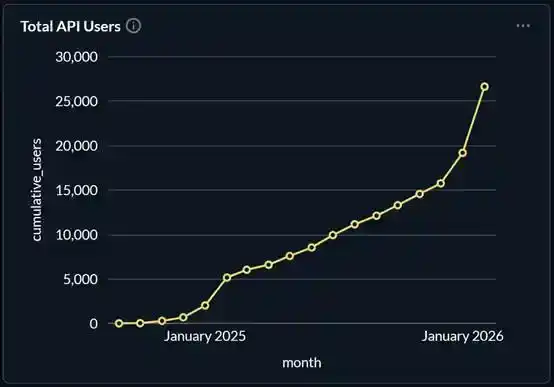
According to the Venice API user statistics chart disclosed by Erik Voorhees in March, Venice's API user count grew from near zero to 15,000 throughout 2025.
However, the corresponding price performance of $VVV has been lukewarm, with occasional rebounds reaching only about a $200 million market cap at most. It once fell below a $45 million market cap, far from its all-time high of nearly $1 billion when it first launched.

It's also noticeable that entering 2026, Venice's API user count experienced rapid growth. This has to be credited to the explosion of OpenClaw. Due to its privacy-focused positioning, Venice was prominently recommended in the model provider section of OpenClaw's official documentation.
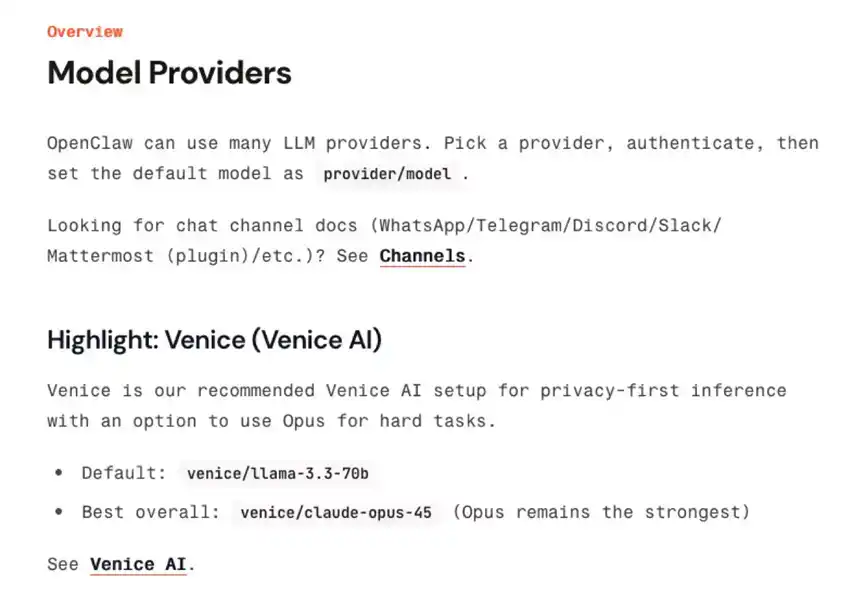
Although this prominent recommendation was later removed, 2026 has been a year of rapid growth for Venice. According to data disclosed by Erik Voorhees, by March this year, Venice's total user count exceeded 2 million, paid subscription users reached 55,000, monthly revenue hit $835,000, with a monthly growth rate of 15%.

Corresponding to this is the continuous rise of $VVV. Since entering 2026, $VVV has increased by over 9 times.

$VVV/$DIEM

Earlier, we covered Venice's growth in exposure and user numbers this year, which are the macro-narrative reasons for its rise. But as a crypto AI project with a token, its price increase is also closely tied to the token's mechanisms.

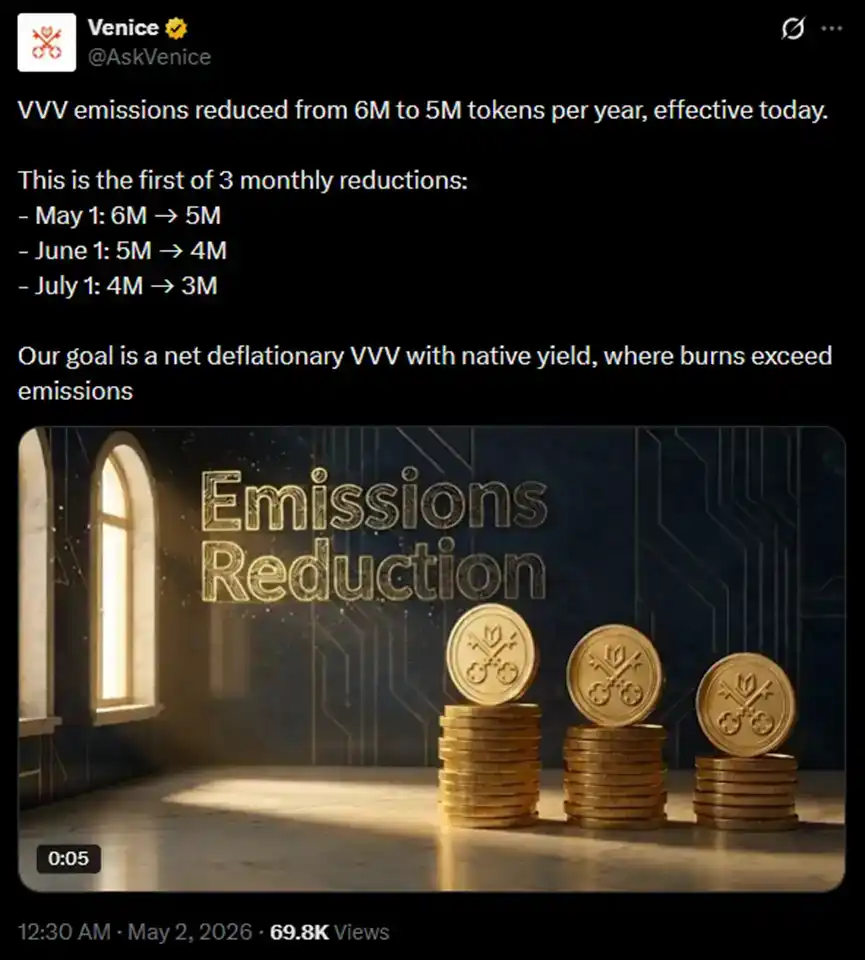
This year, the annual emission of $VVV has undergone multiple reductions and adjustments, dropping from 8 million tokens per year to 5 million. By July 1st, the annual emission will be further reduced to 3 million tokens. The official stated goal is to achieve net deflation for $VVV, ensuring the burn rate exceeds the emission rate to guarantee $VVV's native yield.
$VVV's initial total supply was 100 million tokens. The current total token supply is approximately 79.9 million, with 42.22% (about 33.73 million) of the current supply already burned.

The burn of $VVV is linked to Venice's subscription revenue. At the end of April, Venice allocated more subscription revenue towards token buybacks. For each new Pro plan subscription ($18), $2 will be allocated to buy back and burn $VVV. The Pro+ plan ($68) and Max plan ($200) correspond to $5 and $10 for buyback and burn, respectively.

The current circulating token count is approximately 46 million tokens. Additionally, about 8.85 million tokens remain locked, and around 32.47 million tokens are staked.

The token utility of $VVV is quite interesting. Compared to the awkward situation faced by past crypto projects where "token rights are useless compared to equity," $VVV offers a very compelling solution.

On the foundation of continuously controlling token supply, staking $VVV not only earns more $VVV (receiving more rewards from emission cuts) but also grants the right to mint $DIEM using the staked token $sVVV.
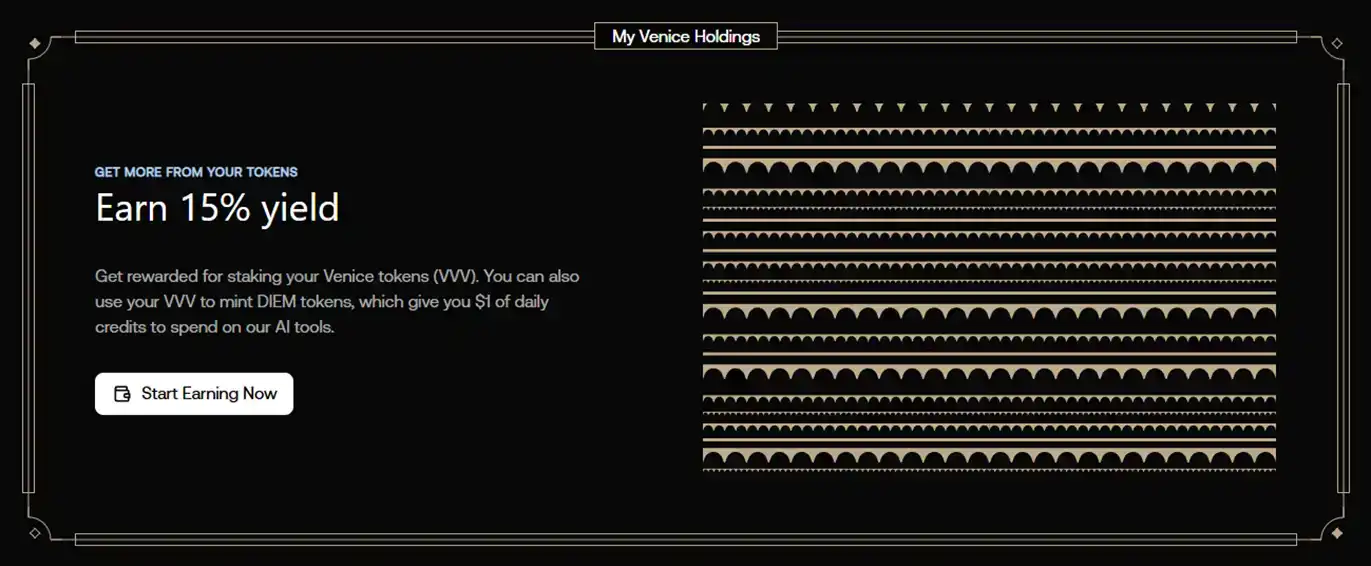
$DIEM can either be traded or staked. Staking 1 $DIEM corresponds to $1 worth of Venice API credit per day.

This credit refreshes daily; what's used today is replenished tomorrow, and it's permanent. What can you do with $1 of Venice API credit? Quite a lot, according to Venice itself:
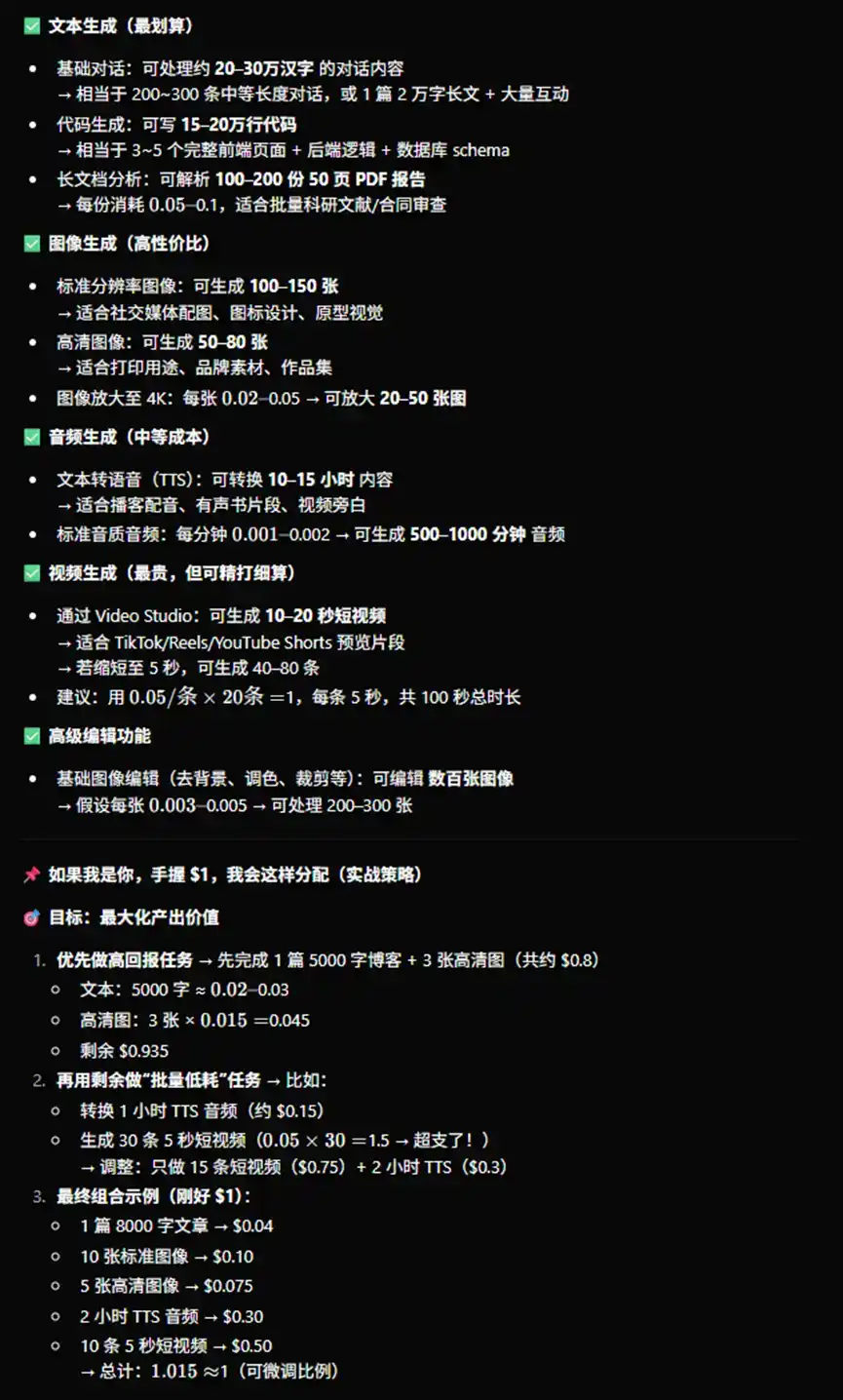
Stake 1 $DIEM, and get free daily processing of the above with Venice.

However, one must consider that the current price of one $DIEM has skyrocketed to around $1,500. To mint one $DIEM requires approximately 756 $sVVV, costing about $12,800. Is it worth it? Venice's own calculation looks like this:
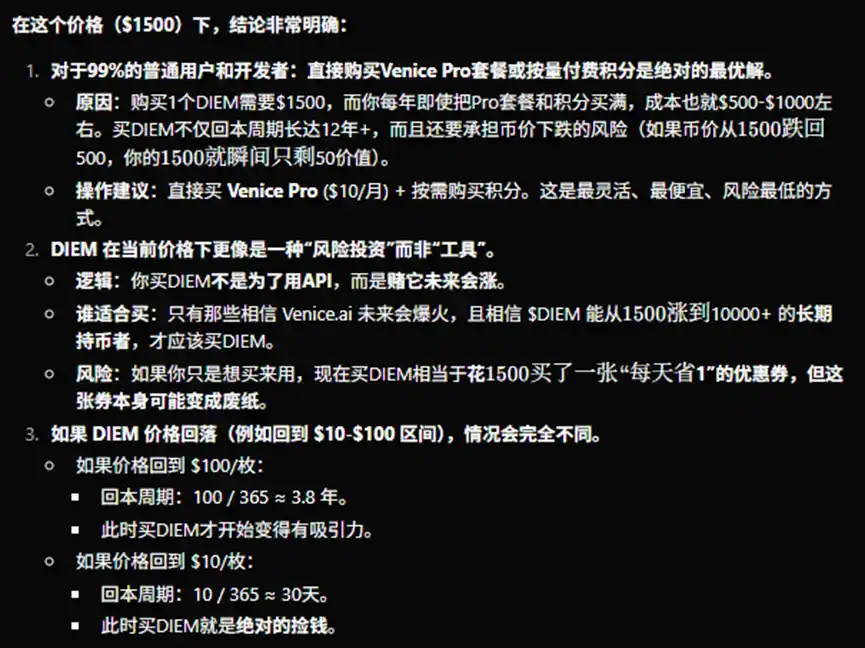
Overall, the $VVV/$DIEM economic structure, combined with Venice's regulatory mechanisms, gives $VVV a genuine "tech stock" flavor while retaining unique crypto characteristics:

- Supply-side emission reduction prevents excessive dilution of token value (and also protects the $VVV dividends for stakers from dilution).

- Subscription revenue is used for token buybacks.

- Staked $VVV can be used to mint $DIEM, allowing the token to serve a practical function within the product through $DIEM.

- However, this practical utility comes at a cost; $VVV used to mint $DIEM only receives 80% of the dividends ($VVV staking rewards).

- Enables on-chain DeFi operations, such as staking $VVV to obtain $DIEM, then selling $DIEM to buy more $VVV. There are even community projects like @cheaptokensAI that allow users to profit without selling $DIEM, by reselling the daily credit granted by $DIEM.

$POD

Since entering May, $POD has surged over 12 times at its peak, with its market cap rising from about $7.8 million to briefly surpass $100 million.

$POD is the token for Dolphin's distributed AI inference and training network. In simple terms, it involves "mining" with idle GPUs, providing computing power to those needing AI computation services, and earning $POD rewards.

However, the reason for $POD's speculative frenzy isn't the network itself, but another aspect of Dolphin's business—AI models. Venice's current default model, Venice Uncensored 1.2, is jointly developed by Dolphin and Venice and evolved from Dolphin Mistral 24B Venice Edition.

Therefore, although $POD is solely the token for Dolphin's distributed AI network, at this stage, it is being treated as the only investment vehicle for Dolphin and is being heavily speculated upon.

$cyb3rwr3n

This project claims to be building a USDC-based auction market for Venice usage credits. However, it is seen as part of the "VVV" related concepts largely because some players, after analyzing correlations between on-chain behavior and tweets, believe this project is highly associated with Venice founder Erik Voorhees.

The Venice official Twitter account has clarified these speculations, stating that cyb3rwr3n is not an official Venice project.

When this news broke last month, it caused about a 50% price drop, but a few days ago, the token hit a new all-time high. The official clarification hasn't completely erased market associations. According to some community discussions, Erik Voorhees was the first follower of the cyb3rwr3n official Twitter account, and Venice team members like co-founder @TeanaTaylor, CTO @jesseproudman, and product lead @willyogo also follow the account. They argue that even if Venice has no formal link, the supportive sentiment conveyed by such interactions is still a significant bullish signal.

This is also currently one of the cheaper tokens among "VVV" related concepts, with only a $4 million market cap. But being cheap comes with reasons—its product hasn't launched yet, and it currently functions more like a meme coin.

$SR

STRIKEROBOT.AI is a full-stack embodied intelligence platform building a humanoid robot framework for physical AI Business Process Outsourcing (BPO), focusing on safety in hazardous environments (nuclear plants, high-voltage facilities, radiation zones, etc.).

They have a robot training and simulation platform called SR Platform, and $SR is the token for this platform. The project's connection to Venice is the announcement on May 7th about jointly developing a VLM inference layer for robots with Venice and receiving funding sponsorship from Venice.
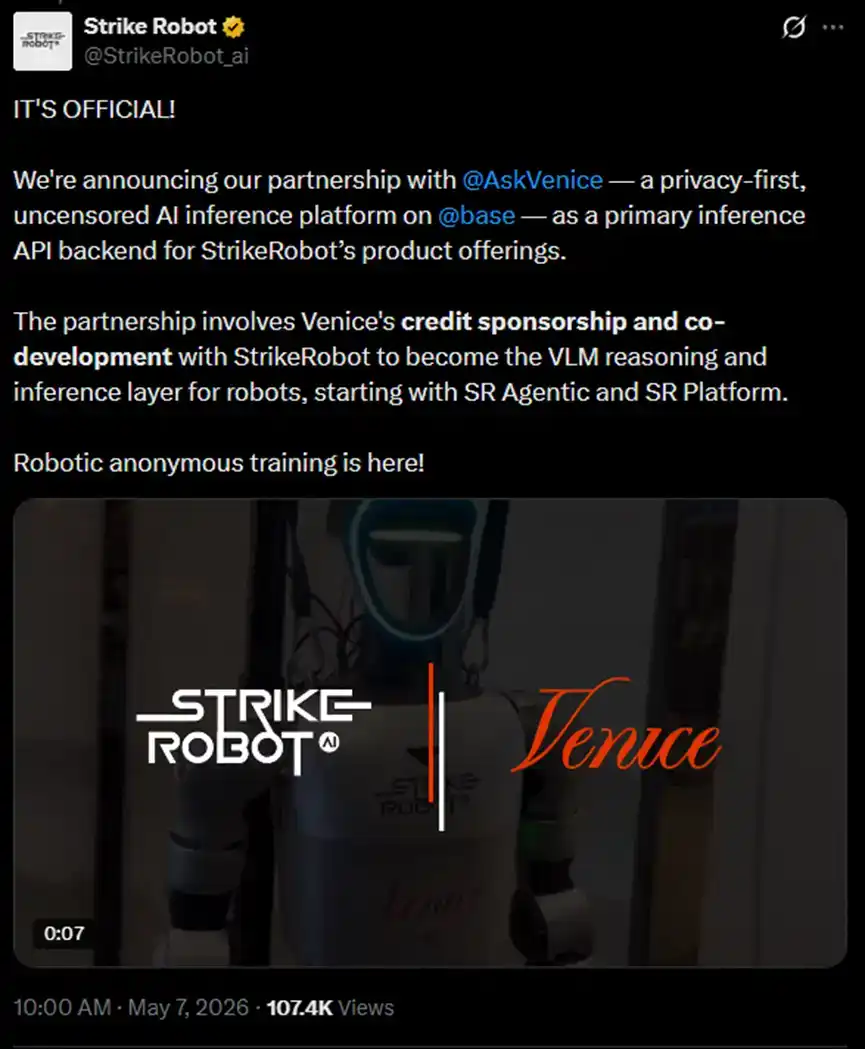
Since entering May, $SR has risen approximately 4 times, with a current market cap of around $9 million.


Questions liées

QWhat is the 'VVV' concept referred to in the article, and what is its primary platform?

AThe 'VVV' concept refers to the $VVV token associated with Venice, which is a privacy-focused, uncensored generative AI platform on the Base blockchain ecosystem, led by Erik Voorhees.

QAccording to the article, what was a significant driver for Venice's rapid growth in user numbers in 2026?

AThe significant driver for Venice's rapid growth in user numbers in 2026 was its high-profile recommendation in the official documentation of the popular project OpenClaw, thanks to its privacy-focused positioning.

QHow does the Venice platform's subscription model contribute to the $VVV token's economics?

AVenice uses a portion of its subscription revenue from Pro, Pro+, and Max packages to buy back and burn $VVV tokens. For example, each new $18 Pro subscription allocates $2 for this buyback and burn, creating deflationary pressure on the token's supply.

QWhat is the relationship between the $VVV token and the $DIEM token within the Venice ecosystem?

AStaking $VVV tokens yields staked $sVVV, which can be used to mint $DIEM tokens. Each staked $DIEM token provides a daily $1 credit for using the Venice API. While $DIEM can be traded, it also has this core utility within the Venice product.

QBesides $VVV itself, name two other tokens mentioned in the article that are considered part of the 'VVV' concept and briefly state their connection to Venice.

ATwo other tokens are $POD and $SR. $POD is the token for Dolphin, a distributed AI network, which co-developed the Venice Uncensored 1.2 model with Venice. $SR is the token for STRIKEROBOT.AI, which received funding from Venice and is collaborating with them to develop a VLM inference layer for robots.

Lectures associées

L'action de Circle s'effondre de 76 %, un stablecoin lié au dollar hongkongais sera lancé d'ici deux semaines

Le cours de l'action de Circle (CRCL) a chuté d'environ 76% depuis son pic de juin de l'année dernière, atteignant environ 62 dollars le 19 juillet. Cette baisse reflète une réévaluation par le marché face à l'intensification de la concurrence et aux pressions sur les marges, malgré la confiance affichée par la direction dans la stratégie à long terme. Le président de Circle, Heath Tarbert, met en avant les atouts de l'entreprise, notamment l'USDC et ses 730 milliards de dollars de circulation. Cependant, de nouveaux défis émergent : l'alliance entre le nouveau stablecoin Open USD et la plateforme Visa Stablecoin Platform menace de fragmenter le marché. Parallèlement, Circle poursuit son expansion dans les paiements réels, comme en témoigne son partenariat avec JCB au Japon. Le paysage réglementaire ajoute à la complexité. Tether (USDT) dispose d'une période d'adaptation d'environ deux ans pour se conformer au GENIUS Act américain, ce qui pourrait nécessiter un important réajustement de ses réserves. À Hong Kong, le secteur entre dans une phase de concrétisation, avec Standard Chartered et l'entreprise Anchorage prêtes à lancer un stablecoin lié au dollar de Hong Kong (HKDAP) après avoir obtenu une licence. La chute du cours de Circle symbolise la transition du secteur des stablecoins d'une dynamique de "vainqueur unique" à un paysage concurrentiel multipolaire. La valeur attribuée par le marché aux avantages d'échelle est en cours de révision, et la capacité d'exécution des acteurs sera déterminante dans les deux prochaines années.

marsbitIl y a 11 mins

L'action de Circle s'effondre de 76 %, un stablecoin lié au dollar hongkongais sera lancé d'ici deux semaines

marsbitIl y a 11 mins

Sous le siège du capital, la décentralisation est la seule défense des chaînes publiques

L'auteur, Omid Malekan, professeur adjoint à la Columbia Business School, défend farouchement la décentralisation comme la caractéristique essentielle et non négociable des blockchains publiques. Il s'oppose à ceux qui privilégient la scalabilité, le business développement ou le financement abondant, estimant que ces priorités conduisent inévitablement à la corruption par le capital. Son raisonnement, qu'il qualifie de réaliste et machiavélique, repose sur la nature intrinsèquement opportuniste des entreprises et des institutions. Celles-ci chercheront toujours à s'approprier ou à neutraliser toute technologie menaçant leur position dominante. Le principal risque pour une blockchain n'est donc pas une attaque externe (comme une attaque à 51%), mais une prise de contrôle interne par des intérêts capitalistes. L'auteur illustre ce propos par l'exemple des blockchains de consortium ou "permissionnées". Ces systèmes, présentés comme des solutions pragmatiques, sont en réalité des outils pour préserver les oligopoles existants (comme Visa et Mastercard) en verrouillant l'accès à la concurrence. Pour lui, ces solutions hybrides et centralisées sont inefficaces et peu sûres à long terme. Il conclut que, malgré ses défauts et sa complexité, une blockchain comme Ethereum, avec son haut degré de décentralisation, reste la meilleure défense contre cette capture institutionnelle. C'est l'infrastructure la plus résistante pour construire un système financier véritablement ouvert et neutre, où les actifs finiront par affluer naturellement vers la sécurité la plus forte.

Foresight NewsIl y a 19 mins

Sous le siège du capital, la décentralisation est la seule défense des chaînes publiques

Foresight NewsIl y a 19 mins

Qui décide des règles du Bitcoin ? Le BIP-110 déclenche un conflit de gouvernance

L’article aborde la controverse soulevée par la proposition BIP-110, qui vise à réduire temporairement la capacité d’enregistrement de données non financières sur la blockchain Bitcoin via un soft fork. La proposition, initiée par Dathon Ohm, prévoit d’imposer de nouvelles limites au niveau du consensus, notamment sur la taille des scripts et l’utilisation d’OP_RETURN. Elle est activable par un signal minier à 55% sur une période déterminée. Les partisans soutiennent que les inscriptions et les runes surchargent les nœuds et détournent Bitcoin de sa mission monétaire, notant que les politiques de relais par défaut (comme l’ajustement dans Bitcoin Core v30) sont devenues inefficaces face aux canaux privés vers les mineurs. Les opposants, dont Michael Saylor et Adam Back, critiquent fermement l’approche. Saylor y voit un précédent de gouvernance dangereux, avec un seuil d’activation trop bas (55% contre 95% pour BIP-9) et des risques de division de la chaîne. Adam Back défend le principe d’un réseau sans permission, où la lenteur du consensus technique agit comme un système immunitaire contre les modifications non éprouvées. Techniquement, des experts comme Martin Habovštiak montrent que le stockage arbitraire de données pourrait contourner ces restrictions, tandis qu’un client alternatif comme DOG Mode pourrait les neutraliser au niveau du relais. Le débat révèle des tensions plus profondes sur la gouvernance de Bitcoin : les mineurs (divisés, avec des positions variées chez Ocean, Foundry et F2Pool), les opérateurs de nœuds (comme Bitcoin Knots) qui défendent leur souveraineté, les mainteneurs du code, et désormais des acteurs économiques majeurs comme MicroStrategy, dont les réserves de BTC influencent le récit. Un bug potentiel (BlockSlop) lié à l’activation tardive de BIP-110 a également été révélé, ajoutant un risque technique. En définitive, BIP-110 sert de test de pression pour la gouvernance bitcoin, opposant une vision interventionniste visant à préserver la fonction monétaire du réseau à une vision neutraliste défendant son ouverture et son processus de consensus prudent. La question centrale reste : qui a le pouvoir de décider ce qu’est Bitcoin ?

marsbitIl y a 32 mins

Qui décide des règles du Bitcoin ? Le BIP-110 déclenche un conflit de gouvernance

marsbitIl y a 32 mins

Qui décide des règles du Bitcoin ? Le BIP-110 déclenche une divergence de gouvernance

Le débat autour du BIP-110 (Réduction de données par softfork temporaire) a remis en lumière les profondes divergences de gouvernance au sein de la communauté Bitcoin. Cette proposition vise à limiter par consensus les données non financières, comme les inscriptions et les runes, en imposant des restrictions sur la taille des scripts et OP_RETURN. Ses partisans, incluant certains nœuds et mineurs comme Ocean, arguent que ces données parasitaires alourdissent la charge des nœuds et détournent l'objectif monétaire de Bitcoin, et que les politiques de relayage par défaut (comme l'ajustement dans Bitcoin Core v30) sont inefficaces. Les opposants, menés par des figures comme Michael Saylor et Adam Back, contestent vigoureusement l'approche. Ils estiment que modifier les règles de consensus pour interdire des transactions valides est antidémocratique, contraire au principe de neutralité du protocole et crée un précédent dangereux en matière de gouvernance. Back souligne que le processus de consensus technique lent et méticuleux est précisément ce qui protège Bitcoin. Saylor, représentant d'un grand détenteur institutionnel, met en garde contre les risques de division de la chaîne et d'instabilité du marché. La discussion révèle également les limites techniques du BIP-110 : des méthodes alternatives pour encoder des données persistent, et un logiciel client comme "DOG Mode" pourrait contourner les restrictions. De plus, un problème potentiel de consensus ("BlockSlop") a été révélé, exposant les risques techniques d'une telle mise à niveau. Au-delà de la question des données, le conflit pose une question fondamentale : qui décide de ce qu'est Bitcoin ? Les mineurs (avec des divisions internes, comme le montre le vote pondéré de Foundry), les opérateurs de nœuds, les développeurs principaux ou les grands détenteurs de capitaux ? Le BIP-110, qu'il soit activé ou non, sert de test de pression pour le système de gouvernance décentralisé et sans autorité unique de Bitcoin.

链捕手Il y a 44 mins

Qui décide des règles du Bitcoin ? Le BIP-110 déclenche une divergence de gouvernance

链捕手Il y a 44 mins

Trading

Spot
活动图片