# Mint Articles associés

Le Centre d'actualités HTX fournit les derniers articles et analyses approfondies sur "Mint", couvrant les tendances du marché, les mises à jour des projets, les développements technologiques et les politiques réglementaires dans l'industrie crypto.

The Return of NFT Summer: Which Projects on Robinhood Chain Are Worth Focusing On?

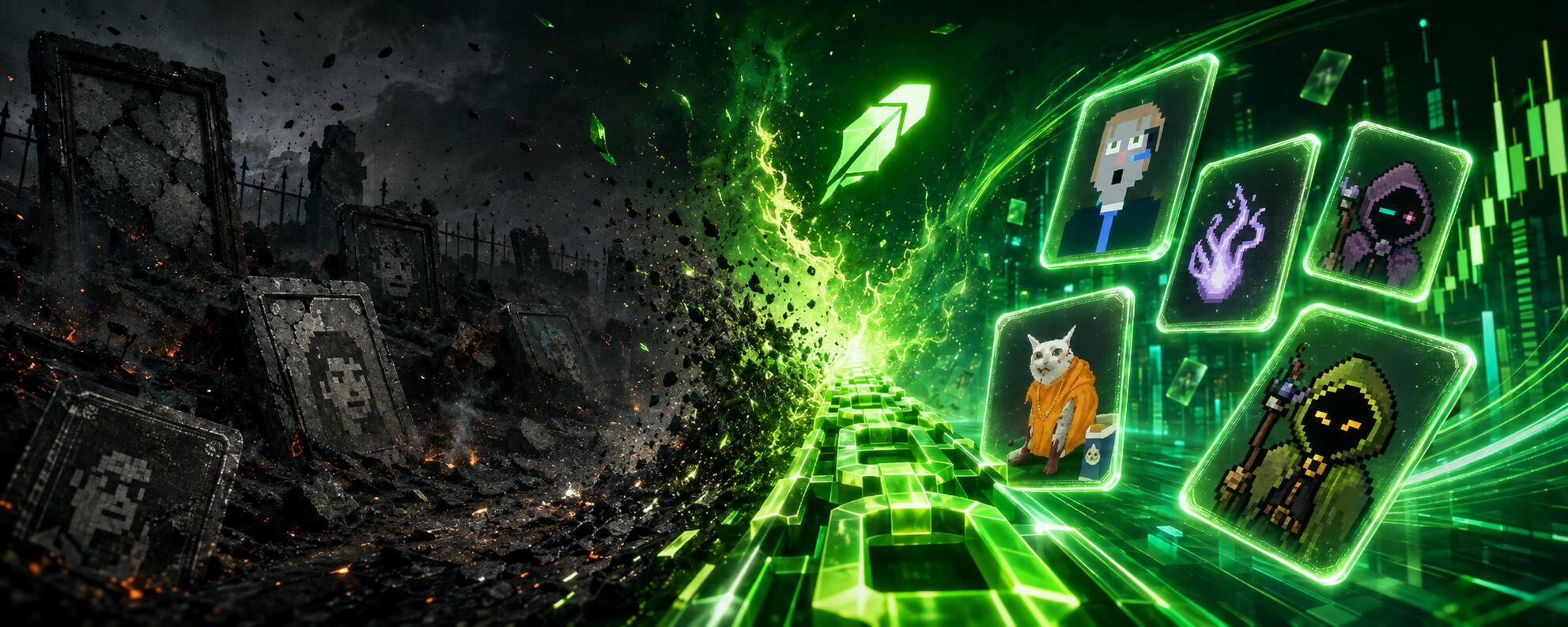
**Summary: "NFT Summer Returns – Which Robinhood Chain Projects Deserve Attention?"** Following the meme coin trend, NFTs are emerging as the new speculative focus on Robinhood Chain. The recent NFT surge gained traction with **StonkBrokers**, a pixel-style "stockbroker" PFP collection of 4,444 NFTs, whose floor price briefly surpassed 13 ETH. The hype significantly amplified with the launch of **Spritehood Wisps** by former Pudgy Penguins co-founder Cole Villemain. This 44,444-item fantasy RPG-inspired collection sold out in under an hour, generating approximately $1.28 million. The article highlights key projects driving this wave: **Already Minted Projects:** * **StonkBrokers**: ERC-6551 NFTs pre-loaded with tokenized stocks, offering rewards based on activation levels with its native token, $STONKBROKER. Floor: ~11.98 ETH. * **Spritehood Wisps**: "Wisp" NFTs that can later be burned to summon customizable Sprite characters. Floor: ~0.0125 ETH. * **Cash Cats**: A 10k PFP collection capitalizing on the popularity of the $CASHCAT meme coin. Floor: ~0.26 ETH. * **Chain Mancers**: A 5k PFP project where each NFT is tied to 500k $MANCER tokens, offering a share of protocol fees. Floor: ~0.9 ETH. **Upcoming Projects (Not Yet Minted):** * **The Saudis**: A revival of a popular 2022 pixel-art project, planning a 5,555-item collection on Robinhood Chain. Whitelist requires holding an original NFT. * **bolds**: A potential "pure art" PFP collection from artist boldleonidas, emphasizing "no utility, anti-hype." * **Chog**: The mascot of the Monad ecosystem, planning a free NFT mint on Robinhood Chain this month, with whitelist tied to holding $CHOG tokens. * **Pizza Ninjas**: An established Bitcoin Ordinals project hinting at a potential new series on Robinhood Chain. The trend underscores renewed creator and investor interest in NFTs, fueled by Robinhood Chain's growing ecosystem.

Odaily星球日报08/14 02:46

The Return of NFT Summer: Which Projects on Robinhood Chain Are Worth Focusing On?

Odaily星球日报08/14 02:46

Whitepaper 2.0, Two Sets of State Forks, the Rise of Clones: What Happened to Sato Overnight?

On the night of May 7, 2026, the SATO project released "Whitepaper 2.0" alongside significant front-end changes, shifting from "buy/sell" to "mint/burn" terminology. This update aimed to clarify market confusion regarding trading mechanics, token burns, and price discrepancies between its bonding curve and secondary markets. Key changes included explicitly defining the separate existence of the bonding curve pool (for minting/burning) and the secondary SATO/USDT pool, and detailing the core mathematical formulas governing the curve. Concurrently, SATO's market cap fell sharply from near $40 million to around $14.4 million. A fork project, SAT1, emerged with a similar bonding curve model but a key technical difference: SAT1 uses a single unified state variable (`ethCum`) for all core logic (minting, burning, halt trigger), whereas SATO's mechanism relies on two state variables (`ethCum` and `totalMintedFair`), which can drift apart and cause operational discrepancies. Both projects position themselves as operator-free "issuance machines" with asymptotic supply curves approaching 21 million tokens and charge a 0.3% fee on transactions, which remains in the protocol. The article emphasizes that despite intricate designs, both SATO and SAT1 are in highly volatile, sentiment-driven phases, and warns that mechanism innovation does not replace the need for personal risk management.

marsbit05/08 16:12

Whitepaper 2.0, Two Sets of State Forks, the Rise of Clones: What Happened to Sato Overnight?

marsbit05/08 16:12

1 Billion DOT Minted Out of Thin Air, Yet Hacker Only Made $230,000

On April 13, a security breach occurred involving the Polkadot bridge on the Ethereum network, where an attacker exploited a replay vulnerability in the MMR proof mechanism of Hyperbridge’s ISMP protocol. By reusing a historically valid proof and pairing it with a malicious request, the attacker bypassed verification and gained admin and minting rights over the wrapped DOT contract on Ethereum. They then minted 1 billion wrapped DOT tokens—2,805 times the existing supply—and attempted to liquidate them. However, due to extremely low liquidity in the wrapped DOT market, the massive sell-off crashed the token’s price by 99.98%, from $1.22 to approximately $0.000128. The attacker ultimately exchanged the tokens for only about 108.2 ETH (worth roughly $237,000), with gas costs as low as $0.74. The same exploit had been used previously in attacks on MANTA and CERE tokens, resulting in a total loss of around $242,000. Polkadot confirmed that the incident only affected DOT bridged via Hyperbridge to Ethereum and did not impact the native Polkadot network or DOT on other bridges. Exchanges including Upbit and Bithumb temporarily suspended DOT deposits and withdrawals as a precaution. The event highlights ongoing vulnerabilities in cross-chain infrastructure and the critical role of liquidity in limiting actual damages during large-scale exploits. It also reflects a broader trend of increasing DeFi security incidents in early 2026.

marsbit04/13 10:10

1 Billion DOT Minted Out of Thin Air, Yet Hacker Only Made $230,000

marsbit04/13 10:10

活动图片