"Shelling" Google Gemini, But Apple Hasn't Given Up on Its Own Model

marsbitPublié le 2026-01-13Dernière mise à jour le 2026-01-13

Résumé

Apple has reportedly entered into a significant partnership with Google to integrate its Gemini AI model into Apple's ecosystem, as a "foundation" component for its future AI features, including a more personalized Siri expected later this year. The deal, estimated at around $1 billion annually, is not a direct replacement of Apple's own models but rather a strategic collaboration where Gemini will assist in training and enhancing Apple's proprietary on-device AI, with all processing occurring on Apple's private cloud servers to ensure user data privacy and isolation from Google. This move is seen as a tactical, transitional step for Apple to accelerate its AI capabilities and meet product launch timelines, especially after facing delays and setbacks with its in-house Apple Intelligence development and losing key AI talent to competitors like Meta. Despite this partnership, Apple continues its independent research and is reportedly developing its own trillion-parameter model, targeted for around 2027. The collaboration has drawn criticism, notably from Elon Musk, who raised concerns about the concentration of power with Google, which also controls Android and Chrome. For Google, the deal is a major win, boosting its market valuation, while OpenAI's existing partnership with Apple, which positions ChatGPT as a supplementary option for Siri, appears less central by comparison. The arrangement highlights Apple's pragmatic approach to bridging its AI gap while maintaining its l...

Written by: Xiaojinya, Zimu AI

Apple has "bowed its head".

On January 12 local time, Apple and Google issued a joint statement:

"After careful evaluation, Apple believes that Google's artificial intelligence technology provides the most robust foundation for the Apple base model, and is excited about the innovative experiences it will unlock for Apple users."
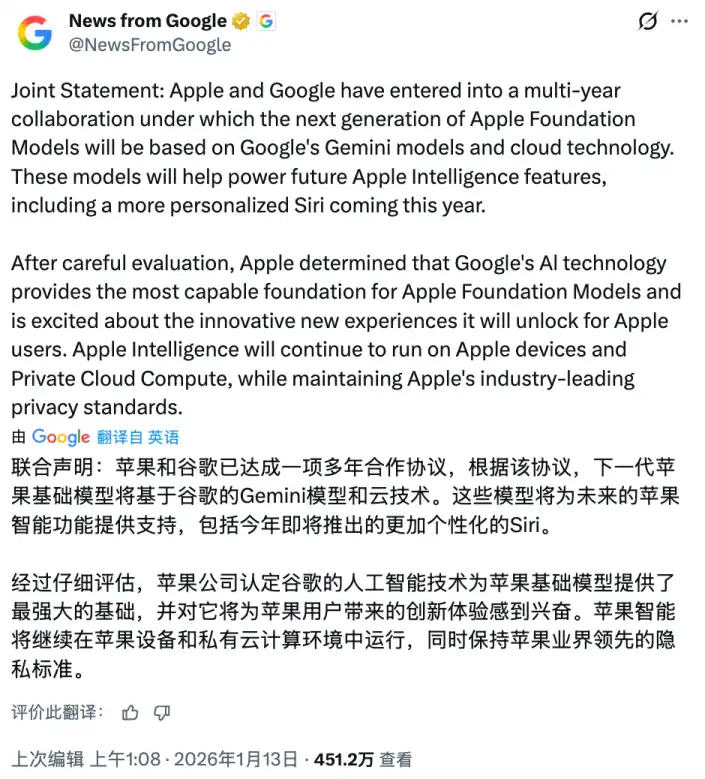
The two companies stated that these models will help support future Apple Intelligence features, including a more personalized Siri set to launch later this year.

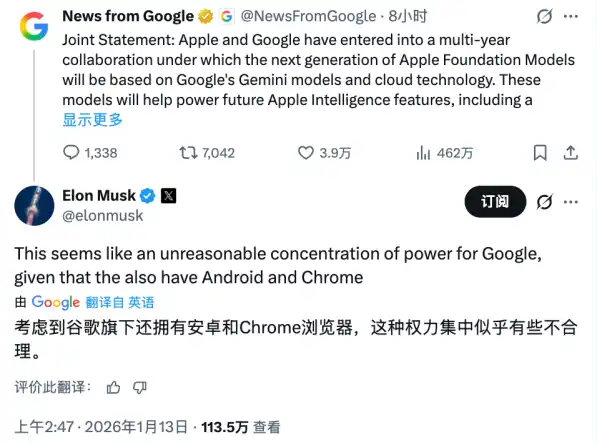
As soon as the news broke, Musk was the first to express displeasure, commenting on X that this kind of "power concentration" is unreasonable, given that Google also owns Android and the Chrome browser.
This is tantamount to saying that Google now controls Apple's AI as well. But Apple would certainly disagree with this statement.

For Apple, this is a temporary bowing of the head, but by no means an admission of defeat or surrender.

The introduction of Google Gemini is more like a temporary worker Apple has found for the transition period; it will not completely replace Apple's self-developed model. Moreover, Apple is still developing a trillion-parameter model.

Gemini Has Not Replaced Apple's Self-Developed Model

The statements released by Apple and Google are limited and deliberately vague, but one thing is clear: Gemini will participate in the construction of the new Apple base model.

This matter was reported by Bloomberg's Mark Gurman back in November last year, when he cited sources familiar with the matter saying that Apple would pay Google about $1 billion annually.

However, this is not a simple "one-for-one" swap of the Gemini model for the Apple base model, but rather a system architecture that allows Apple to continue using its own model while not providing any data to Google.

As the initial rumor pointed out, Gemini will not be directly embedded into Apple's operating system.

Instead, everything will still be presented externally with the Apple base model at its core, but at the underlying architectural level, Gemini will become its "foundation." In other words, Apple's use of Gemini falls somewhere between "shelling" and "distillation," and of course, given the cooperation between the two parties, this is certainly legal.

This is crucial; interpreting this news as "Apple's AI will be powered by Gemini" is inaccurate.

When you buy an iPhone, it internally uses chips manufactured by TSMC, displays from Samsung, and various components from all over the world. But no one would therefore claim that Samsung is "powering" the iPhone.

The on-device Apple Intelligence will still be powered by the Apple base model.

In other words, the Gemini model will serve as a tool to help train the Apple base model, enabling it to better perform the various tasks Apple sets for it.

Last year, Gurman's report mentioned that, according to the agreement between Google and Apple, Google's Gemini model would be responsible for Siri's summarization and planning functions—components that help the voice assistant synthesize information and decide how to execute complex tasks. Some of Siri's functions will continue to use Apple's self-developed model.

The report also stated that the model would run on Apple's own private cloud computing servers, ensuring user data is completely isolated from Google's infrastructure. Apple has allocated AI server hardware to support the operation of this model.

As the current public statements from both sides are ambiguous, the above content has not been refuted.

This deal is fundamentally different from the "Google Search" type of cooperation because it is completely invisible to the end user. When conversing with Siri, there will be no Gemini branding, nor should there be.

Apple Has Not Given Up

Further cooperation with Google is Apple's "transitional" choice.

Apple users have been looking forward to the new Siri since 2024, when Apple showcased it at WWDC and said it would be rolled out gradually. But since then, it has been repeatedly delayed, becoming a major embarrassment for Apple.

Currently, multiple media reports indicate that the new Siri will be released in March with iOS 26.4.

In addition, Apple Intelligence itself has not been progressing smoothly either; the initially launched features like "News Summaries" have been questioned for making errors.

Worse still, when Meta suddenly initiated a "war for AI talent" last year, Apple also suffered heavy losses. The most well-known case was the head of Apple's AI base model team at the time, Ruoming Pang, being poached, reportedly offered a sky-high compensation of $200 million by Meta.

In this situation, if delays continue, it would not only mean falling behind in the AI race for Apple but would also severely damage market trust.

At this point, turning to a third party to push forward the most urgent matters (like the new Siri) according to the schedule and deliver results to users is Apple's top priority.

And choosing Google is not surprising.

Apple and Google have a long-standing cooperative relationship; for example, Google has been paying Apple over $20 billion annually for years to remain the default search engine in Apple's Safari browser.

Their cooperation has attracted antitrust lawsuits, but the latest ruling only required adjustments to specific practices; the $20 billion cooperation between the two is still permitted.

Furthermore, Gemini is currently one of the strongest models. According to previous coverage, Apple tested several mainstream models including Gemini, GPT, and Claude, and ultimately selected Gemini.

As an aside, Apple's emphasis on "user privacy" in this new cooperation with Google Gemini, stressing that everything runs on the "Apple Private Cloud" and that no data will be shared with Google, is also a lesson learned from past collaborations with Google. In 2012, the "Safari tracking cookie scandal" occurred, where Google was accused of exploiting a privacy setting vulnerability in the Safari browser to place tracking cookies, bypassing the policy of blocking third-party cookies by default. Ultimately, Google was fined $22.5 million by the FTC and required to make changes. Additionally, Google reached a $17 million settlement with 37 states and the District of Columbia to resolve a class-action lawsuit.

In summary, this cooperation between Apple and Google can be called a temporary "bowing of the head," but by no means "admitting defeat" or "giving up."

Apple is still developing its own trillion-parameter model, expected to be launched around 2027.

Even when that model is released, Apple will likely still retain Gemini for reinforcement training, comparative analysis, and further optimization. Using it as a "tool" to strengthen itself is precisely what Apple expects from Google Gemini.

The One Who Benefits Most is Still Google

Although we just spent a long篇幅 trying to clarify what this deeper cooperation between Apple and Google is and is not.

But it can be foreseen that the perception that "Apple's AI relies on Gemini" will be difficult to eliminate.

Some can't help but imagine: Imagine if by March or April, Siri suddenly becomes super easy to use......
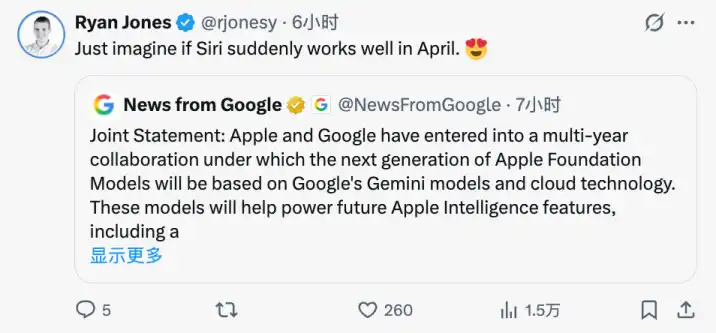
This isn't hard to imagine. The awkward situation Apple faces now is that if the introduction of Gemini indeed has an immediate effect and significantly accelerates the progress of Apple Intelligence and Siri, then the evaluation that "Apple really isn't up to it" would be confirmed.

In this case, even if Apple successfully develops its own trillion-parameter model and moves from the transition phase to self-reliance, Gemini would still be considered the功臣 (meritorious servant), not Apple itself.

As for Google, the market has already given it positive feedback.

After the joint statement from Apple and Google was released, Alphabet's stock price rose by up to 1.7%, and its market capitalization closed the day by breaking through the $4 trillion mark for the first time, setting a company record, while Apple's stock price rose by less than 1%.

This cooperation also puts other peers under pressure.

Elon Musk, who spoke out to express dissatisfaction, is one of them. He criticized Google, which controls Android and Chrome, for now also penetrating Apple, calling it an embodiment of "excessive concentration of power," hinting at monopolistic tendencies.

Another who might be uncomfortable is OpenAI's Sam Altman. OpenAI previously reached a cooperation agreement with Apple, where ChatGPT would serve as a "supplementary option" when Siri answers user questions. That is, just as Siri sometimes lists web search results now, it would, when necessary, provide answers from ChatGPT in the future.

This cooperation had previously brought glory to OpenAI, but now it pales in comparison to the new cooperation between Apple and Google.

Clearly, this cooperative status of being a "supplementary option" on the front stage is far inferior to Google Gemini's status as a "foundational helper" in the back stage. It's like the Apple club is putting on a show: OpenAI is performing on stage, but Google is working the lights backstage. Altman has not yet commented on this.

And in the Chinese market, whether Apple is also looking for a "transitional helper" before it builds its trillion-parameter self-developed model remains to be seen.


Cryptos en tendance

Questions liées

QWhat is the nature of the partnership between Apple and Google regarding AI, as announced on January 12th?

AApple and Google announced a partnership where Google's Gemini AI technology will serve as the foundational base for Apple's on-device models. This is not a direct replacement but a system where Gemini helps train and support Apple's own models, with all processing occurring on Apple's private cloud servers to ensure data privacy and isolation from Google.

QAccording to the article, why did Apple choose to partner with Google's Gemini instead of relying solely on its own AI development?

AApple chose this partnership as a transitional solution to meet its deadlines, particularly for the launch of the new, more personalized Siri. The company has faced delays and setbacks with its own Apple Intelligence and Siri development, including the loss of key AI talent to competitors like Meta.

QHow does the article describe the potential market perception of this Apple-Google deal, and what is the risk for Apple?

AThe article states that the public perception will likely be that 'Apple AI is powered by Gemini,' which could solidify the view that 'Apple is not capable' on its own. Even if Apple later succeeds with its own trillion-parameter model, Gemini could still be seen as the功臣 (key contributor), damaging Apple's reputation.

QWhat was Elon Musk's reaction to the Apple-Google AI partnership, as mentioned in the article?

AElon Musk expressed dissatisfaction on X, criticizing the partnership as an unreasonable 'concentration of power' because Google already controls Android and Chrome, and this deal further expands its influence into Apple's ecosystem.

QHow does the status of OpenAI's partnership with Apple compare to Google's new role, according to the article?

AOpenAI's partnership with Apple is described as significantly less important. OpenAI's ChatGPT is a 'supplementary option' presented to users on the front end, similar to web search results, whereas Google's Gemini is a foundational 'helper' in the backend, akin to a backstage technician compared to a stage performer.

Lectures associées

Coinbase affiche des pertes pour le deuxième trimestre consécutif et doit compter sur des sources de revenus autres que le trading

La plateforme d'échange de cryptomonnaies américaine Coinbase a publié ses résultats pour le deuxième trimestre, affichant une baisse de son chiffre d'affaires à 1,22 milliard de dollars et une perte nette GAAP de 359 millions de dollars, marquant ainsi son deuxième trimestre consécutif dans le rouge. Malgré un marché global des cryptos en recul (volumes de transactions au comptant en baisse de 25%), Coinbase a augmenté sa part de marché estimée à 10,3%. Ceci démontre que sa position d'acteur conforme aux régulations américaines lui permet de capturer une part plus importante de l'activité, même en période de volatilité réduite. La structure des revenus évolue significativement. Les revenus de transaction (599M$) et les revenus d'abonnement/services (555M$) sont désormais presque à égalité. Une part importante des revenus de services provient des stablecoins, générant 292M$ grâce aux intérêts sur les soldes USDC détenus sur ses produits. Ceci crée un flux de revenus plus récurrent, moins dépendant du seul volume transactionnel. La plateforme développe également ses offres sur les produits dérivés, dont les volumes (1,03 trillion de dollars) sont restés stables tandis que les volumes au comptant diminuaient. L'objectif est d'intégrer comptant, stablecoins et dérivés sur une même plateforme de liquidités pour fidéliser les utilisateurs. Bien que le résultat net GAAP soit négatif, l'EBITDA ajusté reste positif à 208M$, soulignant la capacité opérationnelle à couvrir les coûts courants. La société contrôle ses dépenses mais le défi reste de valider la croissance de ces nouvelles sources de revenus (stablecoins, dérivés, services) pour mieux résister aux cycles futurs du marché.

marsbitIl y a 8 mins

Coinbase affiche des pertes pour le deuxième trimestre consécutif et doit compter sur des sources de revenus autres que le trading

marsbitIl y a 8 mins

Le trimestre de juin de l'entreprise technologique la plus précieuse au monde : le chiffre d'affaires d'Apple franchit pour la première fois la barre des 1000 milliards de dollars

Apple a franchi pour la première fois la barre des 100 milliards de dollars de chiffre d'affaires (109,4 milliards) au cours de son trimestre de juin (exercice 2026, T3), le plus fort jamais enregistré pour cette période habituellement plus calme. La croissance annuelle du revenu a atteint 16,4%, portée principalement par l'iPhone, mais aussi par le Mac et les services. Ces trois secteurs ont établi des records pour un trimestre de juin. Les ventes d'iPhone ont généré près des deux tiers de la croissance totale du chiffre d'affaires, démontrant un rebond significatif du matériel. Les régions d'Europe et de Grande Chine ont été des moteurs clés de cette expansion. Malgré une contribution moindre au chiffre d'affaires total (28,1%), les services ont fourni 42,4% de la marge brute, grâce à un taux de marge très élevé de 75,6%. Ils jouent un rôle crucial en rendant chaque dollar de revenu plus profitable. Le bénéfice par action (EPS) a augmenté de 28,7%, soit un rythme plus rapide que le chiffre d'affaires. Cependant, Apple précise qu'un remboursement de droits de douane a ajouté environ 0,11$ à l'EPS et a amélioré la marge brute d'environ 2 points de pourcentage. En excluant cet effet ponctuel, la croissance de l'EPS serait d'environ 21,7%.

marsbitIl y a 9 mins

Le trimestre de juin de l'entreprise technologique la plus précieuse au monde : le chiffre d'affaires d'Apple franchit pour la première fois la barre des 1000 milliards de dollars

marsbitIl y a 9 mins

À l'ère de l'IA, nous avons besoin de « magiciens », non de « gestionnaires »

À l'ère de l'IA, le leadership évolue : il ne s'agit plus de ce que le leader sait, mais de ce qu'il permet aux autres d'accomplir. L'article plaide pour un passage d'une pensée managériale "de l'intérieur vers l'extérieur", axée sur le contrôle et les connaissances existantes, à une approche "de l'extérieur vers l'intérieur", tournée vers les opportunités externes, les besoins clients et l'innovation disruptive. Les technologies comme l'IA ne sont que des infrastructures ; la vraie magie vient des humains. Les leaders doivent devenir des "architectes de la prospérité", créant des environnements où les idées nouvelles peuvent éclore, où la créativité est encouragée et où l'autonomie est accordée. Leur rôle n'est plus de tout contrôler, mais d'habiliter, de faciliter et d'inspirer. Face à la courte durée de vie des connaissances, la capacité d'apprentissage continu et l'agilité priment sur l'expertise statique. La formation des futurs leaders doit donc mettre l'accent sur les compétences fondamentales durables, les sciences humaines et le développement d'un état d'esprit dynamique capable de s'adapter à un monde en mutation rapide. En somme, le défi n'est pas de gérer, mais de libérer le potentiel. L'avenir récompensera les leaders qui, tels des magiciens, savent créer les conditions pour que des possibilités inattendues puissent émerger et prospérer au sein de l'organisation.

marsbitIl y a 41 mins

À l'ère de l'IA, nous avons besoin de « magiciens », non de « gestionnaires »

marsbitIl y a 41 mins

La fin du «plus grand mythe» de ce marché haussier ! Léopold, le «prophète de l'IA», terrassé en quelques semaines, Citadel rachète 16 milliards de dollars d'actifs boursiers

**Le crépuscule d’un « prophète de l’IA » : comment Leopold Aschenbrenner a perdu 160 milliards de dollars en quelques semaines** À 24 ans seulement, Leopold Aschenbrenner était célébré comme un visionnaire de l’IA après la publication d’un essai de 165 pages prédisant l’avènement d’une super-intelligence d’ici 2027. Son fonds, Situational Awareness (SA), levé avec seulement 225 millions de dollars de capital initial, a vu ses actifs gonfler à près de 45 milliards de dollars, enregistrant un rendement net de 439% au premier semestre 2026. La stratégie était simple et audacieuse : parier massivement, avec un effet de levier de 4x, sur les sociétés d’infrastructures d’IA (comme SK Hynix, Nebius, CoreWeave) tout en vendant à découvert des éditeurs de logiciels traditionnels. Cette concentration extrême sur un seul thème a fonctionné… jusqu’à ce que le marché se retourne en juillet 2026. Une correction brutale des actions de l’IA, couplée à une hausse des titres qu’il vendait à décourt, a mis le fonds sous pression. Les appels de marge des banques (Bank of America, Goldman Sachs, JPMorgan) se sont multipliés. En seulement 36 heures, contraint de liquider, SA a vendu la totalité de ses positions boursières publiques – environ 16 milliards de dollars – en un seul bloc à Citadel, avec une décote significative. Cette transaction historique a mis fin au volet hedge fund de SA, réduisant ses actifs gérés de plus de moitié. Le fonds conserve environ 10 milliards d’actifs privés, dont une participation majeure dans l’entreprise d’IA Anthropic. L’histoire d’Aschenbrenner illustre une leçon cruciale de Wall Street : avoir raison sur une mégatendance ne garantit pas la survie financière si la structure du portefeuille (concentration excessive, levier élevé) ne laisse aucune marge de manœuvre face à la volatilité du marché.

marsbitIl y a 55 mins

La fin du «plus grand mythe» de ce marché haussier ! Léopold, le «prophète de l'IA», terrassé en quelques semaines, Citadel rachète 16 milliards de dollars d'actifs boursiers

marsbitIl y a 55 mins

Trading

Spot

Articles tendance

Comment acheter T

Bienvenue sur HTX.com ! Nous vous permettons d'acheter Threshold Network Token (T) de manière simple et pratique. Suivez notre guide étape par étape pour commencer votre parcours crypto.Étape 1 : Création de votre compte HTXUtilisez votre adresse e-mail ou votre numéro de téléphone pour ouvrir un compte sur HTX gratuitement. L'inscription se fait en toute simplicité et débloque toutes les fonctionnalités.Créer mon compteÉtape 2 : Choix du mode de paiement (rubrique Acheter des cryptosCarte de crédit/débit : utilisez votre carte Visa ou Mastercard pour acheter instantanément Threshold Network Token (T).Solde :utilisez les fonds du solde de votre compte HTX pour trader en toute simplicité.Prestataire tiers :pour accroître la commodité d'utilisation, nous avons ajouté des modes de paiement populaires tels que Google Pay et Apple Pay.P2P :tradez directement avec d'autres utilisateurs sur HTX.OTC (de gré à gré) : nous offrons des services personnalisés et des taux de change compétitifs aux traders.Étape 3 : stockage de vos Threshold Network Token (T)Après avoir acheté vos Threshold Network Token (T), stockez-les sur votre compte HTX. Vous pouvez également les envoyer ailleurs via un transfert sur la blockchain ou les utiliser pour trader d'autres cryptos.Étape 4 : tradez des Threshold Network Token (T)Tradez facilement Threshold Network Token (T) sur le marché Spot de HTX. Il vous suffit d'accéder à votre compte, de sélectionner la paire de trading, d'exécuter vos trades et de les suivre en temps réel. Nous offrons une expérience conviviale aux débutants comme aux traders chevronnés.

603 vues totalesPublié le 2024.12.10Mis à jour le 2026.06.02

Comment acheter T

Discussions

Bienvenue dans la Communauté HTX. Ici, vous pouvez vous tenir informé(e) des derniers développements de la plateforme et accéder à des analyses de marché professionnelles. Les opinions des utilisateurs sur le prix de T (T) sont présentées ci-dessous.

活动图片