Qubic Sets April 1 Start Date For Dogecoin Attack

bitcoinistPublié le 2026-03-23Dernière mise à jour le 2026-03-23

Résumé

Qubic has announced it will launch its Dogecoin mining initiative on April 1, 2026, as part of a broader strategy to integrate external proof-of-work into its decentralized compute network. The project aims to use Dogecoin ASIC mining to strengthen QUBIC tokenomics by selling mined DOGE to buy and burn QUBIC, making it deflationary. The effort also serves as a real-world stress test for Qubic’s Oracle Machines, which validate mining shares through a Byzantine fault-tolerant system. This follows Qubic’s earlier controversial campaign against Monero, which was later reassessed as a 34% attack rather than a 51% takeover. Unlike the Monero operation, Dogecoin mining will run concurrently with Qubic’s AI training workloads, without displacing them.

Qubic says it will begin its Dogecoin push on April 1, marking the next phase of a mining strategy that first drew attention through its campaign against Monero. The big question is whether Qubic can turn Dogecoin mining into a live demonstration of its broader thesis: that external proof-of-work can be absorbed into a decentralized compute network and used to strengthen Qubic’s own token economics.

In a series of posts over the weekend, Qubic framed the rollout as both a product launch and a stress test. “Every Dogecoin share mined through the Qubic network gets validated by Oracle Machines: independent computors spread across the network who each verify the share separately. Up to 13 oracle commits per transaction. If the result passes the quorum’s Byzantine fault tolerance threshold (agreement from 451 of 676 computors), it’s validated on-chain.”

Qubic To Launch Dogecoin Mining Offensive On April 1

The team added that Oracle Machines went live on mainnet on February 11 and described Dogecoin mining as “the first real-world external use case built on top of this system.” Those claims line up with Qubic’s March technical updates, which said Dogecoin mining is on track for an April 1 mainnet launch and positioned it as a real-world stress test for the network’s outsourced-computing stack.

Dogecoin ASICs will be able to mine Qubic and receive higher rewards, while mined DOGE will be sold to buy QUBIC on the open market. Part of that purchased supply, it said, would be recycled into mining incentives, while “the rest will be burned,” with the explicit goal of making QUBIC deflationary. Qubic’s official Dogecoin mining explainer similarly says the community is still finalizing how mining revenue will be split between ASIC miners, computors, and broader network incentives.

That makes the April 1 launch more than a simple mining integration. Qubic has been arguing for months that Dogecoin changes its operating model because ASIC-based Scrypt mining can run in parallel with the network’s CPU- and GPU-based AI training, rather than alternating between workloads as it previously did with Monero.

“ASIC miners handle Dogecoin. CPUs and GPUs continue training Aigarth. Both contribute to the network. Neither displaces the other,” Qubic wrote in its March 3 explainer. “The same validation framework can serve price feeds, cross-chain data, and any external information that smart contracts need to act on.”

The backdrop is Qubic’s much more controversial Monero campaign. In August 2025, the project published a post titled “Qubic Performs 51% Monero Network Takeover Demonstration,” claiming it had reached majority hashrate and reorganized the chain. But that version did not hold up cleanly under later scrutiny.

Later independent analyses placed Qubic’s effective share closer to 28% to 35%. Even Sergey Ivancheglo ultimately conceded the operation “should be rebranded into ‘34% attack,’” a nod to the fact that the maneuver looked more like selfish mining than outright majority control.

Dogecoin was not a sudden pivot. By mid-August 2025, after the Monero episode, Qubic’s community had already chosen Dogecoin as its next target for “the following mining season,” with Ivancheglo indicating the transition would take months of development. Qubic’s January and March 2026 updates show that timeline now converging on launch: planning began in January, testing advanced through March, and the dispatcher is already live for test tasks.

At press time, DOGE traded at $0.09.
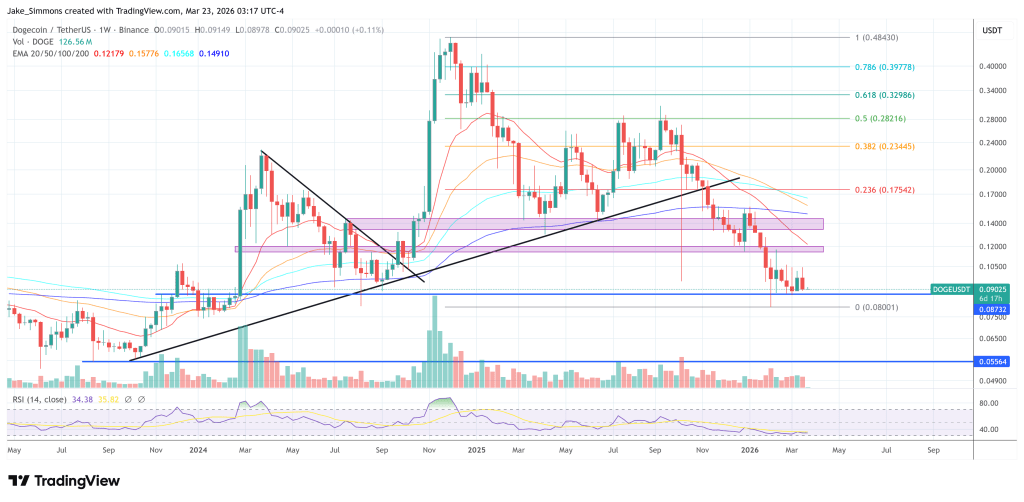
DOGE hovers above key support area, 1-week chart | Source: DOGEUSDT on TradingView.com

Questions liées

QWhat is the start date for Qubic's Dogecoin mining initiative and what is the broader goal of this strategy?

AQubic will begin its Dogecoin push on April 1. The broader goal is to demonstrate that external proof-of-work can be absorbed into a decentralized compute network to strengthen Qubic's own token economics.

QHow does the Qubic network validate Dogecoin shares, and what is the threshold for validation?

ADogecoin shares are validated by Oracle Machines, which are independent computors spread across the network. Validation requires agreement from 451 out of 676 computors to meet the Byzantine fault tolerance threshold.

QWhat will happen to the Dogecoin (DOGE) mined through the Qubic network, and how does this relate to QUBIC tokens?

AMined DOGE will be sold to buy QUBIC on the open market. Part of the purchased QUBIC will be recycled into mining incentives, and the rest will be burned to make QUBIC deflationary.

QHow does Qubic's approach to Dogecoin mining differ from its previous campaign against Monero?

AUnlike the Monero campaign, which alternated workloads, Dogecoin mining with ASICs can run in parallel with Qubic's CPU- and GPU-based AI training, allowing both to contribute without displacing each other.

QWhat was the outcome of Qubic's Monero campaign, and how did independent analyses view it?

AQubic initially claimed a 51% network takeover, but independent analyses later placed its effective hashrate share at 28% to 35%, leading to it being rebranded as a '34% attack' rather than a majority control.

Lectures associées

Le trading de l'IA refroidit, le KOSPI sud-coréen plonge de 1,8 %, l'or au comptant monte de 1 %, le Bitcoin dévisse

Le ralentissement des transactions liées à l'intelligence artificielle a déclenché une forte correction sur les marchés. L'indice sud-coréen KOSPI a chuté de 1,8%, menant les baisses en Asie-Pacifique après que Broadcom a publié des perspectives décevantes, signalant une transition plus lente que prévu vers ses clients IA. Ce revers a interrompu une série de gains sur Wall Street et refroidi l'appétit pour le risque. Les autorités sud-coréennes se sont réunies en urgence, promettant des mesures pour stabiliser le marché des changes et exprimant leur inquiétude face au niveau record des prêts sur marge. La bulle potentielle est mise en évidence par la concentration extrême des gains : deux géants des semi-conducteurs, Samsung et SK Hynix, représentent plus de 40% de la capitalisation du KOSPI. Sur les autres marchés, l'or a profité d'achats de repli pour gagner 1%, tandis que le Bitcoin est tombé vers 64 000$, son plus bas depuis février. Le pétrole a reculé après des rumeurs de cessez-le-feu au Moyen-Orient. Les déclarations de responsables de la Fed, évoquant de possibles hausses de taux, ont également pesé sur le sentiment, les investisseurs attendant les données sur l'emploi aux États-Unis. Les avis des institutions divergent : certaines maintiennent des objectifs ambitieux pour la Corée, tandis que d'autres, comme Bridgewater, mettent en garde contre un "énorme bulle" sur un marché porté par un enthousiasme excessif pour l'IA et un endettement record des investisseurs.

华尔街日报Il y a 54 mins

Le trading de l'IA refroidit, le KOSPI sud-coréen plonge de 1,8 %, l'or au comptant monte de 1 %, le Bitcoin dévisse

华尔街日报Il y a 54 mins

Pourquoi le marché boursier américain pourrait s'effondrer en juin ? - Article populaire de Seeking Alpha

L'article de Seeking Alpha, écrit par Damir Tokic, professeur de finance et analyste, avertit d'un risque d'effondrement majeur des marchés américains en juin 2026. Il identifie deux facteurs clés : une bulle spéculative surévaluée, en particulier dans la technologie, et l'escalade de la guerre en Iran qui menace de provoquer un choc inflationniste. La bulle, comparable à celle de l'internet en 2000 avec un ratio Shiller P/E supérieur à 40, est alimentée par les bénéfices des géants de la tech et des dépenses d'investissement massives en IA (7700 milliards de dollars), qualifiées de "plan de relance Trump" insoutenable. Les gains récents du marché sont perçus comme un dernier rallye spéculatif. Le conflit iranien, en bloquant le détroit d'Hormuz depuis trois mois, crée une pénurie énergétique critique. Les réserves stratégiques de pétrole devraient atteindre un niveau minimal opérationnel en juin, risquant de faire monter le brut à 200 dollars le baril et de déclencher une inflation par l'offre. Cette inflation forcerait la Réserve Fédérale, malgré son biais actuel accommodant, à adopter officiellement une position hawkish lors de sa réunion de juin. Ce revirement, anticipé par les marchés, pourrait être le déclencheur qui fait éclater la bulle. Même si la Fed restait accommodante, sa crédibilité s'effondrerait, provoquant une flambée des rendements obligataires et une secousse systémique. L'auteur conclut que les investisseurs doivent se préparer à une correction importante, similaire aux baisses de 2000 et 2008, car la combinaison d'une bulle extrême et d'un choc inflationniste géopolitique crée un risque de krach élevé pour juin.

marsbitIl y a 1 h

Pourquoi le marché boursier américain pourrait s'effondrer en juin ? - Article populaire de Seeking Alpha

marsbitIl y a 1 h

Trading

Spot
Futures
活动图片