Leaving OpenAI, How Much Has Their Net Worth Increased?

marsbitPublié le 2026-05-13Dernière mise à jour le 2026-05-13

Résumé

Former OpenAI employees have collectively accrued near-trillion dollar valuations through ventures and investments, charting AI's future. The article highlights two main paths: founding high-value companies like Anthropic and Perplexity, or applying insider insights as investors. Leopold Aschenbrenner exemplifies the investor path. After being fired from OpenAI, he leveraged firsthand knowledge of AI's massive energy demands to make hugely successful public market bets on nuclear and fuel cell companies, practicing "cross-industry cognitive arbitrage." Other alumni, like the Zero Shot VC fund founders, use their technical foresight for early-stage investing. Their key advantage lies not just in picking winners, but in knowing which technical approaches are likely dead ends—a "veto list" derived from internal OpenAI experience. Angel investing within the network, as seen with Mira Murati and Sam Altman, operates on deep, pre-existing understanding of a founder's capabilities, reducing due diligence to near zero. This creates an ecosystem bound by a shared belief in AGI's imminent arrival, differing from networks like the "PayPal Mafia" which were built on shared past struggles. The shift of these builders to investors signals a profound conviction: their situational awareness of the AI landscape is now so clear that deploying capital based on that judgment is more efficient than building themselves. They are allocating bets on the future they helped shape from the inside.

There is only one way to use a true information advantage: place your bet before others price it.

Over the past two years, everyone has been anxious, trying to find the answer to the same question: What will be the next AI sector to rise?

Storage, optical modules, compute stocks, energy stocks... the narrative changes every few months. Each time, some miss the boat, and each time, some say "next time for sure."

Few ask another question: What are the people who understand AI best betting on?

The combined net worth of those who left OpenAI has now approached $1 trillion. And their ventures and investments are at the start of AI's next era.

Dario Amodei founded Anthropic, potential valuation $900 billion. Ilya Sutskever's SSI has no product, valuation $32 billion. Aravind Srinivas built Perplexity, valuation $21.2 billion. Mira Murati's Thinking Machines Lab, valuation $12 billion.
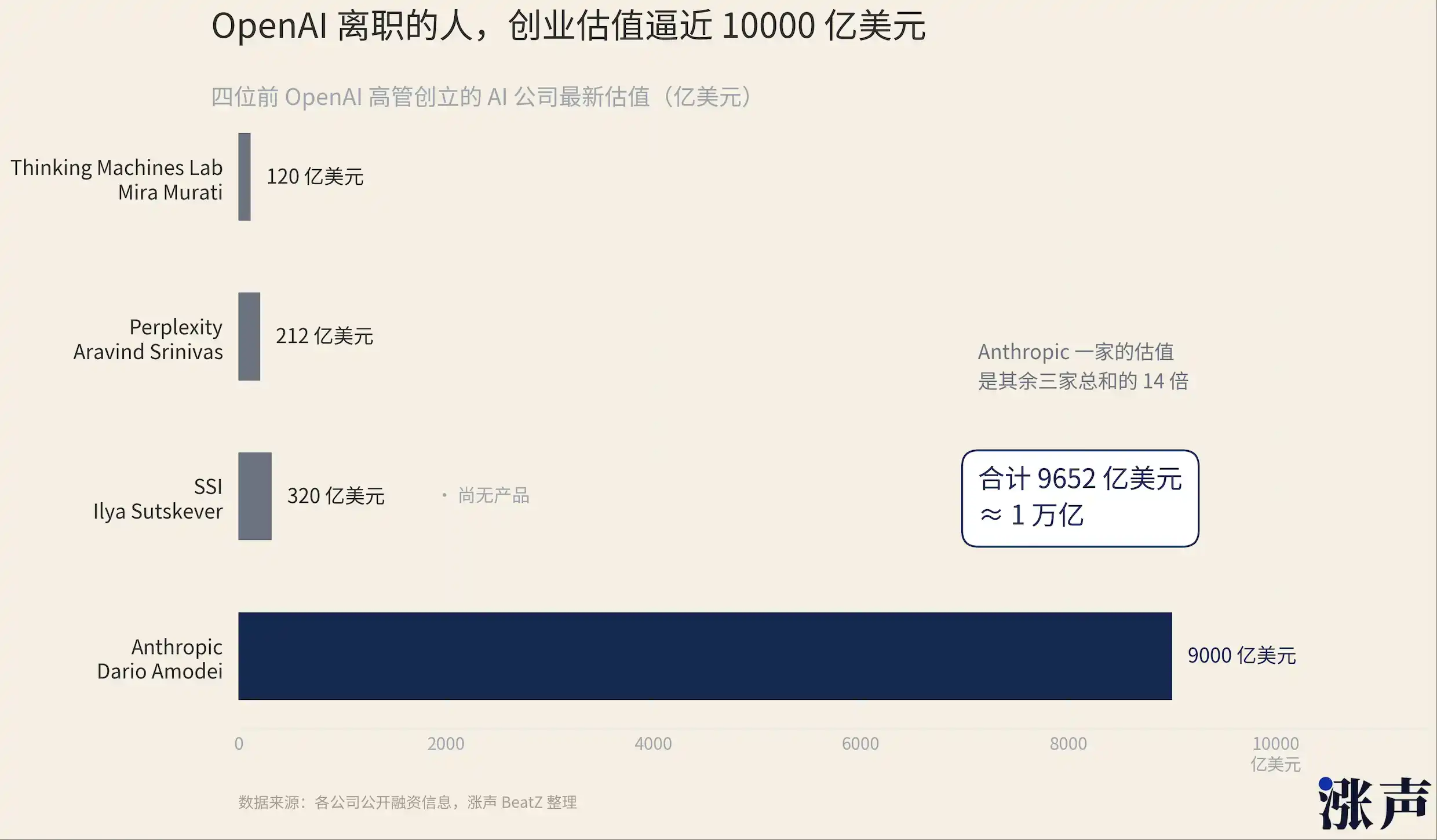
Therefore, OpenAI's most important output in recent years might not be GPT-4, but these departing employees it has exported to society.

Among them, the youngest person fired by OpenAI, Leopold Aschenbrenner, has become one of the most frequently cited names in capital markets over the past two years.

The legendary record has been chewed over repeatedly by the media: fired by OpenAI at age 23, wrote a 165-page report titled "Situational Awareness," raised a hedge fund from $225 million to $5.5 billion within a year, heavily invested in nuclear power and fuel cells—and got it all right.

The story is too perfect, the contrast too sharp, the outcome too successful. Today, whenever discussing investment logic in the AI era, he is almost an unavoidable figure.

But Leopold is merely the first of this group to be seen.

Those who left OpenAI have broadly taken two paths.

One is the path of Ilya, Mira, Aravind: starting companies, raising massive funds, rushing toward the next disruptive product—exactly like every other Silicon Valley genius exodus.

The other is much quieter: a group chose to place bets, leaving execution to others, specializing in judgment.

Leopold took the extreme form of this second path.

He went to public markets, used an operator's perspective from the AI industry, found assets in traditional energy stocks that were mispriced, and bought heavily. He doesn't understand energy, but he knows how much electricity AI will burn. That's enough. This kind of insight cannot be replicated by reading reports or attending industry conferences; it can only be accumulated by being in that position.

Beyond this path, there's another group doing things with the same logic but in a different form: smaller funds, completing due diligence in hours that others take months, where the list of rejections is more valuable than the investment list. They constitute the most easily overlooked, yet most worth examining, layer of this great exodus.

Most people leave a company taking their resume. Those leaving OpenAI take with them a set of answers others don't yet know they need.

I. There Is No Second Leopold

Leopold heavily invested in the nuclear power company Vistra and the fuel cell company Bloom Energy.

After both bets succeeded, he gradually adjusted his portfolio in late 2025, sold Vistra, and further concentrated funds on Bloom Energy and data center infrastructure.

Traditional energy analysts looking at these two stocks would pull up grid expansion plans, compare carbon tax policies, build demand growth models. Leopold's approach is completely different.
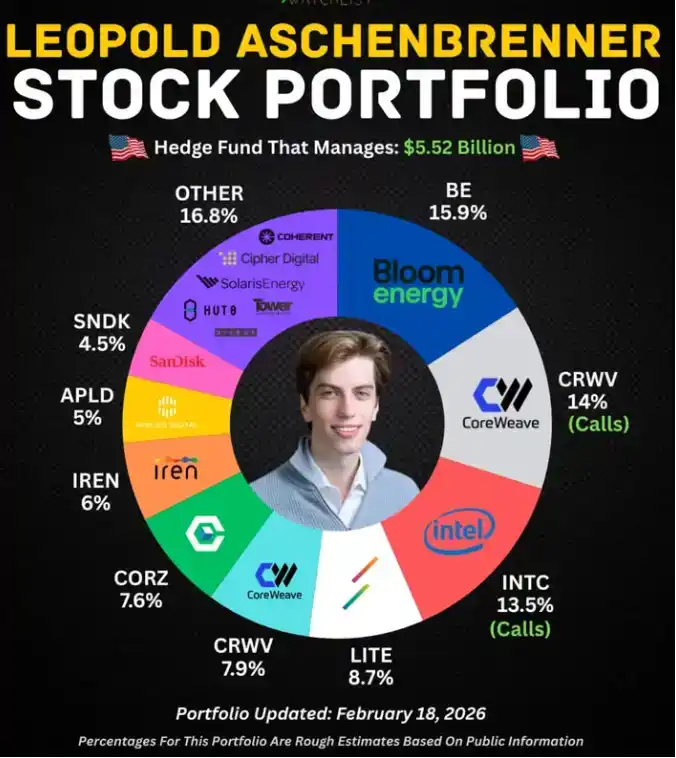
At OpenAI, he saw the scale of server rooms, saw the electricity bill for training a flagship model, heard engineers discuss why the next generation of data centers must be located next to nuclear power plants. These details are not in any financial report or analyst report, but they form a conclusion about energy demand more real than any model.

This playbook is called "cross-industry cognitive arbitrage" in investing: translating insider information from one industry into undervalued assets in another.

In the past, this was the domain of top macro hedge funds, relying on a global macroeconomic perspective.

Leopold did something more precise: he used the operator's perspective from the AI industry to find pricing lag vulnerabilities in traditional energy public markets.

This path is hard to replicate.

II. Zero Shot: The Most Valuable Thing Is the Rejection List

Evan Morikawa, founder of Zero Shot Fund, also came from OpenAI, with a similarly solid technical background. He went into VC.

Alumni, completely different paths.

Leopold's judgment comes from his concrete experience in AI's most core roles—a firsthand sense of model training costs, data center planning, energy demand. It can only be accumulated by being in that seat; there's no fast-forward button. Within OpenAI's core positions, very few are truly qualified to answer this question.

In April this year, a new fund sized at $100 million quietly surfaced, named Zero Shot.

This is a term from AI training, referring to a model answering directly without having seen any examples.

The three co-founders are from OpenAI: former DALL-E and ChatGPT application engineering lead Evan Morikawa, OpenAI's original prompt engineer Andrew Mayne, and former researcher and engineer Shawn Jain.

They have already invested in three companies: AI enterprise workflow company Worktrace, AI-enhanced factory robotics company Foundry Robotics, and another project still in stealth.

$100 million, in today's AI funds that often raise tens of billions, is a small number.

But talking about which sectors they refuse to invest in speaks volumes.

Mayne publicly stated he is bearish on most "vibes programming" tools—that category of products that help you write code with natural language.

The reason is straightforward: he knows what OpenAI has accumulated internally in the programming direction and knows how quickly the moats of such tools will be eroded directly by foundation models. Morikawa, meanwhile, keeps his distance from many "human-centric video data companies" in the robotics sector. Those enterprises specifically collecting human motion data to train robots—in his view, this technical path will hit a wall.

These two judgments, ordinary VCs can't make.

They haven't been at the source of information, haven't seen those internal discussions, so they have no way to judge which path is a dead end.

Zero Shot's advantage lies hidden in the rejection list. In a market where everyone is shouting about AI startups, knowing where the pitfalls are is more valuable than knowing who to bet on. Those who have already mined, a list of landmines is more useful than a treasure map.

They deliberately keep the size at $100 million, for specific reasons.

They know clearly in which stage their advantage is most valuable: the early stage when the technical path hasn't converged. At that stage, those with insider knowledge can distinguish at a glance which path is viable.

Once a project reaches Series C or D, financial data and public information will cover up the information advantage, and this card is played out.

The larger the scale, the more one needs to chase "certain big tracks," the more one is fighting using others' playbooks.

$100 million is their honest assessment of the boundary of their advantage.

III. Being an Angel Investor Is Another Business

Both Mira Murati and Zero Shot Fund invested in former OpenAI colleague Angela Jiang's Worktrace, a company using AI to optimize enterprise workflows.

But the investment logic is more solid than "good relationships."

Mira saw Angela's decision-making style under OpenAI's high-pressure environment, saw her judgment on AI product boundaries, saw her execution within real constraints. These things can't be faked in a two-hour founder pitch, nor fully reconstructed by the most meticulous due diligence.

Angela didn't need to convince Mira to believe in her, because Mira had already formed her judgment. The information cost for angel investment approaches zero, but the information quality far exceeds the market average.

A bigger flywheel is with Sam Altman.

Reportedly, Altman decides whether to follow-on invest within hours of hearing about a former employee starting a company, then adds capital from the OpenAI Startup Fund and substantial API resources.

He personally holds no OpenAI equity, but every alumnus's success expands OpenAI's data inlets, distribution channels, and policy influence. He is using capital to maintain an ecosystem that doesn't belong to him but continuously rewards him. This is an invisible form of equity, but it compounds in a very real way.

This ecosystem leads many to mistakenly think it's old colleagues helping each other out.

Comparing it with the PayPal Mafia clarifies the difference.

The PayPal Mafia's cohesion came from shared hardship: surviving the payment wars together, experiencing the eBay acquisition together, forming trench camaraderie during those near-death years. That trust was real, but their judgments about the future were individual. Thiel did venture capital, Musk built rockets, Hoffman built social networks—their paths diverged.

What binds the OpenAI alumni together is a shared bet on the future: AGI will come, the window is limited, now is a once-in-a-millennium opportunity to position. The driving force of belief is more lasting than camaraderie because it directly connects to interests. Once anyone's bet direction proves correct, the entire network benefits.

This also makes the entry threshold for this circle微妙 subtle.

If your product is good enough, raising money from this group isn't a problem. But if you harbor doubts about AI's future, or if your startup logic is premised on "AGI is still far away," even with an excellent product, it's hard to get a check from these people.

Differences in worldview end the conversation before the handshake.

IV. From Builders to Investors

The destinations of OpenAI alumni can be grouped into three categories.

Ilya, Aravind, Mira all chose entrepreneurship.

But even within entrepreneurship, they are doing completely different things. Aravind is in a fiercely competitive consumer business, Mira is building a tool platform, Ilya's SSI doesn't even have a product, got a $32 billion valuation, betting on the word "safety" itself.

Leopold and Zero Shot chose investing.

Leopold went to public markets, Zero Shot does early-stage VC. Both are paths externalizing judgment into capital, not personally executing. This is the minority among OpenAI alumni, but this minority deserves a separate look: when someone is willing to bet but not personally build, it usually means their judgment of the outcome is clear enough that they don't need action to explore.

People usually think the highest expression of genius is creation. But this group offers another answer: when judgment is clear enough, dispersing cognition by betting on multiple directions and letting those with execution capabilities build is a more efficient choice.

Leopold's report is titled "Situational Awareness," a military term referring to a pilot's real-time perception of the entire battlefield.

A pilot's situational awareness determines his actions two seconds later; losing it means death. What this group brought out from OpenAI is precisely situational awareness of this AI battlefield. They know the battle's direction, know where the high ground is, know which trench leads to a dead end.

What they are doing now is deploying accordingly.

The era's smartest people starting to choose ALL IN indicates that, in their view, the answer is already clear enough—clear enough that they no longer need to verify it by getting their hands dirty.


Questions liées

QWhat is the key advantage that former OpenAI employees hold when they leave, according to the article?

AThey possess unique 'situational awareness'—first-hand, internal knowledge about AI's trajectory, costs (like energy consumption for model training), and technological dead ends, which they can use to identify undervalued opportunities in other sectors or make superior investment decisions.

QWhat are the two main career paths taken by people who left OpenAI, as described in the article?

A1. Founding companies to build the next disruptive AI product (like Ilya Sutskever, Mira Murati). 2. Becoming investors, using their insider knowledge to make strategic bets in public markets or venture capital (like Leopold Aschenbrenner and the Zero Shot fund).

QHow does Leopold Aschenbrenner's investment strategy differ from that of a traditional energy analyst?

ATraditional analysts rely on public data, reports, and models. Leopold used his firsthand experience from OpenAI (e.g., seeing data center scales and power bills) to understand future AI-driven energy demand. This 'cross-industry cognitive arbitrage' allowed him to identify mispriced assets like nuclear and fuel cell companies before the market corrected.

QWhat is the unique value of the Zero Shot investment fund's 'rejection list'?

ATheir 'rejection list'—knowing which AI ideas or technical paths are likely dead ends—is more valuable than knowing what to invest in. This insight comes from their internal OpenAI experience, allowing them to avoid pitfalls (like certain 'vibes coding' tools or robotics approaches) that outside investors might not foresee, saving capital and time.

QHow does the 'OpenAI alumni' network differ from historical networks like the 'PayPal Mafia'?

AThe PayPal Mafia was bonded by shared past hardships and camaraderie. The OpenAI network is united by a shared future bet—a strong belief in the imminent arrival of AGI (Artificial General Intelligence). This shared worldview and strategic alignment on the AI opportunity drive their collaboration and investments more than personal history alone.

Lectures associées

La station relais IA déclenche un vif débat sur Zhihu : derrière les tokens bon marché, quelles sont les vraies inquiétudes des utilisateurs ?

Une question sur Zhihu concernant les stations relais d'IA a mis en lumière le thème des "jetons (Tokens) bon marché", suscitant un vif débat au-delà de la simple dichotomie "légal ou illégal". Les discussions ont porté sur des préoccupations concrètes : la provenance de ces jetons, l'authenticité des modèles utilisés, la confidentialité des données (prompts, codes, clés API) et l'évaluation réelle du risque pour les utilisateurs occasionnels. L'inquiétude principale ne porte pas uniquement sur le prix, mais sur la fiabilité. Les utilisateurs redoutent que les modèles annoncés ne soient pas ceux réellement utilisés ("détournement de modèle"), une fraude difficile à détecter en raison de la variabilité naturelle des réponses des grands modèles de langage (LLM). Cela transforme l'avantage tarifaire en une transaction à l'information asymétrique. Les discussions ont également nuancé l'idée de "bon marché", soulignant que la comparaison doit se faire avec les abonnements officiels, les modèles nationaux chinois ou les quotas gratuits, et non seulement avec l'API officielle au paiement à l'usage. Le prix bas peut provenir de sources variées, allant d'optimisations techniques légitimes (achats groupés, cache) à des pratiques grises (partage de comptes, exploitation de différences tarifaires régionales). Le débat a rapidement évolué vers la sécurité des données, un enjeu critique pour les usages professionnels (code propriétaire, documents commerciaux, données clients). Transmettre ces informations sensibles via un relais opaque pose des risques de fuite et des problèmes de conformité, notamment dans les scénarios d'agents IA pouvant exécuter des actions. Le consensus qui se dégage est que ces services peuvent être utilisés avec prudence pour des tâches non sensibles (résumés, traduction simple, tests). Cependant, ils ne doivent pas être l'entrée par défaut, surtout pour les données sensibles ou les flux de production. Les recommandations incluent : ne pas faire de gros dépôts, diversifier ses fournisseurs, tester régulièrement la qualité des modèles, anonymiser les données lorsque c'est possible et éviter d'intégrer ces relais dans les systèmes critiques d'entreprise. En somme, cette discussion révèle que le coût réel de l'utilisation de l'IA ne se résume pas au prix du jeton. Il inclut la confiance, l'authenticité du modèle, la stabilité du service et les risques pour la sécurité des données. Alors que l'accès à l'IA se démocratise, la transparence sur la provenance des modèles et le traitement des données devient primordiale.

marsbitIl y a 26 mins

La station relais IA déclenche un vif débat sur Zhihu : derrière les tokens bon marché, quelles sont les vraies inquiétudes des utilisateurs ?

marsbitIl y a 26 mins

La Blockchain Association Exhorte le Sénat à Adopter la Loi CLARITY avec une Lettre Soutenue par 160 Anciens Responsables

L'Association Blockchain, un groupe de pression majeur de l'industrie, a exhorté le Sénat américain à adopter la loi CLARITY dans une lettre signée par 160 anciens responsables de la sécurité nationale, des renseignements et des forces de l'ordre. Ils soutiennent qu'en l'absence d'un cadre fédéral clair, les activités liées aux crypto-monnaies pourraient continuer à migrer vers des marchés opaques, rendant plus difficile la lutte contre la criminalité financière pour les autorités américaines. La lettre souligne que la loi CLARITY renforcerait les capacités des forces de l'ordre en étendant les obligations de lutte contre le financement illicite (notamment via le *Bank Secrecy Act*), en améliorant le partage d'informations entre le Trésor, le ministère de la Justice, le FBI et le secteur privé, et en instaurant des garanties pour les kiosques d'actifs numériques (surveillance des transactions, limites, lutte contre la fraude). L'association insiste sur le fait qu'il s'agit de mesures d'amélioration de l'application de la loi, et non de dérégulation. Un vote complet au Sénat est attendu cet été, après l'avancée du texte en commission. Cependant, même en cas d'approbation par le Sénat, le projet de loi devra encore être réconcilié avec une version différente adoptée par la Chambre des représentants à l'automne dernier.

bitcoinistIl y a 40 mins

La Blockchain Association Exhorte le Sénat à Adopter la Loi CLARITY avec une Lettre Soutenue par 160 Anciens Responsables

bitcoinistIl y a 40 mins

Bloqué par sa propre plateforme, l'IA de WeChat entre en scène

En juin, une forte hausse boursière de Tencent a été déclenchée par des rumeurs concernant le test final d'un agent IA natif intégré à WeChat, qui serait accessible par un simple glissement vers la droite sur l'interface principale. Ce développement intervient après plus d'un an de débats internes sur la stratégie IA, accélérés par le blocage en février 2026 par WeChat de sa propre application "Yuanbao" pour violation des règles de partage, révélant un manque de consensus initial. L'agent IA de WeChat se distingue des produits existants comme Yuanbao. Il vise non pas le dialogue, mais l'exécution de tâches en appelant directement les mini-programmes et WeChat Pay, permettant ainsi des actions comme réserver, commander ou payer par commande vocale. Son atout majeur est d'activer les 1,4 milliard d'utilisateurs existants de WeChat sans téléchargement, en s'appuyant sur l'écosystème mature des mini-programmes (interfaces standardisées) et du système d'identité/paiement. Cette initiative est une réponse stratégique à la concurrence. Des rivaux comme Doubao (ByteDance) et Qianwen (Alibaba) progressent dans la connexion des services et l'exécution, tandis que la croissance de WeChat ralentit. L'agent IA vise à retenir l'intention des utilisateurs au sein de WeChat, transformant la plateforme d'un outil de communication en un assistant capable d'accomplir des tâches. Cependant, des défis subsistent : la performance du modèle maison Hunyuan, les coûts de calcul élevés pour 1,4 milliard d'utilisateurs, et surtout, la nécessaire redéfinition des incitations pour les millions de développeurs de mini-programmes dont le modèle économique pourrait être perturbé par un accès direct via l'IA. Le succès dépendra de la capacité de Tencent à naviguer dans cette complexité écologique tout en maintenant la confiance des partenaires.

marsbitIl y a 1 h

Bloqué par sa propre plateforme, l'IA de WeChat entre en scène

marsbitIl y a 1 h

Broadcom donne un indicateur Q3 inférieur de 1,2 milliard de dollars aux attentes, chute de plus de 13 % en after-market, le récit de l'IA « se refroidit » ?

**Broadcom plonge en après-bourse après des prévisions décevantes pour les puces IA** Broadcom a publié des résultats records pour son Q2 2026, avec un chiffre d'affaires en hausse de 48% à 22,19 milliards de dollars et un bénéfice par action ajusté supérieur aux attentes. Cependant, les actions ont chuté de plus de 13% en après-bourse en raison des prévisions pour le Q3. Bien que les revenus totaux anticipés soient supérieurs aux estimations, les revenus des semi-conducteurs pour l'IA sont attendus à 16 milliards de dollars, soit environ 7% de moins que le consensus des analystes (17,2 milliards). Cet écart, ainsi qu'un léger retard de la division logicielle, a déclenché une forte vente. L'entreprise a maintenu son objectif annuel de plus de 100 milliards de dollars de revenus IA pour 2027, mais n'a pas relevé ses prévisions pour l'exercice 2026. Cette prudence a déçu des investisseurs qui s'attendaient à des résultats exceptionnels, d'autant plus que l'action avait fortement augmenté et que sa valorisation était élevée. Un autre point d'attention est la prévision du PDG, Hock Tan, concernant la part des revenus "réseau IA" (composants pour la connectivité) au sein des ventes IA. Après avoir représenté environ 40% au Q2, cette part devrait se normaliser vers 30%, ce qui pourrait remettre en question les valorisations des fabricants de modules optiques chinois très exposés à ce segment. L'effet s'est propagé à d'autres acteurs du secteur comme Marvell. La question centrale est de savoir si ce repli marque un infléchissement de la dynamique IA ou simplement une prise de bénéfices sur des titres survendus. La tendance à long terme de la demande en calcul IA reste, selon la direction, "insatiable".

marsbitIl y a 1 h

Broadcom donne un indicateur Q3 inférieur de 1,2 milliard de dollars aux attentes, chute de plus de 13 % en after-market, le récit de l'IA « se refroidit » ?

marsbitIl y a 1 h

Nouvelle manœuvre à Wall Street : les vendeurs à découvert sur le yen continuent d'ajouter des positions, mais la hausse des actions japonaises ne repose pas sur le dénouement du carry trade

Le yen affaibli face au dollar (USD/JPY atteignant 160,44) et le Nikkei 225 atteignant un record historique au-dessus de 68 000 points ont ravivé les craintes d'un effondrement des *carry trades*. Cependant, les données racontent une autre histoire. Les positions spéculatives nettes à découvert sur le yen (CFTC) ont atteint -114 667 contrats fin mai, indiquant que les investisseurs augmentent leurs paris contre la monnaie japonaise, et non qu'ils les réduisent. Cette position vulnérable rappelle la couverture forcée de l'été 2024. Pour contrer cela, le ministère des Finances japonais a mené la plus importante intervention de soutien du yen de son histoire (11 734,9 milliards de yens entre fin avril et fin mai), sans parvenir à maintenir durablement la paire sous le seuil psychologique de 160. La hausse du Nikkei ne provient pas d'un rapatriement de fonds lié aux *carry trades*. Les investisseurs étrangers achètent activement des actions japonaises (achat net record sur 8 semaines), attirés par des valeurs liées à l'IA et aux semi-conducteurs, dopées par les perspectives positives du secteur. Paradoxalement, le Nikkei a continué de grimper malgré le resserrement progressif de la Banque du Japon (taux à 0,75%). La hausse est principalement portée par la thématique technologique, la rendant moins sensible aux coûts de financement pour l'instant. Cependant, cette relation pourrait changer si la BOJ durcissait davantage sa politique. En résumé, trois réalités coexistent : les positions à découvert sur le yen restent importantes, l'intervention massive n'a pas fixé le cours, et la Bourse japonaise est portée par des flux ciblés sur l'IA, et non par la dynamique des *carry trades*.

marsbitIl y a 1 h

Nouvelle manœuvre à Wall Street : les vendeurs à découvert sur le yen continuent d'ajouter des positions, mais la hausse des actions japonaises ne repose pas sur le dénouement du carry trade

marsbitIl y a 1 h

Trading

Spot
Futures

Articles tendance

Comment acheter ONE

Bienvenue sur HTX.com ! Nous vous permettons d'acheter Harmony (ONE) de manière simple et pratique. Suivez notre guide étape par étape pour commencer votre parcours crypto.Étape 1 : Création de votre compte HTXUtilisez votre adresse e-mail ou votre numéro de téléphone pour ouvrir un compte sur HTX gratuitement. L'inscription se fait en toute simplicité et débloque toutes les fonctionnalités.Créer mon compteÉtape 2 : Choix du mode de paiement (rubrique Acheter des cryptosCarte de crédit/débit : utilisez votre carte Visa ou Mastercard pour acheter instantanément Harmony (ONE).Solde :utilisez les fonds du solde de votre compte HTX pour trader en toute simplicité.Prestataire tiers :pour accroître la commodité d'utilisation, nous avons ajouté des modes de paiement populaires tels que Google Pay et Apple Pay.P2P :tradez directement avec d'autres utilisateurs sur HTX.OTC (de gré à gré) : nous offrons des services personnalisés et des taux de change compétitifs aux traders.Étape 3 : stockage de vos Harmony (ONE)Après avoir acheté vos Harmony (ONE), stockez-les sur votre compte HTX. Vous pouvez également les envoyer ailleurs via un transfert sur la blockchain ou les utiliser pour trader d'autres cryptos.Étape 4 : tradez des Harmony (ONE)Tradez facilement Harmony (ONE) sur le marché Spot de HTX. Il vous suffit d'accéder à votre compte, de sélectionner la paire de trading, d'exécuter vos trades et de les suivre en temps réel. Nous offrons une expérience conviviale aux débutants comme aux traders chevronnés.

389 vues totalesPublié le 2024.12.12Mis à jour le 2026.06.02

Comment acheter ONE

Discussions

Bienvenue dans la Communauté HTX. Ici, vous pouvez vous tenir informé(e) des derniers développements de la plateforme et accéder à des analyses de marché professionnelles. Les opinions des utilisateurs sur le prix de ONE (ONE) sont présentées ci-dessous.

活动图片