During the World Cup, USDT becomes the preferred chip for illegal gambling? Beware of three typical scams

marsbitPublié le 2026-06-22Dernière mise à jour le 2026-06-22

Résumé

During the 2026 FIFA World Cup, USDT has become the preferred payment method for illegal online gambling due to its price stability, anonymity, and fast cross-border transfers. This article analyzes how USDT facilitates this activity and outlines three major scams targeting users. **Why USDT is the "Chip of Choice"**: It solves bettors' anxiety over crypto volatility, enables instant cross-border transfers without traditional banking, and shows significant abnormal transaction spikes during major events. **The Fund Flow**: Gambling platforms use a complex laundering chain involving multi-layer address hopping, cross-chain transfers (e.g., Polygon to Tron), mixers like Tornado Cash, and final cash-out via exchanges. **Three Typical Scams**: 1. **"USDT Betting Evades Regulation"**: Fake platforms promising anonymous, high-odds betting but manipulating outcomes. 2. **Fake Sportsbooks**: High-quality replica sites that allow small initial withdrawals to build trust before freezing accounts with larger funds. 3. **"Insider Tips / Guaranteed Wins"**: Schemes selling fabricated "AI predictions" or "fixed match" models to exploit information anxiety. **Identifying Suspicious Addresses**: Key chain-based indicators include a "fast-in, fast-out" transaction pattern, clustered addresses with consistent behavior, uniform Gas fee patterns, and frequent cross-chain jumps. **User Protection Advice**: * Avoid any project promoting "USDT betting," "Web3 predictions," or "anonymous h...

Preface

At 12:00 AM Beijing time on June 12, 2026, the 23rd FIFA World Cup officially kicked off. With 48 teams, 104 matches, and spanning three host nations—Canada, Mexico, and the United States—it is not only a global celebration for football fans but also a "high-risk area" for illegal gambling and cryptocurrency scams.

Hong Kong police have explicitly stated that, with the start of the World Cup, illegal gambling activities are expected to increase significantly. More alarmingly, in recent years, the promotion, communication, and betting methods for illegal gambling have shown a clear trend of digitization, even using virtual currencies to settle bets to evade law enforcement investigations. Meanwhile, on-chain security monitoring has discovered multiple active cryptocurrency scams targeting World Cup fans, with related scam funds converging into specific public chain and exchange addresses.

USDT—this stablecoin with a market cap of approximately $190 billion—is leveraging its features of price stability, strong anonymity, and fast cross-border transfers to become the "preferred chip" for illegal gambling payments during the World Cup. Deconstructing this on-chain capital flow is a key step in understanding the risk chain behind online gambling.

Part 01 - Why has USDT become the "Preferred Chip" for World Cup Online Gambling?

During the World Cup, gambling platforms experience a surge in demand for fund flows, with USDT playing a central role.

1. Stablecoins Solve "Betting Volatility Anxiety"

Traditional cryptocurrencies (BTC/ETH) are highly volatile, while USDT is pegged to the US dollar, allowing users to:

• Deposit 1000 USDT ≈ 1000 USD

• Be unaffected by market fluctuations

• Use it directly as a "betting unit"

This enables gambling platforms to establish a unified pricing system.

2. No Reliance on Banking Systems, Cross-Border Transfers in Seconds

USDT (especially TRC-20) offers:

• Transfers without KYC

• Global wallet interoperability

• Irreversible transactions

For gambling platforms, this means: once funds enter the chain, they enter an "irrecoverable state."

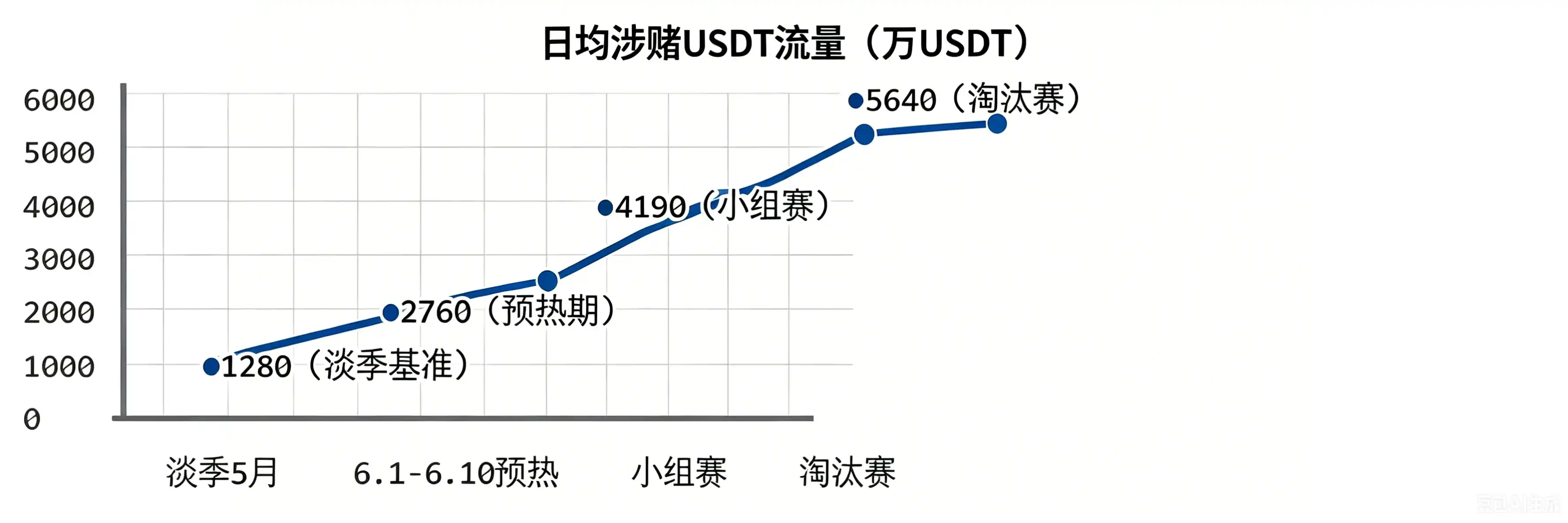
3. Significant Anomalies in USDT Traffic During the World Cup

According to observations from multiple on-chain security institutions:

• The frequency of USDT transfers during the World Cup period has increased significantly.

• Activity of gambling-related addresses has increased.

• The number of intermediary addresses has expanded rapidly.
Part 02 - At a Glance: The Complete On-Chain Fund Flow of USDT Online Gambling

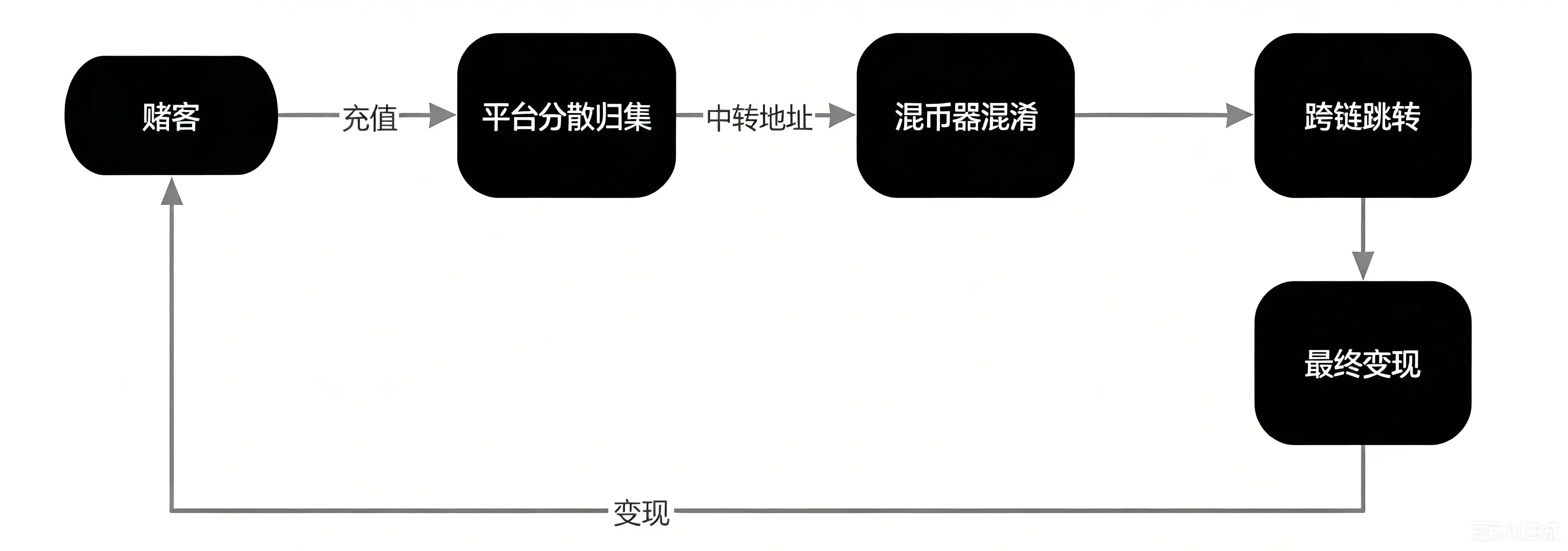
The capital flow in USDT online gambling is not a simple "gambler → platform → withdrawal" process but involves complex money laundering chains with multi-layered hops and cross-chain dispersion.

1. Gambler Deposit

The gambler sends USDT from their personal wallet to the deposit address provided by the platform. This address is often a one-time address generated by the platform to track the user's deposit. The transaction is usually recorded on the Tron or Ethereum network.
2. Platform Dispersed Aggregation

The platform does not concentrate all gambling funds in a single address but aggregates them through numerous scattered addresses. Each address receives small amounts of funds, which are then transferred out in a dispersed manner to evade detection by on-chain monitoring and risk control systems.

3. Intermediary Address Group

Funds are gathered from dispersed addresses into an intermediary address group. This stage is characterized by rapid inflows and outflows, with large sums briefly held—funds are quickly transferred out after entering, and the Gas fee payment patterns across addresses controlled by the same group are highly consistent, serving as a key clue for on-chain identification.

4. Mixer Obfuscation

Some funds enter mixers (like Tornado Cash), where multiple funds from different sources are mixed and then redistributed, disrupting the correlation of fund origins and increasing tracing difficulty.

5. Cross-Chain Hopping

Funds hop across multiple public chains via cross-chain bridges—for example, flowing from Polygon to Tron, then to Ethereum. This leverages the information silos between different blockchains to create a "broken chain illusion."

6. Final Cashing Out

Funds are funneled into exchange deposit addresses, exchanged for fiat currency to complete the money laundering. Notably, security monitoring platforms have found that World Cup-related crypto scam funds are moving from Polygon to Tron and directly into exchange deposit addresses—indicating that the entire money laundering chain is accelerating its closure.

Part 03 - Three Typical USDT Online Gambling Scams During the World Cup

Scams during the World Cup are not a "single model" but operate with a high degree of industrial sophistication.

1. "USDT Betting to Evade Regulation" Scam

Updated tactics:

• "Bet on-chain, no real-name verification needed"

• "Unregulated, high odds"

Nature:

👉Fake betting platform + backend manipulation of outcomes

2. Counterfeit Sports Betting Platforms (High-Replica Sites)

Characteristics:

• UI highly模仿s legitimate platforms

• Allows small withdrawals initially

• Directly freezes accounts later

Typical pattern:

👉"Let you win 100 USDT first, then make you lose 1000 USDT"

3. Inside Information Predictions / Guaranteed Win Plans

Tactics:

• "Internal data predictions"

• "AI analysis guarantees wins"

• "Match result manipulation models"

Nature:

👉Harvesting "information-anxious users"

Case: The "Gambling Network" Behind Promotion and Referral

Beyond scams directly targeting gamblers, online gambling groups are also deploying large-scale promotion and referral operations. During the World Cup, the "guaranteed profit recommendations," "inside score predictions," and "high-odds entry points" you scroll past on social media are often paid advertisements for gambling websites.

In June 2026, during the "Clean Internet—2026" campaign, the Yulin Public Security Cyberspace Department in Guangxi cracked a case involving World Cup online gambling promotion and referral. The suspects established a studio, posting a large number of gambling-related advertisements in graphic and video formats across multiple social media platforms, providing referral and operational services for gambling websites to profit illegally. They have since been criminally detained.

The police action illustrates: Online gambling promotion and referral are clearly illegal and subject to crackdowns. As ordinary users, encountering such ads—do not click, do not trust, do not share.

Part 04 - How to Identify USDT Gambling Addresses On-Chain?

From a security analysis perspective, abnormal fund flows can be identified through on-chain behavior:

1. Rapid In-and-Out Pattern

The most typical transaction feature of gambling addresses is rapid in-and-out—funds remain in an address for an extremely short time, rarely staying overnight; dispersed inflow, concentrated outflow—small amounts from different addresses converge, then are transferred out in a large sum; daily balance is essentially zero—funds do not settle in any address.

2. Abnormal Address Clustering

Clustering algorithms can reveal that many addresses interacting with the same gambling platform, while seemingly independent, show high consistency in transaction timing, amount distribution, and counterparty interactions, allowing them to be grouped as the same entity.

3. Gas Fee Consistency

Different addresses controlled by the same group show highly consistent Gas fee payment patterns—whether in Gas price selection, transaction time distribution, or Gas limit settings, they exhibit clear signs of "the same operator." This is known as a "behavioral fingerprint" in on-chain analysis.

4. High-Frequency Cross-Chain Hopping

Gambling funds frequently hop across different public chains—entering Polygon, exiting Tron, then moving to Ethereum. This cross-chain behavior itself is a significant risk indicator, especially when funds eventually converge into exchange deposit addresses, essentially locking in the cashing-out stage.

Part 05 - How Can Ordinary Users Identify and Prevent USDT Online Gambling Traps?

As an ordinary user, you don't need to become an on-chain detective, but the following points can help you avoid most traps:

✅Avoid Any Projects Involving "USDT Betting"

As soon as you see the following keywords:

• Stablecoin betting

• On-chain gambling

• Web3 prediction games

• High returns without real-name verification

👉Directly assess as high risk.

✅Be Wary of "Guaranteed Profit Models"

Any promises of:

• Guaranteed wins

• Inside information

• AI predictions ensuring victory

• High win-rate tips

👉Are standard tactics of gambling scams.

✅Don't Believe "Ability to Withdraw Small Profits"

The core logic of gambling scams:

Let you win first, then encourage you to increase your stake.

Platforms often allow small withdrawals initially to build trust. As users gradually increase their investments, the platform restricts withdrawals using excuses like account anomalies, deposit requirements, or withdrawal reviews, eventually absconding with the funds.

👉The ability to withdraw small amounts does not indicate platform safety.

✅Preserve On-Chain Evidence (Crucial)

If you have already transferred funds to a suspicious platform, be sure to immediately save:

• Transaction hash

• Wallet address

• Chat records

• Transfer screenshots

• Platform URL

While blockchain transactions are difficult to reverse, on-chain data is public and transparent. Complete evidence aids in subsequent fund tracking, risk analysis, and reporting to relevant authorities.

👉Upon discovering anomalies, stop transferring funds immediately and preserve evidence first.

Conclusion

USDT makes cross-border fund transfers extremely efficient but also endows illicit industries with unprecedented "liquidity capabilities." The World Cup is not just a sporting event; it is also becoming one of the most active periods for illicit fund flows on-chain.

From an on-chain perspective, the nature of such USDT online gambling is not complicated:

⚠️Using stablecoins as packaging, gambling as the entry point, and cross-chain transfers for laundering.

For ordinary users, the most effective protective measure is simply one statement:

⚠️Not participating in any form of on-chain gambling is the best risk isolation.

Cryptos en tendance

Questions liées

QWhy is USDT becoming the preferred 'chip' for illegal online gambling during the World Cup?

AUSDT has become the preferred choice for illegal online gambling during the World Cup due to three main reasons: 1. Its stability (pegged to the US dollar) solves the 'betting volatility anxiety' for users and platforms. 2. It allows for cross-border, near-instantaneous transfers without reliance on the traditional banking system and without the need for KYC, making transactions difficult to trace and irreversible. 3. There is a significant, observable increase in USDT transaction frequency and activity on gambling-related blockchain addresses during the World Cup period.

QWhat are the three typical scams related to USDT online gambling during the World Cup mentioned in the article?

AThe three typical USDT online gambling scams are: 1. The 'USDT betting to avoid regulation' scam, which uses promises of anonymity and high odds to lure users to fake platforms that manipulate results. 2. Fake sports betting platforms (high imitation sites) that mimic legitimate platforms, allow small withdrawals initially to build trust, and then freeze accounts after users deposit larger amounts. 3. 'Inside information / guaranteed win' schemes that claim to use internal data, AI analysis, or match-fixing models to predict outcomes, essentially preying on users' information anxiety.

QHow can ordinary users identify and prevent falling into USDT online gambling traps?

AOrdinary users can protect themselves by: 1. Avoiding any project involving 'USDT betting,' 'on-chain gambling,' 'Web3 guessing,' or promises of 'high returns without real-name verification.' 2. Being wary of any scheme promising guaranteed wins, inside information, AI-predicted victories, or high-win-rate tips. 3. Not being fooled by the ability to withdraw small profits initially, as this is a common tactic to build trust before scamming larger deposits. 4. Preserving on-chain evidence (transaction hash, wallet addresses, chat records, screenshots, website URLs) if they have already transferred funds to a suspicious platform.

QFrom a blockchain analysis perspective, what are the key characteristics for identifying addresses involved in USDT online gambling?

AKey on-chain characteristics for identifying USDT gambling addresses include: 1. A 'fast-in, fast-out' transaction pattern, where funds are received and sent out almost immediately without staying overnight. 2. Address clustering anomalies, where many seemingly independent addresses show highly consistent behavior patterns (transaction timing, amount distribution, counterparties). 3. Consistency in Gas fee payment patterns across different addresses controlled by the same entity, acting as a behavioral fingerprint. 4. High-frequency cross-chain jumps (e.g., Polygon to Tron to Ethereum), which is a significant risk signal, especially when funds ultimately flow into exchange deposit addresses.

QWhat is the complete fund flow path for USDT online gambling as described in the article?

AThe complete on-chain fund flow path for USDT online gambling is a multi-layered process: 1. Player Deposit: Users transfer USDT from their personal wallets to addresses provided by the gambling platform. 2. Platform Dispersed Collection: The platform collects funds into numerous分散 addresses to avoid detection. 3. Transit Address Groups: Funds are aggregated from分散 addresses into transit address groups, characterized by quick transfers and large amounts. 4. Mixer Obfuscation: Some funds enter mixers (e.g., Tornado Cash) to break the link between source and destination. 5. Cross-Chain Jumps: Funds are moved across different blockchains (e.g., Polygon to Tron to Ethereum) using cross-chain bridges to create disconnection. 6. Final Cash-Out: Funds are sent to exchange deposit addresses to be converted into fiat currency, completing the money laundering cycle.

Lectures associées

Quand des milliards de personnes s'habituent à tout contrôler par la voix, à quand la « mise en chaîne des actifs totaux » ?

En juin 2026, l’application chinoise WeChat a lancé en phase de test limitée son assistant IA natif, « Xiao Wei ». Cet événement, bien plus qu’un simple ajout fonctionnel, pourrait marquer un tournant dans la transition d’Internet d’un accès universel (« tous en ligne ») vers un paradigme où tous les actifs seraient numérisés et potentiellement enregistrés sur des chaînes de blocs (« tout sur la chaîne »). L'assistant, accessible via une icône en forme d'œil vert dans l'interface principale, utilise un modèle linguistique développé par WeChat (WeLM) et d'autres modèles pour des tâches complexes. Son potentiel se décline en plusieurs niveaux : contrôle natif par la voix (« dit-obtenu »), appel de services via des mini-programmes, compréhension de contenu et génération d'outils à partir du langage naturel. En intégrant un agent IA directement dans le super-application utilisé par des milliards de personnes, WeChat supprime les barrières d'accès et pourrait déclencher une adoption massive. Cette étape annonce le passage d'une interaction « personne-cherche-fonction » à une interaction « fonction-trouve-personne », où l'IA anticipe et exécute les besoins. À plus grande échelle, cela s'inscrit dans l'histoire de l'Internet chinois : la connexion universelle, puis la mise en ligne des services, et aujourd'hui, le potentiel de numérisation des actifs. Le concept de « tout sur la chaîne » dépasse les actifs traditionnels (immobilier, obligations) pour inclure toute valeur quantifiable : influence sociale, attention, crédit personnel. Les prévisions de croissance pour les actifs du monde réel tokenisés (RWA) sont colossales. La convergence d'agents IA omniprésents et d'actifs numérisés ouvre la voie à une nouvelle ère de gestion patrimoniale, où un assistant pourrait gérer automatiquement un portefeuille diversifié d'actifs sur chaîne. Ainsi, l'introduction discrète de « Xiao Wei » représente plus qu'une mise à niveau technique. C'est le signal d'une transition profonde où l'IA, en fluidifiant notre interaction avec le monde numérique, devient le catalyseur d'une reconfiguration radicale de la valeur et de la propriété dans l'ère numérique.

marsbitIl y a 8 mins

Quand des milliards de personnes s'habituent à tout contrôler par la voix, à quand la « mise en chaîne des actifs totaux » ?

marsbitIl y a 8 mins

Des groupes catholiques et de l'application de la loi mettent en garde contre la loi CLARITY qui pourrait affaiblir les garde-fous contre la criminalité liée aux crypto-actifs

Une coalition de dirigeants catholiques, de groupes liés à l'application de la loi et de défenseurs de la lutte contre la traite des êtres humains met en garde contre le projet de loi CLARITY Act. Ils estiment qu'il pourrait affaiblir les garde-fous utilisés pour lutter contre la criminalité facilitée par les crypto-monnaies. Leurs critiques portent principalement sur des dispositions qui protégeraient les développeurs de logiciels non-custodiaux d'être assimilés à des transmetteurs de fonds. Ce débat soulève une question centrale de la régulation des crypto-actifs : comment distinguer un logiciel neutre d'une intermédiation financière ? Les partisans des crypto-monnaies soutiennent que les développeurs publiant du code non-custodial ne devraient pas être régulés comme des plateformes d'échange. Les critiques, quant à eux, craignent que des exemptions trop larges ne rendent plus difficile le suivi des financements illicites. Le logiciel non-custodial est au cœur de la finance décentralisée (DeFi), permettant des transactions sans qu'une entreprise ne contrôle les fonds. Si cette architecture est un pilier de la valeur des crypto-actifs, elle pose aussi des défis pour les autorités lorsque des acteurs malveillants l'utilisent. L'opposition rencontrée par le CLARITY Act signifie que ses partisans devront répondre aux préoccupations concernant d'éventuelles lacunes favorisant la finance illicite. Cela pourrait conduire à des amendements, des protections plus limitées ou des obligations de déclaration supplémentaires. Pour l'industrie, l'enjeu est de taille : des règles plus claires pourraient stimuler les investissements, mais si le projet est perçu comme affaiblissant la lutte contre le crime, son adoption politique deviendra plus difficile.

bitcoinistIl y a 5 h

Des groupes catholiques et de l'application de la loi mettent en garde contre la loi CLARITY qui pourrait affaiblir les garde-fous contre la criminalité liée aux crypto-actifs

bitcoinistIl y a 5 h

Trading

Spot
Futures

Articles tendance

Comment acheter CHIP

Bienvenue sur HTX.com ! Nous vous permettons d'acheter USD.AI (CHIP) de manière simple et pratique. Suivez notre guide étape par étape pour commencer votre parcours crypto.Étape 1 : Création de votre compte HTXUtilisez votre adresse e-mail ou votre numéro de téléphone pour ouvrir un compte sur HTX gratuitement. L'inscription se fait en toute simplicité et débloque toutes les fonctionnalités.Créer mon compteÉtape 2 : Choix du mode de paiement (rubrique Acheter des cryptosCarte de crédit/débit : utilisez votre carte Visa ou Mastercard pour acheter instantanément USD.AI (CHIP).Solde :utilisez les fonds du solde de votre compte HTX pour trader en toute simplicité.Prestataire tiers :pour accroître la commodité d'utilisation, nous avons ajouté des modes de paiement populaires tels que Google Pay et Apple Pay.P2P :tradez directement avec d'autres utilisateurs sur HTX.OTC (de gré à gré) : nous offrons des services personnalisés et des taux de change compétitifs aux traders.Étape 3 : stockage de vos USD.AI (CHIP)Après avoir acheté vos USD.AI (CHIP), stockez-les sur votre compte HTX. Vous pouvez également les envoyer ailleurs via un transfert sur la blockchain ou les utiliser pour trader d'autres cryptos.Étape 4 : tradez des USD.AI (CHIP)Tradez facilement USD.AI (CHIP) sur le marché Spot de HTX. Il vous suffit d'accéder à votre compte, de sélectionner la paire de trading, d'exécuter vos trades et de les suivre en temps réel. Nous offrons une expérience conviviale aux débutants comme aux traders chevronnés.

373 vues totalesPublié le 2026.04.21Mis à jour le 2026.06.02

Comment acheter CHIP

Discussions

Bienvenue dans la Communauté HTX. Ici, vous pouvez vous tenir informé(e) des derniers développements de la plateforme et accéder à des analyses de marché professionnelles. Les opinions des utilisateurs sur le prix de CHIP (CHIP) sont présentées ci-dessous.

活动图片