Crossing the 'Memory Wall': The Wafer-Level Revolution and Computing Power Routes in the AI Inference Era

marsbitPublié le 2026-06-05Dernière mise à jour le 2026-06-05

Résumé

In 2026, a historic shift occurred in AI as major cloud providers' inference spending surpassed training spending for the first time, signaling a move from "building large models" to "using large models." This shifts the core challenge from computing power to the "memory wall"—the bottleneck of data movement (model weights, activations, KV Cache) between external DRAM and processors, where energy and latency from data transfer far exceed computation itself. Companies like Nvidia face GPU idle time due to bandwidth limits. In contrast, Cerebras Systems adopts a radical "wafer-scale" approach with its Wafer-Scale Engine (WSE). Instead of cutting a silicon wafer into many chips, Cerebras uses almost the entire wafer as one massive chip (WSE-3). This design provides 44GB of on-chip SRAM, delivering memory bandwidth thousands of times higher than traditional HBM (e.g., 21 PB/s vs. Nvidia B200). For LLM inference, weights are streamed layer-by-layer from external MemoryX storage to the chip, avoiding HBM bottlenecks. This results in token generation speeds 1.5–5 times faster than Nvidia's B200 in some models and significant advantages in first-token latency and long-context tasks. Additionally, Cerebras's architecture offers much lower interconnect power consumption (0.15 pJ/bit vs. GPU's ~10 pJ/bit). However, Cerebras faces challenges: SRAM scaling has slowed with advanced nodes, limiting future capacity gains; the chip requires specialized liquid cooling and custom software sta...

In 2026, the global development of AI reached a landmark inflection point—the capital expenditure on inference by hyperscale cloud vendors historically exceeded that on training for the first time. The industry's anchor shifted from 'training large models' to 'using large models,' fundamentally flipping the structure of computing demand.

In the training era, the core challenge of computing power was 'double-precision floating-point and cluster scale'; entering the inference era, the core challenge became 'memory bandwidth and communication latency.'

The bottleneck for large model inference is no longer merely computation, but data movement—model weights, intermediate activations, and KV Cache need frequent interaction between off-chip DRAM (like HBM) and GPUs. The larger the model, the higher the energy consumption and latency of data transfer, ultimately far exceeding the energy consumption of computation itself, thus forming the memory wall.

NVIDIA GPUs have built a solid fortress with CUDA and NVLink, but still cannot avoid GPU idling caused by bandwidth bottlenecks.

A domestic large model company, Zhipu, conducted a simple experiment: In a 512-card inference cluster, keeping the GPUs, model, and code unchanged, but only upgrading the network bandwidth cap from 200GB/s to 400GB/s, inference throughput directly increased by 10%, and first-token output latency decreased by 19%—the principle is simple: widen the road, and the cars can run faster.

However, non-GPU architectures represented by Cerebras seem to be tearing an opening in this memory wall.
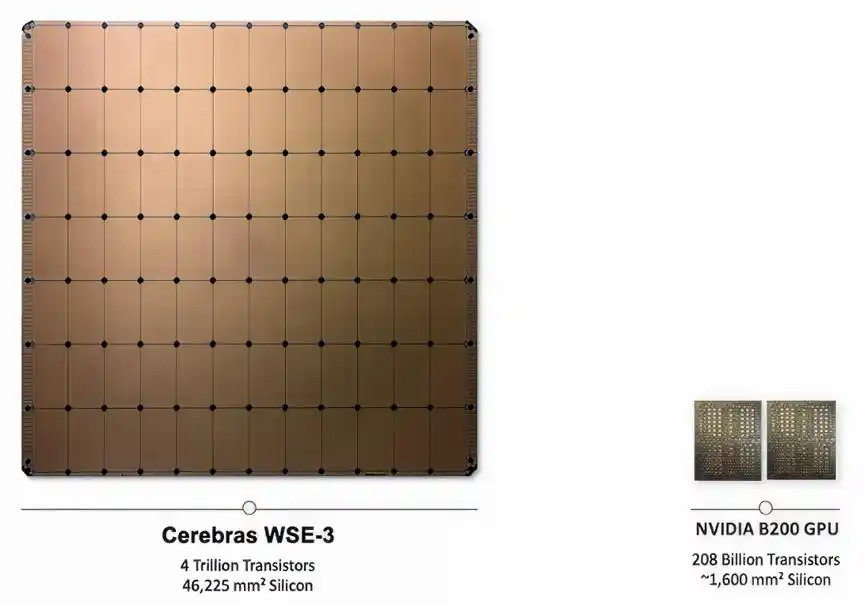
Size comparison between Cerebras WSE-3 chip and NVIDIA B200 GPU

The Essence of Cerebras: A Near-Memory Computer Based on SRAM

Cerebras Systems was founded in Silicon Valley by Andrew Feldman and others. The early founding team all came from SeaMicro, a low-power microserver company that was later acquired by AMD. Subsequently:

In 2015, the founding team established the 'wafer-scale computing' route.

In 2016, they completed registration and Series A financing, entering a stealth R&D phase.

In 2019, they released their first product, the WSE-1 chip and CS-1 system, based on TSMC's 16nm process.

In 2021, they released the second-generation product, based on TSMC's 7nm process.

In 2024, they released the third-generation product (WSE-3 / CS-3), based on TSMC's 5nm process. Both the chip and system are manufactured entirely in the USA, making it a genuinely pure US-made chip system.
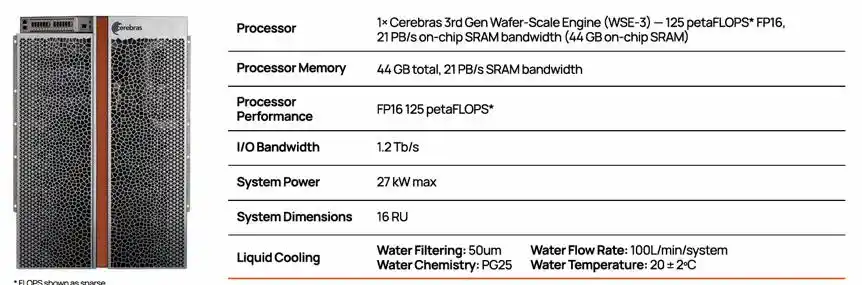
CS-3 system configuration, containing 1 WSE-3 chip

Cerebras's Wafer-Scale Engine (WSE) architecture philosophy is simple, direct, yet hits the pain point: trade extreme physical expansion for extreme compression of data movement latency.

Ordinary chips slice a wafer into many small chips; NVIDIA GPUs follow this approach. Cerebras does the opposite: don't slice, directly turn nearly the entire wafer into one giant chip, called the Wafer-Scale Engine (WSE).

Traditional chips are formed by cutting a 300mm diameter wafer into hundreds of small chips; Cerebras chooses to keep the entire wafer intact, using it directly as the whole chip. The latest WSE-3 boasts 4 trillion transistors, 900,000 AI cores, each equipped with 48KB of local SRAM, giving the entire chip 44GB of on-chip SRAM, providing 21 PB/s of on-chip memory bandwidth and 214 Pb/s of fabric bandwidth—thousands of times the bandwidth of traditional HBM.
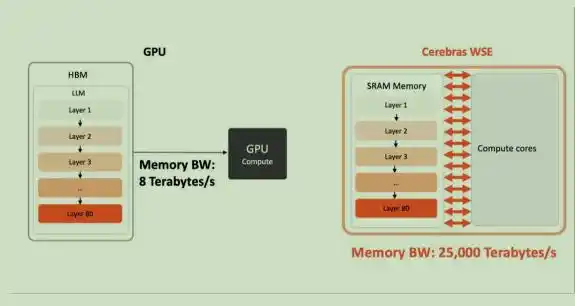
Cerebras WSE's memory bandwidth is 2625 times that of NVIDIA's B200 packaged chip, breaking the memory bandwidth bottleneck in large model inference scenarios.

In Cerebras's architecture, model weights are never stored on the SRAM but reside in off-chip storage (MemoryX) and are transferred layer by layer to the giant chip. The approach involves separating the storage of neural network model weights from the computing units.

All model weights are stored externally in the MemoryX memory extension module. The weights required for computing each layer of the network are transmitted layer by layer to the CS-3 system on demand. Weights are stored in the DRAM and flash memory of MemoryX and transmitted to the CS-3 system at full bandwidth rates. These weights are not stored in the CS-3 system—not even temporarily cached—CS-3 relies on the core's underlying dataflow mechanism to complete computations.

Leveraging its wafer-scale architecture, Cerebras demonstrates barrier-breaking advantages in LLM inference constrained by memory bandwidth. When generating tokens sequentially, weights are streamed layer by layer from off-chip MemoryX to CS-3. For different models, the token rate is 1.5 to 5 times that of NVIDIA's B200.
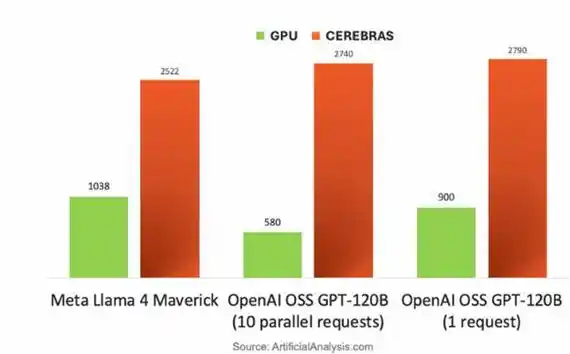
NVIDIA DGX B200 GPU versus Cerebras CS-3 chip, token rate comparison when running different large models

Its core advantage lies in: The 44GB of on-chip SRAM in CS-3 provides 21 PB/s of ultra-high bandwidth (2625 times that of B200) and 214 Pb/s of interconnect bandwidth, freeing weight streaming from HBM interface limitations. Therefore, it performs exceptionally well in TTFT (Time To First Token), long-context, and agent workload scenarios.

Although weights are external to MemoryX, loaded layer by layer on demand, and not cached on-chip, CS-3 relies on the core's dataflow mechanism to perform lossless full FP16 precision computations in SRAM; leveraging linear performance scaling, it also unleashes astonishing total throughput in multi-user concurrent inference.

Besides bandwidth, there is also a power advantage. Recently, in a speech, Sutong Liu, Chairman of InnoLight, mentioned that customers' requirement for optical modules is 1 pJ/bit, while the current level is 10 pJ/bit. In Cerebras chips, the interconnect power consumption is only 0.15 pJ/bit, whereas the current GPU interconnect power consumption is 10 pJ/bit.
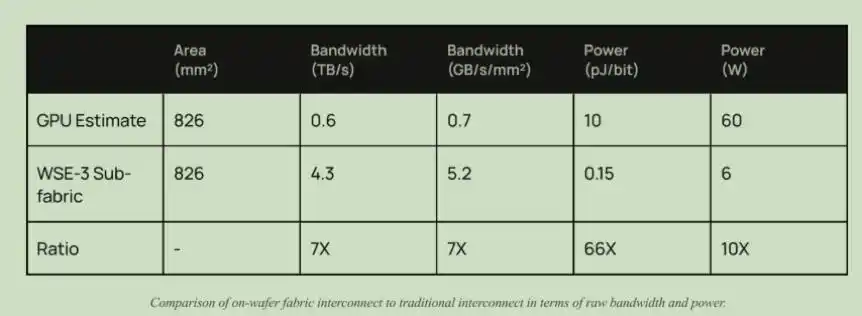
Bandwidth and power consumption comparison between Cerebras interconnect and GPU interconnect architectures

Thus, if Cerebras's wafer-scale large-chip architecture becomes mainstream for AI inference or even training, it might significantly suppress and structurally alter the shipment volumes of traditional optical modules and CPO (Co-Packaged Optics). The core logic is: the high demand for optical modules and CPO essentially aims to solve the bandwidth bottleneck of 'chip-to-chip interconnect' and 'node-to-node interconnect' in GPU clusters; Cerebras's architecture precisely solves the problem by 'eliminating distributed interconnects.'

Counterintuitive: The 'True and False' Fatal Flaws of Wafer-Scale Large Chips

The core of chips always lies in Trade-Off. To achieve extreme on-chip SRAM bandwidth, Cerebras also brings some issues.

Low Yield?

Quite the opposite. The size of a single AI core is reduced to 0.05 square millimeters (1% the size of a single H100 compute core), resulting in higher yield. By routing on-chip, defective cores can be disabled and bypassed, improving defect tolerance by 100 times compared to traditional multi-core processors. The chip actually has 1 million AI cores, but considering yield, it is advertised as having 900,000 AI cores.

Only Good at Inference, Not at Training?

In the years following Cerebras's founding, training was the mainstream topic, so the company focused heavily on training. It's only after inference demand surged that people realized its advantages in inference were more pronounced.

In reality, simplified distributed computing also brings advantages like reduced code complexity and lower communication overhead.

Training a 175-billion-parameter model on 4000 GPUs typically requires about 20,000 lines of distributed training code.

Cerebras achieves equivalent training with 565 lines of code—the entire model can be placed on the wafer without dealing with data parallelism complexity.

SRAM Scaling is Dead; Core Advantage Faces a Physical Ceiling.

The third-generation product is based on TSMC's 5nm, and its SRAM capacity only increased by 10% compared to the second-generation product based on TSMC's 7nm. Beyond 5nm, SRAM cell area hardly shrinks with process node advancement.

This means Cerebras can no longer significantly increase its core advantage (SRAM capacity) by upgrading TSMC's process nodes (e.g., from 5nm to 3nm) as it did before.

Limited by wafer size, cooling capability, and manufacturing costs, on-chip storage resources like SRAM are difficult to scale linearly with computing cores, encountering a resource ratio bottleneck. This almost blocks its evolutionary path.
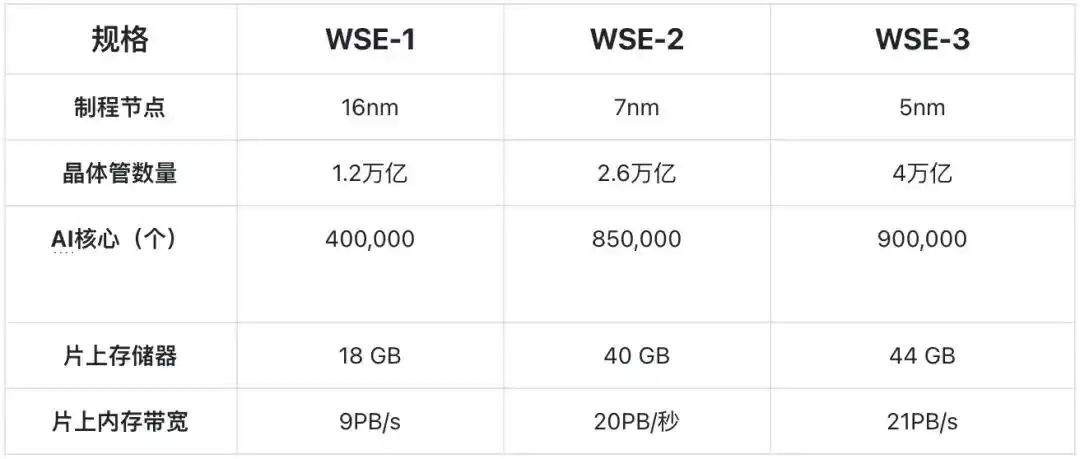
Technical specifications of Cerebras's three product generations

The Triple Purgatory: Cooling, Process, and Ecosystem.

The entire wafer concentrates heat, leading to high heat flux density, necessitating reliance on customized data centers and dedicated liquid cooling systems. Moreover, ecosystem compatibility means customers must adapt to its customized software stack, with weak compatibility with existing general-purpose programming frameworks like CUDA, leading to high software porting and adaptation costs.

Low Off-Chip Bandwidth Creates an Expansion 'Island'.

Due to the limitations of wafer-scale physical design, the number of I/O pins that can be led out from the edge of the WSE is extremely limited, resulting in an I/O bandwidth of only 150GB/s. Compared to NVIDIA NVLink's 1.8TB/s bi-directional bandwidth, it's like a snail. This makes it extremely difficult for WSE to scale out at high speeds. Although Cerebras's SwarmX interconnect performs decently in multi-system combinations, in the face of super-large models requiring high-speed multi-chip interconnection, the extremely low off-chip bandwidth becomes a structural physical shackle.

Route Competition: Big Tech In-House Development—How Much Window Does Cerebras Have Left?

Big tech companies have multiple parallel paths to address 'inference requiring higher bandwidth + lower latency,' not just wafer-scale. They are encircling and suppressing the technological dividends of startups like Cerebras through three concurrent approaches.

1 In-House ASIC Development

Google TPU v8 has already split into training-specific and inference-specific versions; AWS Trainium 4 is on the way; Microsoft Maia is already in use within Azure, built on TSMC's 3nm process, with native FP8/FP4 tensor cores, a redesigned memory system equipped with 216GB HBM3e, and 272MB on-chip SRAM; even Anthropic has begun evaluating in-house inference chip development.

This path is highly probable and will directly cause the TAM (Total Addressable Market) for 'third-party inference procurement' in 2028 to be compressed by 10% to 25%.

2 Process Generalization of the Standard Packaging Route

This is the most direct dimensional reduction attack on Cerebras.

TSMC's SoW (System-on-Wafer) is already widely open to customers, and CoWoS 9.5x interposer will launch in 2027.

What these two products do—stitching multiple dies at the wafer level—essentially makes Cerebras's physical process generic and accessible to all.

NVIDIA's Vera Rubin will enter this ecosystem in the second half of 2026.

Although Cerebras's own cross-reticle stitching is exclusive, the exclusivity window lasts at most 2 to 3 years. Beyond 2027-2028, its process barrier will be diluted by TSMC's advanced packaging.

3 Breakthrough of Optical Interconnect/Optical Computing

The interconnect and memory wall of electronic chips have reached their limits. Photonics' high bandwidth, low latency, and zero crosstalk are the ultimate solution.

Optical routes represented by Lumentum are rising. The biggest advantage of wafer-scale is on-chip computing, but models will inevitably grow larger, making high-speed interconnect beyond wafer scale a necessity.

With the maturity of CPO (Co-Packaged Optics) and Optical Interconnects, it's highly likely we will see optical I/O directly introduced into WSE wafers, breaking the shackles of electrical interconnect. NVIDIA might also acquire companies with specific architectural advantages like LPU (e.g., Groq), combine them with optical interconnects, and develop wafer-scale systems compatible with existing NV super-node software.

Sprinting on the Cliff: Cerebras's Business and Delivery

Cerebras is currently facing a cliff-edge sprint forced by massive orders.

Deals with leading clients like OpenAI are forcing Cerebras to transform from a chip company into a new type of cloud service provider. It no longer just sells hardware but needs to lock in and build massive data center power and facilities in the short term.

According to contract requirements, Cerebras needs to deliver 250MW of data center capacity annually from 2026 to 2028. However, wafer-scale systems have extremely high requirements for data center rooms and cannot be directly placed into traditional air-cooled IDCs. Currently, Cerebras's progress in preparing data center capacity is significantly behind the contract requirements.

From tape-out to factory construction, from power approval to cooling system deployment—this is a quagmire of heavy assets and long cycles.

Epilogue: Left or Right?

Returning to the initial proposition, as the inflection point for inference computing power has arrived, the core of computing architecture always lies in trade-offs.

There is no absolute right or wrong, only the relatively optimal solution for the most important workloads. And workloads are already changing.

Cerebras goes left, choosing extreme physical optimization, trading the entire wafer and massive SRAM for extreme low latency for a single task, which is unbeatable in scenarios extremely sensitive to first-token latency.

NVIDIA goes right, choosing to maintain generality, using HBM + NVLink + massive cluster throughput to handle ever-changing workloads, responding with constancy to change.

The winds are shifting, and the road ahead is uncertain. It is precisely this dual uncertainty of technology and business that breeds the possibility of disruption. In the torrent of computing power flowing towards AGI, it is still too early to draw conclusions—because of uncertainty, there is opportunity.

This article is from the WeChat public account "Garlic Particle Machine Research Institute," author: Pili Youxia (Thunderbolt Ranger)

Cryptos en tendance

Questions liées

QWhat is the key structural shift in the global AI industry in 2026, as identified in the article, and what does it signify?

AIn 2026, the global AI industry reached a pivotal inflection point where for the first time, capital expenditure on inference by hyperscale cloud providers surpassed that on training. This marks a fundamental shift in the focus of the industry from 'forging large models' to 'using large models', fundamentally flipping the structure of computing demand.

QWhat is the 'memory wall' in the context of large model inference, and how does Cerebras' WSE-3 architecture attempt to overcome it?

AIn large model inference, the 'memory wall' refers to the bottleneck caused by the energy consumption and latency of frequently moving data (model weights, intermediate activations, KV Cache) between off-chip DRAM (like HBM) and the GPU, which eventually far exceeds the energy cost of computation itself. Cerebras' WSE-3 architecture attacks this by using an entire wafer as a single, massive chip, packing 44GB of on-chip SRAM. This provides 21 PB/s of on-chip memory bandwidth, which is 2625 times the bandwidth of Nvidia's B200 GPU, drastically reducing data movement latency and breaking the memory bandwidth bottleneck for inference.

QAccording to the article, what are the three main parallel paths that major tech companies are taking to compete with specialized solutions like Cerebras?

AMajor tech companies are pursuing three parallel paths to address the need for higher bandwidth and lower latency in inference, thereby challenging specialized players: 1) Developing their own ASIC chips (e.g., Google TPU v8, AWS Trainium 4, Microsoft Maia). 2) Adopting standardized packaging processes like TSMC's SoW (System-on-Wafer) and CoWoS, which essentially democratize wafer-scale integration techniques. 3) Exploring breakthroughs in optical interconnects/computing (e.g., CPO, Optical Interconnects) to overcome the limits of electrical interconnects.

QWhat are the main potential weaknesses or challenges of the Cerebras wafer-scale chip (WSE) architecture, as outlined in the article?

AThe article highlights several challenges for Cerebras' wafer-scale architecture: 1) A physical scaling limit for SRAM, as SRAM cell area barely shrinks with process nodes beyond 5nm, blocking a key path for increasing its core advantage. 2) Significant thermal management challenges requiring specialized liquid-cooled data centers. 3) A weak software ecosystem and compatibility with existing frameworks like CUDA, leading to high adaptation costs. 4) Very low off-chip I/O bandwidth (150GB/s) compared to alternatives like NVLink, making the system a potential 'island' and hindering high-speed scaling for very large models.

QWhat critical business challenge is Cerebras currently facing due to large customer contracts, according to the article?

AFacing massive orders from leading customers like OpenAI, Cerebras is being forced into a 'cliff-side sprint' to transition from a chip company to a new type of cloud service provider. Its contracts reportedly require the delivery of 250MW of data center capacity annually from 2026 to 2028. However, building specialized data centers for its wafer-scale systems, which require unique power, cooling (liquid), and facility approvals, is a heavy-asset, long-cycle process where Cerebras' progress is already significantly lagging behind the contractual requirements.

Lectures associées

NVIDIA fait pression avec ses CPU, la Chine riposte avec RISC-V : Plongée approfondie dans les semi-conducteurs - Quatrième partie

Une information significative est apparue cette semaine : le CPU Vera de NVIDIA, conçu pour l'IA des centres de données, sera disponible pour les clients chinois dès août, à un prix unitaire dépassant 20 000 $. Face à cette arrivée, reposant toujours sur l'architecture Arm, la question se pose en Chine : existe-t-il une alternative autonome pour les CPU haute performance au-delà du duopole x86/Arm ? RISC-V émerge comme la réponse. Cette architecture ouverte, née il y a plus de dix ans, dépasse désormais le domaine de l'embarqué pour viser les serveurs et l'IA. Elle représente une opportunité de briser le "triangle impossible" de l'industrie (prospérité, contrôle, autonomie), offrant une voie potentiellement libre, contrôlée et florissante. La Chine devient un acteur central de cette poussée, motivée par la sécurité d'approvisionnement, la réduction des coûts, la souveraineté technologique et l'explosion de l'IA. Des équipes locales ont franchi le seuil symbolique des 15 points SPECint par GHz, signe d'entrée dans le club haute performance. Les progrès vont au-delà du simple cœur (core) pour englober des sous-systèmes complets : réseaux sur puce cohérents (NoC), gestion, fiabilité (RAS). Un processeur serveur 40 cœurs, 100% compatible avec le standard RVA23 (sans instructions personnalisées), illustre cette maturité croissante et cette priorité donnée à la compatibilité logicielle sur les performances artificielles. Cependant, les défis restent immenses. La fragmentation de l'écosystème due aux extensions personnalisées, l'immaturité des outils de développement (EDA) et de validation, les écarts de performance monocœur et d'efficacité énergétique par rapport aux architectures établies, ainsi que les contraintes liées aux procédés de fabrication avancés, constituent autant d'obstacles concrets. Le fossé logiciel, symbolisé par CUDA chez NVIDIA, est particulièrement profond. En résumé, la porte s'est ouverte pour RISC-V en Chine comme une alternative sérieuse et nécessaire à long terme. Le chemin est néanmoins long et semé d'épreuves techniques ardues. La course ne consiste pas à remplacer immédiatement des solutions comme le Vera de NVIDIA, mais à construire, pierre par pierre, une base autonome pour la prochaine révolution du calcul.

marsbitIl y a 3 h

NVIDIA fait pression avec ses CPU, la Chine riposte avec RISC-V : Plongée approfondie dans les semi-conducteurs - Quatrième partie

marsbitIl y a 3 h

Le tableau de paris codé a rapporté de l'argent, mais Polymarket n'est vraiment pas un bon endroit pour "l'arbitrage"

Dans son article, l'auteur partage son expérience de développement d'un tableau de bord personnalisé pour suivre et gérer ses paris sur Polymarket, une plateforme de prédiction. En utilisant cet outil avec un capital d'environ 1600 dollars, il a obtenu un rendement de plus de 30% sur une quinzaine de jours. Cependant, il insiste sur le fait que Polymarket n'est pas un lieu adapté pour des stratégies d'arbitrage traditionnelles. Le tableau de bord, divisé en un "Tableau de bord des positions" et une "Veille des opportunités", vise à visualiser les investissements, gérer les risques et suivre les marchés d'intérêt. L'outil intègre un système de contrôle des risques basé sur le fractionnement des paris en trois catégories (T1, T2, T3) selon le niveau de conviction et le risque, et limite l'exposition à certains thèmes pour éviter une "diversification illusoire". L'auteur met en garde contre les pièges des marchés binaires comme Polymarket. Il explique que même pour un pari perçu comme ayant une probabilité de réussite très élevée, le risque de perdre 100% du capital engagé existe toujours. Il souligne l'importance cruciale de la gestion de la taille des positions pour survivre à des erreurs de jugement inévitables à long terme. Il note également que de nombreux marchés, bien que distincts, peuvent être corrélés autour d'un même événement sous-jacent, amplifiant ainsi les risques. Son expérience l'amène à considérer Polymarket non pas comme une source de revenus stables, mais plutôt comme un terrain d'entraînement pour affiner son jugement sur l'actualité politique, économique et technologique. Il conclut que la valeur principale de son outil réside dans l'imposition d'une discipline et d'un cadre rigoureux, transformant l'intuition en processus contrôlé, bien plus que dans la performance affichée sur une période courte.

marsbitIl y a 7 h

Le tableau de paris codé a rapporté de l'argent, mais Polymarket n'est vraiment pas un bon endroit pour "l'arbitrage"

marsbitIl y a 7 h

Analyse de la croissance de Notion : D'un outil de prise de notes à 100 millions d'utilisateurs, comment Notion a construit sa triple roue de croissance via le produit, les modèles et la communauté

Notion est passé d'un outil de prise de notes à une plateforme de gestion des connaissances et de collaboration comptant 100 millions d'utilisateurs, grâce à un système de croissance à trois niveaux. La croissance a été principalement tirée par le produit (PLG) : sa structure modulaire offre une grande adaptabilité, sa stratégie gratuite a facilité l'adoption et ses fonctionnalités de partage et de collaboration ont généré une diffusion virale naturelle. Le deuxième moteur est l'économie des modèles. Face à la liberté parfois déroutante du produit, les modèles (officiels et créés par les utilisateurs) fournissent des solutions concrètes, réduisant les coûts d'activation pour les nouveaux venus et créant un canal de croissance via les moteurs de recherche. Ils ont également permis l'émergence d'une communauté de créateurs qui soutient l'écosystème. Le troisième moteur est la croissance communautaire. La communauté Notion va au-delà du support technique : elle produit des tutoriels, organise des événements locaux via des ambassadeurs et participe à la traduction culturelle du produit. Elle transforme les utilisateurs en éducateurs et en promoteurs, réduisant ainsi les coûts d'expansion mondiale. Le marketing de contenu de Notion se concentre sur l'éducation aux méthodes de travail plutôt que sur la vente de fonctionnalités. Son passage au marché professionnel s'est fait "par le bas", les équipes adoptant d'abord l'outil avant que les entreprises ne formalisent son usage. À l'ère de l'IA, Notion intègre ces capacités dans ses flux de travail existants, renforçant sa valeur et ouvrant la voie à une évolution potentielle vers un système d'exploitation du travail. La force durable de Notion réside dans cet écosystème difficile à répliquer : la combinaison d'un produit flexible, d'un vaste patrimoine de connaissances utilisateur, d'une économie de modèles dynamique et d'une communauté engagée crée un effet de levier et une fidélité qui vont bien au-delà de simples fonctionnalités logicielles.

marsbitIl y a 9 h

Analyse de la croissance de Notion : D'un outil de prise de notes à 100 millions d'utilisateurs, comment Notion a construit sa triple roue de croissance via le produit, les modèles et la communauté

marsbitIl y a 9 h

Trading

Spot
Futures

Articles tendance

Comment acheter ERA

Bienvenue sur HTX.com ! Nous vous permettons d'acheter Caldera (ERA) de manière simple et pratique. Suivez notre guide étape par étape pour commencer votre parcours crypto.Étape 1 : Création de votre compte HTXUtilisez votre adresse e-mail ou votre numéro de téléphone pour ouvrir un compte sur HTX gratuitement. L'inscription se fait en toute simplicité et débloque toutes les fonctionnalités.Créer mon compteÉtape 2 : Choix du mode de paiement (rubrique Acheter des cryptosCarte de crédit/débit : utilisez votre carte Visa ou Mastercard pour acheter instantanément Caldera (ERA).Solde :utilisez les fonds du solde de votre compte HTX pour trader en toute simplicité.Prestataire tiers :pour accroître la commodité d'utilisation, nous avons ajouté des modes de paiement populaires tels que Google Pay et Apple Pay.P2P :tradez directement avec d'autres utilisateurs sur HTX.OTC (de gré à gré) : nous offrons des services personnalisés et des taux de change compétitifs aux traders.Étape 3 : stockage de vos Caldera (ERA)Après avoir acheté vos Caldera (ERA), stockez-les sur votre compte HTX. Vous pouvez également les envoyer ailleurs via un transfert sur la blockchain ou les utiliser pour trader d'autres cryptos.Étape 4 : tradez des Caldera (ERA)Tradez facilement Caldera (ERA) sur le marché Spot de HTX. Il vous suffit d'accéder à votre compte, de sélectionner la paire de trading, d'exécuter vos trades et de les suivre en temps réel. Nous offrons une expérience conviviale aux débutants comme aux traders chevronnés.

569 vues totalesPublié le 2025.07.17Mis à jour le 2026.06.02

Comment acheter ERA

Discussions

Bienvenue dans la Communauté HTX. Ici, vous pouvez vous tenir informé(e) des derniers développements de la plateforme et accéder à des analyses de marché professionnelles. Les opinions des utilisateurs sur le prix de ERA (ERA) sont présentées ci-dessous.

活动图片