Crossing the 'Memory Wall': The Wafer-Level Revolution and Computing Power Routes in the AI Inference Era

marsbitPublié le 2026-06-05Dernière mise à jour le 2026-06-05

Résumé

In 2026, a historic shift occurred in AI as major cloud providers' inference spending surpassed training spending for the first time, signaling a move from "building large models" to "using large models." This shifts the core challenge from computing power to the "memory wall"—the bottleneck of data movement (model weights, activations, KV Cache) between external DRAM and processors, where energy and latency from data transfer far exceed computation itself. Companies like Nvidia face GPU idle time due to bandwidth limits. In contrast, Cerebras Systems adopts a radical "wafer-scale" approach with its Wafer-Scale Engine (WSE). Instead of cutting a silicon wafer into many chips, Cerebras uses almost the entire wafer as one massive chip (WSE-3). This design provides 44GB of on-chip SRAM, delivering memory bandwidth thousands of times higher than traditional HBM (e.g., 21 PB/s vs. Nvidia B200). For LLM inference, weights are streamed layer-by-layer from external MemoryX storage to the chip, avoiding HBM bottlenecks. This results in token generation speeds 1.5–5 times faster than Nvidia's B200 in some models and significant advantages in first-token latency and long-context tasks. Additionally, Cerebras's architecture offers much lower interconnect power consumption (0.15 pJ/bit vs. GPU's ~10 pJ/bit). However, Cerebras faces challenges: SRAM scaling has slowed with advanced nodes, limiting future capacity gains; the chip requires specialized liquid cooling and custom software sta...

In 2026, the global development of AI reached a landmark inflection point—the capital expenditure on inference by hyperscale cloud vendors historically exceeded that on training for the first time. The industry's anchor shifted from 'training large models' to 'using large models,' fundamentally flipping the structure of computing demand.

In the training era, the core challenge of computing power was 'double-precision floating-point and cluster scale'; entering the inference era, the core challenge became 'memory bandwidth and communication latency.'

The bottleneck for large model inference is no longer merely computation, but data movement—model weights, intermediate activations, and KV Cache need frequent interaction between off-chip DRAM (like HBM) and GPUs. The larger the model, the higher the energy consumption and latency of data transfer, ultimately far exceeding the energy consumption of computation itself, thus forming the memory wall.

NVIDIA GPUs have built a solid fortress with CUDA and NVLink, but still cannot avoid GPU idling caused by bandwidth bottlenecks.

A domestic large model company, Zhipu, conducted a simple experiment: In a 512-card inference cluster, keeping the GPUs, model, and code unchanged, but only upgrading the network bandwidth cap from 200GB/s to 400GB/s, inference throughput directly increased by 10%, and first-token output latency decreased by 19%—the principle is simple: widen the road, and the cars can run faster.

However, non-GPU architectures represented by Cerebras seem to be tearing an opening in this memory wall.
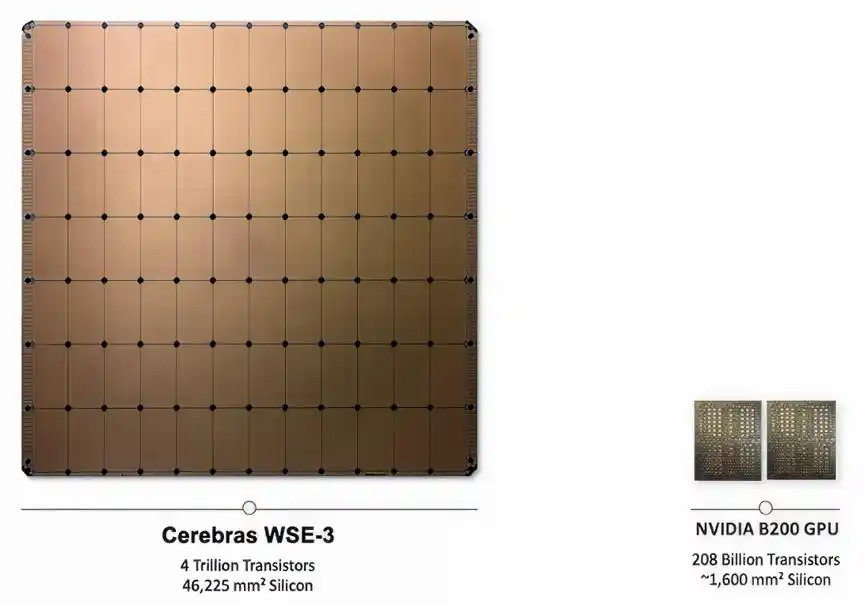
Size comparison between Cerebras WSE-3 chip and NVIDIA B200 GPU

The Essence of Cerebras: A Near-Memory Computer Based on SRAM

Cerebras Systems was founded in Silicon Valley by Andrew Feldman and others. The early founding team all came from SeaMicro, a low-power microserver company that was later acquired by AMD. Subsequently:

In 2015, the founding team established the 'wafer-scale computing' route.

In 2016, they completed registration and Series A financing, entering a stealth R&D phase.

In 2019, they released their first product, the WSE-1 chip and CS-1 system, based on TSMC's 16nm process.

In 2021, they released the second-generation product, based on TSMC's 7nm process.

In 2024, they released the third-generation product (WSE-3 / CS-3), based on TSMC's 5nm process. Both the chip and system are manufactured entirely in the USA, making it a genuinely pure US-made chip system.
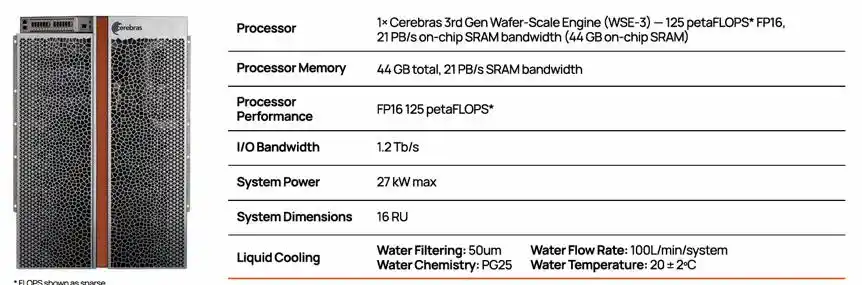
CS-3 system configuration, containing 1 WSE-3 chip

Cerebras's Wafer-Scale Engine (WSE) architecture philosophy is simple, direct, yet hits the pain point: trade extreme physical expansion for extreme compression of data movement latency.

Ordinary chips slice a wafer into many small chips; NVIDIA GPUs follow this approach. Cerebras does the opposite: don't slice, directly turn nearly the entire wafer into one giant chip, called the Wafer-Scale Engine (WSE).

Traditional chips are formed by cutting a 300mm diameter wafer into hundreds of small chips; Cerebras chooses to keep the entire wafer intact, using it directly as the whole chip. The latest WSE-3 boasts 4 trillion transistors, 900,000 AI cores, each equipped with 48KB of local SRAM, giving the entire chip 44GB of on-chip SRAM, providing 21 PB/s of on-chip memory bandwidth and 214 Pb/s of fabric bandwidth—thousands of times the bandwidth of traditional HBM.
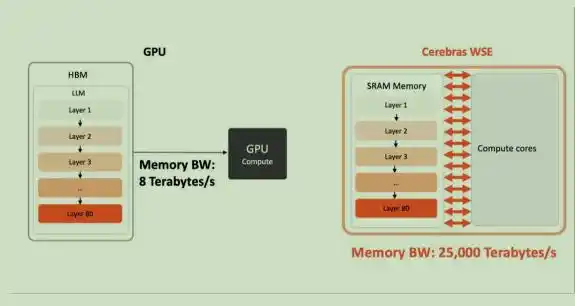
Cerebras WSE's memory bandwidth is 2625 times that of NVIDIA's B200 packaged chip, breaking the memory bandwidth bottleneck in large model inference scenarios.

In Cerebras's architecture, model weights are never stored on the SRAM but reside in off-chip storage (MemoryX) and are transferred layer by layer to the giant chip. The approach involves separating the storage of neural network model weights from the computing units.

All model weights are stored externally in the MemoryX memory extension module. The weights required for computing each layer of the network are transmitted layer by layer to the CS-3 system on demand. Weights are stored in the DRAM and flash memory of MemoryX and transmitted to the CS-3 system at full bandwidth rates. These weights are not stored in the CS-3 system—not even temporarily cached—CS-3 relies on the core's underlying dataflow mechanism to complete computations.

Leveraging its wafer-scale architecture, Cerebras demonstrates barrier-breaking advantages in LLM inference constrained by memory bandwidth. When generating tokens sequentially, weights are streamed layer by layer from off-chip MemoryX to CS-3. For different models, the token rate is 1.5 to 5 times that of NVIDIA's B200.
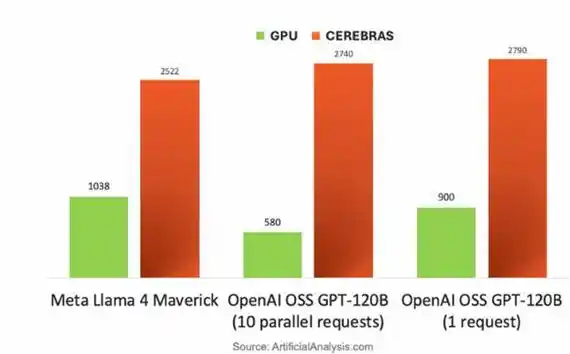
NVIDIA DGX B200 GPU versus Cerebras CS-3 chip, token rate comparison when running different large models

Its core advantage lies in: The 44GB of on-chip SRAM in CS-3 provides 21 PB/s of ultra-high bandwidth (2625 times that of B200) and 214 Pb/s of interconnect bandwidth, freeing weight streaming from HBM interface limitations. Therefore, it performs exceptionally well in TTFT (Time To First Token), long-context, and agent workload scenarios.

Although weights are external to MemoryX, loaded layer by layer on demand, and not cached on-chip, CS-3 relies on the core's dataflow mechanism to perform lossless full FP16 precision computations in SRAM; leveraging linear performance scaling, it also unleashes astonishing total throughput in multi-user concurrent inference.

Besides bandwidth, there is also a power advantage. Recently, in a speech, Sutong Liu, Chairman of InnoLight, mentioned that customers' requirement for optical modules is 1 pJ/bit, while the current level is 10 pJ/bit. In Cerebras chips, the interconnect power consumption is only 0.15 pJ/bit, whereas the current GPU interconnect power consumption is 10 pJ/bit.
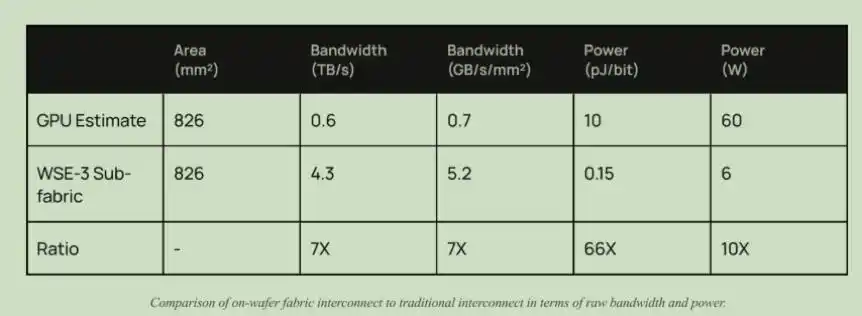
Bandwidth and power consumption comparison between Cerebras interconnect and GPU interconnect architectures

Thus, if Cerebras's wafer-scale large-chip architecture becomes mainstream for AI inference or even training, it might significantly suppress and structurally alter the shipment volumes of traditional optical modules and CPO (Co-Packaged Optics). The core logic is: the high demand for optical modules and CPO essentially aims to solve the bandwidth bottleneck of 'chip-to-chip interconnect' and 'node-to-node interconnect' in GPU clusters; Cerebras's architecture precisely solves the problem by 'eliminating distributed interconnects.'

Counterintuitive: The 'True and False' Fatal Flaws of Wafer-Scale Large Chips

The core of chips always lies in Trade-Off. To achieve extreme on-chip SRAM bandwidth, Cerebras also brings some issues.

Low Yield?

Quite the opposite. The size of a single AI core is reduced to 0.05 square millimeters (1% the size of a single H100 compute core), resulting in higher yield. By routing on-chip, defective cores can be disabled and bypassed, improving defect tolerance by 100 times compared to traditional multi-core processors. The chip actually has 1 million AI cores, but considering yield, it is advertised as having 900,000 AI cores.

Only Good at Inference, Not at Training?

In the years following Cerebras's founding, training was the mainstream topic, so the company focused heavily on training. It's only after inference demand surged that people realized its advantages in inference were more pronounced.

In reality, simplified distributed computing also brings advantages like reduced code complexity and lower communication overhead.

Training a 175-billion-parameter model on 4000 GPUs typically requires about 20,000 lines of distributed training code.

Cerebras achieves equivalent training with 565 lines of code—the entire model can be placed on the wafer without dealing with data parallelism complexity.

SRAM Scaling is Dead; Core Advantage Faces a Physical Ceiling.

The third-generation product is based on TSMC's 5nm, and its SRAM capacity only increased by 10% compared to the second-generation product based on TSMC's 7nm. Beyond 5nm, SRAM cell area hardly shrinks with process node advancement.

This means Cerebras can no longer significantly increase its core advantage (SRAM capacity) by upgrading TSMC's process nodes (e.g., from 5nm to 3nm) as it did before.

Limited by wafer size, cooling capability, and manufacturing costs, on-chip storage resources like SRAM are difficult to scale linearly with computing cores, encountering a resource ratio bottleneck. This almost blocks its evolutionary path.
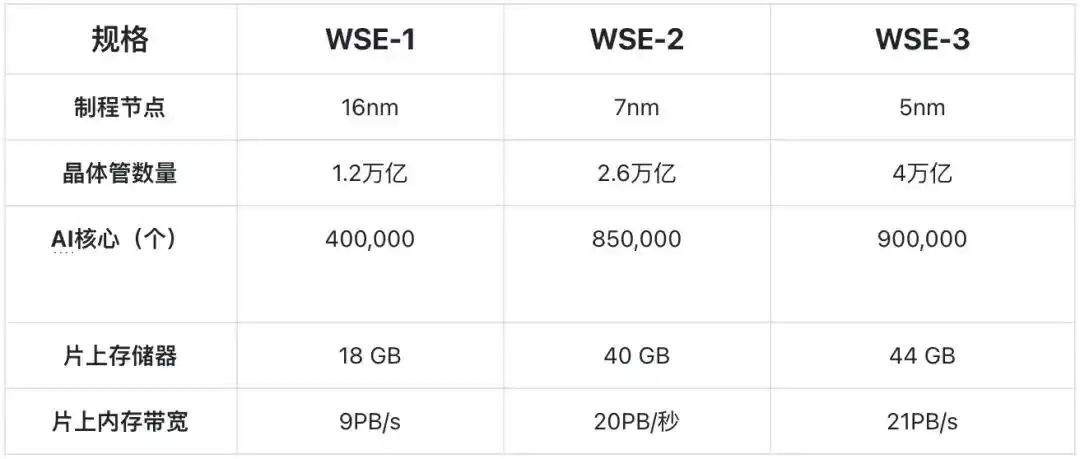
Technical specifications of Cerebras's three product generations

The Triple Purgatory: Cooling, Process, and Ecosystem.

The entire wafer concentrates heat, leading to high heat flux density, necessitating reliance on customized data centers and dedicated liquid cooling systems. Moreover, ecosystem compatibility means customers must adapt to its customized software stack, with weak compatibility with existing general-purpose programming frameworks like CUDA, leading to high software porting and adaptation costs.

Low Off-Chip Bandwidth Creates an Expansion 'Island'.

Due to the limitations of wafer-scale physical design, the number of I/O pins that can be led out from the edge of the WSE is extremely limited, resulting in an I/O bandwidth of only 150GB/s. Compared to NVIDIA NVLink's 1.8TB/s bi-directional bandwidth, it's like a snail. This makes it extremely difficult for WSE to scale out at high speeds. Although Cerebras's SwarmX interconnect performs decently in multi-system combinations, in the face of super-large models requiring high-speed multi-chip interconnection, the extremely low off-chip bandwidth becomes a structural physical shackle.

Route Competition: Big Tech In-House Development—How Much Window Does Cerebras Have Left?

Big tech companies have multiple parallel paths to address 'inference requiring higher bandwidth + lower latency,' not just wafer-scale. They are encircling and suppressing the technological dividends of startups like Cerebras through three concurrent approaches.

1 In-House ASIC Development

Google TPU v8 has already split into training-specific and inference-specific versions; AWS Trainium 4 is on the way; Microsoft Maia is already in use within Azure, built on TSMC's 3nm process, with native FP8/FP4 tensor cores, a redesigned memory system equipped with 216GB HBM3e, and 272MB on-chip SRAM; even Anthropic has begun evaluating in-house inference chip development.

This path is highly probable and will directly cause the TAM (Total Addressable Market) for 'third-party inference procurement' in 2028 to be compressed by 10% to 25%.

2 Process Generalization of the Standard Packaging Route

This is the most direct dimensional reduction attack on Cerebras.

TSMC's SoW (System-on-Wafer) is already widely open to customers, and CoWoS 9.5x interposer will launch in 2027.

What these two products do—stitching multiple dies at the wafer level—essentially makes Cerebras's physical process generic and accessible to all.

NVIDIA's Vera Rubin will enter this ecosystem in the second half of 2026.

Although Cerebras's own cross-reticle stitching is exclusive, the exclusivity window lasts at most 2 to 3 years. Beyond 2027-2028, its process barrier will be diluted by TSMC's advanced packaging.

3 Breakthrough of Optical Interconnect/Optical Computing

The interconnect and memory wall of electronic chips have reached their limits. Photonics' high bandwidth, low latency, and zero crosstalk are the ultimate solution.

Optical routes represented by Lumentum are rising. The biggest advantage of wafer-scale is on-chip computing, but models will inevitably grow larger, making high-speed interconnect beyond wafer scale a necessity.

With the maturity of CPO (Co-Packaged Optics) and Optical Interconnects, it's highly likely we will see optical I/O directly introduced into WSE wafers, breaking the shackles of electrical interconnect. NVIDIA might also acquire companies with specific architectural advantages like LPU (e.g., Groq), combine them with optical interconnects, and develop wafer-scale systems compatible with existing NV super-node software.

Sprinting on the Cliff: Cerebras's Business and Delivery

Cerebras is currently facing a cliff-edge sprint forced by massive orders.

Deals with leading clients like OpenAI are forcing Cerebras to transform from a chip company into a new type of cloud service provider. It no longer just sells hardware but needs to lock in and build massive data center power and facilities in the short term.

According to contract requirements, Cerebras needs to deliver 250MW of data center capacity annually from 2026 to 2028. However, wafer-scale systems have extremely high requirements for data center rooms and cannot be directly placed into traditional air-cooled IDCs. Currently, Cerebras's progress in preparing data center capacity is significantly behind the contract requirements.

From tape-out to factory construction, from power approval to cooling system deployment—this is a quagmire of heavy assets and long cycles.

Epilogue: Left or Right?

Returning to the initial proposition, as the inflection point for inference computing power has arrived, the core of computing architecture always lies in trade-offs.

There is no absolute right or wrong, only the relatively optimal solution for the most important workloads. And workloads are already changing.

Cerebras goes left, choosing extreme physical optimization, trading the entire wafer and massive SRAM for extreme low latency for a single task, which is unbeatable in scenarios extremely sensitive to first-token latency.

NVIDIA goes right, choosing to maintain generality, using HBM + NVLink + massive cluster throughput to handle ever-changing workloads, responding with constancy to change.

The winds are shifting, and the road ahead is uncertain. It is precisely this dual uncertainty of technology and business that breeds the possibility of disruption. In the torrent of computing power flowing towards AGI, it is still too early to draw conclusions—because of uncertainty, there is opportunity.

This article is from the WeChat public account "Garlic Particle Machine Research Institute," author: Pili Youxia (Thunderbolt Ranger)

Cryptos en tendance

Questions liées

QWhat is the key structural shift in the global AI industry in 2026, as identified in the article, and what does it signify?

AIn 2026, the global AI industry reached a pivotal inflection point where for the first time, capital expenditure on inference by hyperscale cloud providers surpassed that on training. This marks a fundamental shift in the focus of the industry from 'forging large models' to 'using large models', fundamentally flipping the structure of computing demand.

QWhat is the 'memory wall' in the context of large model inference, and how does Cerebras' WSE-3 architecture attempt to overcome it?

AIn large model inference, the 'memory wall' refers to the bottleneck caused by the energy consumption and latency of frequently moving data (model weights, intermediate activations, KV Cache) between off-chip DRAM (like HBM) and the GPU, which eventually far exceeds the energy cost of computation itself. Cerebras' WSE-3 architecture attacks this by using an entire wafer as a single, massive chip, packing 44GB of on-chip SRAM. This provides 21 PB/s of on-chip memory bandwidth, which is 2625 times the bandwidth of Nvidia's B200 GPU, drastically reducing data movement latency and breaking the memory bandwidth bottleneck for inference.

QAccording to the article, what are the three main parallel paths that major tech companies are taking to compete with specialized solutions like Cerebras?

AMajor tech companies are pursuing three parallel paths to address the need for higher bandwidth and lower latency in inference, thereby challenging specialized players: 1) Developing their own ASIC chips (e.g., Google TPU v8, AWS Trainium 4, Microsoft Maia). 2) Adopting standardized packaging processes like TSMC's SoW (System-on-Wafer) and CoWoS, which essentially democratize wafer-scale integration techniques. 3) Exploring breakthroughs in optical interconnects/computing (e.g., CPO, Optical Interconnects) to overcome the limits of electrical interconnects.

QWhat are the main potential weaknesses or challenges of the Cerebras wafer-scale chip (WSE) architecture, as outlined in the article?

AThe article highlights several challenges for Cerebras' wafer-scale architecture: 1) A physical scaling limit for SRAM, as SRAM cell area barely shrinks with process nodes beyond 5nm, blocking a key path for increasing its core advantage. 2) Significant thermal management challenges requiring specialized liquid-cooled data centers. 3) A weak software ecosystem and compatibility with existing frameworks like CUDA, leading to high adaptation costs. 4) Very low off-chip I/O bandwidth (150GB/s) compared to alternatives like NVLink, making the system a potential 'island' and hindering high-speed scaling for very large models.

QWhat critical business challenge is Cerebras currently facing due to large customer contracts, according to the article?

AFacing massive orders from leading customers like OpenAI, Cerebras is being forced into a 'cliff-side sprint' to transition from a chip company to a new type of cloud service provider. Its contracts reportedly require the delivery of 250MW of data center capacity annually from 2026 to 2028. However, building specialized data centers for its wafer-scale systems, which require unique power, cooling (liquid), and facility approvals, is a heavy-asset, long-cycle process where Cerebras' progress is already significantly lagging behind the contractual requirements.

Lectures associées

GPT conçoit GPT

OpenAI a dévoilé son premier puce, Jalapeño, destinée à l'inférence des grands modèles linguistiques. Ce mouvement ne vise pas principalement à concurrencer Nvidia, mais marque une étape stratégique où OpenAI cherche à maîtriser l'ensemble du processus de production de l'intelligence artificielle, des modèles aux puces, en passant par les centres de données et l'énergie. Alors que l'écart entre les modèles se réduit, le vrai fossé se creuse au niveau de la puissance de calcul, des coûts d'inférence et de l'efficacité système. Chaque jeton (Token) généré représente un coût, et OpenAI, avec ses produits à forte demande comme ChatGPT, supporte une « taxe de calcul » importante sur le matériel externe. Jalapeño est conçu pour réduire cette « taxe d'inférence » en optimisant les coûts opérationnels quotidiens. Un détail crucial est le cycle de conception de seulement neuf mois, accéléré par l'utilisation par OpenAI de ses propres modèles d'IA pour aider à concevoir et optimiser la puce. Cela crée un cycle vertueux : de meilleurs modèles conçoivent de meilleures puces, qui réduisent le coût d'exécution des modèles futurs, permettant plus d'utilisateurs et de données pour affiner les prochaines générations de puces. OpenAI ne cherche pas à devenir un fournisseur de matériel comme Nvidia. Son approche s'apparente plutôt à celle d'Apple : construire un écosystème fermé et intégré où les modèles, les produits (ChatGPT, API), les puces et les infrastructures sont optimisés conjointement pour contrôler l'ensemble de la chaîne de valeur de l'IA. À long terme, cela pourrait repositionner les entreprises de modèles en tant que joueurs majeurs de l'infrastructure IA, aux côtés des fournisseurs de matériel traditionnels.

marsbitIl y a 12 mins

GPT conçoit GPT

marsbitIl y a 12 mins

Le directeur exécutif intérimaire de l'Ethereum Foundation s'exprime : Quelle est notre mission ?

Le directeur exécutif intérimaire de l'Ethereum Foundation (EF) définit la mission de l'organisation : garantir qu'Ethereum reste une infrastructure véritablement sans autorisation, résistante à la censure, privée, sécurisée et ouverte, soutenant la coordination souveraine à grande échelle. L'EF n'existe pas pour sa propre importance, sa popularité ou pour soutenir des applications spécifiques. Son rôle central est d'éliminer les faiblesses et les risques d'extraction, de contrôle par des cartels ou des États, et de surveillance. Cela implique de renforcer toutes les couches : le protocole, l'accès, les utilisateurs et les institutions. L'EF mènera par l'exemple en adoptant les paiements en ETH. Les priorités clés incluent : * **Lutte contre le MEV nuisible** : Un enjeu central pour préserver la neutralité. L'EF se concentrera sur la réduction des barrières à la construction de blocs, la garantie de l'inclusion et l'exploration de solutions ouvertes pour le flux d'ordres. * **Confidentialité** : Essentielle pour éviter une plateforme de surveillance. La vie privée inconditionnelle doit précéder toute divulgation sélective. * **Staking** : Doit rester sans autorisation, privé et diversifié pour éviter la concentration des risques. * **Interfaces d'accès** : Doivent maximiser l'autonomie des utilisateurs, pas compromettre les valeurs fondamentales pour une adoption facile. L'EF vise aussi à saisir des opportunités comme faire d'Ethereum la première infrastructure anti-quantique, un "argent numérique" privé, une plateforme pour des agents IA souverains, et une base pour une extension scalable qui préserve l'autonomie. Concernant les départs récents, l'EF les traite avec respect et discrétion, sans commentaires publics sur les cas individuels. Elle gère également le spin-off de certaines activités. Le financement externe sera accordé uniquement si le travail est crucial, aligné sur la mission de l'EF, et ne crée pas de dépendances ou de risques d'appropriation indue. L'EF n'est pas neutre sur la direction d'Ethereum. Elle est engagée à construire un système de neutralité crédible et collaborera avec tous ceux qui partagent cet objectif fondamental.

marsbitIl y a 37 mins

Le directeur exécutif intérimaire de l'Ethereum Foundation s'exprime : Quelle est notre mission ?

marsbitIl y a 37 mins

La directrice exécutive intérimaire de l'Ethereum Foundation prend la parole : Quelle est notre mission ?

L'auteur, directeur exécutif conjoint par intérim de l'Ethereum Foundation (EF), définit la mission claire de l'EF : garantir qu'Ethereum reste une infrastructure véritablement sans permission et souveraine, résistante à la censure, libre, ouverte, privée et sécurisée. L'article souligne ce que l'EF n'est pas : elle ne cherche pas sa propre importance, à plaire aux spéculateurs ou à promouvoir chaque application. L'EF se concentre sur l'élimination des vulnérabilités. Elle doit renforcer Ethereum aux niveaux du protocole, de l'accès, de l'utilisateur et institutionnel. Les priorités incluent : migrer les salaires de l'EF vers l'ETH, lutter contre les MEV (Maximal Extractable Value) nuisibles pour préserver la neutralité, rendre la confidentialité par défaut essentielle, garantir un jalonnement (staking) sans permission et diversifié, et sécuriser les interfaces d'accès pour l'autonomie des utilisateurs. L'EF doit aussi saisir des opportunités : devenir la première infrastructure mondiale résistante aux attaques quantiques, créer une pile de protocole entièrement vérifiable et sans extraction de données, faire d'Ethereum une monnaie numérique privée et digne, soutenir les portefeuilles personnels avec agents IA, et permettre une adoption institutionnelle sans compromettre les valeurs fondamentales. Concernant les départs, l'EF traite les questions de personnel avec respect et discrétion, sans débats publics, reconnaissant le droit aux désaccords et aux forks. Enfin, l'EF rationalise ses activités. Certains travaux seront externalisés via des sociétés dérivées (spin-offs). Le financement externe sera accordé uniquement si le travail est crucial pour la mission de l'EF, réduit la dépendance et évite la capture, et non par convenance ou amitié. L'EF est résolue à soutenir les caractéristiques fondamentales d'Ethereum (CROP : sans permission, résistant à la censure, ouvert, privé) pour en faire une infrastructure neutre et durable.

链捕手Il y a 50 mins

La directrice exécutive intérimaire de l'Ethereum Foundation prend la parole : Quelle est notre mission ?

链捕手Il y a 50 mins

Dernière année de doctorat, un changement de direction mène à une offre d'OpenAI : mon parcours d'entretiens a été rempli de « surprises »

Yong Zheng-Xin, doctorant à l’Université Brown, annonce rejoindre OpenAI en tant qu’Astra Fellow pour se consacrer à la recherche sur la sécurité de l’IA (AI Safety). Après avoir changé de domaine de recherche en dernière année de thèse, passant des grands modèles multilingues à la sécurité de l’IA, il partage six observations surprenantes tirées de sa recherche d’emploi. Premièrement, seuls un ou deux articles de recherche ont réellement compté pour obtenir des entretiens. Deuxièmement, les processus de recrutement sont très variés, incluant parfois des tests pratiques, des design systems ou des mises en situation avec des agents IA. Troisièmement, les périodes d’essai rémunérées, parfois d’une semaine, sont de plus en plus courantes dans les startups d’IA. Quatrièmement, le timing est crucial sur le marché du travail actuel, les opportunités évoluant rapidement. Cinquièmement, les offres de conversion après un stage sont rares pour les postes de recherche. Enfin, de nombreux entretiens portent sur des compétences générales en IA plutôt que sur la spécialité du candidat, même pour des rôles en sécurité IA. Zheng-Xin souligne que cette expérience lui a permis de rejoindre OpenAI malgré son changement d’orientation tardif, démontrant qu’une expertise ciblée et une adaptation aux besoins des équipes peuvent ouvrir des portes, indépendamment du nombre de publications.

marsbitIl y a 1 h

Dernière année de doctorat, un changement de direction mène à une offre d'OpenAI : mon parcours d'entretiens a été rempli de « surprises »

marsbitIl y a 1 h

Trading

Spot
Futures

Articles tendance

Comment acheter ERA

Bienvenue sur HTX.com ! Nous vous permettons d'acheter Caldera (ERA) de manière simple et pratique. Suivez notre guide étape par étape pour commencer votre parcours crypto.Étape 1 : Création de votre compte HTXUtilisez votre adresse e-mail ou votre numéro de téléphone pour ouvrir un compte sur HTX gratuitement. L'inscription se fait en toute simplicité et débloque toutes les fonctionnalités.Créer mon compteÉtape 2 : Choix du mode de paiement (rubrique Acheter des cryptosCarte de crédit/débit : utilisez votre carte Visa ou Mastercard pour acheter instantanément Caldera (ERA).Solde :utilisez les fonds du solde de votre compte HTX pour trader en toute simplicité.Prestataire tiers :pour accroître la commodité d'utilisation, nous avons ajouté des modes de paiement populaires tels que Google Pay et Apple Pay.P2P :tradez directement avec d'autres utilisateurs sur HTX.OTC (de gré à gré) : nous offrons des services personnalisés et des taux de change compétitifs aux traders.Étape 3 : stockage de vos Caldera (ERA)Après avoir acheté vos Caldera (ERA), stockez-les sur votre compte HTX. Vous pouvez également les envoyer ailleurs via un transfert sur la blockchain ou les utiliser pour trader d'autres cryptos.Étape 4 : tradez des Caldera (ERA)Tradez facilement Caldera (ERA) sur le marché Spot de HTX. Il vous suffit d'accéder à votre compte, de sélectionner la paire de trading, d'exécuter vos trades et de les suivre en temps réel. Nous offrons une expérience conviviale aux débutants comme aux traders chevronnés.

620 vues totalesPublié le 2025.07.17Mis à jour le 2026.06.02

Comment acheter ERA

Discussions

Bienvenue dans la Communauté HTX. Ici, vous pouvez vous tenir informé(e) des derniers développements de la plateforme et accéder à des analyses de marché professionnelles. Les opinions des utilisateurs sur le prix de ERA (ERA) sont présentées ci-dessous.

活动图片