This Year's Graduates, Trapped in Countless 'Online Assessments'

marsbitPublié le 2026-08-20Dernière mise à jour le 2026-08-20

Résumé

This Year's Graduates, Trapped in Endless "Online Assessments" After years of standardized exams, new graduates face a new hurdle: a seemingly endless series of online evaluations to enter the job market. Over 60% of large and mid-sized companies now incorporate online tests into their campus recruitment, increasingly using AI for screening and even initial interviews. For graduates like Yang Liu, daily life revolves around practicing for these assessments—covering professional skills, aptitude tests (similar to civil service exams), and personality quizzes. The pressure is immense, with a record 12.22 million graduates in 2025 and fierce competition for limited positions. Even securing an internship often requires passing multiple rounds of tests, some involving complex tasks like producing full industry reports using specific AI tools. From an HR perspective, these rigorous screenings are a necessary tool to manage overwhelming application volumes and identify candidates with the right learning ability, logic, and resilience. Some insiders acknowledge the process also acts as a "compliance test" to filter for stable, adaptable candidates. However, many graduates feel the tests are often irrelevant to the actual job and serve merely as a bulk-filtering mechanism. This has spawned a grey market catering to graduate anxiety. Services range from selling leaked question banks and AI-powered cheating tools to high-priced "full-process tutoring" packages promising to secure of...

Entrance exams for junior high, high school, college, postgraduate studies... After countless exams, fresh graduates are finally ready to knock on the door of their ideal careers, only to find an endless array of assessments still waiting for them.

Relevant data shows that over 60% of large and medium-sized enterprises incorporate online written tests into their campus recruitment processes. Furthermore, with the widespread adoption of AI, most of these assessments no longer require HR personnel to grade them personally; AI directly screens the results, and even interviews can be conducted by AI.

Academic qualifications and internship experience are no longer the ticket to an interview; whether you can pass the aptitude tests, personality tests, and AI video interviews now determines if you have the qualification to be seen.

To cope with these assessments, many job seekers jokingly call themselves suffering from 'assessment anxiety' on social media. The prevailing belief is that most online tests are unrelated to the actual work of the position and are merely tools for companies to screen candidates en masse. But no one can avoid them.

For countless young people, the daily routine of job hunting has ultimately become an endless cycle of mass applications, practicing test questions, being a mere participant, getting eliminated, and applying again.

This issue of 'Micro-Story' will delve into the job seekers trapped by these assessments.

Here are their real stories:

Trapped in Endless Tests

Since submitting her graduation thesis in April, 25-year-old Yangliu has spent several hours every day practicing test questions, listening to lectures, reviewing answer strategies, and sometimes even recording videos of herself on her phone to check the effect.

Don't get it wrong—she is not preparing for civil service or graduate school entrance exams. Every set of questions she practices is for one thing only: dealing with the massive wave of online assessments for the upcoming autumn recruitment.

Every July and August is the core window period for autumn campus recruitment, also the time when job-seeking activity is most concentrated throughout the year.

Data shows that in 2025 alone, 12.22 million college graduates entered the job market. Over 31% of fresh graduates submitted more than 20 resumes in the initial stage of their job search, and 42% of previous-year graduates reported being invited by companies to take assessments after submitting their resumes.

Facing a massive influx of resumes, simple academic screening and initial resume filtering are no longer sufficient to meet companies' recruitment pace. Nowadays, not only state-owned enterprises, central enterprises, and leading internet giants but almost all large-scale enterprises have made online application (resume submission) and participating in written tests or assessments mandatory steps before interviews. Some companies have even started using AI interviews.
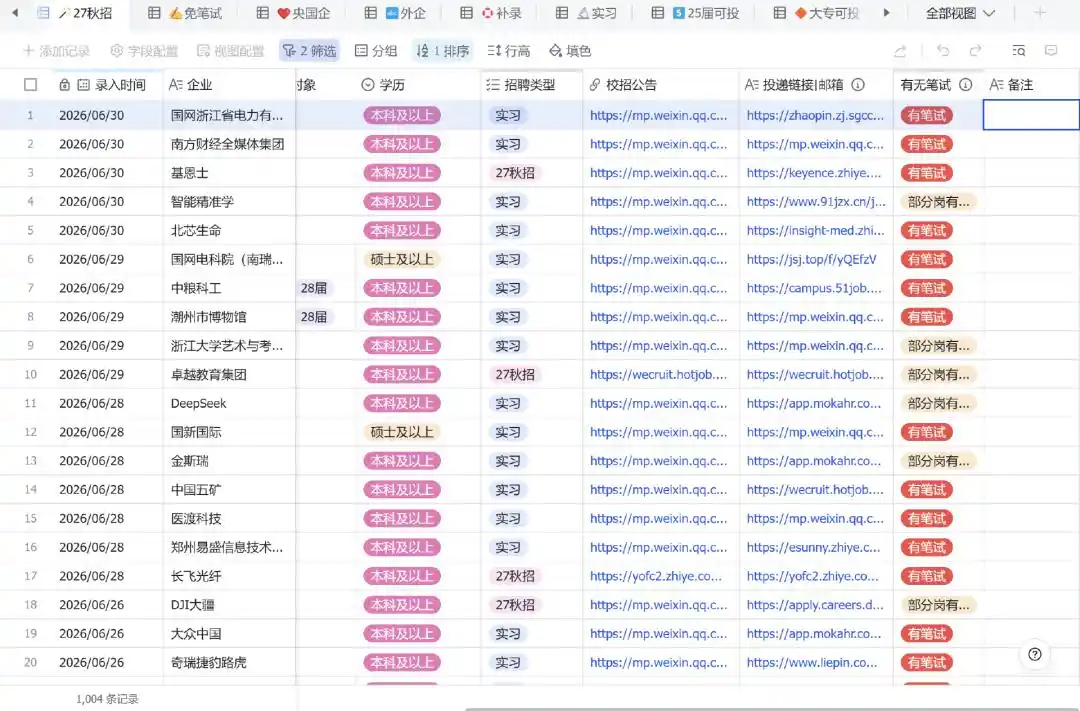
Image | Some companies explicitly mention a written test phase in related online autumn recruitment information

"AI interviews use algorithms to observe the candidate's body language and emotional changes, analyze their verbal logic, and finally, AI screens whether they proceed to the next stage," Yangliu explained. Some AI interviews are very strict; uncoordinated body movements or wandering eyes might be flagged as 'cheating.'

Besides AI interviews, written tests have also become more difficult than before. Some sections have time limits, and they might even suddenly ask you about specific details of certain company projects.

To improve her answer accuracy and efficiency, Yangliu had to prepare on multiple fronts—even though she graduated from a 211 university, her degree is not a significant advantage in the job market. "Without hardcore professional barriers, I can only rely on mass applications, taking many assessments, and trying widely, using quantity to exchange for probability."

Yangliu's senior used a similar strategy, applying to over 100 positions, taking more than 20 written tests, and finally finding a job. "This year, there are even more graduates, so the situation might be more severe," Yangliu said.

Currently, company written tests are mainly divided into three categories: position-specific professional ability tests, general aptitude tests similar to civil service exams, and personality tests used to screen for specific traits.
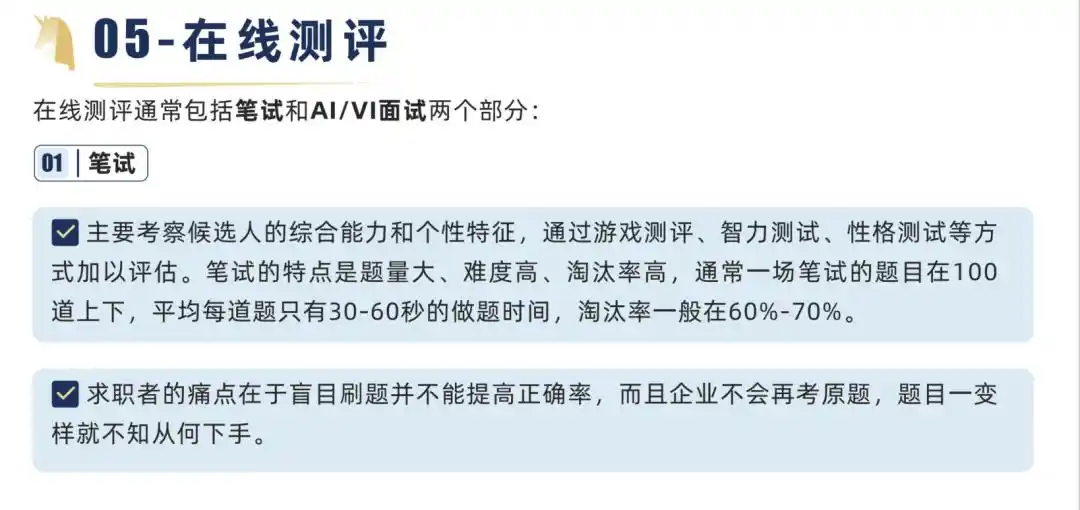
Image | Introduction to online assessments by a certain career service agency

These three question types are randomly combined with varying difficulty levels, so one can only rely on advance preparation as a safety net.

Her senior summarized a preparation formula: Professional questions are closely related to the business and are the most difficult; you can only accumulate problem-solving ideas by analyzing industry cases. Aptitude test questions have no shortcuts; only massive practice makes perfect. For personality tests, you cannot answer freely; you must simulate repeatedly to align with the workplace's core expectations for employee resilience, ambition, and stability.

In a way, this is also the job-seeking path for all current graduates: To not miss any opportunity, the vast majority of graduates choose to apply in bulk. The cost of mass applications is being swept along by countless online assessments.

Xu Wang, who just secured a summer internship offer, feels similarly. "Nowadays, even finding a summer internship requires participating in multiple assessments."

In the past two years, the number of internship positions in the market has shrunk by over 15%, while the number of applications has surged dramatically. The competition of 'many monks, little gruel' is intensifying.

To gain an advantage, starting in February this year, Xu Wang threw himself wholeheartedly into assessment preparation. By June, he had submitted over 120 applications, triggering 32 written test invitations.

After screening out some positions, Xu Wang took on 21 tests and ultimately secured 7 internship offers.

In contrast, Li Xin, an international student from the UK, was less fortunate. In the same timeframe, she submitted 15 internship applications, 12 triggered written assessments, and only 1 progressed to the interview stage.

"The written tests contain many obscure professional terms and comprehensive assessments that require long periods of thought," Li Xin said. The most mentally exhausting one required her to use a designated AI tool to answer continuously for three hours and independently complete a logically sound, data-rich, and comprehensive industry research report.

In the past, such tasks might only be undertaken independently by professionals with 3-5 years of experience. Now, they have become written test questions for newcomers.

Thinking they could escape over a decade of exam-driven competition after leaving school, they never expected that the first step into the workplace would be entering an even denser, harsher, and more inescapable cage of exams.

"Our generation seems to be born to be exam-taking tools," Li Xin often jokes.

"You Could Also See It as a Compliance Test"

Compared to school exams, pre-employment tests are more like a never-ending, answerless 'compliance test' that consumes you endlessly.

In one written test, Li Xin spent over two hours answering professional questions related to data maintenance and merchant operation optimization for a Key Account position at an internet company. However, the system wouldn't reveal her score or accuracy; she could only wait to see if anyone would notify her within two days.

After entering the interview, Li Xin was surprised to find that the interviewer didn't ask any business-related questions at all. All the questions revolved around her personal experience: "Your undergraduate internship experience isn't vertical enough. Why? Didn't you know what you wanted to do back then? How can I be sure you're passionate about this position?"

Towards the end of the interview, the HR representative was even more direct: "Aside from you being a local, I don't see any traits in your experience that fit this position."

Ultimately, Li Xin 'failed' the interview. The reason given was 'not a good match.'

This left Li Xin puzzled: "If they could tell I wasn't a good match for this position during the resume screening phase, why set up so many steps, keep me until the interview, and then tell me I'm not suitable?"

However, from the perspective of companies and HR, setting up these complex hurdles to challenge applicants is also a helpless move under the imbalance of market supply and demand.

Chen Chen, an HR professional with years of experience at a major internet company, explained that hiring fresh graduates carries higher risks than experienced hires. Most people's resumes are relatively simple and don't reveal their logical ability, learning ability, or resilience when facing actual work problems. Therefore, they can only screen through complex question design.

At the same time, the逐年暴涨 skyrocketing number of fresh graduates each year has infinitely lowered companies' tolerance for hiring mistakes. The number of graduates in 2026 is approximately 12.7 million, with graduates from top-tier 985 and 211 universities alone reaching the hundreds of thousands. In stark contrast, all the leading internet companies in China combined offer only about 25,000 summer internship positions per year.

Image | Scene from the 2026 Heilongjiang Talent Week

"This means that even if only one-third of the students from 985 and 211 schools intend to apply for internet summer internships, at least 300,000 people will be competing. Assuming each person applies for an average of 10 positions, that's 3 million resumes to process."

Chen Chen stated that without these assessment stages, companies simply wouldn't have a way to screen candidates in bulk.

Furthermore, with rising labor costs and the widespread adoption of AI, many companies themselves have entered an era of improving efficiency and tightening budgets. Even experienced employees face constant optimization and layoff risks, so companies are even more cautious about hiring new employees.

"We still hire fresh graduates now, but the graduates we bring in all have at least 2-3 internship experiences lasting around 3 months each, equivalent to the level of newcomers with 1-2 years of experience in the past," Chen Chen said.

This also means that pure newcomers are no longer welcome in the industry.

"Once we hire a newcomer who cannot quickly adapt or perform in the role, our recruitment department gets complaints from the business units and faces warnings or performance deductions," Chen Chen explained. To avoid recruitment risks and improve efficiency, companies can only continuously raise the hiring bar, increase the difficulty of written tests, and use high-intensity assessments to select the best from the best.

Therefore, Chen Chen doesn't deny the term 'compliance test.' "If you can't withstand these pre-employment tests during the job search, it will be very difficult to establish yourself in the future workplace. The written test itself is also a low-cost way to screen out potential hires who are more emotionally stable and compliant."

Moreover, for companies, compared to headhunting, written tests are relatively inexpensive.

"Having 200 people take a written test for one position costs less than half of what a headhunter charges. For the company, the written test is almost a zero-cost, zero-risk, high-return screening solution for newcomers."

As newcomers increase, positions decrease, and patience for training newcomers diminishes, the vicious cycle of assessment competition has become an unsolvable industry norm.

Struggling with All Their Might to 'Land' a Job

As pre-employment assessments become increasingly competitive, gray-market demands have also emerged. A commercialized gray industry chain, attached to job-seeking assessments and specifically serving fresh graduates' exam needs, has begun to permeate the entire graduation-season job market.

In major job-seeking communities and social media platforms, some people specifically compile and aggregate 'positions without written tests' lists. Such compilation posts are always traffic goldmines, instantly being saved, forwarded, and bookmarked by graduates upon release.
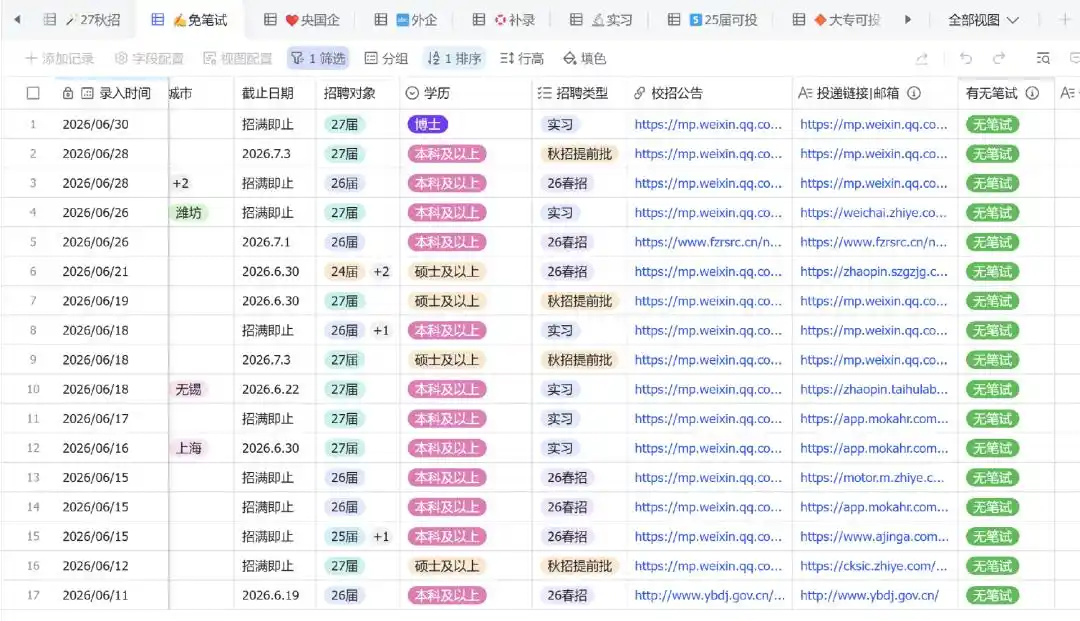
Image | In reality, the number of companies explicitly stating 'no written test' is extremely scarce in recruitment.

"Some people openly sell access to related positions at fixed prices," Chen Chen said, having seen people openly claim in their social media circles that they could secure state-owned enterprise jobs for a fee of 150,000 RMB. "But as things get stricter now, such things are mostly scams or only lead to outsourcing jobs."

Since the vast majority of job seekers can't avoid the written test stage, corresponding businesses have emerged: from test question banks and AI-powered answering services to guaranteed pass packages and full-process job-seeking guidance, each layer feeding on graduates' anxiety.

Li Xin tried buying a question bank.

When summer internship positions opened, she learned from friends that most companies' assessments rely on mainstream third-party platforms like Beisen, Zhiding, Niuke, and Saima—these platforms have fixed question banks, and the system randomly draws questions to form tests. Even though question types vary, the core test points and answering strategies are traceable.

"Taking the Beisen question bank as an example, I saw online that some say if you score below 50, your resume might be automatically filtered out and not reach the interview selection stage," Li Xin said. After learning this 'unspoken rule,' she felt particularly anxious and ultimately bought a set of Beisen assessment questions online for a low price of 4.9 RMB, claiming to be the 'most comprehensive on the entire internet.'
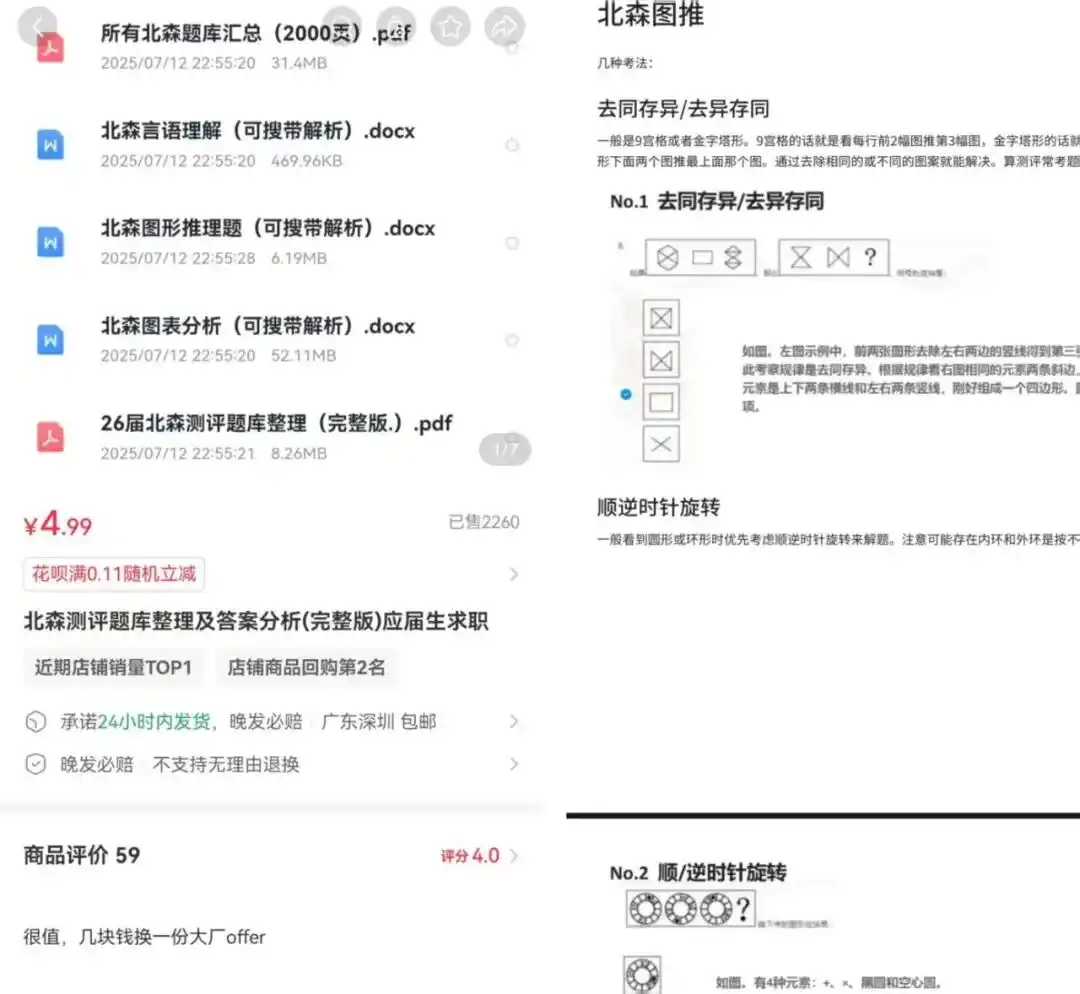
Image | Beisen question bank sold online

The question bank content is all-encompassing, covering past years' real questions, answering技巧 skills, standard answers for personality tests, and quick-solving思路 for aptitude tests. The purchase page showed that this document had already sold over 2,000 copies, meaning at least two thousand anxious graduates like her had clicked 'pay.'

Given mass applications, practicing questions is ultimately a笨办法消耗极大的体力消耗笨办法 that requires significant stamina. The autumn and spring recruitment windows are highly concentrated. A single student often submits hundreds of resumes and faces twenty or thirty assessments in succession. Aptitude tests, situational questions, and personality tests come one after another. No one has the energy to practice all the questions.

Many start taking risks, using AI to search for answers and cheat to提高通过率抬高通过率.

Image | The interviewer's system may display which candidates are suspected of cheating; in Chen Chen's words, he would directly screen out such candidates.

Fresh graduate Xu Wang is very familiar with these tactics—during summer internship recruitment, many of his classmates employed such methods.

"Each company's requirements are different," Xu Wang explained. Many中小企业的线上笔试中小企业的线上笔试 do not require enabling the camera or microphone; the entire test is done on a webpage, with supervision几乎形同虚设几乎形同虚设. Job seekers simply open AI tools, search for answers while answering, and can submit a logically complete答卷答卷 within a few dozen minutes.

Even when facing strict assessments with single-camera or dual-camera全程录像全程录像, the圈子圈子 had long prepared countermeasures: virtual machines, private browsers, device isolation—using technology to bypass system风控风控 and search for answers悄无声息悄无声息.

"There is a cost, though. If detected cheating, it might affect subsequent recruitment," Xu Wang said. Many of his competitors 'went under' this way.

Nevertheless, Chen Chen stated that every year, many job seekers still take the risk and cheat, betting on their luck.

"Even though there's a chance of being flagged for cheating, 'fortune favors the bold,'" some总结道总结道.

Practicing questions and自助作弊自助作弊 are just small-scale actions. To secure a stable and decent job, many middle-class families are willing to spend tens of thousands of RMB to sign up for '全程陪跑全程陪跑' services offered by career agencies.

"Every autumn and spring recruitment peak season, our business immediately booms," said Wang Weijia, who once worked at a career training institution, revealing the industry's引流套路引流套路. During recruitment seasons, a large number of accounts渲染就业焦虑渲染就业焦虑 appear online in batches, most of which are水军账号水军账号 operated by同行同行.

Online题库售卖帖题库售卖帖 and晒单帖晒单帖 are随处可见随处可见,帖子帖子 constantly渲染渲染 'successful上岸上岸 with coaching,' deliberately放大放大 graduates' job-seeking恐慌恐慌, all ultimately paving the way for引流引流 to高价付费业务高价付费业务.

Agencies charge based on company tiers. Guaranteed pass packages for written tests at internet giants, state-owned enterprises, and central enterprises are priced动不动上万动不动上万, "the highest can reach 36,800 RMB." Services bundled include内部内推内部内推, one-on-one远程协助答题远程协助答题, pre-exam真题梳理真题梳理, and even承诺承诺 'full refund if not passed' to打消打消 students' and parents'顾虑顾虑.
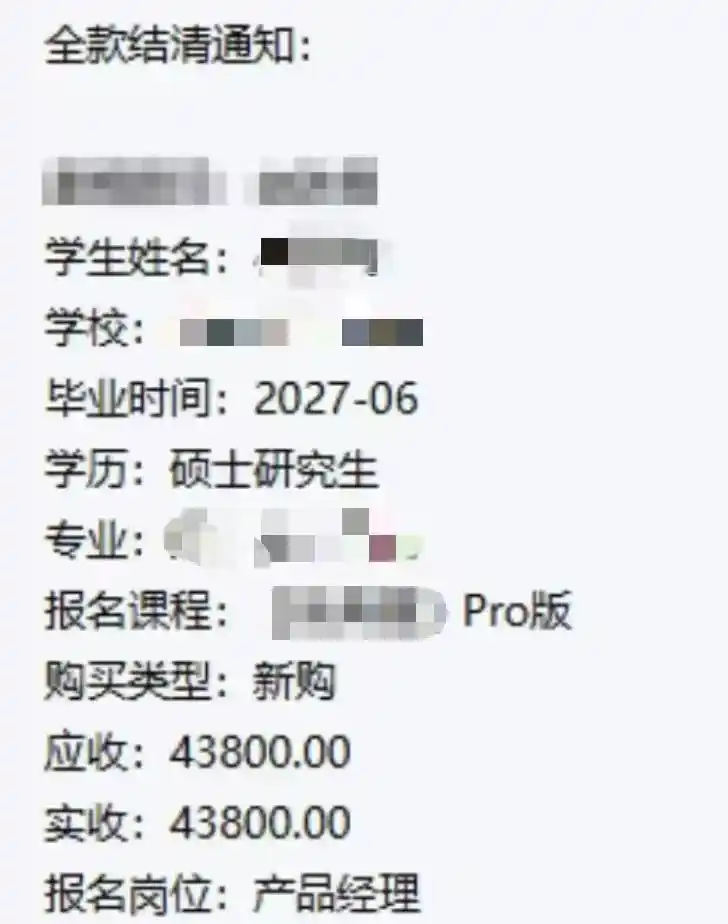
Image | A case shared by a career agency, claiming a student landed a Product Manager position at a major internet company through a 43,800 RMB全程陪跑全程陪跑 service.

Wang Weijia observed that the profile of those willing to pay a hefty price is very clear: middle-class families with decent financial means but no industry connections to help their children find jobs. "These parents lack the ability to pull strings for their children. Watching their children fail repeatedly at the written test stage, filled with anxiety, they would rather place a heavy bet just to secure a job entry ticket for their child."

Such衍生服务衍生服务 sell very well. The most popular 'background enhancement' costs around 10,000 RMB. "Simply put, it's paying to have your name listed on project rosters or purchasing short-term paid internships to包装包装 an impressive履历履历 and提高面试通过率提高面试通过率," Wang Weijia explained. Additionally,配套配套面试辅导面试辅导, career choice consultation are generally priced at 500 RMB per hour per subject, and many families are willing to pay this fee.
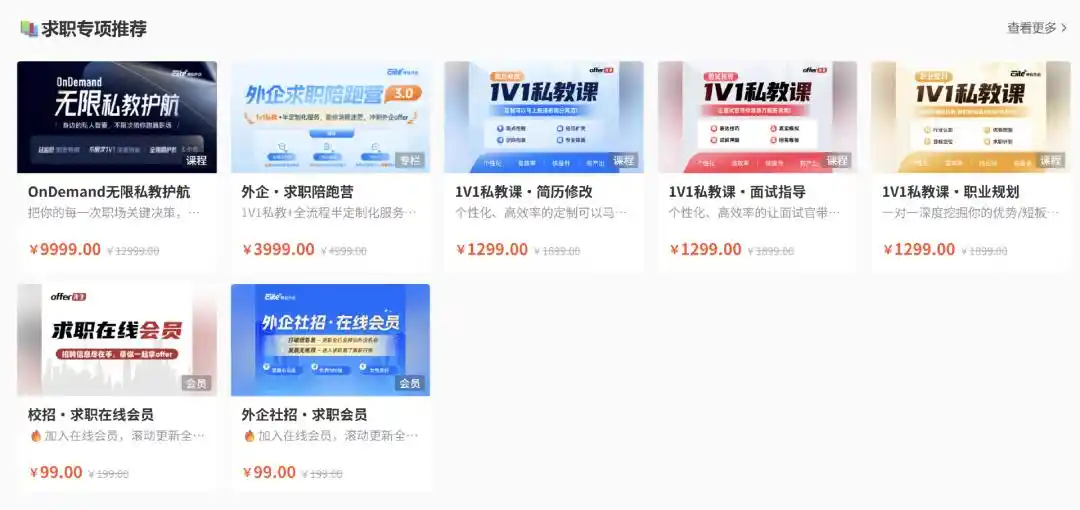
Image | Service pricing of a certain career agency

"Earlier, I found it hard to understand the concept of 'paying to work,' but after seeing more in recent years, I realized such businesses are booming year by year. Even requiring a deposit of several thousand RMB first, customers still keep coming," Wang Weijia感慨感慨.

On one side, companies continuously升级测评难度升级测评难度,抬高筛选门槛抬高筛选门槛, using rigorous assessments to筛选优质人才筛选优质人才,测试新人抗压能力测试新人抗压能力与服从性与服从性. On the other side, fresh graduates疯狂刷题疯狂刷题,付费买题付费买题,借助AI作弊借助AI作弊,购买保过服务购买保过服务, using every means to突破考核壁垒突破考核壁垒 to successfully 'land' a job.

No one wants to陷入无休止的应试内卷陷入无休止的应试内卷, and no one wants to依赖灰色手段求职依赖灰色手段求职. But in a job market with岗位稀缺岗位稀缺,竞争白热化竞争白热化, and淘汰无底线淘汰无底线, everyone is被大势裹挟被大势裹挟,只能被动挣扎只能被动挣扎,全力突围全力突围.

Changed Lives

The白热化白热化的求职考核与招聘节奏,一点一点地掰正了年轻人原本清晰的人生规划.

Yangliu originally had plans to pursue a Ph.D. Her teachers and seniors劝她冷静劝她冷静 time and again: nowadays, the threshold for academic positions in universities is越来越高越来越高, job prospects for humanities Ph.D. holders are狭窄狭窄, and emerging into the job market as a fresh graduate at thirty, with no work履历履历, would only make就业就业 even more被动被动.

After weighing her options several times, she temporarily搁置搁置 her academic理想理想 and plunged into the求职人海求职人海,开始了开始了 one笔试拉锯战笔试拉锯战 after another.

Li Xin originally planned to go to the United States for a one-year master's degree. But she carefully calculated the job-seeking节奏节奏: the one-year U.S. program is short, with graduation in June the following year. The graduation year刚好撞上刚好撞上 autumn recruitment. According to the current recruitment rule where companies lock in candidates a year in advance, she would have to仓促开启仓促开启 job search备战备战 even before setting foot on campus.

To争取喘息的余地争取喘息的余地, she临时改换赛道临时改换赛道, switching her target institutions to the UK. The UK system issues graduation certificates in December each year. Enrolling in 2025 would顺延划为顺延划为 the 2027 graduating class, finally giving herself an额外多出额外多出一整年的缓冲期缓冲期.

Li Xin has a friend who once满怀憧憬满怀憧憬,立志成为一名立志成为一名 free travel blogger. Faced with the现实现实 of连续多月投递无果连续多月投递无果, they最终妥协最终妥协, accepting an internet sales position. In the industry's求职履历求职履历, such positions are not considered优质经历优质经历 and might even become短板短板 for future job changes.

But they had no more挑选余地挑选余地, only hoping to尽快拿到尽快拿到 offer顺利上岸顺利上岸 and早日结束早日结束 the遥遥无期的等待遥遥无期的等待.

To this day, Li Xin still has零 offer零 offer and can only重整心态重整心态,备战备战 the even more竞争激烈的竞争激烈的 autumn recruitment.

She occasionally jokes about the闭环闭环 that has formed: "It's good. Graduates use AI to write theses, companies use AI for assessments, we use AI to search for answers, and then use AI to work after getting in. Everyone is魔法对轰魔法对轰."

This article is from the WeChat public account 'Micro-Story' (ID: xianweigushi), author: Micro-Story Editorial Department


Cryptos en tendance

Questions liées

QWhat are the three main types of written assessments that enterprises commonly use in their online recruitment process for graduates?

AThe three main types are: 1) Professional Competency Tests specific to the job position; 2) General Aptitude Tests similar to civil service exams; and 3) Personality Tests used to screen for specific traits.

QWhy do HR professionals from enterprises justify the use of increasingly complex and difficult online assessments in graduate recruitment?

AHR professionals justify the complex assessments due to a severe market imbalance where a massive number of graduates far exceeds the available job positions. These tests allow for efficient bulk screening. Additionally, they serve as a low-cost way to assess a candidate's logical thinking, learning ability, and pressure tolerance, acting as a form of 'compliance test' to find candidates who are more stable and adaptable.

QWhat 'gray industry' practices have emerged in response to the intense competition and prevalence of online assessments?

ASeveral gray industry practices have emerged, including: selling 'written test-free job position lists'; compiling and selling past question banks and answer keys for common testing platforms; using AI tools or technical methods to cheat during online exams; and offering expensive 'full-process job-seeking coaching' services from agencies, which may include paid internships for resume padding, guaranteed interview packages, and one-on-one tutoring.

QAccording to the article, how has the intense job-seeking process impacted the life plans of some graduates mentioned?

AThe intense process has significantly altered their plans. One student (Yang Liu) postponed her PhD aspirations to focus on job hunting. Another (Li Xin) switched her intended study destination from the US to the UK to better align her graduation timeline with the recruitment cycle. A friend of Li Xin's abandoned his dream of being a travel blogger and reluctantly accepted a sales job just to secure an offer.

QWhat is the core irony or 'closed loop' that the graduate Li Xin sarcastically points out regarding the use of AI in the education-to-employment pipeline?

ALi Xin sarcastically points out a 'closed loop' or irony where: graduates use AI to write their theses, enterprises use AI to screen candidates (through assessments and interviews), candidates use AI to search for answers during tests, and finally, once hired, they use AI to perform their jobs. It's a cycle of 'magic against magic' where AI is used at every stage, often to counteract or navigate systems also powered by AI.

Lectures associées

MemeCore arrive sur le Nasdaq grâce à une transaction historique du Trésor d'un milliard de dollars !

MemeCore annonce une transaction stratégique historique d'un milliard de dollars américains avec la société cotée au Nasdaq, ZeroStack Corp. Les entités principales de l'écosystème MemeCore, Puple AI Inc. et Blockcat Pte. Ltd., contribueront 925 925 926 jetons $M, d'une valeur de 1,08 $ chacun, en échange de 3 500 000 actions ordinaires de ZeroStack et de bons de souscription préfinancés pour acquérir jusqu'à 36 198 293 actions supplémentaires. Cette opération crée un pont stratégique entre l'écosystème MemeCore, axé sur la transformation de la culture meme en valeur économique durable via sa blockchain Layer 1, et les marchés publics. Elle vise à explorer des synergies avec la stratégie d'intelligence artificielle décentralisée de ZeroStack, élargissant ainsi les possibilités de collaboration dans les domaines des actifs numériques et des économies culturelles propulsées par la blockchain. Rudy Rong, un responsable de MemeCore nommé président de ZeroStack, souligne que cette relation va au-delà d'un simple investissement et représente une nouvelle étape pour connecter la culture meme aux marchés institutionnels. Daniel Reis-Faria, PDG de ZeroStack, y voit une étape déterminante pour son entreprise et l'industrie des actifs numériques. La transaction est soumise à l'approbation des actionnaires de ZeroStack conformément à la règle 5635 du Nasdaq, et les actions issues des bons seront soumises à une période de blocage pouvant aller jusqu'à dix ans.

TheNewsCryptoIl y a 17 mins

MemeCore arrive sur le Nasdaq grâce à une transaction historique du Trésor d'un milliard de dollars !

TheNewsCryptoIl y a 17 mins

Trading

Spot

Articles tendance

Qu'est ce que $S$

Comprendre SPERO : Un aperçu complet Introduction à SPERO Alors que le paysage de l'innovation continue d'évoluer, l'émergence des technologies web3 et des projets de cryptomonnaie joue un rôle central dans la façon dont se dessine l'avenir numérique. Un projet qui a attiré l'attention dans ce domaine dynamique est SPERO, désigné comme SPERO,$$s$. Cet article vise à rassembler et à présenter des informations détaillées sur SPERO, afin d'aider les passionnés et les investisseurs à comprendre ses fondations, ses objectifs et ses innovations dans les domaines du web3 et de la crypto. Qu'est-ce que SPERO,$$s$ ? SPERO,$$s$ est un projet unique dans l'espace crypto qui cherche à tirer parti des principes de décentralisation et de la technologie blockchain pour créer un écosystème qui favorise l'engagement, l'utilité et l'inclusion financière. Le projet est conçu pour faciliter les interactions entre pairs de nouvelles manières, offrant aux utilisateurs des solutions et des services financiers innovants. Au cœur de SPERO,$$s$, l'objectif est d'autonomiser les individus en fournissant des outils et des plateformes qui améliorent l'expérience utilisateur dans l'espace des cryptomonnaies. Cela inclut la possibilité de méthodes de transaction plus flexibles, la promotion d'initiatives dirigées par la communauté et la création de voies pour des opportunités financières via des applications décentralisées (dApps). La vision sous-jacente de SPERO,$$s$ tourne autour de l'inclusivité, visant à combler les lacunes au sein de la finance traditionnelle tout en exploitant les avantages de la technologie blockchain. Qui est le créateur de SPERO,$$s$ ? L'identité du créateur de SPERO,$$s$ reste quelque peu obscure, car il existe peu de ressources publiques fournissant des informations détaillées sur son ou ses fondateurs. Ce manque de transparence peut découler de l'engagement du projet envers la décentralisation—une éthique que de nombreux projets web3 partagent, privilégiant les contributions collectives plutôt que la reconnaissance individuelle. En centrant les discussions autour de la communauté et de ses objectifs collectifs, SPERO,$$s$ incarne l'essence de l'autonomisation sans désigner des individus spécifiques. Ainsi, comprendre l'éthique et la mission de SPERO reste plus important que d'identifier un créateur unique. Qui sont les investisseurs de SPERO,$$s$ ? SPERO,$$s$ est soutenu par une diversité d'investisseurs allant des capital-risqueurs aux investisseurs providentiels dédiés à favoriser l'innovation dans le secteur crypto. L'objectif de ces investisseurs s'aligne généralement avec la mission de SPERO—priorisant les projets qui promettent des avancées technologiques sociétales, l'inclusivité financière et la gouvernance décentralisée. Ces fondations d'investisseurs s'intéressent généralement à des projets qui non seulement offrent des produits innovants, mais qui contribuent également positivement à la communauté blockchain et à ses écosystèmes. Le soutien de ces investisseurs renforce SPERO,$$s$ en tant que concurrent notable dans le domaine en rapide évolution des projets crypto. Comment fonctionne SPERO,$$s$ ? SPERO,$$s$ utilise un cadre multifacette qui le distingue des projets de cryptomonnaie conventionnels. Voici quelques-unes des caractéristiques clés qui soulignent son unicité et son innovation : Gouvernance décentralisée : SPERO,$$s$ intègre des modèles de gouvernance décentralisée, permettant aux utilisateurs de participer activement aux processus de décision concernant l'avenir du projet. Cette approche favorise un sentiment de propriété et de responsabilité parmi les membres de la communauté. Utilité du token : SPERO,$$s$ utilise son propre token de cryptomonnaie, conçu pour servir diverses fonctions au sein de l'écosystème. Ces tokens permettent des transactions, des récompenses et la facilitation des services offerts sur la plateforme, améliorant ainsi l'engagement et l'utilité globaux. Architecture en couches : L'architecture technique de SPERO,$$s$ supporte la modularité et l'évolutivité, permettant une intégration fluide de fonctionnalités et d'applications supplémentaires à mesure que le projet évolue. Cette adaptabilité est primordiale pour maintenir la pertinence dans le paysage crypto en constante évolution. Engagement communautaire : Le projet met l'accent sur des initiatives dirigées par la communauté, utilisant des mécanismes qui incitent à la collaboration et aux retours d'expérience. En cultivant une communauté forte, SPERO,$$s$ peut mieux répondre aux besoins des utilisateurs et s'adapter aux tendances du marché. Accent sur l'inclusion : En proposant des frais de transaction bas et des interfaces conviviales, SPERO,$$s$ vise à attirer une base d'utilisateurs diversifiée, y compris des individus qui n'ont peut-être pas engagé auparavant dans l'espace crypto. Cet engagement envers l'inclusion s'aligne avec sa mission globale d'autonomisation par l'accessibilité. Chronologie de SPERO,$$s$ Comprendre l'histoire d'un projet fournit des aperçus cruciaux sur sa trajectoire de développement et ses jalons. Voici une chronologie suggérée cartographiant les événements significatifs dans l'évolution de SPERO,$$s$ : Phase de conceptualisation et d'idéation : Les idées initiales formant la base de SPERO,$$s$ ont été conçues, s'alignant étroitement avec les principes de décentralisation et de concentration sur la communauté au sein de l'industrie blockchain. Lancement du livre blanc du projet : Suite à la phase conceptuelle, un livre blanc complet détaillant la vision, les objectifs et l'infrastructure technologique de SPERO,$$s$ a été publié pour susciter l'intérêt et les retours de la communauté. Construction de la communauté et engagements précoces : Des efforts de sensibilisation actifs ont été entrepris pour construire une communauté d'adopteurs précoces et d'investisseurs potentiels, facilitant les discussions autour des objectifs du projet et recueillant du soutien. Événement de génération de tokens : SPERO,$$s$ a organisé un événement de génération de tokens (TGE) pour distribuer ses tokens natifs aux premiers soutiens et établir une liquidité initiale au sein de l'écosystème. Lancement de la première dApp : La première application décentralisée (dApp) associée à SPERO,$$s$ a été mise en ligne, permettant aux utilisateurs d'interagir avec les fonctionnalités principales de la plateforme. Développement continu et partenariats : Des mises à jour et des améliorations continues des offres du projet, y compris des partenariats stratégiques avec d'autres acteurs de l'espace blockchain, ont façonné SPERO,$$s$ en un acteur compétitif et évolutif sur le marché crypto. Conclusion SPERO,$$s$ se dresse comme un témoignage du potentiel du web3 et de la cryptomonnaie pour révolutionner les systèmes financiers et autonomiser les individus. Avec un engagement envers la gouvernance décentralisée, l'engagement communautaire et des fonctionnalités conçues de manière innovante, il ouvre la voie vers un paysage financier plus inclusif. Comme pour tout investissement dans l'espace crypto en rapide évolution, les investisseurs et utilisateurs potentiels sont encouragés à mener des recherches approfondies et à s'engager de manière réfléchie avec les développements en cours au sein de SPERO,$$s$. Le projet illustre l'esprit d'innovation de l'industrie crypto, invitant à une exploration plus approfondie de ses nombreuses possibilités. Bien que le parcours de SPERO,$$s$ soit encore en cours, ses principes fondamentaux pourraient en effet influencer l'avenir de nos interactions avec la technologie, la finance et entre nous dans des écosystèmes numériques interconnectés.

379 vues totalesPublié le 2024.12.17Mis à jour le 2024.12.17

Qu'est ce que $S$

Qu'est ce que AGENT S

Agent S : L'avenir de l'interaction autonome dans Web3 Introduction Dans le paysage en constante évolution de Web3 et des cryptomonnaies, les innovations redéfinissent constamment la manière dont les individus interagissent avec les plateformes numériques. Un projet pionnier, Agent S, promet de révolutionner l'interaction homme-machine grâce à son cadre agentique ouvert. En ouvrant la voie à des interactions autonomes, Agent S vise à simplifier des tâches complexes, offrant des applications transformantes dans l'intelligence artificielle (IA). Cette exploration détaillée plongera dans les subtilités du projet, ses caractéristiques uniques et les implications pour le domaine des cryptomonnaies. Qu'est-ce qu'Agent S ? Agent S se présente comme un cadre agentique ouvert révolutionnaire, spécifiquement conçu pour relever trois défis fondamentaux dans l'automatisation des tâches informatiques : Acquisition de connaissances spécifiques au domaine : Le cadre apprend intelligemment à partir de diverses sources de connaissances externes et d'expériences internes. Cette approche double lui permet de construire un riche répertoire de connaissances spécifiques au domaine, améliorant ainsi sa performance dans l'exécution des tâches. Planification sur de longs horizons de tâches : Agent S utilise une planification hiérarchique augmentée par l'expérience, une approche stratégique qui facilite la décomposition et l'exécution efficaces de tâches complexes. Cette fonctionnalité améliore considérablement sa capacité à gérer plusieurs sous-tâches de manière efficace et efficiente. Gestion d'interfaces dynamiques et non uniformes : Le projet introduit l'Interface Agent-Ordinateur (ACI), une solution innovante qui améliore l'interaction entre les agents et les utilisateurs. En utilisant des Modèles de Langage Multimodaux de Grande Taille (MLLMs), Agent S peut naviguer et manipuler sans effort diverses interfaces graphiques. Grâce à ces fonctionnalités pionnières, Agent S fournit un cadre robuste qui aborde les complexités impliquées dans l'automatisation de l'interaction humaine avec les machines, préparant le terrain pour d'innombrables applications en IA et au-delà. Qui est le créateur d'Agent S ? Bien que le concept d'Agent S soit fondamentalement innovant, des informations spécifiques sur son créateur restent insaisissables. Le créateur est actuellement inconnu, ce qui souligne soit le stade naissant du projet, soit le choix stratégique de garder les membres fondateurs sous le radar. Quoi qu'il en soit, l'accent reste mis sur les capacités et le potentiel du cadre. Qui sont les investisseurs d'Agent S ? Étant donné qu'Agent S est relativement nouveau dans l'écosystème cryptographique, des informations détaillées concernant ses investisseurs et soutiens financiers ne sont pas explicitement documentées. Le manque d'aperçus publiquement disponibles sur les fondations d'investissement ou les organisations soutenant le projet soulève des questions sur sa structure de financement et sa feuille de route de développement. Comprendre le soutien est crucial pour évaluer la durabilité du projet et son impact potentiel sur le marché. Comment fonctionne Agent S ? Au cœur d'Agent S se trouve une technologie de pointe qui lui permet de fonctionner efficacement dans divers environnements. Son modèle opérationnel est construit autour de plusieurs caractéristiques clés : Interaction homme-ordinateur semblable à l'humain : Le cadre offre une planification IA avancée, s'efforçant de rendre les interactions avec les ordinateurs plus intuitives. En imitant le comportement humain dans l'exécution des tâches, il promet d'élever l'expérience utilisateur. Mémoire narrative : Utilisée pour tirer parti des expériences de haut niveau, Agent S utilise la mémoire narrative pour suivre les historiques de tâches, améliorant ainsi ses processus de prise de décision. Mémoire épisodique : Cette fonctionnalité fournit aux utilisateurs un accompagnement étape par étape, permettant au cadre d'offrir un soutien contextuel au fur et à mesure que les tâches se déroulent. Support pour OpenACI : Avec la capacité de fonctionner localement, Agent S permet aux utilisateurs de garder le contrôle sur leurs interactions et flux de travail, s'alignant avec l'éthique décentralisée de Web3. Intégration facile avec des API externes : Sa polyvalence et sa compatibilité avec diverses plateformes IA garantissent qu'Agent S peut s'intégrer sans effort dans des écosystèmes technologiques existants, en faisant un choix attrayant pour les développeurs et les organisations. Ces fonctionnalités contribuent collectivement à la position unique d'Agent S dans l'espace crypto, alors qu'il automatise des tâches complexes en plusieurs étapes avec un minimum d'intervention humaine. À mesure que le projet évolue, ses applications potentielles dans Web3 pourraient redéfinir la manière dont les interactions numériques se déroulent. Chronologie d'Agent S Le développement et les jalons d'Agent S peuvent être encapsulés dans une chronologie qui met en évidence ses événements significatifs : 27 septembre 2024 : Le concept d'Agent S a été lancé dans un document de recherche complet intitulé “Un cadre agentique ouvert qui utilise les ordinateurs comme un humain”, présentant les bases du projet. 10 octobre 2024 : Le document de recherche a été rendu publiquement disponible sur arXiv, offrant une exploration approfondie du cadre et de son évaluation de performance basée sur le benchmark OSWorld. 12 octobre 2024 : Une présentation vidéo a été publiée, fournissant un aperçu visuel des capacités et des caractéristiques d'Agent S, engageant davantage les utilisateurs et investisseurs potentiels. Ces jalons dans la chronologie illustrent non seulement les progrès d'Agent S, mais indiquent également son engagement envers la transparence et l'engagement communautaire. Points clés sur Agent S Alors que le cadre Agent S continue d'évoluer, plusieurs attributs clés se distinguent, soulignant sa nature innovante et son potentiel : Cadre innovant : Conçu pour offrir une utilisation intuitive des ordinateurs semblable à l'interaction humaine, Agent S propose une approche nouvelle de l'automatisation des tâches. Interaction autonome : La capacité d'interagir de manière autonome avec les ordinateurs via une interface graphique signifie un bond vers des solutions informatiques plus intelligentes et efficaces. Automatisation des tâches complexes : Avec sa méthodologie robuste, il peut automatiser des tâches complexes en plusieurs étapes, rendant les processus plus rapides et moins sujets aux erreurs. Amélioration continue : Les mécanismes d'apprentissage permettent à Agent S de s'améliorer grâce à ses expériences passées, améliorant continuellement sa performance et son efficacité. Polyvalence : Son adaptabilité à travers différents environnements d'exploitation comme OSWorld et WindowsAgentArena garantit qu'il peut servir un large éventail d'applications. Alors qu'Agent S se positionne dans le paysage Web3 et crypto, son potentiel à améliorer les capacités d'interaction et à automatiser les processus représente une avancée significative dans les technologies IA. Grâce à son cadre innovant, Agent S incarne l'avenir des interactions numériques, promettant une expérience plus fluide et efficace pour les utilisateurs à travers divers secteurs. Conclusion Agent S représente un saut audacieux en avant dans le mariage de l'IA et de Web3, avec la capacité de redéfinir notre interaction avec la technologie. Bien qu'il soit encore à ses débuts, les possibilités de son application sont vastes et convaincantes. Grâce à son cadre complet abordant des défis critiques, Agent S vise à mettre les interactions autonomes au premier plan de l'expérience numérique. À mesure que nous plongeons plus profondément dans les domaines des cryptomonnaies et de la décentralisation, des projets comme Agent S joueront sans aucun doute un rôle crucial dans la façon dont la technologie et la collaboration homme-machine évolueront à l'avenir.

1.1k vues totalesPublié le 2025.01.14Mis à jour le 2025.01.14

Qu'est ce que AGENT S

Comment acheter S

Bienvenue sur HTX.com ! Nous vous permettons d'acheter Sonic (S) de manière simple et pratique. Suivez notre guide étape par étape pour commencer votre parcours crypto.Étape 1 : Création de votre compte HTXUtilisez votre adresse e-mail ou votre numéro de téléphone pour ouvrir un compte sur HTX gratuitement. L'inscription se fait en toute simplicité et débloque toutes les fonctionnalités.Créer mon compteÉtape 2 : Choix du mode de paiement (rubrique Acheter des cryptosCarte de crédit/débit : utilisez votre carte Visa ou Mastercard pour acheter instantanément Sonic (S).Solde :utilisez les fonds du solde de votre compte HTX pour trader en toute simplicité.Prestataire tiers :pour accroître la commodité d'utilisation, nous avons ajouté des modes de paiement populaires tels que Google Pay et Apple Pay.P2P :tradez directement avec d'autres utilisateurs sur HTX.OTC (de gré à gré) : nous offrons des services personnalisés et des taux de change compétitifs aux traders.Étape 3 : stockage de vos Sonic (S)Après avoir acheté vos Sonic (S), stockez-les sur votre compte HTX. Vous pouvez également les envoyer ailleurs via un transfert sur la blockchain ou les utiliser pour trader d'autres cryptos.Étape 4 : tradez des Sonic (S)Tradez facilement Sonic (S) sur le marché Spot de HTX. Il vous suffit d'accéder à votre compte, de sélectionner la paire de trading, d'exécuter vos trades et de les suivre en temps réel. Nous offrons une expérience conviviale aux débutants comme aux traders chevronnés.

2.3k vues totalesPublié le 2025.01.15Mis à jour le 2026.06.02

Comment acheter S

Discussions

Bienvenue dans la Communauté HTX. Ici, vous pouvez vous tenir informé(e) des derniers développements de la plateforme et accéder à des analyses de marché professionnelles. Les opinions des utilisateurs sur le prix de S (S) sont présentées ci-dessous.

活动图片