Terra's Bitcoin Reserves Hit $1 Billion Following Aggressive Buying On Price Dips

zycryptoPublié le 2022-03-27Dernière mise à jour le 2022-03-27

Résumé

Terra has begun the purchase of $10 billion worth of Bitcoin to use it as a reserve asset.

Terra has begun the purchase of $10 billion worth of Bitcoin to use it as a reserve asset.

According to blockchain search and analytics engine Blockchair, Terra bought 5,934 BTC for approximately $260 million between 20th March and 24th March as part of its gradual accumulation plan for the said asset.

As of Saturday, 26th March, the network had accumulated a total of 15,390.9 BTC, bringing its total holdings to 24,954.95 BTC ($1,108,077,140.35). Terra, which is now the 40th largest BTC holder in the world plans on wrapping on Cosmos and depositing them in smart contracts supporting the algorithmic UST stable coin, with more purchases on the way.

Terra's BTC Reserves Hit $1 Billion Following Aggressive Buying On Bitcoin Price Dips
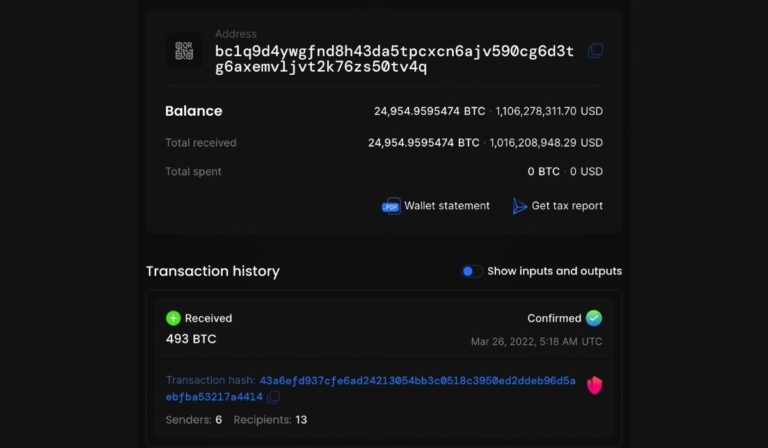
The purchase comes days after Do Kwon, founder of Terra and Terraform Labs announced that his firm was planning on purchasing Bitcoin worth $10 billion to back its UST stablecoin as part of its bigger strategy to decouple from centralized stablecoins while creating a more “sustainable and organic” stablecoin.

The plan to form a Bitcoin reserve for Terra’s UST has however been in the works, and as recently as last month, the Luna Foundation raised $1Billion for this purpose through a private sale of LUNA tokens.

After the event, Kwon stated that Terra would continue stacking its reserves “until it becomes mathematically impossible for idiots to claim de-peg risk for UST”. He thereafter outlined a $3 billion investment plan on Bitcoin before raising the bar to $10 billion. If Kwon’s purchase is to come to fruition, it would mean purchasing more than 232,018.50 BTC (at current prices) which is almost double what MicroStrategy holds.

Given the large sums involved, it is however sufficient to believe that the purchases will be rolled out gradually, catalyzing the ushering in of a “new monetary era of the Bitcoin standard”.

In the past two or so months, Terra’s ecosystem has been riding the DeFi wave, emerging out exceptionally strong due to its attractive UST stablecoin. As ZyCrypto reported, the ecosystem recently toppled Solana, Ethereum, Cardano, and Avalanche, becoming the most staked blockchain.

“One of the fastest-growing categories of applications on Terra has been neo banks that use stable coin rails to make transactions easier and to expose people to defy structured yields,” Kwon said in a podcast with ‘Udiverse’ on Tuesday.

That said, the purchase of $10 billion worth of Bitcoin could ignite a bullish run for the crypto asset as Terra continues to accumulate with no intention of selling. As stated, the process which will be gradual could also give Terra the much-needed attention, igniting a strong move for its native coin LUNA, which is currently trading at $90, up 110% in the past fifty days.
Lectures associées

De Web3 à l'Agent IA, le vieux VC crypto Variant mise 2 milliards sur une transformation

Variant, un vétéran du capital-risque crypto, annonce un nouveau fonds de 222 millions de dollars, le "Variant 4". Ce fonds marque une évolution de sa thèse d'investissement centrale : du concept de "propriété numérique" vers celui plus large de "souveraineté individuelle" (autonomie). Cette autonomie concerne le contrôle accru que les utilisateurs ont sur leur vie numérique, leurs actifs, leur identité et leur capacité d'action, au-delà de la simple automatisation. La distinction clé est que l'automatisation intelligente doit servir l'utilisateur final, et non la plateforme, pour véritablement accroître l'autonomie. Variant investira donc dans les technologies qui étendent cette souveraineté, en augmentant l'accès, les connaissances et la propriété des utilisateurs. Ce cadre englobe ses investissements passés dans les blockchains (Ethereum, Solana), l'infrastructure pour développeurs, les marchés financiers décentralisés et les produits grand public. Le fonds voit dans la convergence des agents d'IA intelligents et des rails financiers globaux ouverts un potentiel de transformation structurelle d'Internet, passant d'un modèle où "l'utilisateur est le produit" à un modèle où l'utilisateur dispose d'une autonomie inédite. Variant mettra son expertise, acquise dans l'écosystème crypto, au service des fondateurs qui construisent aux frontières de ces systèmes autonomes.

marsbitIl y a 1 h

De Web3 à l'Agent IA, le vieux VC crypto Variant mise 2 milliards sur une transformation

marsbitIl y a 1 h

Bloomberg révèle : Comment les riches Chinois contournent la limite annuelle de 50 000 dollars pour transférer leurs actifs ?

Bloomberg révèle que malgré le plafond annuel de 50 000 dollars par personne fixé par l'administration chinoise des changes, environ 150 milliards de dollars s'échappent chaque année via des canaux informels ou souterrains. L'article retrace l'évolution du contrôle des capitaux depuis 1994, avec un durcissement notable après la dévaluation de 2015 et une sophistication numérique accrue entre 2024 et 2026, incluant le CRS et un suivi renforcé des transactions. Cinq principales méthodes de transfert sont identifiées : le système de compensation "Duiqiao" (aucune sortie effective de RMB), le "déménagement de fourmis" utilisant les quotas légaux de multiples personnes, la falsification des factures commerciales, la migration vers des canaux de gestion de fortune des grandes banques (ex: QDII), et les arrangements structurels comme les fiducies ou l'immigration. La réponse réglementaire se concentre désormais sur les individus plutôt que sur les seules entreprises, avec le CRS comme outil de rétrospection clé pour identifier les actifs offshore. Même les cryptomonnaies, parfois perçues comme une échappatoire, font l'objet de poursuites pour infraction. La pression pour diversifier les actifs à l'étranger reste forte parmi les millions de ménages aisés chinois, malgré un "mur" réglementaire de plus en plus haut et intelligent.

marsbitIl y a 1 h

Bloomberg révèle : Comment les riches Chinois contournent la limite annuelle de 50 000 dollars pour transférer leurs actifs ?

marsbitIl y a 1 h

Trading

Spot
Futures
活动图片