Arthur Hayes explains why Bitcoin has likely bottomed out

Arthur HayesPublié le 2022-12-10Dernière mise à jour le 2022-12-10

Résumé

In a recent Medium blog post, Arthur Hayes claims that Bitcoin, the flagship cryptocurrency, has likely bottomed out.

The question at hand is whether the current price for Bitcoin is at the “bottom”. Bitcoin is the purest and most battle-tested form of crypto money — and while it may not fall the most, its role as crypto’s reserve asset will ensure that it’s Bitcoin that leads us out of the shadow of darkness. Therefore, we must focus on Bitcoin’s price action to divine whether this market’s bottom has occurred or not.

There are three cohorts that were forced to puke their Bitcoin into the righteous hands of the true believers: the centralised lending and trading firms, Bitcoin mining operations, and ordinary speculators. In every case, misuse of leverage — whether it was in their business operating model or they used it to finance their trades — was the cause of the liquidations. With short-term US Treasury yields moving from 0% in Q3 2021 to 5% at present, everyone has suffered bigly for their uber-bullish convictions.

After walking through how leverage destroyed each cohort’s position as rates rose, I will then explain why I think they have no more Bitcoin left to sell — And why, therefore, at the margin, we likely already hit the lows of this cycle during the recent FTX / Alameda catastrophe.

In the final section of this essay, I will then lay out the way in which I plan to trade this possible bottom. To that end, I recently participated in a webinar with my macro daddy Felix Zulauf. At the end of the broadcast, he said something that hit home. He said that investors and traders need to be concerned with recognising the tops and bottoms, but that most focus on the noise in the middle, and that calling a bottom is usually a fool’s errand. Since I’m embarking on that very fool’s errand, I intend to try to call it in a way that protects my portfolio, with the maximum amount of cushion to be wrong on the level and/or timing.

With that in mind, let’s dive in.

Bankruptcy Order of Operations

Most of us are probably not as gifted as Caroline Ellison, so we had to learn maths the hard way. Do you remember PEMDAS? It’s the acronym that describes the order of operations when solving equations:

P — Parentheses

E — Exponents

M — Multiplication

D — Division

A — Addition

S — Subtraction

The fact that I still remember this acronym many decades after first learning it speaks to its sticking power.

But equations aren’t the only thing with a static order of operations — bankruptcies (and the contagion that follows) occur in a very specific order, too. Let me start by explaining what that order looks like, and why it occurs in that sequence.

Before I do, though, I want to acknowledge that no one wants or intends to go bankrupt. So, I apologise in advance if I come across as insensitive to the strife of those who lost money because of Sam “I mislabeled my bank accounts” Bankman-Fried (SBF). But, this scammer just keeps opening his mouth and saying dumb shit that he needs to be called out for — so the rest of this essay will be peppered with references to our “right kind of white” boy and the sad melodrama he is responsible for. Now, let’s get back to it.

Centralised lending firms (CEL) usually go bankrupt because they either lent money to entities that can’t pay them back, or they have duration mismatches in their lending books. Duration mismatches occur because the lenders receive deposits that can be recalled by their depositors on a short time frame, but they make loans using those deposits on a longer time frame. If the depositors want their money back or demand a higher rate of interest due to changing market conditions, then the CEL — absent an injection from some white knight firm — becomes insolvent and bankruptcy quickly follows.

Before a CEL becomes insolvent or goes bankrupt, they will attempt to raise funds to ameliorate the situation. The first thing they will do is call all loans that they can. This mainly affects anyone who borrowed money from them with a short time horizon.

Imagine you are a trading firm that borrowed money from Celsius — but within a week, Celsius asks for those funds back, and you have to oblige. As a trading firm, getting recalled in a bull market is no biggie. There are plenty of other CELs who will lend you funds so that you don’t have to liquidate your existing positions. But when the bull market fades and there’s a market-wide credit crunch, all CELs typically recall their loans at around the same time. With no one to turn to for additional credit, trading firms are forced to liquidate their positions to meet capital calls. They will liquidate their most liquid assets first (i.e., Bitcoin and ETH), and hopefully their portfolio doesn’t contain too many illiquid shitcoins like Serum, MAPS, and Oxygen (*cough* Alameda and 3AC *cough*).

After a CEL recalls all the short-term loans that it can, it will begin liquidating the collateral that underpins its loans (assuming it actually asked for any — looking at you, Voyager). In the crypto markets, the biggest collateralised lending category prior to the recent implosions was loans secured by Bitcoin and Bitcoin mining machines. So once things start to go south, CELs start by selling Bitcoin, as it’s the asset most used to collaterlise loans AND it’s the most liquid cryptocurrency. They also turn to the mining firms that they have lent to and ask them to pony up either Bitcoin, or their mining rigs — but if those CELs don’t operate a data centre with cheap electricity, the mining rigs are about as useful as SBF’s accounting skills.

So while the credit crunch is ongoing, we see large physical sales of Bitcoin hitting the centralised and decentralised exchanges from both a) CELs trying to avoid bankruptcy by selling the Bitcoin they have received as collateral, and b) trading firms who have seen their loans recalled and must liquidate their positions. This is why the price of Bitcoin swoons BEFORE CELs go bankrupt. That’s the big move. The second move down — if there is one — is driven by the fear that occurs when firms which were once thought to be unshakable suddenly start posturing as zombies that are on the cusp of liquidating their assets. This tends to be a smaller move, as any firms at risk of bankruptcy are already busy liquidating Bitcoin so that they can survive the crash.

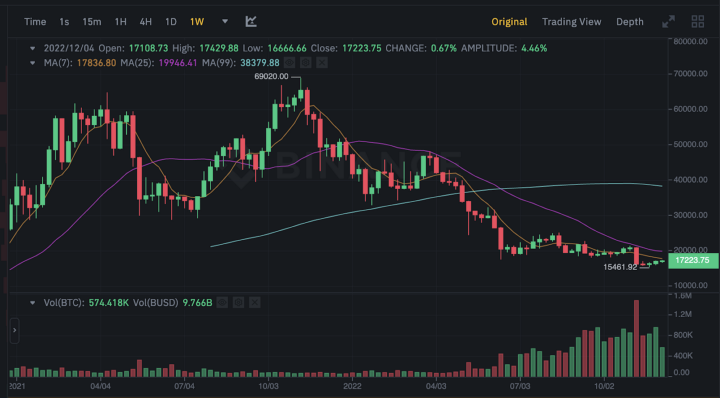
The above chart of Binance’s BTC/BUSD trading volume illustrates that volumes spiked during the two credit crashes of 2022. It is in this span of time that all these once storied firms bit the dust.

To summarise, as CELs transition from solvency, to insolvency, to bankruptcy, these other ecosystem players are affected:

1. Trading firms who borrowed short-term money from CELs and saw their loans recalled.

2. Bitcoin mining firms who borrowed what was typically fiat collateralised by either Bitcoin on their balance sheet, future Bitcoin to be mined, and/or Bitcoin mining rigs.

The two largest muppet crypto trading firms, Alameda and 3AC, both grew to such a gargantuan size because of cheap borrowed money. In the case of Alameda, the polite way to put it is that they “borrowed” it from FTX customers — although others might call it theft. In the case of 3AC, they hoodwinked gullible and desperate CELs to lend them funds with little-to-no collateral. In both cases, the lenders believed these and other trading firms were engaged in super-duper-smart arbitrage trades that rendered these firms immune to the vicissitudes of the markets. However, we know now these firms were just a bunch of degen, long-only punters in meth mode. The only difference between them and the masses was that they had billions of dollars to play with.

When these two firms got into trouble, what did we see? We saw large transfers of the most liquid cryptos — Bitcoin (WBTC in DeFi) and Ether (WETH in DeFi) — to centralised and decentralised exchanges that were then sold. This happened during the big move down. When the dust settled and neither firm could boost the asset side of their balance sheet higher than the liability side, their remaining assets consisted almost purely of the most illiquid shitcoins. Looking through the bankruptcy filings of centralisd lenders and trading firms, it is not entirely obvious what crypto assets remain. The filings lump everything together. So I can’t demonstratively prove that all Bitcoin held by these failed institutions was sold during the multiple crashes, but it does look as if they tried their best to liquidate the most liquid crypto collateral they could right before they went under.

The CELs and all large trading firms already sold most of their Bitcoin. All that is left now are illiquid shitcoins, private stakes in crypto companies, and locked pre-sale tokens. It’s irrelevant to the progression of the crypto bear market how a bankruptcy court eventually deals with these assets. I have comfort that these entities have little to no additional Bitcoin to sell. Next, let’s look at the Bitcoin miners.

Bitcoin Mining Firms

Electricity is priced and sold in fiat, and it is the key input to any Bitcoin mining business. Therefore, if a mining firm wants to expand, they either need to borrow fiat or sell Bitcoin on their balance sheet for fiat in order to pay their electricity bills. Most miners want to avoid selling Bitcoin at all costs, and therefore take out fiat loans collateralised by either Bitcoin on their balance sheets, yet-to-be-produced Bitcoin, or Bitcoin mining rigs.

As Bitcoin’s price rises, lenders feel emboldened to lend more and more fiat to mining firms. The miners are profitable and have hard assets to lend against. However, the ongoing quality of the loans is directly connected to Bitcoin’s price level. If the Bitcoin price falls quickly, then the loans will breach minimum margin levels before the mining firms can earn enough income to service the loans. And if that happens, the lenders will step in and liquidate the miner’s collateral (as I described in the previous section).

We anecdotally know this happened because the massive downturn in asset prices, particularly in the crypto bear market, have — along with rising energy prices — squeezed miners across the industry. Iris Energy is facing a default claim from creditors on $103M of equipment loans. September saw the first Chapter 11 bankruptcy from a major player, Compute North, with other big firms including Argo Blockchain (ARBK) seemingly teetering on the edge of solvency.

But, let’s look at some charts to examine how these waves of crypto credit crunches affected the miners and what they did in response.

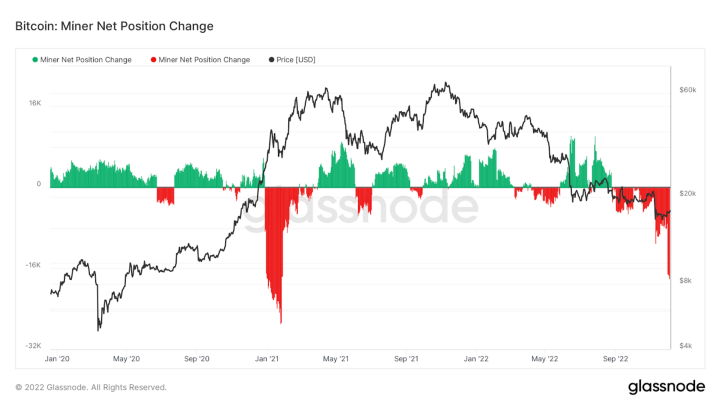
Glassnode publishes an excellent chart which shows the net 30-day change in Bitcoin held by miners.

As we can see, miners have been net selling a large amount of Bitcoin since the first credit crunch in the summer. They must do this in an attempt to stay current on their big fiat debt loads. And if they don’t have debt, they still need to pay electricity bills — and since the price of Bitcoin is so low, they have to sell even more of it to keep the facility operational.

While we don’t — and never will — know if we have hit the maximum amount of net selling, at least we can see that the mining firms are behaving as we would expect given the circumstances.

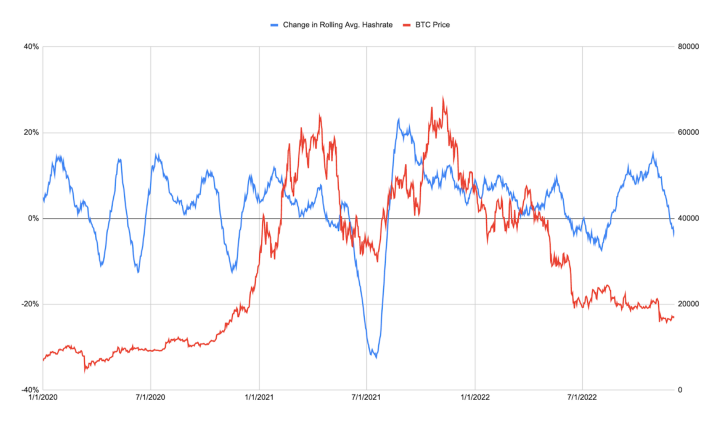
Some miners didn’t make it, or they had to downsize their operations. That is evident in the change in hashrate. I took the hashrate and first computed a rolling 30-day average. I then took that rolling average and looked at the 30-day change. I did this because the hashrate is quite volatile, and it needed some smoothing.

In general, the hashrate has trended higher over time. But, there are periods where the 30-day growth is negative. The hashrate declined right after the summer meltdown, and then most recently plunged due to the FTX / Alameda fallout. Again, this confirms our theory that miners will downsize operations when there is no more credit available to fund their electricity bills.

We also know that some high-cost miners had to cease operations because they defaulted on their loans. Any lender who took mining machines as collateral will likely find it difficult to make use of them, since they aren’t already in the business of operating data centres. And since they can’t use them, the lenders must then sell these machines in the secondary market, and that process takes time. This also contributes to the hashrate falling for a period of time.

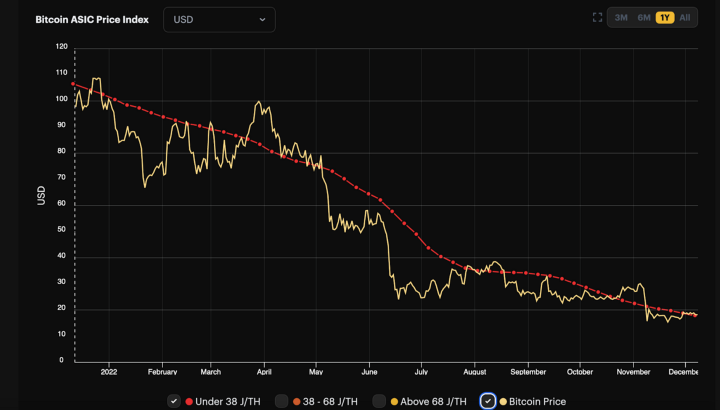
This is a chart of the price of a Bitmain S19 or other comparable mining machine with under 38 Joules (J) / Terahash (TH) efficiency. As we can see, the collateral value of an S19 has plummeted alongside the price of Bitcoin. Imagine you lent USD against these rigs. The miners you lent to tried to sell Bitcoin to provide more fiat to service your loan, but in the end couldn’t do so because marginal profitability declined. The miners then defaulted on their loans and handed over their machines — which are worth almost 80% less now than when the loan was undertaken — as repayment. We can guess that the most feverish point of loan origination was near the top of the market. Muppet lenders always buy the top and sell the bottom … every single fucking time!

Now that CELs have collections of mining rigs that they can’t easily sell and can’t operate, they can try to sell them and recover some funds — but it’s going to be single digit cents on the dollar, given that new machines are trading 80% off from a year ago. They can’t operate a mining farm because they lack a data centre with cheap electricity. And that’s why the hashrate just disappears — because of an inability to turn the machines back on.

Going forward, if we believe that most — if not all — mining loans have been extinguished, and there is no new capital to be lent to miners, then we can expect miners to sell most — if not all — of the block reward they receive.

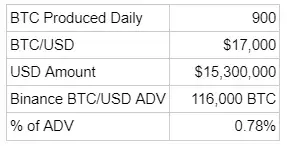
As the table above shows, if miners sold all the Bitcoin they produced each day, it would barely impact the markets at all. Therefore, we can ignore this ongoing selling pressure, as it is easily absorbed by the markets.

I believe that the forced selling of Bitcoin by CELs and miners is over. If you had to sell, you would have already done so. There is no reason why you would hold on if you had an urgent need for fiat to remain a going concern. Given that almost every major CEL has either ceased withdrawals (pointing to insolvency at best) or gone bankrupt, there are no more miner loans or collateral to be liquidated.

Small Scale Speculators

These punters are your run-of-the mill traders. While many of these individuals and firms definitely imploded, the failure of these entities would not be expected to send massive negative reverberations through the ecosystem. That being said, their behaviour can still help us form a guess as to where the bottom is.

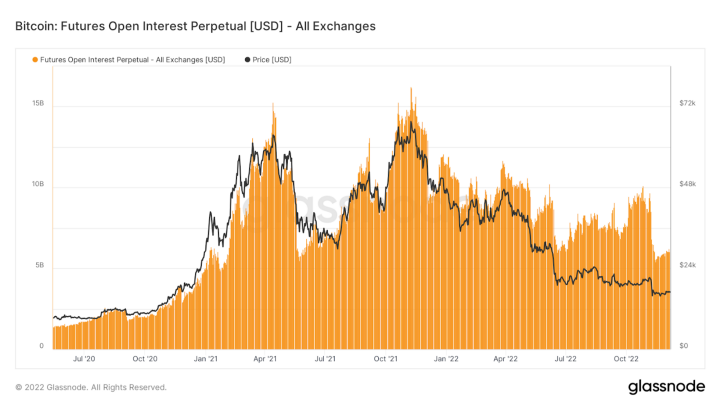
The Bitcoin / USD perpetual swap (invented by BitMEX) is the most traded of any crypto instrument. The number of open long and short contracts — called the open interest (OI) — tells us how speculative the market is. The more speculative it is, the more leverage is being used. And as we know, when the price changes directions quickly, it leads to large amounts of liquidations. In this case, the all-time high in OI coincided with the all-time high of Bitcoin. And as the market fell, longs at the margin got liquidated or closed their losing positions, which resulted in OI falling, too.

Taking a look at the sum of OI across all major crypto derivatives centralised exchanges, we can see that the OI local low also coincided with the sub $16,000 stab of Bitcoin on Monday November 14th. Now, the OI is back to levels not seen since early 2021.

The timing and magnitude of the reduction of the OI leads me to believe that most of the over-leveraged long positions have been extinguished. What remains are traders using derivatives as a hedge, and those using very low leverage. This gives us a bedrock to move higher.

Could the OI fall further as we enter the sideways, non-volatile part of the bear market? Absolutely. But the OI’s rate of change will slow, which means chaotic trading periods featuring large amounts of liquidations (particularly on the long side) are not likely to occur.

Timing Re-entry

What I Don’t Know

I don’t know if $15,900 was this cycle’s bottom. But, I do have confidence that it was due to the cessation of forced selling brought on by a credit contraction.

I don’t know when or if the US Federal Reserve will start printing money again. However, I believe the US Treasury market will become dysfunctional at some point in 2023 due to the Fed’s tightening monetary policies. At that point, I expect the Fed will turn the printer bank on, and then boom shaka-laka — Bitcoin and all other risk assets will spike higher.

What I Do Know

Everything is cyclical. What goes down, will go up again.

I like earning close to 5% by investing in US Treasury bills with durations shorter than 12 months. And therefore, I want to be earning a yield while I wait for the crypto bull market to return.

What to Do?

My ideal crypto asset must have beta to Bitcoin, and to a lesser extent, Ether. These are the reserve assets of crypto. If they are rising, my asset should rise by at least the same amount — this is called crypto beta. This asset must produce revenue that I can claim as a token holder. And this yield must be much greater than the 5% I can earn buying 6- or 12-month treasury bills.

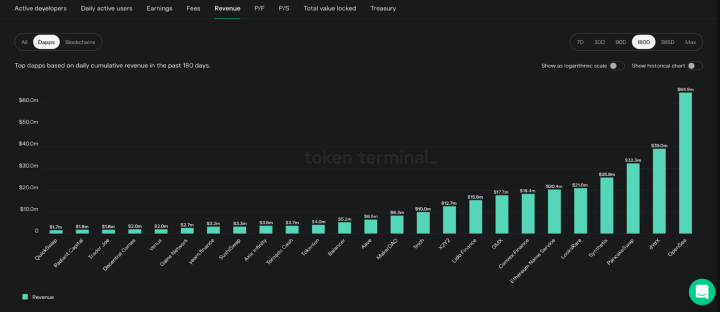
I have a few super-powered assets such as GMX and LOOKS in my portfolio. This is not the essay where I go into why I will be opportunistically selling my T-bills and purchasing these during the upcoming months of the hopefully sideways bear market. But if you want to start down the path towards finding the right asset to both participate in the upside and earn income while you wait for the return of the bull market, pull up a site like Token Terminal and look at which protocols generate actual revenue. It is then up to you to investigate which protocols have appealing tokenomics. Some may earn a lot of revenue, but it is very hard for a token holder to extract their share of that revenue to their own wallet. Some protocols pay out a majority of revenue continuously, directly to token holders.

The best part about some of these projects is that all things DeFi got shellacked during the two downward waves of the 2022 crypto credit crunch. Investors threw out good projects along with the bad as they rushed to raise fiat to repay loans. As a result, many of these projects trade at a truely bombed out price to fees (P/F) ratio.

If I can earn 5% in treasuries, then I should at least earn 4x of that — i.e., 20% — when purchasing one of these tokens. A 20% per annum yield means I should only invest in projects with a P/F ratio of 5x or lower. Everyone will have a different hurdle rate, but that is mine.

I could purchase Bitcoin and or Ether, but neither of these cryptos pays me enough yield. And if I’m not getting sufficient yield, I’m hoping that the price appreciation in fiat terms will be stupendous when the market turns. While I do believe that will occur, if there are cheaply priced protocols where I get the return profile of Bitcoin and Ether plus yield from the actual usage of the service, happy days!

Investing at what you think is the bottom is certainly risky. You are out there all alone, spreading the good word of Satoshi against the sweet siren song of the TradFi devil and their harpies. But be not afraid, intrepid and righteous warrior, for to the faithful the spoils of war shall accrue.


Cryptos en tendance

Lectures associées

Conversation avec Jason Huang, fondateur de NDV : Perce la bulle de l'IA et le mythe de MicroStrategy, à la recherche de l'atout ultime du marché crypto

Dans cet épisode du podcast Wu Shuo, Jason Huang, fondateur de NDV, analyse la récente baisse du Bitcoin. Il attribue la correction à la pression de vente cyclique quadriennale, accentuée par le recul des marchés actions, la contraction de la liquidité et les difficultés financières de MicroStrategy. Selon lui, le marché n'a pas encore touché le fond, car un vrai creux baissier nécessite généralement un événement majeur de type "FTX", générant un sentiment de désespoir généralisé. Il explique que la vente symbolique de 32 bitcoins par MicroStrategy a déclenché une réaction en chaîne, le marché anticipant une pression de vente plus importante sur les 800 000 BTC détenus par l'entreprise. Son fonds a généré environ 20% de rendement cette année, en surperformance par rapport au Bitcoin, grâce à des positions courtes et des investissements dans les matières premières (pétrole, or, argent). Bien qu'utilisateur intensif d'IA, Jason Huang évite d'investir dans les actions du secteur, par manque d'avantage informationnel, et considère que les transactions sur les semi-conducteurs sont trop concentrées. Il reste prudent sur les marchés actions en général, pointant des signes de surchauffe. À long terme, il est optimiste sur les stablecoins, qu'il considère comme l'innovation la plus utile et tangible de la cryptosphère, avec un potentiel de croissance encore important. Pour le Bitcoin, il prévoit une possible baisse supplémentaire (en dessous de 48 000$), suivie d'un rebond, mais estime que le vrai fond sera atteint lors d'un événement catastrophique provoquant une panique généralisée. Il se montre en revanche très pessimiste quant à l'Ethereum.

marsbitIl y a 15 mins

Conversation avec Jason Huang, fondateur de NDV : Perce la bulle de l'IA et le mythe de MicroStrategy, à la recherche de l'atout ultime du marché crypto

marsbitIl y a 15 mins

Entretien avec Jason Huang, fondateur de NDV : Percer la bulle de l'IA et le mythe de MicroStrategy, à la recherche de l'atout ultime sur le marché des cryptomonnaies

Dans ce podcast, Jason Huang, fondateur de NDV, analyse la récente baisse du Bitcoin. Il attribue la correction à la pression de vente cyclique quadriennale, combinée au recul des marchés actions, à la contraction des liquidités et aux difficultés financières de MicroStrategy (MSTR). Huang estime que le marché n'a pas encore touché le fond, un véritable creux nécessitant généralement un événement majeur de type "FTX" pour provoquer une capitulation totale. Il explique que la vente symbolique de 32 BTC par MSTR a déclenché une course anticipative des investisseurs, craignant une pression de vente massive sur ses 80 000+ BTC. Pour résoudre ses dettes et dividendes, MSTR devra probablement vendre davantage ou trouver un acheteur privé, ce qui pourrait marquer un plancher temporaire. Son fonds a généré environ 20% de rendement cette année, en surperformance face au BTC, grâce à des positions courtes et des investissements dans les matières premières (pétrole, or, argent). Il évite délibérément les actions AI par manque d'avantage informationnel et perçoit des bulles dans les semi-conducteurs et le récit autour de SpaceX. Malgré son pessimisme à court terme, Huang reste optimiste sur la valeur à long terme des stablecoins, qu'il considère comme l'innovation la plus utile et tangible de la crypto. Pour le Bitcoin, il prévoit une baisse potentielle en dessous de 48 000 $ avant un rebond, tandis qu'il se montre très sceptique quant à l'avenir de l'Ethereum. Le véritable fond, selon lui, sera atteint lorsque le désespoir sera généralisé et que plus personne ne voudra parler du marché.

链捕手Il y a 21 mins

Entretien avec Jason Huang, fondateur de NDV : Percer la bulle de l'IA et le mythe de MicroStrategy, à la recherche de l'atout ultime sur le marché des cryptomonnaies

链捕手Il y a 21 mins

Tendances du marché boursier américain (24 juin) : La chute du marché coréen ébranle les puces mondiales, Micron chute de plus de 10%, la certitude de l'offre à long terme soumise à un 'test brutal'

**Titre : Les marchés américains sous pression (24 juin) : La chute du marché coréen secoue les puces mondiales, Micron chute de plus de 10%, la certitude de l'offre à long terme mise à rude épreuve** **Résumé en français :** Le marché sud-coréen a subi un choc majeur lundi, le KOSPI plongeant de 10%, entraîné par les titres de SK Hynix et Samsung (-12%). Cette chute, attribuée à des rumeurs d'un ralentissement potentiel de l'expansion de la production de HBM4 par SK Hynix, s'est propagée aux valeurs technologiques américaines. Le secteur des semi-conducteurs a été le plus durement touché à Wall Street. Micron Technology a chuté de plus de 13%, SanDisk de près de 14%, et l'indice Philadelphia Semiconductor a reculé de 7.87%. Le Nasdaq a perdu 2.21%, tandis que le Dow Jones résistait mieux (-0.09%). Les valeurs défensives (IBM, Walmart, Johnson & Johnson) ont affiché des performances positives. La pression sur les actions ne semble pas liée à une remise en cause de la demande d'IA elle-même, mais plutôt à une réévaluation des anticipations trop optimistes concernant les capacités de production de puces mémoires, en particulier la mémoire HBM essentielle pour l'IA. L'annonce potentielle d'un ralentissement chez un acteur clé a semé le doute sur la solidité du cycle d'investissement en infrastructure IA. Les regards se tournent désormais vers deux événements clés de jeudi : les données sur l'inflation PCE aux États-Unis, qui influenceront les anticipations de politique monétaire de la Fed, et les résultats trimestriels de Micron. Les investisseurs scruteront les marges de la division HBM de Micron et ses prévisions de capacité pour 2027. Toute prudence dans les commentaires pourrait déclencher une nouvelle vague de vente. Cette correction marque un tournant vers une tarification plus rationnelle du cycle de l'IA. La certitude d'une offre à long terme suffisante, jusque-là intégrée dans les valorisations, est désormais fortement remise en question, transformant la perception d'entreprises comme Micron, de "garant de l'infrastructure IA" en valeur plus cyclique.

marsbitIl y a 36 mins

Tendances du marché boursier américain (24 juin) : La chute du marché coréen ébranle les puces mondiales, Micron chute de plus de 10%, la certitude de l'offre à long terme soumise à un 'test brutal'

marsbitIl y a 36 mins

À l'ère de l'IA, quels KOL et communautés ne seront pas complètement remplacés ?

À l’ère de l’IA, quels types de KOL (influenceurs) et communautés éviteront d’être remplacés ? Dans un entretien, l’investisseur BitWu partage ses perspectives sur l’évolution de la crypto, les erreurs courantes des nouveaux venus et les opportunités futures. Il souligne que les KOLs qui se contentent de relayer des informations seront progressivement remplacés par l’IA, plus rapide et moins coûteuse. En revanche, ceux qui apportent leur expérience personnelle, leur jugement et leur crédibilité accumulée resteront pertinents. Concernant les communautés, leur importance grandira, mais elles se différencieront. Les communautés purement opportunistes (airdrops, gains rapides) disparaîtront au profit de celles fondées sur la confiance, un objectif commun et des relations durables, notamment via des interactions en présentiel. BitWu met également en lumière les changements dans le cycle actuel par rapport à 2021 : le marché crypto évolue d’un espace spéculatif vers une infrastructure financière globale, intégrant des thèmes comme l’IA, les stablecoins et les RWA (Real World Assets). Pour les jeux Web3, l’échec passé est dû à une focalisation excessive sur le "Play-to-Earn" au détriment du plaisir de jeu. À l’avenir, la combinaison de l’IA, des aspects sociaux et de la création de contenu par les utilisateurs (UGC) sera essentielle pour créer des mondes de jeu vivants et engageants. Enfin, il conseille aux nouveaux venus de développer avant tout leur capacité à identifier les risques, et non de surestimer leurs gains en période de hausse. La gestion du capital et une approche disciplinée sont cruciales pour survivre et prospérer sur le long terme.

marsbitIl y a 53 mins

À l'ère de l'IA, quels KOL et communautés ne seront pas complètement remplacés ?

marsbitIl y a 53 mins

Trading

Spot
Futures

Articles tendance

Qu'est ce que BITCOIN

Comprendre HarryPotterObamaSonic10Inu (ERC-20) et sa position dans l'espace crypto Ces dernières années, le marché des cryptomonnaies a connu une augmentation de la popularité des monnaies mèmes, suscitant l'intérêt non seulement des traders, mais aussi de ceux qui recherchent un engagement communautaire et une valeur divertissante. Parmi ces jetons uniques, HarryPotterObamaSonic10Inu (ERC-20) est un projet intrigant qui mêle des références culturelles à l'univers des cryptomonnaies. Cet article explore les aspects clés de HarryPotterObamaSonic10Inu, en examinant ses mécanismes, son ethos axé sur la communauté, et son engagement avec le paysage crypto plus large. Qu'est-ce que HarryPotterObamaSonic10Inu (ERC-20) ? Comme son nom l'indique, HarryPotterObamaSonic10Inu est une monnaie mème construite sur la blockchain Ethereum, classée selon la norme ERC-20. Contrairement aux cryptomonnaies traditionnelles qui peuvent mettre l'accent sur l'utilité pratique ou le potentiel d'investissement, ce jeton prospère grâce à sa valeur divertissante et à la force de sa communauté. Le projet vise à favoriser un environnement où des utilisateurs engagés peuvent se rassembler, partager des idées et participer à des activités inspirées par divers phénomènes culturels. Une caractéristique notable de HarryPotterObamaSonic10Inu est son absence de taxe sur les transactions. Cet élément attrayant vise à encourager le trading et l'implication de la communauté, sans frais supplémentaires pouvant décourager les petits traders. L'offre totale de la monnaie est fixée à un milliard de jetons, un chiffre qui marque son intention de maintenir une circulation substantielle au sein de la communauté. Créateur de HarryPotterObamaSonic10Inu (ERC-20) Les origines de HarryPotterObamaSonic10Inu sont quelque peu obscures ; les détails concernant le créateur restent inconnus. Le développement de ce jeton ne comporte pas d'équipe identifiable ou de plan explicite, ce qui n'est pas rare dans le secteur des monnaies mèmes. Au lieu de cela, le projet a émergé de manière organique, son progrès s'appuyant fortement sur l'enthousiasme et la participation de sa communauté. Investisseurs de HarryPotterObamaSonic10Inu (ERC-20) En ce qui concerne les investissements externes et le soutien, HarryPotterObamaSonic10Inu reste également ambigu. Le jeton ne mentionne aucune fondation d'investissement connue ou un soutien organisationnel significatif. Au lieu de cela, le cœur battant du projet est sa communauté de base, qui informe sa croissance et sa durabilité par des actions collectives et un engagement dans l'espace crypto. Comment fonctionne HarryPotterObamaSonic10Inu (ERC-20) ? En tant que monnaie mème, HarryPotterObamaSonic10Inu opère principalement en dehors des cadres traditionnels qui régissent souvent la valeur des actifs. Plusieurs aspects distinctifs définissent comment le projet fonctionne : Transactions sans taxe : Sans frais de taxe sur les transactions, les utilisateurs peuvent acheter et vendre librement le jeton sans se préoccuper de frais cachés. Engagement communautaire : Le projet prospère grâce à l'interaction communautaire, exploitant les plateformes de médias sociaux pour créer du bruit et faciliter l'implication. Les discussions, le partage de contenu et l'engagement sont des éléments cruciaux qui aident à étendre sa portée et à favoriser la loyauté parmi les supporters. Pas d'utilité pratique : Il est important de noter que HarryPotterObamaSonic10Inu n'offre pas d'utilité concrète au sein de l'écosystème financier. Au contraire, il est classé comme un jeton principalement pour des activités de divertissement et communautaires. Référence culturelle : Le jeton intègre habilement des éléments de la culture populaire pour susciter l'intérêt, s'adressant à la fois aux amateurs de mèmes et aux suiveurs de crypto. HarryPotterObamaSonic10Inu illustre comment les monnaies mèmes fonctionnent différemment des projets de cryptomonnaies plus traditionnels, entrant sur le marché en tant que constructions sociales innovantes plutôt qu'actifs utilitaires. Chronologie de HarryPotterObamaSonic10Inu (ERC-20) L'histoire de HarryPotterObamaSonic10Inu est jalonnée de plusieurs étapes notables : Création : Le jeton est né d'un mème viral, captivant l'imagination de nombreux passionnés de crypto. Les dates de création spécifiques ne sont pas disponibles, soulignant son ascension organique. Listing sur les échanges : HarryPotterObamaSonic10Inu a fait son apparition sur divers échanges, permettant un accès et un trading plus faciles par la communauté. Initiatives d'engagement communautaire : Activités en cours visant à améliorer l'interaction communautaire, y compris des concours, des campagnes sur les réseaux sociaux, et la génération de contenu par des fans et des défenseurs. Plans d'expansion futurs : La feuille de route du projet comprend le lancement d'une collection NFT, de marchandises, et d'un site eCommerce lié à ses thèmes culturels, engageant davantage la communauté et tentant d'ajouter plus de dimensions à son écosystème. Points clés concernant HarryPotterObamaSonic10Inu (ERC-20) Nature axée sur la communauté : Le projet privilégie l'apport collectif et la créativité, garantissant que l'implication des utilisateurs est au cœur de son développement. Classification de monnaie mème : Il représente l'apogée de la cryptomonnaie basée sur le divertissement, se distinguant des véhicules d'investissement traditionnels. Pas d'affiliation directe avec Bitcoin : Malgré la similitude dans le nom du ticker, HarryPotterObamaSonic10Inu est distinct et n'a aucun lien avec Bitcoin ou d'autres cryptomonnaies établies. Focus sur la collaboration : HarryPotterObamaSonic10Inu est conçu pour créer un espace de collaboration et de partage d'histoires parmi ses détenteurs, offrant une voie pour la créativité et le lien communautaire. Perspectives d'avenir : L'ambition de s'étendre au-delà de son concept initial vers des NFT et des marchandises dessine un chemin pour le projet afin de potentiellement entrer dans des avenues plus grand public au sein de la culture numérique. Alors que les monnaies mèmes continuent de captiver l'imagination de la communauté des cryptomonnaies, HarryPotterObamaSonic10Inu (ERC-20) se distingue par ses liens culturels et son approche centrée sur la communauté. Bien qu'il ne corresponde pas au modèle typique d'un jeton axé sur l'utilité, son essence réside dans la joie et la camaraderie cultivées parmi ses supporters, soulignant la nature en évolution des cryptomonnaies dans un âge de plus en plus numérique. À mesure que le projet continue de se développer, il sera important de surveiller comment les dynamiques communautaires influencent sa trajectoire dans le paysage toujours changeant de la technologie blockchain.

1.7k vues totalesPublié le 2024.04.01Mis à jour le 2024.12.03

Qu'est ce que BITCOIN

Comment acheter BTC

Bienvenue sur HTX.com ! Nous vous permettons d'acheter Bitcoin (BTC) de manière simple et pratique. Suivez notre guide étape par étape pour commencer votre parcours crypto.Étape 1 : Création de votre compte HTXUtilisez votre adresse e-mail ou votre numéro de téléphone pour ouvrir un compte sur HTX gratuitement. L'inscription se fait en toute simplicité et débloque toutes les fonctionnalités.Créer mon compteÉtape 2 : Choix du mode de paiement (rubrique Acheter des cryptosCarte de crédit/débit : utilisez votre carte Visa ou Mastercard pour acheter instantanément Bitcoin (BTC).Solde :utilisez les fonds du solde de votre compte HTX pour trader en toute simplicité.Prestataire tiers :pour accroître la commodité d'utilisation, nous avons ajouté des modes de paiement populaires tels que Google Pay et Apple Pay.P2P :tradez directement avec d'autres utilisateurs sur HTX.OTC (de gré à gré) : nous offrons des services personnalisés et des taux de change compétitifs aux traders.Étape 3 : stockage de vos Bitcoin (BTC)Après avoir acheté vos Bitcoin (BTC), stockez-les sur votre compte HTX. Vous pouvez également les envoyer ailleurs via un transfert sur la blockchain ou les utiliser pour trader d'autres cryptos.Étape 4 : tradez des Bitcoin (BTC)Tradez facilement Bitcoin (BTC) sur le marché Spot de HTX. Il vous suffit d'accéder à votre compte, de sélectionner la paire de trading, d'exécuter vos trades et de les suivre en temps réel. Nous offrons une expérience conviviale aux débutants comme aux traders chevronnés.

5.4k vues totalesPublié le 2024.12.12Mis à jour le 2026.06.02

Comment acheter BTC

Qu'est ce que $BITCOIN

OR DÉMATÉRIEL ($BITCOIN) : Une Analyse Complète Introduction à OR DÉMATÉRIEL ($BITCOIN) OR DÉMATÉRIEL ($BITCOIN) est un projet basé sur la blockchain opérant sur le réseau Solana, qui vise à combiner les caractéristiques des métaux précieux traditionnels avec l'innovation des technologies décentralisées. Bien qu'il partage un nom avec Bitcoin, souvent appelé “or numérique” en raison de sa perception en tant que réserve de valeur, OR DÉMATÉRIEL est un jeton distinct conçu pour créer un écosystème unique au sein du paysage Web3. Son objectif est de se positionner comme un actif numérique alternatif viable, bien que les spécificités concernant ses applications et fonctionnalités soient encore en développement. Qu'est-ce qu'OR DÉMATÉRIEL ($BITCOIN) ? OR DÉMATÉRIEL ($BITCOIN) est un jeton de cryptomonnaie explicitement conçu pour une utilisation sur la blockchain Solana. Contrairement à Bitcoin, qui joue un rôle de stockage de valeur largement reconnu, ce jeton semble se concentrer sur des applications et caractéristiques plus larges. Les aspects notables incluent : Infrastructure Blockchain : Le jeton est construit sur la blockchain Solana, connue pour sa capacité à gérer des transactions rapides et peu coûteuses. Dynamique de l'Offre : OR DÉMATÉRIEL a une offre maximale plafonnée à 100 quadrillions de jetons (100P $BITCOIN), bien que les détails concernant son offre en circulation soient actuellement non divulgués. Utilité : Bien que les fonctionnalités précises ne soient pas explicitement décrites, il y a des indications que le jeton pourrait être utilisé pour diverses applications, impliquant potentiellement des applications décentralisées (dApps) ou des stratégies de tokenisation d'actifs. Qui est le Créateur d'OR DÉMATÉRIEL ($BITCOIN) ? À l'heure actuelle, l'identité des créateurs et de l'équipe de développement derrière OR DÉMATÉRIEL ($BITCOIN) reste inconnue. Cette situation est typique parmi de nombreux projets innovants dans l'espace blockchain, en particulier ceux alignés avec la finance décentralisée et les phénomènes de meme coin. Bien qu'une telle anonymité puisse favoriser une culture axée sur la communauté, elle intensifie les préoccupations concernant la gouvernance et la responsabilité. Qui sont les Investisseurs d'OR DÉMATÉRIEL ($BITCOIN) ? Les informations disponibles indiquent qu'OR DÉMATÉRIEL ($BITCOIN) n'a pas de bailleurs de fonds institutionnels connus ou d'investissements en capital-risque notables. Le projet semble fonctionner sur un modèle peer-to-peer axé sur le soutien et l'adoption de la communauté plutôt que sur des voies de financement traditionnelles. Son activité et sa liquidité se situent principalement sur des échanges décentralisés (DEX), tels que PumpSwap, plutôt que sur des plateformes de trading centralisées établies, soulignant davantage son approche de base. Comment fonctionne OR DÉMATÉRIEL ($BITCOIN) Les mécanismes opérationnels d'OR DÉMATÉRIEL ($BITCOIN) peuvent être élaborés en fonction de sa conception blockchain et des attributs du réseau : Mécanisme de Consensus : En s'appuyant sur le mécanisme de preuve d'historique (PoH) unique de Solana combiné à un modèle de preuve d'enjeu (PoS), le projet assure une validation efficace des transactions contribuant à la haute performance du réseau. Tokenomics : Bien que des mécanismes déflationnistes spécifiques n'aient pas été largement détaillés, l'immense offre maximale de jetons implique qu'elle pourrait répondre à des microtransactions ou à des cas d'utilisation de niche qui restent à définir. Interopérabilité : Il existe un potentiel d'intégration avec l'écosystème plus large de Solana, y compris diverses plateformes de finance décentralisée (DeFi). Cependant, les détails concernant des intégrations spécifiques restent non spécifiés. Chronologie des Événements Clés Voici une chronologie qui met en évidence des jalons significatifs concernant OR DÉMATÉRIEL ($BITCOIN) : 2023 : Le déploiement initial du jeton a lieu sur la blockchain Solana, marqué par son adresse de contrat. 2024 : OR DÉMATÉRIEL gagne en visibilité en devenant disponible à la négociation sur des échanges décentralisés comme PumpSwap, permettant aux utilisateurs de l'échanger contre SOL. 2025 : Le projet connaît une activité de trading sporadique et un intérêt potentiel pour des engagements dirigés par la communauté, bien qu'aucun partenariat notable ou avancée technique n'ait été documenté jusqu'à présent. Analyse Critique Forces Scalabilité : L'infrastructure sous-jacente de Solana prend en charge des volumes de transactions élevés, ce qui pourrait améliorer l'utilité de $BITCOIN dans divers scénarios de transaction. Accessibilité : Le potentiel faible prix de négociation par jeton pourrait attirer les investisseurs de détail, facilitant une participation plus large grâce aux opportunités de propriété fractionnée. Risques Manque de Transparence : L'absence de bailleurs de fonds, de développeurs ou de processus d'audit connus publiquement peut susciter du scepticisme quant à la durabilité et à la fiabilité du projet. Volatilité du Marché : L'activité de trading dépend fortement du comportement spéculatif, ce qui peut entraîner une volatilité des prix significative et une incertitude pour les investisseurs. Conclusion OR DÉMATÉRIEL ($BITCOIN) émerge comme un projet intrigant mais ambigu au sein de l'écosystème Solana en rapide évolution. Bien qu'il tente de tirer parti du récit de “l'or numérique”, son éloignement du rôle établi de Bitcoin en tant que réserve de valeur souligne la nécessité d'une différenciation plus claire de son utilité prévue et de sa structure de gouvernance. L'acceptation et l'adoption futures dépendront probablement de la résolution de l'opacité actuelle et de la définition plus explicite de ses stratégies opérationnelles et économiques. Remarque : Ce rapport englobe des informations synthétisées disponibles jusqu'en octobre 2023, et des développements peuvent avoir eu lieu au-delà de la période de recherche.

98 vues totalesPublié le 2025.05.13Mis à jour le 2025.05.13

Qu'est ce que $BITCOIN

Discussions

Bienvenue dans la Communauté HTX. Ici, vous pouvez vous tenir informé(e) des derniers développements de la plateforme et accéder à des analyses de marché professionnelles. Les opinions des utilisateurs sur le prix de BTC (BTC) sont présentées ci-dessous.

活动图片