6,000 CEOs Admit AI 'Did Nothing', Yet It Was Used to Lay Off 40,000 People in Q1 This Year

marsbitPublié le 2026-04-20Dernière mise à jour le 2026-04-20

Résumé

A study by the National Bureau of Economic Research (NBER) surveying 6000 executives across four countries reveals that nearly 90% of businesses report AI has had "no measurable impact" on employment or productivity over the past three years. Despite global AI investments exceeding $250 billion in 2024, only 12% of CEOs reported both cost reductions and revenue growth from AI. Contrastingly, in Q1 2026, the industry saw 78,557 tech job cuts, with 47.9% attributed to AI and automation. Critics label this contradiction an "AI version of the Solow Paradox," referencing the visible lack of AI's effect in productivity data amid widespread adoption. While some leaders, like Anthropic’s CEO, predict AI will eliminate half of entry-level white-collar jobs, others accuse firms of "AI washing"—using AI as a pretext for layoffs originally planned due to over-hiring or weak demand. However, companies like IBM and Cognizant are bucking the trend by increasing entry-level hiring and retraining staff to work alongside AI. Economists suggest a "J-curve" effect may be underway, where initial productivity stagnation is followed by significant gains, as was seen with IT in the 1990s. The transition remains challenging, with true productivity improvements expected within 6–12 months.

Author: Claude, Deep Tide TechFlow

Deep Tide Guide: A survey of 6,000 executives in four countries by the National Bureau of Economic Research (NBER) shows that nearly 90% of companies believe AI has had "no impact" on employment and productivity over the past three years. However, in Q1 2026, the tech industry laid off 78,557 people, with 47.9% attributed to AI. While productivity data remains blank, a wave of layoffs is surging in the name of AI. Economists compare this contradiction to an AI version of the "computer paradox" proposed by Robert Solow, winner of the 1987 Nobel Prize in Economics.
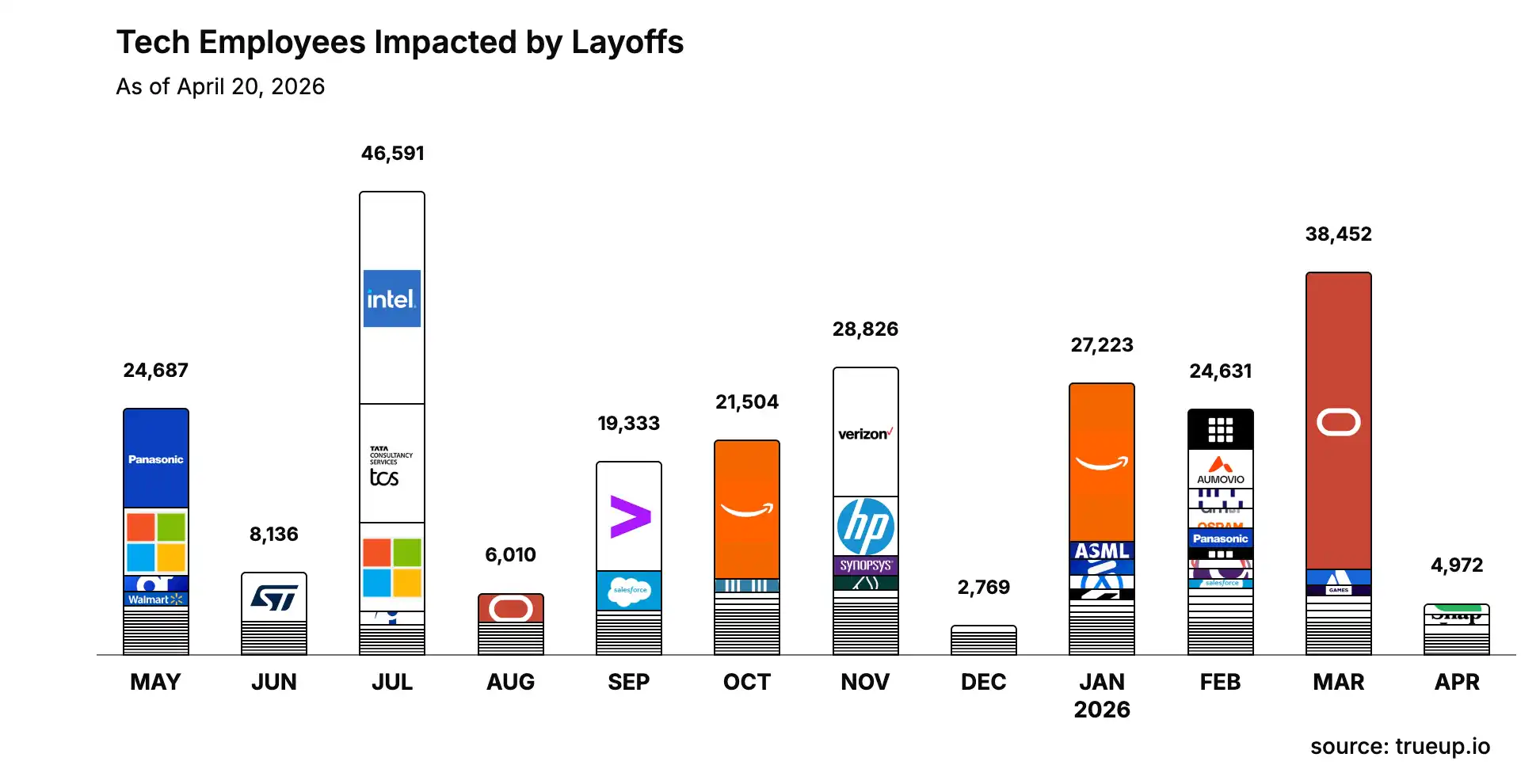
$250 billion invested, nearly 90% of companies say AI hasn't brought any productivity improvements. Meanwhile, tech companies are conducting large-scale layoffs in the name of AI.

This is the most absurd scene in the current AI industry.

According to a Fortune magazine report on April 19, a study published by NBER in February covering 6,000 corporate executives in the US, UK, Germany, and Australia found that nearly 90% of respondent companies said AI had no measurable impact on their employment and productivity over the past three years. Although two-thirds of executives are using AI, their average weekly usage is only 1.5 hours, and 25% of respondents said they don't use AI at work at all.

On the other hand, according to Nikkei Asia citing RationalFX data, from January 1 to early April 2026, the tech industry has laid off 78,557 people, with 37,638 (47.9%) explicitly attributed to AI and workflow automation. Over 76% of the layoffs occurred in the United States.

Apollo chief economist Torsten Slok directly quoted the classic statement of Robert Solow, winner of the 1987 Nobel Prize in Economics, summarizing the current situation as the AI version of the "Solow Paradox." Solow's original words were: "You can see the computer age everywhere but in the productivity statistics."

Slok's judgment almost exactly maps to today. AI is nowhere to be found in employment data, productivity data, or inflation data.

90% of Companies See No AI Effect, $250 Billion Investment Return Questioned

The data from this NBER study is quite solid. Among the four countries, 69% of companies use AI to some extent, with the US highest (78%) and Germany lowest (65%). But using it is one thing, effectiveness is another: over 90% of managers said AI had no impact on their company's employment size, and 89% said it had no impact on labor productivity (measured by sales per capita).

According to Stanford University's 2025 AI Index Report, global AI investment in 2024 exceeded $250 billion. PwC's 2026 Global CEO Survey shows that only 12% of CEOs said AI brought both cost reduction and revenue growth, while 56% of CEOs reported no significant financial benefits.

Slok pointed out in his blog post that aside from the "Magnificent Seven," AI has no visible impact on profit margins and earnings expectations.

This is not an isolated opinion. A 2024 MIT study predicted that AI would only boost productivity by 0.5% over the next decade. The study's author, Nobel laureate Daron Acemoglu, said at the time: "0.5% is better than zero. But relative to the promises of the industry and tech media, it is indeed disappointing."

A study published by Boston Consulting Group (BCG) in March this year revealed a counterintuitive phenomenon: when employees use fewer than three AI tools, productivity increases; but after using four or more tools, self-rated productivity drops significantly, with employees reporting "brain fog" and more minor errors. BCG calls this "AI Brain Overload."

ManpowerGroup's 2026 Global Talent Barometer shows that among nearly 14,000 employees in 19 countries, the routine use rate of AI rose by 13% in 2025, but confidence in AI's practicality plummeted by 18%.

Nearly 80,000 Layoffs in Q1, Is AI the Biggest "Scapegoat" or the Real Culprit?

While productivity data remains blank, the layoff wave is advancing at an alarming rate.

According to Nikkei Asia, the tech industry laid off 78,557 people in Q1 2026, with 47.9% attributed to AI implementation and workflow automation. Oracle recently quietly laid off over 10,000 people, with the saved funds redirected to data center construction. Anthropic CEO Dario Amodei and Ford CEO Jim Farley have both publicly stated that AI will eliminate half of US entry-level white-collar jobs within the next five years. Stanford University research also shows that junior programming and customer service positions are already being impacted, with related job postings dropping 13% over three years.
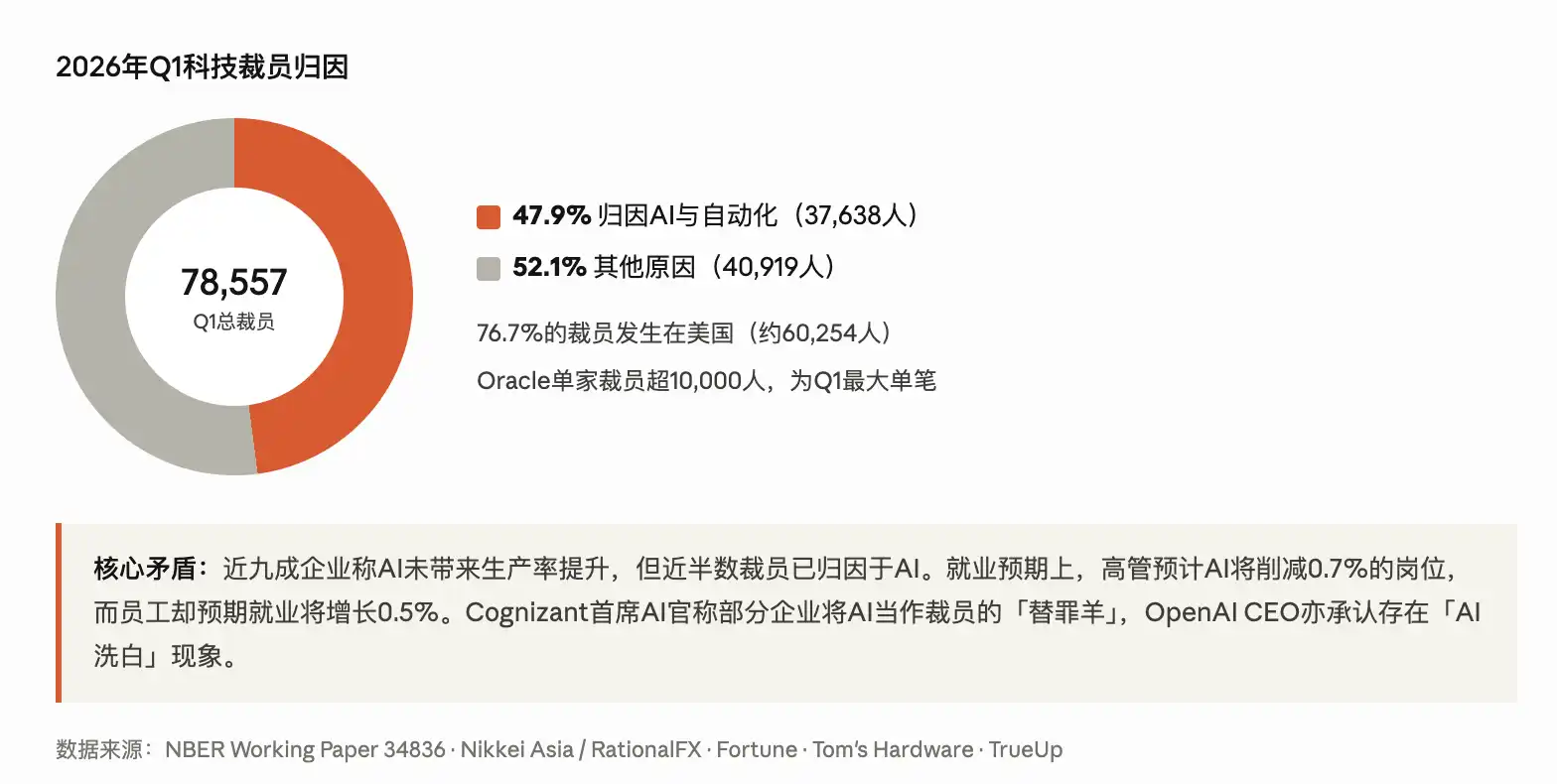
An MIT simulation study provided even more startling numbers: AI could replace 11.7% of the US workforce, involving approximately $1.2 trillion in total wages.

But how many of these layoffs are truly driven by AI?

Cognizant Chief AI Officer Babak Hodjat was blunt with Nikkei Asia: "I'm not sure if these layoffs are directly related to actual productivity gains. Sometimes, AI is just a scapegoat on the financial level—companies overstaffed, want to downsize, and then blame it on AI."

OpenAI CEO Sam Altman also acknowledged the existence of "AI washing" at the India AI Impact Summit, "There's a certain percentage of 'AI washing,' where people blame layoffs that were going to happen anyway on AI, but there are also some jobs that are being genuinely replaced by AI."

Deutsche Bank analysts directly named this phenomenon "AI redundancy washing," believing companies attribute layoffs to AI because "it sends a more positive signal to investors than admitting weak demand or previous over-hiring."

IBM Increases Entry-Level Hiring Against the Trend, Cognizant Refuses Layoffs

Not all companies are following the trend.

IBM tripled its entry-level hiring in 2026. The company's Chief Human Resources Officer, Nickle LaMoreaux, logic is: while AI can perform many entry-level tasks, eliminating these positions would destroy the talent pipeline for cultivating future middle managers, endangering the company's long-term leadership reserves.

Cognizant—a process outsourcing giant highly dependent on human resources—also stated it will not lay off people because of AI. The company has established AI labs in San Francisco and Bangalore to develop custom AI agents for clients (as off-the-shelf generic AI products don't perform well in enterprise environments, with performance and security issues), but its employees will be trained to work alongside AI, not be replaced by it.

Hodjat emphasized: "There will be a large number of young graduates who can't find jobs and lack domain expertise. You have to hire them and let them learn on the job how to use AI in various fields."

Data from the European Central Bank also supports this view from another angle: companies that deploy and invest in AI on a large scale are more likely to be expanding hiring.

J-Curve or Mirage: When Will the AI Productivity Inflection Point Arrive?

Historical experience offers some hope.

IT investment in the 1970s and 80s also seemed ineffective, but from 1995 to 2005, IT-driven productivity growth reached 1.5%. Stanford University Digital Economy Lab Director Erik Brynjolfsson wrote in the Financial Times that the AI productivity inflection point may have begun to appear: US productivity grew 2.7% last year, Q4 GDP tracking growth was 3.7%, but only 181,000 new jobs were added in the same period—this decoupling of job growth from GDP growth might be a signal that AI is starting to work. Former Pimco CEO Mohamed El-Erian also noticed the same decoupling phenomenon.

A study by the Stanford Institute for Economic Policy Research, using web browsing data from 200,000 US households, found that AI improved efficiency in online tasks like job searching, travel planning, and shopping by 76% to 176%. However, researchers found that users spent the saved time socializing and watching TV instead of working or learning new skills.

Apollo's Slok describes AI's future impact as a "J-curve": first a period of declining performance, followed by an exponential leap. But he also points out that unlike the IT era of the 80s, where innovators had monopoly pricing power, today's AI tools face fierce competition and continuously falling prices. Therefore, AI's value creation lies not in the product itself, but in "how generative AI is used and deployed across economic sectors."

Hodjat's judgment is perhaps the most practical: in another 6 to 12 months, companies will begin to see the real productivity improvements brought by AI, and "this transition period will be painful for all of us."


Questions liées

QWhat is the main contradiction highlighted in the article regarding AI's impact on businesses?

AThe main contradiction is that while nearly 90% of surveyed companies report that AI has had no measurable impact on employment or productivity over the past three years, tech companies have attributed 47.9% of their Q1 2026 layoffs (37,638 jobs) to AI and workflow automation.

QWhat historical economic concept is used to describe the current AI productivity paradox?

AThe current situation is described as an AI version of the 'Solow Paradox,' a concept from Nobel laureate Robert Solow, who in 1987 stated, 'You can see the computer age everywhere but in the productivity statistics.'

QAccording to the article, what is 'AI redundancy washing'?

A'AI redundancy washing' is a term used by Deutsche Bank analysts to describe the phenomenon where companies attribute layoffs to AI implementation to present a more positive signal to investors, rather than admitting to weak demand or previous over-hiring.

QWhich companies are cited as examples of not following the trend of AI-driven layoffs?

AIBM and Cognizant are cited as examples. IBM tripled its entry-level hiring to preserve its future leadership pipeline, while Cognizant refuses to lay off employees and instead trains them to work alongside AI.

QWhat does the 'J curve' refer to in the context of AI's future impact?

AThe 'J curve' describes the predicted trajectory of AI's impact: an initial period of underwhelming performance and productivity data, followed by a future period of exponential growth and significant productivity gains as the technology is more effectively deployed across the economy.

Lectures associées

Les market-makers de cryptos cherchent à se transformer collectivement, l'argent devient de plus en plus difficile à gagner

L'année 2024 a vu un mouvement de transformation significatif parmi les principaux market makers cryptographiques, dont GSR en est un exemple marquant. Ces acteurs cherchent à diversifier leurs activités au-delà du simple marché secondaire pour devenir des banques d'investissement "Web3" complètes. GSR a accéléré sa transition par une série d'acquisitions et de partenariats stratégiques : acquisition d'une société de courtage enregistrée auprès de la SEC (devenue GSR Securities) pour un accès régulé aux actifs numériques de type titre, rachat de deux sociétés de conseil en tokens pour maîtriser la conception économique et le financement, et lancement d'un ETF. Un investissement croisé avec SC Ventures (Standard Chartered) renforce ses liens avec le système bancaire traditionnel et la tokenisation d'actifs réels (immobilier, créances...). Cette tendance est collective. Des concurrents comme Keyrock, B2C2 et Wintermute suivent des trajectoires similaires : renforcement de la conformité réglementaire (MiCA dans l'UE, licences aux États-Unis), expansion des services OTC pour les institutions, et diversification vers la gestion d'actifs, les produits structurés et les actifs tokenisés. Cette mutation est motivée par un resserrement des marges : la baisse des budgets de market making des projets, la concurrence accrue et la concentration de la liquidité sur les premiers projets rendent le cœur de métier moins rentable. Parallèlement, la réglementation croissante et la nécessité d'une gestion des risques robuste poussent à la professionnalisation. Le secteur évolue d'une industrie spéculative tirant profit de la volatilité vers un secteur institutionnel, structuré et à services intégrés.

marsbitIl y a 1 h

Les market-makers de cryptos cherchent à se transformer collectivement, l'argent devient de plus en plus difficile à gagner

marsbitIl y a 1 h

Les teneurs de marché en crypto changent collectivement, l'argent devient de plus en plus difficile à gagner

L'année dernière, les principaux market makers cryptographiques ont intensifié leurs actions pour se conformer à la réglementation et diversifier leurs activités. GSR, par exemple, a acquis un courtier enregistré auprès de la SEC, obtenant ainsi une licence de broker-dealer aux États-Unis, et a racheté deux sociétés de conseil en jetons. Il a également lancé un ETF et investi dans des plateformes de tokenisation. D'autres acteurs majeurs comme Keyrock, B2C2, Wintermute et DWF Labs suivent une trajectoire similaire : expansion géographique et réglementaire (notamment sous MiCA dans l'UE), développement des activités OTC pour les institutions, et extension vers la gestion d'actifs, les produits financiers complexes et les actifs tokenisés. Cette transformation collective est motivée par un environnement devenu plus difficile : les budgets de market making des projets ont diminué, la concurrence s'est accrue, et les marges se sont resserrées. Les market makers doivent désormais posséder des capacités plus systémiques, une solide gestion des risques et une conformité réglementaire accrue. Le secteur évolue ainsi d'une industrie tirant profit de l'asymétrie d'information et de la volatilité vers un secteur institutionnalisé, remodelé par la réglementation, la structure de la clientèle et les nouvelles formes d'actifs.

链捕手Il y a 1 h

Les teneurs de marché en crypto changent collectivement, l'argent devient de plus en plus difficile à gagner

链捕手Il y a 1 h

Le marché s'ajuste après le financement de 84,7 milliards de dollars de Google, l'évaluation de l'IA se tourne vers la vitesse de retour sur investissement

TL;DR Ces dernières années, la question centrale pour les investissements en IA était de savoir si elle changerait le monde. Une réponse positive justifiait des valorisations élevées pour les fabricants de puces, les fournisseurs de cloud, les éditeurs de logiciels et les entreprises de modèles. Le discours du marché évolue désormais. Des corrections sont observées sur certains titres des semi-conducteurs et des logiciels IA à forte valorisation. Les investisseurs se tournent vers des actifs aux commandes plus visibles et aux flux de trésorerie plus stables. Parallèlement, Alphabet a annoncé une importante levée de capitaux de 84,75 milliards de dollars et relevé ses prévisions de dépenses d'investissement (capex) pour 2026. Ces événements signalent un changement de perception : le marché réévalue l'IA non plus comme une simple histoire de croissance logicielle, mais comme un cycle d'infrastructure lourd en capital. L'IA nécessite des puces, des data centers, des réseaux, de l'électricité et des terrains. L'ampleur des capex soulève trois questions cruciales : la source du financement, son coût et le délai de retour sur investissement. La levée d'Alphabet, même si une partie est destinée à des obligations administratives, rappelle que la construction de l'IA est un projet capitalistique massif. Elle pousse le marché à se demander comment les autres acteurs (sociétés de modèles comme OpenAI, propriétaires de data centers, services publics) financeront leurs propres besoins. Les besoins en capitaux s'étendent à toute la chaîne, des GPU au réseau électrique. La logique de valorisation bascule vers la vitesse de rentabilisation. Les investisseurs privilégient désormais les actifs aux commandes tangibles (matériel, stockage, équipements réseau, data centers, énergie) plutôt que les récits de croissance future. La divergence se creuse entre la vision stratégique à long terme des gestionnaires, qui voient ces investissements comme nécessaires, et la prudence des investisseurs, inquiets de la pression sur les flux de trésorerie et les multiples de valorisation à court terme. L'étape suivante consistera à observer si la croissance des revenus liés à l'IA pourra rattraper et justifier l'envolée des dépenses d'investissement. La capacité du marché à absorber les futures émissions de capitaux sera également clé. Le marché de l'IA n'est pas terminé, mais sa valorisation a irréversiblement quitté le stade du seul pari sur l'imagination.

marsbitIl y a 1 h

Le marché s'ajuste après le financement de 84,7 milliards de dollars de Google, l'évaluation de l'IA se tourne vers la vitesse de retour sur investissement

marsbitIl y a 1 h

Orbs lance une infrastructure de trading institutionnelle DeFi

Aujourd'hui, Orbs, l'infrastructure blockchain décentralisée de couche 3 pour le trading on-chain sophistiqué, a lancé Orbs Institutional. Cette nouvelle offre fournit aux salles de marché, sociétés de gré à gré, trésoreries, dépositaires et plateformes financières un accès direct à son infrastructure d'exécution on-chain. Cette technologie, qui a traité plus de 2,5 milliards de dollars de volume spot depuis 2023 sur plus de 10 blockchains et 30 DEX, était auparavant accessible via des plateformes comme PancakeSwap. Elle répond aux défis institutionnels liés à la qualité d'exécution, la garde d'actifs et la transparence sur les marchés décentralisés. Au cœur de l'offre se trouve Liquidity Hub, un protocole d'agrégation de liquidités qui améliore la qualité d'exécution tout en réduisant l'exposition au MEV. Les institutions bénéficient également d'outils comme le dTWAP, dLIMIT et dSLTP. Les actifs restent sous le contrôle du client et les ordres peuvent être signés via des infrastructures de garde conformes à la norme EIP-712. Orbs Institutional propose deux voies d'intégration : un accès direct via API pour les clients institutionnels, et des intégrations en marque blanche pour les dépositaires, exchanges et autres fournisseurs. Orbs anticipe une demande croissante pour une infrastructure d'exécution transparente, automatisée et en self-custody, alors que l'adoption institutionnelle de la DeFi se poursuit.

TheNewsCryptoIl y a 1 h

Orbs lance une infrastructure de trading institutionnelle DeFi

TheNewsCryptoIl y a 1 h

Trading

Spot
Futures

Articles tendance

Comment acheter PEOPLE

Bienvenue sur HTX.com ! Nous vous permettons d'acheter ConstitutionDAO (PEOPLE) de manière simple et pratique. Suivez notre guide étape par étape pour commencer votre parcours crypto.Étape 1 : Création de votre compte HTXUtilisez votre adresse e-mail ou votre numéro de téléphone pour ouvrir un compte sur HTX gratuitement. L'inscription se fait en toute simplicité et débloque toutes les fonctionnalités.Créer mon compteÉtape 2 : Choix du mode de paiement (rubrique Acheter des cryptosCarte de crédit/débit : utilisez votre carte Visa ou Mastercard pour acheter instantanément ConstitutionDAO (PEOPLE).Solde :utilisez les fonds du solde de votre compte HTX pour trader en toute simplicité.Prestataire tiers :pour accroître la commodité d'utilisation, nous avons ajouté des modes de paiement populaires tels que Google Pay et Apple Pay.P2P :tradez directement avec d'autres utilisateurs sur HTX.OTC (de gré à gré) : nous offrons des services personnalisés et des taux de change compétitifs aux traders.Étape 3 : stockage de vos ConstitutionDAO (PEOPLE)Après avoir acheté vos ConstitutionDAO (PEOPLE), stockez-les sur votre compte HTX. Vous pouvez également les envoyer ailleurs via un transfert sur la blockchain ou les utiliser pour trader d'autres cryptos.Étape 4 : tradez des ConstitutionDAO (PEOPLE)Tradez facilement ConstitutionDAO (PEOPLE) sur le marché Spot de HTX. Il vous suffit d'accéder à votre compte, de sélectionner la paire de trading, d'exécuter vos trades et de les suivre en temps réel. Nous offrons une expérience conviviale aux débutants comme aux traders chevronnés.

558 vues totalesPublié le 2024.12.12Mis à jour le 2026.06.02

Comment acheter PEOPLE

Discussions

Bienvenue dans la Communauté HTX. Ici, vous pouvez vous tenir informé(e) des derniers développements de la plateforme et accéder à des analyses de marché professionnelles. Les opinions des utilisateurs sur le prix de PEOPLE (PEOPLE) sont présentées ci-dessous.

活动图片












