This article is from:Trump's White House Speech
Compiled|Odaily Planet Daily(@OdailyChina);Translator|Azuma(@azuma_eth)
Editor's Note: In the early morning of August 20th Beijing time, the White House hosted a gathering of cryptocurrency industry executives. Trump himself attended and delivered a speech. Government officials from the SEC and CFTC, industry representatives from Robinhood, Coinbase, Ripple, Gemini, a16z, and traditional finance leaders from the Intercontinental Exchange and Nasdaq all participated in the meeting.
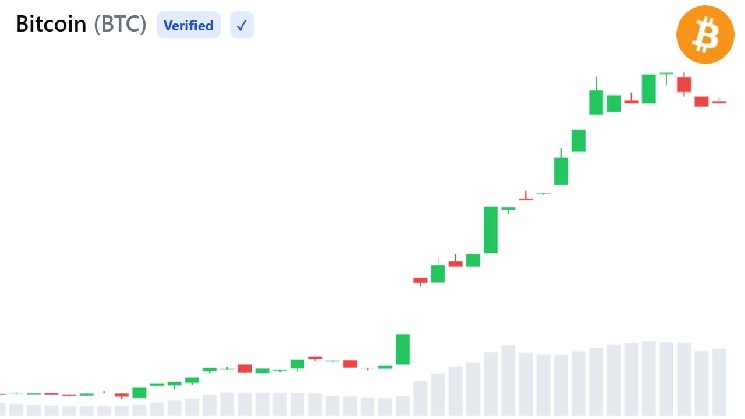
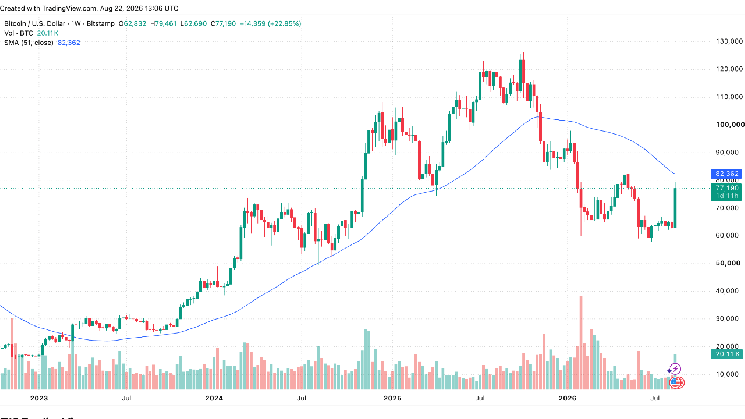
Possibly influenced by this clear positive signal, the cryptocurrency industry surged overnight, with BTC once breaking through the $70,000 mark and ETH approaching a 20% gain — for details, please refer to "The Bull Is Back: The Four Major Drivers Behind the Overnight Surge in the Crypto Market".
Below is the speech and remarks made by Trump himself at the meeting, compiled by Odaily Planet Daily.
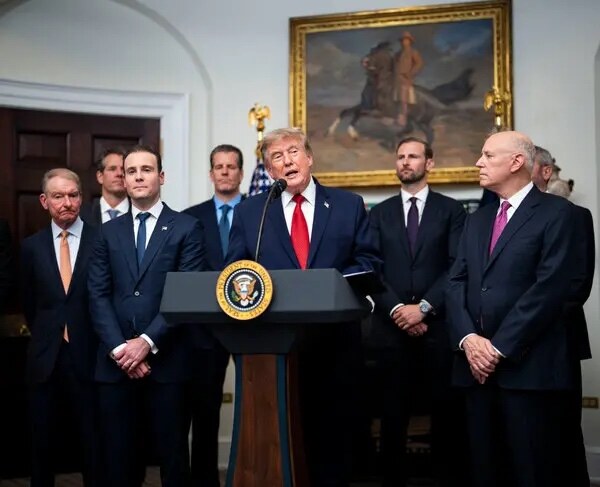
Seriously, we have a group of very important people here today. If you love the financial world like I do — and I really do love finance — everyone here today is a big figure in finance. Incredibly, you might not know some of them, but anyone in the finance circle should know every single person here.
Thank you all very much for being here today. We warmly welcome the best talent from America's finance, cryptocurrency, and technology sectors.
Here in Washington D.C., we are about to hold the first meeting of the U.S. Commodity Futures Trading Commission (CFTC) Innovation Advisory Committee. This is a committee of very smart people who will advise us on what we should do.
Right, Paul (referring to SEC Chairman Paul Atkins)? They're going to tell us some things.
But I think Paul understands these issues better than anyone, and he's doing a fantastic job. We are all very pleased with Paul, and I think everyone feels the same. He is really great.
From the cryptocurrency market, prediction markets, to traditional finance, and then to decentralized finance, the people in this room are ensuring that the future of commercial markets is pioneered and perfected right here in the United States.
We are competing with many other countries for control of these markets, market share, and the profits, jobs, and everything else created from them. And we are doing very well. We are leading in every aspect, including artificial intelligence, and by a significant margin. We want to maintain that lead.
I want to thank CFTC Chairman Michael Selig for his outstanding leadership. (Looking around) Michael, come here quickly... (Then suddenly noticing he's nearby) Oh, you're so close, I almost didn't recognize you.
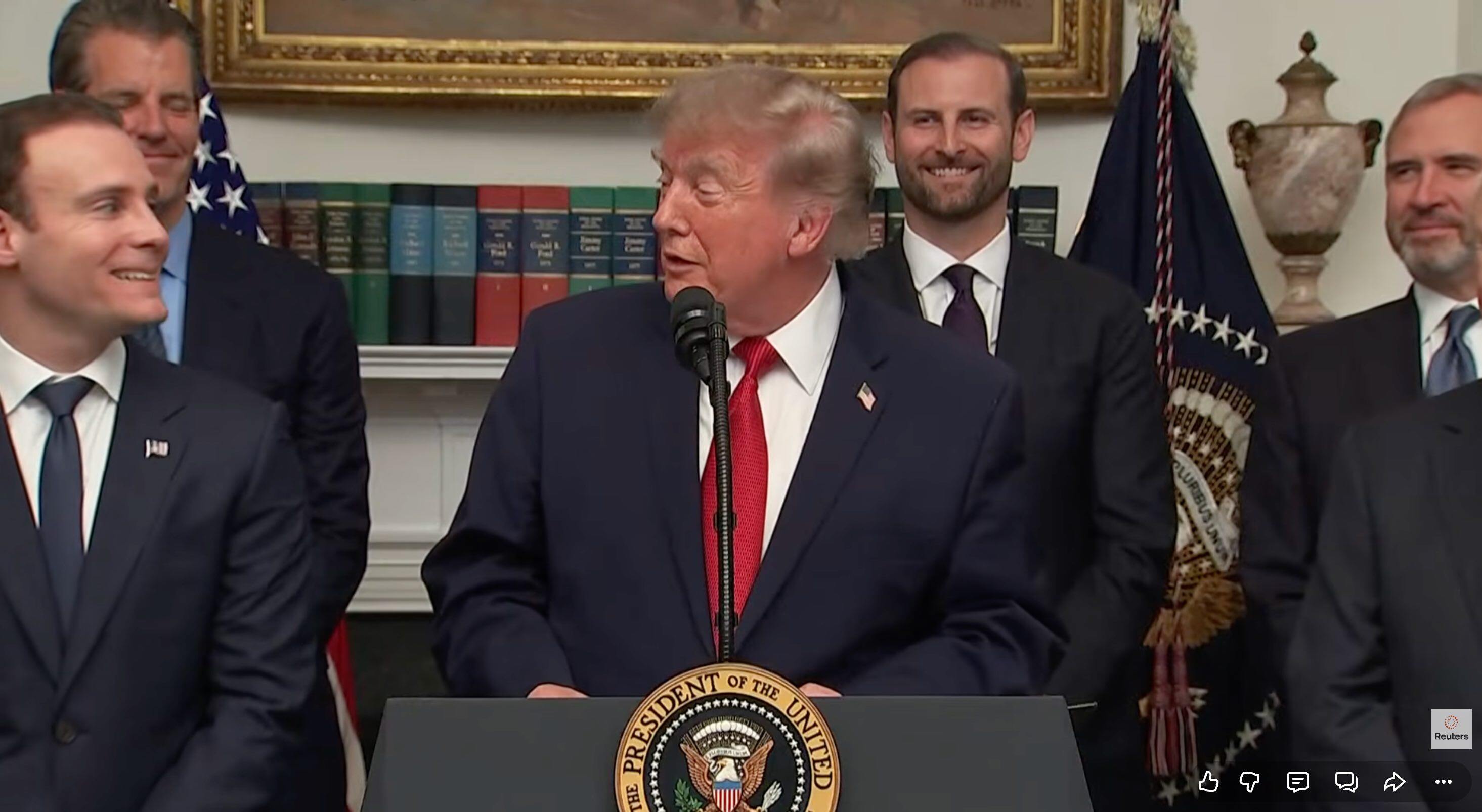
I also want to thank a very special person, someone who has long been respected by everyone. I wanted him for this position long before he became SEC Chairman.
Paul Atkins, you are also doing a fantastic job, and you handle everything well. You have done a lot for the country. So I want to thank you very much. Well done. Thank you.
We also welcome the Executive Director of the Presidential Digital Asset Advisory Committee, Patrick Witt... and many top industry leaders, including Coinbase CEO Brian Armstrong, one of the best in this field.
(To Brian) Where are you? Where did you go? Oh, you look good. You look much younger. In great shape.
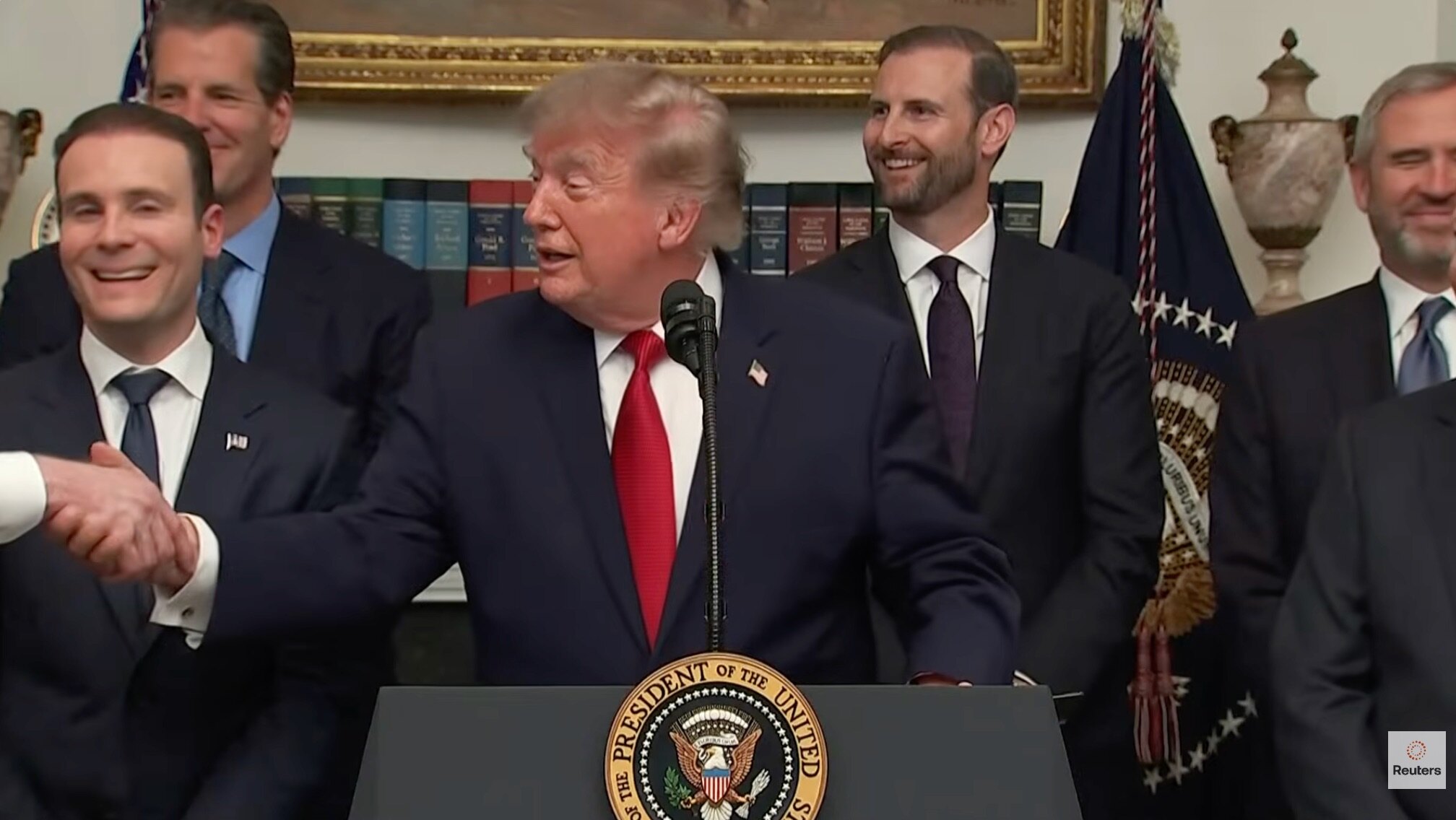
And Intercontinental Exchange CEO Jeff Sprecher. They own a little outfit called the New York Stock Exchange. That's right, he owns the NYSE. That's a pretty good asset, right?
And Nasdaq CEO Adena Friedman. Thank you very much. You're doing great.
And Robinhood CEO Vlad Tenev, thank you. Nice to meet you.
And Kraken CEO Arjun Sethi. (Looking around) Wherever you are, thank you very much.
Thank you all. This is a group of very talented people. We have some others here whom we also hoped would attend.
(Continuing to look around) Where is Mike (referring to Mike Belshe)? He is the Co-founder, CEO, CTO, and President of BitGo. BitGo is a big player in the cryptocurrency space.
And Ripple CEO Brad Garlinghouse. Brad, thank you very much.
Chainlink Labs Co-founder Sergey Nazarov. Thank you, Sergey, well done.
(Looking for Kraken CEO again) Arjun, are you here? Oh, Arjun, I'm still here, and you're still here, you haven't left.
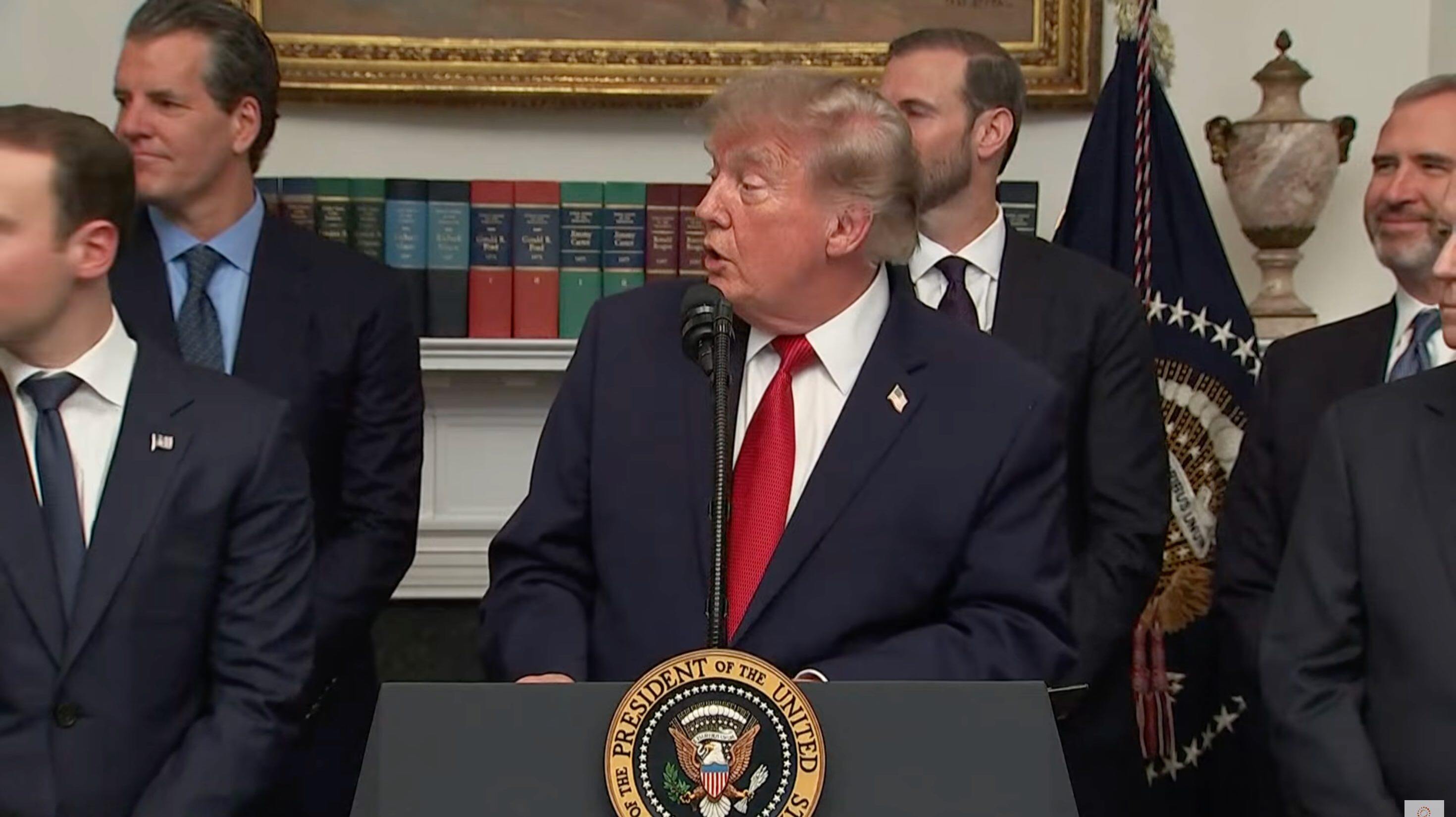
Peter Smith (referring to Blockchain.com CEO) is also here.
And Tyler and Cameron Winklevoss (referring to the two co-founders of Gemini), they are both excellent people, outstanding investors, and Chris Dixon (referring to a16z crypto Managing Partner) is here too.
I think I've pretty much mentioned everyone. If I missed anyone, by the way..., they gave me four lists, so it's a bit complicated. You definitely don't want to read the same name more than three times in a row like in the "corrupt Joe Biden administration."
The innovative spirit that gave birth to America was under unprecedented attack. This was especially true in cryptocurrency and other emerging fintech fields, where we were on the verge of being left completely behind by China and other countries.
The radical left tried to strangle these developments with devastating regulations, brutal restrictions, and weaponized tactics. They used political means to suppress and continued to target the industry, ultimately driving innovation overseas.
They just wanted to drive innovation out. But as the election was nearing its end — if you remember — they suddenly declared that they loved cryptocurrency very much because they suddenly discovered that over 100 million people started liking Trump more, just because I supported cryptocurrency.
They were against cryptocurrency, then suddenly became very supportive. But by then, it was too late.
Those days are completely over. It was a very bad period, especially for many good, honest financial people.
On day one, we fired the runaway SEC Chairman Gary Gensler from the Biden administration.
I think we prefer Paul (audience applauds), right?
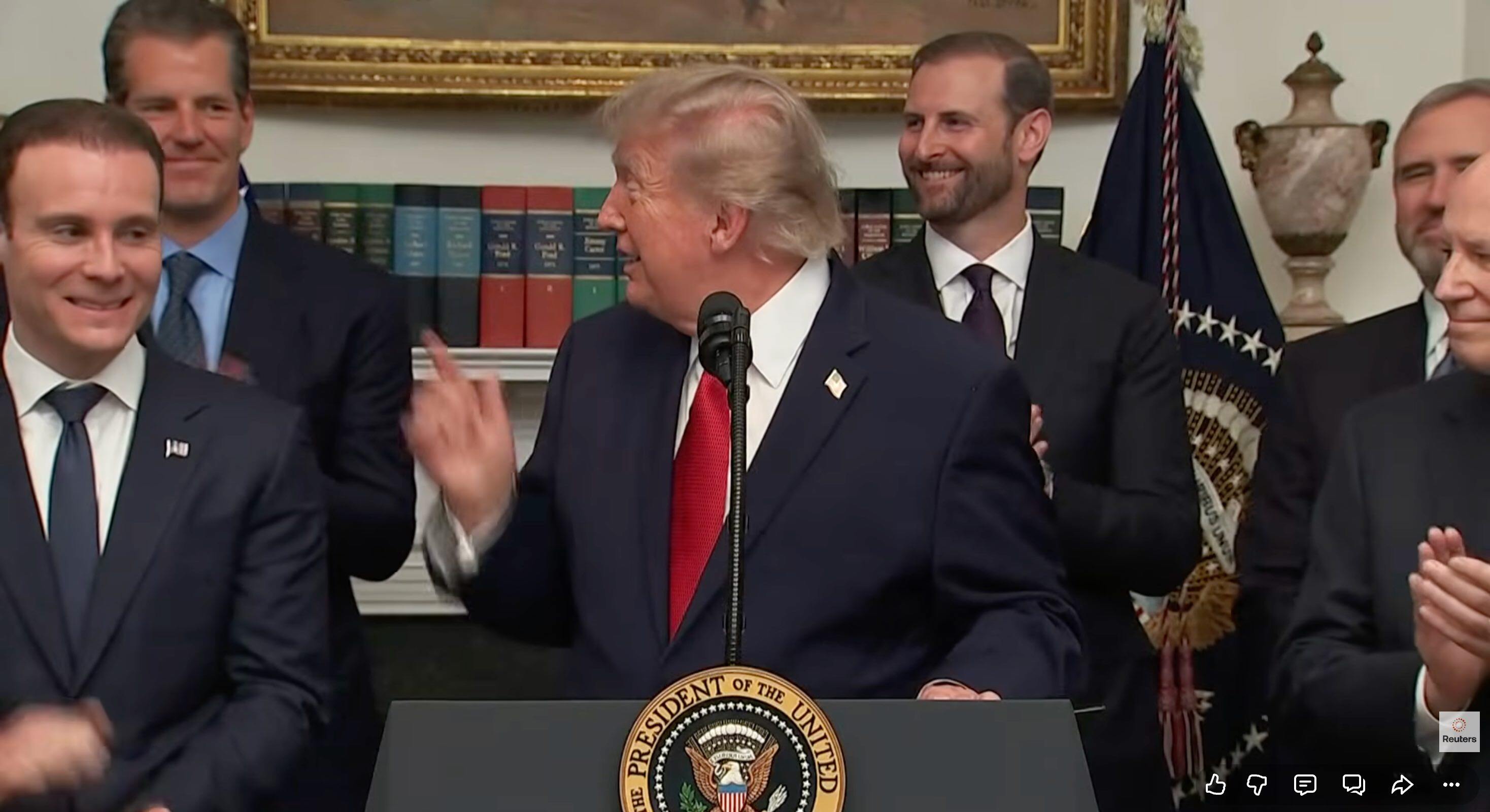
The top guy (referring to SEC Chairman) got smarter. By the way, Paul is indeed much smarter, but anyway, we fired Gensler, just kicked him out. We ended the so-called "Operation Choke Point 2.0" — that's what they called it then, it was a political weaponization.
We ended the war on cryptocurrency once and for all. And now, the crypto industry is booming. Doing very well, and no one can stop it.
China certainly wants to break into this field, and they are still trying.
I signed a historic executive order prohibiting any attempt to establish a Central Bank Digital Currency (CBDC).
We launched "Project Crypto" to modernize the rules, allowing U.S. financial markets to enter the era of blockchain technology.
I established the U.S. Strategic Bitcoin Reserve, making Bitcoin a permanent asset of the U.S. Treasury. This policy has proven to have a very amazing effect.
I also created the U.S. Digital Asset Stockpile to custody all other digital assets. This is its mission, and the results are astonishing.
About this summer a year ago, I signed a landmark law called the "GENIUS Act." That's the name I gave it. I didn't want to use my own name, so I called it the "GENIUS" Act.
This act paved the way for the widespread adoption of U.S. dollar-backed stablecoins. This policy is working very well, and every American benefits greatly from America's position as the global financial center, and we want to maintain that position. We are leading by a huge margin.
The progress we've made in the last 16 months is so great, nobody can believe it.
Not only that, but the investment capital flowing into the U.S. now is more than any country at any time in history. Money is pouring in by the trillions of dollars.
America's economic dominance has brought in trillions of dollars in investment, created millions of jobs, and expanded access to credit and capital for everyone, giving every American a chance at the "American Dream."
We hear the term "American Dream" a lot now. Young people are rediscovering the American Dream. Two years ago, they weren't thinking about that.
New fintech is extending this American dominance into the 21st century. That's why we are committed to establishing a clear regulatory framework for innovators and builders — like the people here with me today — so they can operate with confidence right here in the United States.
They don't need to go to other countries to do business.
We are ensuring that America maintains its undisputed leadership not only in Bitcoin and cryptocurrency, but also in prediction markets, artificial intelligence, and more technologies.
And we are taking the lead in every field. I'll tell you, in artificial intelligence, we are far ahead of second place, which is China.
I never want to underestimate China. But right now, we are leading by a lot. President Xi Jinping will be visiting on September 24th, we look forward to that meeting, we will probably talk about AI, and many other things.
But we are doing very well now, and that is largely thanks to the people here, and a few others on the committee who will be joining us in two weeks.
This past May, CFTC Chairman Michael approved the first true Bitcoin perpetual futures contract and launched it on an exchange registered with the CFTC. That was the first step.
I understand Michael is also working hard to bring Hyperliquid into the U.S. in a fully compliant, legal way. He is working very hard on that there.
We really want to see interest rates come down.
You know, in the past, interest rates were like this — many people might be too young to know this — whenever we released great economic data, interest rates would go down.
The theory then was that asset values would become better, more investable, but now, whenever we release strong data (and we are constantly releasing good data), they keep pushing rates up because they're afraid of inflation, which they absolutely shouldn't do.
They shouldn't do that, they should let rates come down.
When you release good economic data, you shouldn't push interest rates up because of it. They've always thought they had to raise rates to curb inflation, but economic growth and success do not cause inflation; inflation is caused by other factors.
We inherited the highest inflation in American history from the Biden administration. It drove up prices and everything else, and we are bringing all of that down.
But as America succeeds, interest rates should be allowed to fall, not rise because America is succeeding.
Meanwhile, we are in the very early stages of a financial revolution. Look at some of the things happening in finance now, fintech has enormous potential to create more jobs, more opportunities, and more wealth, allowing all Americans to benefit. And that's exactly what it's doing — creating jobs and tremendous wealth.
I don't think anything illustrates this better than the stock market. In a very short period, about a year and a half, our stock market has hit all-time highs 80 times.
I haven't looked today, maybe I shouldn't look, I don't want to look, but I hear it's doing well today.
(Calling out to Intercontinental Exchange CEO) Jeff, the stock market has hit all-time highs 80 times, nobody has ever seen anything like this before, right?
And I think we are taking it to another level, maybe a higher level — judging by its importance.
401(k) pension accounts have hit all-time highs about 40% of the time during my presidency. This affects tens of millions of Americans, 401(k) accounts are now at record levels.
So, two years ago, our country was "dead." And now, our country is the hottest country in the world. No other country comes close. No other country can compare. Every country would acknowledge this.
So now, we need Congress to take the next step and push through the "CLARITY Act." A fair version of the "CLARITY Act" will be landmark structural legislation.
This is a very, very powerful market structure bill. It will allow us to stay ahead of China, stay ahead of all other countries. At the same time, it will also open the door for the next wave of innovation and the next generation of innovators.
Related Reading
"SEC's New Crypto Regulation Explained: Token Offerings Under $5 Million No Longer Require Registration, Is the Altcoin Season Returning?"