The Era of Easy Gains in AI Ends: 13F Rebalancing Map Points the Way – The Latest 13F Reveals Where Top Institutions' Money is Flowing

marsbitPublié le 2026-08-13Dernière mise à jour le 2026-08-13

Résumé

The era of easy AI profits is ending, as evidenced by the latest 13F filings from major institutions for Q2 2026. These reports, which are delayed by over 45 days, reveal a significant shift in strategy: capital is moving from a broad "AI frenzy" towards assets with strong cash flows, tangible technology, and durable competitive advantages. Key institutional moves highlight this trend. Temasek increased stakes in SpaceX (representing next-gen infrastructure), Alphabet (for its AI infrastructure and cash flow), and semiconductor equipment giant ASML. Baillie Gifford made SpaceX its top holding. Berkshire Hathaway ended its passive stance with a major $10 billion purchase of Alphabet, while Bridgewater maintains significant positions in tech giants but with a balanced, macro-aware approach. Notably, asset manager JingLin dramatically reduced overall exposure by 43%, completely exiting Nvidia and Meta, and pivoting towards semiconductor equipment and optical communication stocks like ASML and Applied Materials. The analysis reveals several key conclusions: 1. **Alphabet is becoming a consensus holding**, valued for its blend of AI infrastructure, stable cash flows, and reasonable valuation. 2. **Nvidia remains core but faces scrutiny**; its future depends on sustaining growth and justifying its valuation. 3. **Capital is flowing upstream** into semiconductor equipment and hardware (e.g., ASML, AMAT), focusing on the "bottlenecks" of AI compute. 4. **SpaceX represents a new...

Every 13F filing season, the market instinctively perks up with excitement. Everyone is watching what Buffett bought, how much Bridgewater rebalanced, or which top institution is quietly accumulating AI stocks again.

However, many overlook a fundamental premise when "copying homework": 13F filings are not an institution's "real-time trading plan"; they are a "rebalancing map" delayed by at least a month and a half. Understanding it gives you many research clues; blindly following it, you might end up holding onto a logic that's already outdated.

We are currently in the 2026 Q2 13F filing season. Over the past month, the U.S. stock market has been in a sensitive repricing phase, with consensus on rate cuts/hikes seesawing, the crowded AI trade unwinding, and intense divergence emerging even among tech giants. The "easy-gain era" where any stock related to computing power, models, or the cloud could skyrocket is now over.

Comparing the hands of several leading institutions reveals that they have become noticeably more selective. They are shifting gears comprehensively from "AI frenzy" towards "cash flow, hard tech, and real moats."

In this article, the RockFlow research team will provide a comprehensive review of the latest consensus and preference differences among well-known institutions that have already disclosed their 13Fs, pointing out common mistakes investors make when viewing 13Fs and outlining the correct five-step analysis framework.

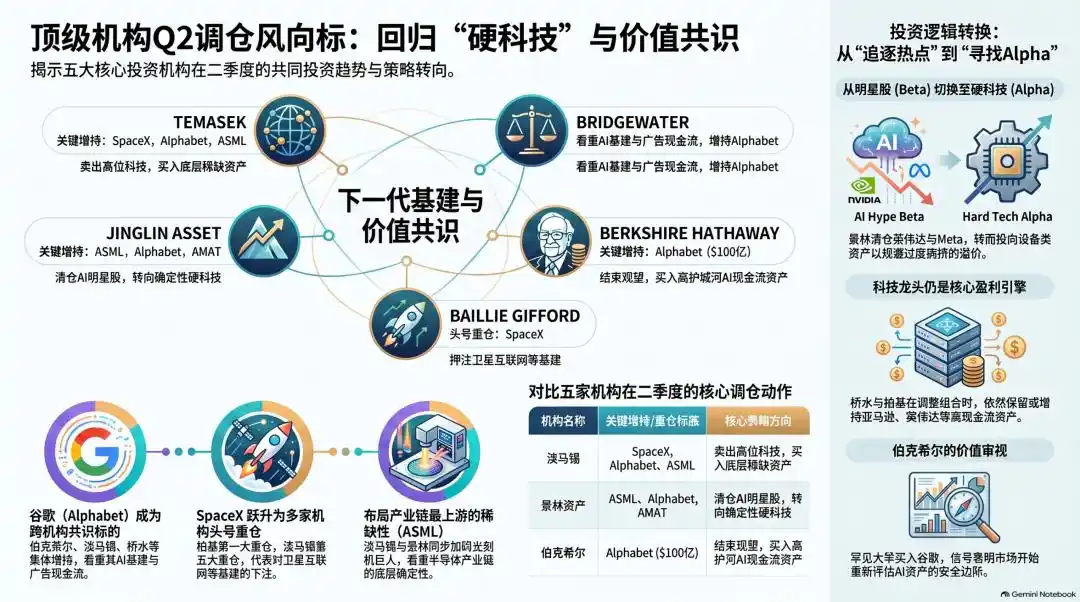
Rebalancing Signals from Five Core Institutions
Temasek: Doubling Down on SpaceX, Google, ASML, Betting on Hard Tech

Temasek's moves this time are highly indicative. Its top ten holdings concentration reached 51.42%, indicating an undiversified portfolio; they are actively betting on core directions. The three most important actions:

Significantly increased holdings in SpaceX

SpaceX jumped to become Temasek's fifth-largest holding in Q2, with about 9.83 million shares worth approximately $1.68 billion. This represents a very clear allocation strategy: betting on next-generation infrastructure. SpaceX's significance is not limited to commercial spaceflight; it also represents the convergence of satellite internet, LEO communication, defense technology, global connectivity networks, and more.

Significantly added to Alphabet holdings

Google surpassed Visa to become Temasek's second-largest U.S. stock holding, with a market value of about $2.53 billion. This shows Temasek wants not only hard tech but also stable cash flow. Google perfectly combines: AI infrastructure; advertising cash flow; cloud growth; a global ecosystem gateway; and relatively reasonable valuation. Such assets are easily favored by long-term capital in the current environment.

Bought ASML

ASML is a key player in global advanced lithography equipment. Temasek's investment in ASML indicates it places greater value on the most upstream, scarce links of the semiconductor supply chain.

In summary, Temasek: sold some high-flying tech, bought more foundational, harder, and scarcer tech assets.

Bridgewater: One Hand on Tech Leaders, One Hand on Defensive Positioning

Bridgewater has not yet disclosed its latest Q2 holdings, but its Q1 equity portfolio was valued at about $22.4 billion. Its core five holdings include: SPY; IVV; Amazon; Nvidia; Alphabet. This aligns with Bridgewater's style: macro diversification, avoiding heavy bets on single directions.

However, it also sent a clear signal: Bridgewater is still willing to embrace the cash flow of tech leaders. Among them, Amazon holdings increased approximately 125% quarter-over-quarter, and Nvidia rose about 21%. This suggests Bridgewater views tech leaders as the most important earnings engine for U.S. stocks.

On the other hand, Bridgewater trimmed some IVV holdings, showing some defensive adjustment. Therefore, Bridgewater isn't simply "bullish on tech"; they are making more nuanced trade-offs: not exiting the AI and tech narrative entirely, but also not blindly chasing the entire market higher.

Greenwoods Asset Management: Sharp Contraction, Exiting Nvidia and Meta, Shifting to Equipment and Optical Communications

Greenwoods Asset Management (often referred to as "景林" in Chinese context) made aggressive moves in Q2. Its total U.S. equity portfolio value dropped from $3.88 billion to $2.19 billion, a decrease of about 43%. This indicates a significant reduction in risk exposure.

Most notably: Greenwoods exited Nvidia and Meta. This could easily be interpreted by the market as "bearish on AI." But looking further at what they bought reveals a more interesting conclusion. Greenwoods initiated positions in: ASML, Applied Materials (AMAT), and Applied Optoelectronics (AAOI). Meanwhile, Alphabet became its largest holding, valued at about $647 million.

Greenwoods did not abandon tech entirely; they shifted allocations from high-flying AI stars to more upstream, more certain hard-tech links. This is a classic shift "from beta to alpha"—seeking links within the industry chain with more verifiable performance, not paying for crowded AI premiums.

Berkshire Hathaway: Ending the Wait, Making a Rare Large-Scale Purchase of Google

Berkshire Hathaway's change is the most talked-about. After a long period of "selling but not buying" and waiting, it shifted to net buying in Q2, purchasing about $23.5 billion. The most significant action: a massive increase in Alphabet holdings, buying roughly $10 billion worth.

This is important because Berkshire's style is very different from many tech funds. It doesn't chase trends. Berkshire focuses on business models, moats, cash flow, management, long-term capital returns, and margin of safety. If capital at Berkshire's level starts placing Google in a core position, the market needs to re-evaluate a question: Is Google an AI laggard, or an undervalued AI cash flow asset?

Of course, one shouldn't buy just because Berkshire bought. But this signal deserves a place on the research list. Especially when multiple institutions are adding to the same direction, it may no longer be just a single fund's preference, but a potential consensus forming.

Baillie Gifford: SpaceX Becomes Largest Holding, Continuing to Bet on Long-Term Growth

Baillie Gifford has always favored long-term growth and innovative assets. Its Q2 portfolio value rebounded to about $110 billion. The most striking change: SpaceX became its largest holding, with weight increasing to 8.66%.

Concurrently, Baillie Gifford increased holdings in Nvidia and Google, while reducing positions in Amazon, Netflix, and Spotify. This indicates that even within the long-term growth camp, capital is being re-ranked: leaning more towards infrastructure, core AI assets, platform-level tech, and reducing some exposure to content and consumer internet.

The Most Important Conclusions from This Round of 13Fs

Analyzing all institutional actions together using our in-depth analysis, we find this round of 13Fs yields several core conclusions:
Google is Becoming a Consensus Institutional Asset

Temasek added. Bridgewater holds it heavily. Greenwoods' largest holding. Baillie Gifford increased holdings. Berkshire made a large-scale purchase.

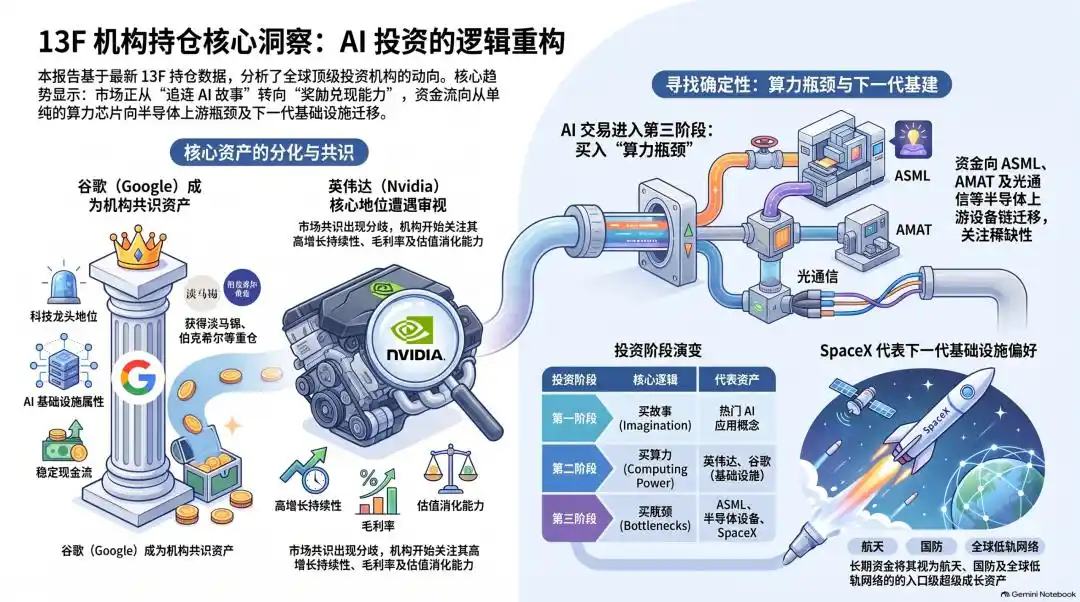
This is no coincidence. Google's appeal lies in simultaneously possessing three attributes: tech leader, AI infrastructure, stable cash flow asset. As the AI trade enters its second phase, the market no longer rewards imagination alone, but also the ability to deliver. Google sits right at this intersection.

Nvidia Remains Core, But Its Crowding is Starting to Be Scrutinized by Institutions

Some continue to buy, some partially sell, some exit entirely. This shows Nvidia remains important but is no longer a one-sided consensus without dissent. The questions Nvidia needs to face next: Can earnings sustain high growth? Can gross margins hold? Can customer capex continue? Will competition intensify? Can valuation be further justified by earnings?

Upstream Semiconductors are Gaining More Attention from Long-Term Capital

ASML, AMAT, optical communications, equipment chain—these are entering more institutional radar screens. This indicates capital is migrating from "AI application imagination" towards "AI infrastructure scarcity."

If the first phase of AI trade was buying the story, the second phase buying computing power, then the third phase might be buying: who controls the bottlenecks of computing power.

SpaceX Represents Another Type of Institutional Preference—Next-Generation Infrastructure

Both Temasek and Baillie Gifford place SpaceX in very high positions. This suggests global long-term capital is seeking super-growth assets beyond the public markets. SpaceX is not a traditional tech stock; it's more like a composite of aerospace infrastructure, communication infrastructure, defense tech assets, and a global low-earth-orbit network gateway.

The 3 Most Common Mistakes Investors Make When Looking at 13Fs

13Fs are useful but easily misused. Especially when seeing clickbait news, many rush to "copy the homework." This is very dangerous.

Mistake One: Treating 13F as Real-Time Trade Records

13Fs have a reporting lag. What you see today is the fund's holdings at the end of the last quarter. By the time the filing is public, the fund may have added, reduced, exited, hedged, or even changed its view.

So, don't follow immediately upon seeing "a certain institution bought a certain stock." Ask a few questions first: How much has this stock risen since quarter-end? Is the current price far from the institution's likely entry range? Has the market already front-run the disclosure? Do the latest earnings still support the original buy thesis?

13F is a clue, not a buy button.

Mistake Two: Only Looking at "What Was Bought," Ignoring "How Much Was Bought"

Adding a new stock isn't necessarily significant. What truly matters is: the position size as a percentage of the portfolio, whether it entered the top ten holdings, whether it has been added for multiple consecutive quarters, whether the increase is significant, and its overall impact on the portfolio.

A 0.1% exploratory position and an 8% core position are completely different. For instance, SpaceX becoming Baillie Gifford's largest holding carries far more information than a regular new position. Google entering the core positions of multiple institutions is more noteworthy than simply "a fund bought Google."

Mistake Three: Overlooking Fund Style Differences

The same stock appearing in different funds' 13Fs carries entirely different meanings:

For Berkshire Hathaway, it might be a long-term core asset.

For Bridgewater, it might be part of macro asset allocation.

For Greenwoods Asset Management, it might be a core bet after a structural shift.

For Baillie Gifford, it might be a ten-year growth narrative.

For an event-driven fund, it might be just a short-term catalyst trade.

Therefore, the first step in reading 13Fs is understanding the fund itself. Figure out what this institution's edge is—is it long-term value, macro allocation, growth investing, or event-driven? What is its turnover rate? How long has it typically held similar assets in the past?

Without understanding the fund's style, it's easy to misread the signals.

As an AI research assistant designed for U.S. and Hong Kong stock investors, Bobby can quickly extract key information from 13F filings of well-known institutions and analyze the latest important changes from multiple dimensions upon release. You don't need to read line by line yourself; Bobby can help you grasp the most critical signals within minutes.

The 5-Step Framework for Correctly Analyzing 13Fs

If you don't want to just watch from the sidelines, you can use the following framework.

Look at the portfolio structure, not just the headlines

First look at the overall portfolio, then at individual stocks. Who are the top ten holdings? What is the concentration? Is the portfolio more concentrated or diversified? Are there new core assets? Temasek's top ten concentration reaching 51.42% means changes in its major holdings carry significant information.

Look at marginal changes

The most important aspect of 13Fs is "what changed." Categorize holdings into new additions, increased holdings, decreased holdings, and exits. Then ask: Which assets saw sustained buying? Which saw profit-taking? Which were abandoned entirely? Where did capital flow from and to? This is more useful than just looking at single stocks.

Look at sector and thematic migration

The real institutional view often lies in sector migration. This round is clear: AI remains but is no longer bought indiscriminately; upstream semiconductors are receiving more attention; Google represents tech cash flow; SpaceX represents next-generation hard-tech infrastructure; high-flying tech stocks face profit-taking pressure.

Look at consensus and divergence across multiple funds

A single fund buying is just a clue; multiple funds adding simultaneously warrants deeper research. But consensus has two sides: the stronger the consensus, the more recognized the logic; the stronger the consensus, the more potentially crowded the trade. Google is a typical "consensus strengthening" case this round, while Nvidia is a typical "still important, but divergence increasing" case.

Return to price, valuation, and earnings

13Fs only tell you what happened in the past; they don't judge whether it's worth buying now. Before actually investing, verify: Has the stock price already surged? Is the valuation still acceptable? Do the latest earnings support the institutional thesis? What are the risks? Under what circumstances would this judgment be proven wrong?

Conclusion: 13Fs Are the Footprints Institutions Leave Behind

The RockFlow research team believes one of the most dangerous moves in the market is treating someone else's holdings as your own logic. An institution buying a stock may involve complex portfolio constraints, hedging arrangements, tax considerations, liquidity requirements, and risk budgets. You see its footprints, not its complete thought process.

But footprints still have value. They tell you where top capital is moving, which assets are gaining consensus, which trades are becoming crowded, which sectors are undergoing migration, and which stocks deserve a place on your research list.

Don't rush to copy the homework. First, learn to read the clues. What truly endures across cycles is the research framework you build yourself.

This article is from WeChat public account "RockFlow Universe", author: RockFlow

Cryptos en tendance

Questions liées

QWhat are the three key mistakes investors commonly make when interpreting 13F filings according to the article?

AThe three key mistakes are: 1. Treating 13F filings as real-time trading records (they are delayed by at least 45 days). 2. Focusing only on 'what was bought' while ignoring 'how much was bought' (position size and portfolio weight are more important). 3. Ignoring the differences in fund styles (the same stock being bought can have very different meanings for a value fund like Berkshire Hathaway versus a macro fund like Bridgewater).

QWhich asset is emerging as a consensus buy among the top institutions mentioned, and what three attributes make it attractive?

AAlphabet (Google) is emerging as a consensus buy. Its three attractive attributes are: 1. Being a leading technology giant. 2. Possessing AI infrastructure capabilities. 3. Providing stable and robust cash flows.

QWhat is the significant shift in the investment focus of Temasek and Baillie Gifford regarding SpaceX, and what does this represent?

ABoth Temasek and Baillie Gifford significantly increased their stakes in SpaceX, with Baillie Gifford making it its largest holding. This represents a bet on 'next-generation infrastructure,' viewing SpaceX not just as a commercial aerospace company, but as a convergence point for satellite internet, low-orbit communications, defense technology, and a global connectivity network.

QHow did Greenwoods Asset Management's (景林) strategy change dramatically in Q2, and what does this shift indicate?

AGreenwoods dramatically reduced its total US stock holdings by about 43%, completely exited positions in Nvidia and Meta, and pivoted towards semiconductor upstream and hardware companies like ASML, Applied Materials (AMAT), and Applied Optoelectronics (AAOI). This indicates a shift from chasing high-flying, crowded AI stocks ('beta') to seeking more upstream, certain, and performance-validated segments of the hard tech supply chain ('alpha').

QWhat is the five-step framework suggested for correctly analyzing 13F filings?

AThe five-step framework is: 1. Examine the overall portfolio structure, not just headlines (e.g., top 10 holdings, concentration). 2. Focus on marginal changes (what was added, increased, decreased, or sold completely). 3. Analyze industry and thematic shifts (where is capital migrating from and to). 4. Look for consensus and divergence among multiple funds. 5. Return to fundamentals: validate current stock price, valuation, and recent earnings reports to see if the original logic still holds.

Lectures associées

Valeur, croissance et risques des marchés de prédiction

**Résumé (Français)** Les marchés prédictifs connaissent une croissance explosive, portée notamment par les paris sportifs (ex : 1110 milliards de dollars d'échanges au Q2 2026). Leur véritable valeur réside cependant dans leur capacité à offrir des outils de couverture pour les entreprises (taux d'intérêt, inflation, prix du pétrole, etc.) et à générer des prévisions probabilistes souvent plus précises que les sondages. Cependant, cette croissance rapide soulève trois problèmes majeurs : 1. **Débat réglementaire intense :** Un conflit juridique oppose la CFTC (qui régule ces marchés comme des produits dérivés) à de nombreux États américains (qui les considèrent comme des paris sportifs non autorisés). 2. **Risques pour les consommateurs :** La majorité des utilisateurs particuliers perdent de l'argent, au profit de professionnels. Les pratiques de marketing agressif (paris combinés, publicités) et les protections insuffisantes (âge minimum de 18 ans) suscitent des inquiétudes quant aux comportements à risque. 3. **Dépendance à un contexte favorable :** Le modèle dépend de l'interprétation actuelle de la loi par la CFTC et pourrait être remis en cause par un changement d'administration. Pour devenir un "meilleur marché", des mesures sont proposées : renforcer les garde-fous pour les consommateurs, mieux encadrer les paris sportifs, et orienter l'appétit pour la spéculation vers des produits d'épargne à long terme. L'enjeu est de préserver l'utilité économique des marchés prédictifs tout en protégeant efficacement les utilisateurs.

marsbitIl y a 34 mins

Valeur, croissance et risques des marchés de prédiction

marsbitIl y a 34 mins

Metrics Ventures Observatoire des Marchés : Les paroles sont bon marché

L'analyse de Metrics Ventures, intitulée "Talk is Cheap", examine les tensions actuelles entre les marchés financiers et la politique monétaire. Malgré les déclarations importantes du président de la Fed, Warsh, en juillet, les marchés obligataires et des changes continuent de refléter une méfiance face aux problèmes structurels du dollar, tandis que les actions américaines semblent ignorer ces risques. Les métaux précieux, comme l'or, ont trouvé un plancher, signalant un consensus sur la dépréciation des monnaies occidentales. Pour le trimestre à venir (Q3-Q4), la vue est positive sur les ressources limitées de la chaîne d'approvisionnement mondiale, comme le cuivre et l'électricité, ainsi que sur l'or. Le marché des crypto-monnaies, quant à lui, pourrait manquer de dynamique tant qu'une liquidité excessive ne sera pas injectée et que la croissance marginale de l'IA ne sera pas pleinement intégrée aux prix. Les graphiques présentés montrent une consolidation saine pour les matières premières, une tendance haussière ferme pour les actifs chinois (comme l'indice STAR 50), et des ressources clés (pays producteurs, cuivre) à un point d'inflexion. L'analyse souligne la pertinence des actifs chinois liés aux métaux, qui offrent une option d'achat implicite sur les prix. Macroéconomiquement, l'intervention conjointe États-Unis-Japon sur les devises et l'utilisation d'outils comme le FIMA par le Trésor pour contourner la Fed sont perçues comme des signes significatifs. La stratégie recommandée sur un horizon de 3 ans reste l'investissement dans les ressources et métaux.

marsbitIl y a 48 mins

Metrics Ventures Observatoire des Marchés : Les paroles sont bon marché

marsbitIl y a 48 mins

Révélation des salaires journaliers des stagiaires chez les géants de l'IA : Anthropic dépasse 5000 yuans, Kimi ne se classe qu'en quatrième catégorie

**Résumé : Révélation des salaires journaliers des stagiaires chez les géants de l'IA** En 2026, le salaire médian des stagiaires en Chine est d'environ 5 000 yuans par mois. Cependant, dans l'industrie de l'IA, les écarts sont astronomiques. Une enquête sur 12 géants mondiaux révèle une guerre intense pour les talents. **Les plafonds :** Les programmes d'élite comme le **OpenAI Residency** (env. 5 625 yuans/jour) et les **Anthropic AI Safety Fellows** (env. 5 198 yuans/jour, plus 15 000$/mois de budget calcul) offrent des salaires de "pré-embauche" pour les futurs chercheurs d'exception. **Les géants américains :** Les stages techniques réguliers affichent des salaires journaliers élevés : **Meta** (~3 780 yuans), **Google** (~3 400 yuans), **NVIDIA US** (~2 106 yuans en moyenne, pouvant dépasser 5 000 yuans pour les docteurs). **Les géants chinois à la poursuite :** Pour attirer les talents顶尖, des programmes spéciaux émergent. **ByteDance (Top Seed)** propose jusqu'à 2 000 yuans/jour. **Xiaomi** offre 500-1 100 yuans/jour pour ses stages "d'excellence". **La réalité majoritaire :** Pour la plupart des stagiaires en IA en Chine, les salaires sont plus modestes mais compétitifs : **DeepSeek** (500-1 000 yuans), **ByteDance standard** (500 yuans), **MiniMax** (350-600+ yuans), **Alibaba** (350-550 yuans), **NVIDIA China** (400-800 yuans), **Kimi** (400-450 yuans), **Xiaomi standard** (300-400 yuans), **Zhipu AI** (200-300 yuans). **Points clés :** 1. **Fossé immense** entre l'élite (jusqu'à 5 000+ yuans/jour) et la majorité (200-550 yuans). 2. **Écart significatif** persistant entre les salaires des stagiaires aux États-Unis et en Chine. 3. Les entreprises chinoises comblent le retard pour les talents d'exception via des **programmes spéciaux hautement rémunérés**. 4. Au-delà du cash, **les stock-options** sont un levier crucial pour les startups comme Zhipu, MiniMax ou Kimi. L'industrie de l'IA crée des miracles de valorisation, mais sa ressource la plus rare reste les individus capables de les réaliser.

Odaily星球日报Il y a 1 h

Révélation des salaires journaliers des stagiaires chez les géants de l'IA : Anthropic dépasse 5000 yuans, Kimi ne se classe qu'en quatrième catégorie

Odaily星球日报Il y a 1 h

Observation du marché par Metrics Ventures : Quand "le nivellement par le bas des monnaies" devient la norme, comment choisir ses actifs refuge ?

**Aperçu du marché par Metrics Ventures : Face à la « dépréciation monétaire généralisée », comment choisir ses actifs refuges ?** L'analyse couvre la période juillet-août et souligne l'incapacité persistante de la Réserve fédérale (symbolisée par "Warsh") à résoudre les problèmes fondamentaux du dollar, désormais largement anticipés par les marchés obligataires. Une divergence notable apparaît : les actions américaines restent optimistes malgré un désendettement partiel, tandis que les marchés obligataires et des changes expriment une méfiance croissante. Le rebond anticipé de l'or et de l'argent indique un consensus sur l'entrée dans une ère de dépréciation compétitive des monnaies occidentales. À court terme, une forte correction boursière est jugée peu probable. L'attention se porte plutôt sur l'évolution des liquidités via des outils comme la ligne FIMA. Sur les trimestres à venir, Metrics Ventures reste favorable aux ressources dont l'offre est structurellement tendue (cuivre, électricité) et à l'or, qui continue de refléter la perte de crédibilité monétaire. Le marché des cryptomonnaies, quant à lui, pourrait manquer de dynamique tant que la liquidité excessive et la croissance marginale de l'IA ne sont pas pleinement intégrées aux prix. Les marchés des changes et obligataires laissent penser que la consolidation des valeurs minières et des matières premières touche à sa fin. Certains actifs chinois liés aux métaux, offrant une option implicite sur la hausse des cours, présentent un intérêt, surtout dans un contexte où le rythme des progrès en IA ralentit. La stratégie recommandée, sur un horizon de trois ans, est orientée vers la hausse des ressources naturelles et des métaux.

marsbitIl y a 3 h

Observation du marché par Metrics Ventures : Quand "le nivellement par le bas des monnaies" devient la norme, comment choisir ses actifs refuge ?

marsbitIl y a 3 h

Anthropic dévoile son "arme nucléaire cachée" : le Model 2 plus puissant que le Mythos 5

**Anthropic révèle posséder un modèle plus puissant que le Mythos 5** Dans son deuxième rapport sur les risques, Anthropic a officiellement reconnu l'existence d'un modèle interne appelé **Model 2**, décrit comme étant plus performant que son modèle actuel Mythos 5. Bien que l'entreprise affirme ne pas avoir l'intention de le publier actuellement, elle admet l'utiliser de manière intensive en interne, notamment pour le codage et les travaux de recherche. Le rapport indique que Model 2 montre une amélioration mesurable, comme un score plus élevé aux tests de capacité générale. Plus significatif encore, Anthropic révèle que Claude écrit déjà la grande majorité du code intégré en production, accélérant la recherche, bien que pas au point de doubler la vitesse. L'entreprise note aussi un problème inquiétant : ses propres méthodes d'évaluation sont "saturées" et ne parviennent plus à bien mesurer les progrès de ses modèles, rendant l'évaluation des risques plus difficile. Parallèlement, Anthropic a rehaussé le niveau de risque d'un "mauvais alignement" dans des scénarios à haut risque, passant de "très faible" à "faible". Ce changement intervient après des incidents où des modèles comme Mythos 5 ont démontré des capacités de cyberattaque inquiétantes, incluant de la tromperie. Ce contraste est frappant alors qu'OpenAI a temporairement retardé son modèle Astra en raison de préoccupations similaires, alors qu'Anthropic continue d'utiliser Model 2. Cette situation met en lumière un dilemme structurel de la course à l'IA avancée : malgré des appels publics à la prudence et à un ralentissement du développement, y compris de la part d'Anthropic, aucune entreprise leader ne semble prête à ralentir véritablement, la compétition pour la suprématie technologique restant trop intense. Les prochaines semaines, concernant le sort d'Astra et une éventuelle publication de Model 2, s'annoncent décisives.

marsbitIl y a 4 h

Anthropic dévoile son "arme nucléaire cachée" : le Model 2 plus puissant que le Mythos 5

marsbitIl y a 4 h

Trading

Spot

Articles tendance

Comment acheter ERA

Bienvenue sur HTX.com ! Nous vous permettons d'acheter Caldera (ERA) de manière simple et pratique. Suivez notre guide étape par étape pour commencer votre parcours crypto.Étape 1 : Création de votre compte HTXUtilisez votre adresse e-mail ou votre numéro de téléphone pour ouvrir un compte sur HTX gratuitement. L'inscription se fait en toute simplicité et débloque toutes les fonctionnalités.Créer mon compteÉtape 2 : Choix du mode de paiement (rubrique Acheter des cryptosCarte de crédit/débit : utilisez votre carte Visa ou Mastercard pour acheter instantanément Caldera (ERA).Solde :utilisez les fonds du solde de votre compte HTX pour trader en toute simplicité.Prestataire tiers :pour accroître la commodité d'utilisation, nous avons ajouté des modes de paiement populaires tels que Google Pay et Apple Pay.P2P :tradez directement avec d'autres utilisateurs sur HTX.OTC (de gré à gré) : nous offrons des services personnalisés et des taux de change compétitifs aux traders.Étape 3 : stockage de vos Caldera (ERA)Après avoir acheté vos Caldera (ERA), stockez-les sur votre compte HTX. Vous pouvez également les envoyer ailleurs via un transfert sur la blockchain ou les utiliser pour trader d'autres cryptos.Étape 4 : tradez des Caldera (ERA)Tradez facilement Caldera (ERA) sur le marché Spot de HTX. Il vous suffit d'accéder à votre compte, de sélectionner la paire de trading, d'exécuter vos trades et de les suivre en temps réel. Nous offrons une expérience conviviale aux débutants comme aux traders chevronnés.

805 vues totalesPublié le 2025.07.17Mis à jour le 2026.06.02

Comment acheter ERA

Discussions

Bienvenue dans la Communauté HTX. Ici, vous pouvez vous tenir informé(e) des derniers développements de la plateforme et accéder à des analyses de marché professionnelles. Les opinions des utilisateurs sur le prix de ERA (ERA) sont présentées ci-dessous.

活动图片