ENS Governance Restructuring Approved: Foundation Formalized, Finally Able to Pursue .ens Top-Level Domain

marsbitPublié le 2026-08-13Dernière mise à jour le 2026-08-13

Résumé

ENS token holders have approved the "Next Era of the ENS DAO" proposal, formally establishing the ENS Foundation as a legal entity. This enables the Foundation to represent ENS in institutional matters such as pursuing the .ens top-level domain with ICANN, engaging with standard-setting bodies like IETF and W3C, participating in regulatory discussions, defending trademarks, and hiring dedicated staff. The new structure clarifies roles: ENS Labs focuses on core protocol development (like ENSv2), the DAO retains control over protocol contracts and treasury (holding 54.6% of ENS tokens), and the Foundation handles off-chain, institutional representation. The five-member inaugural Foundation Board, appointed and overseen by token holders, includes an Executive Director and independent directors. This governance upgrade aims to strengthen ENS's role as credibly neutral, publicly governed internet infrastructure for the long term.

Author: ENS Foundation

Compiled by: Deep Tide TechFlow

Deep Tide Introduction: ENS token holders have approved a governance proposal, formally establishing the Foundation as a legal entity capable of representing ENS in regulatory matters, standards organizations, and top-level domain negotiations. This addresses a long-standing weakness of the DAO, which previously lacked the ability to handle institutional affairs, while preserving token holders' ultimate control over the protocol and the Foundation's personnel. For those focused on ENS's infrastructure status and governance boundaries, this is a crucial step.

ENS token holders have approved the "Next Era for the ENS DAO" proposal, and the relevant executable content has been completed on-chain. The ENS Foundation is now a fully operational organization with a full-time Executive Director, staff, and a five-member board of directors. This article explains the motivation behind this structure, what the Foundation can now do, and how it allows token holders to retain control over the protocol and the Foundation itself.

Why ENS Needs an Institution-Facing Foundation

Over the past decade, ENS has evolved into core infrastructure: hosting millions of domain names, integrated across wallets, applications, and L2s, with other systems relying on it for resolution. ENS has also engaged with policymakers and institutions like ICANN, which are responsible for coordinating the stable and secure operation of internet naming infrastructure. In 2021, the core team at ENS Labs launched the ENS DAO to safeguard the protocol. Specifically, the DAO placed the protocol's core contracts, pricing, and treasury under the control of token holders. These funds are used to finance public goods, service providers, and community projects within the ecosystem.

By itself, the DAO lacks the legal and operational capacity to act in many of the arenas this infrastructure now needs to represent. It cannot advocate for recognition and management rights of the .ens top-level domain at ICANN. It cannot sign agreements required to participate in standards work at IETF and W3C, cannot hire full-time employees, cannot enforce trademark rights against phishing campaigns impersonating ENS, cannot respond to legal proceedings, and cannot represent ENS in regulatory discussions concerning decentralized naming.

For years, some of this work went undone, while some informally fell to ENS Labs. ENS Labs is an engineering organization never authorized to act as the protocol's representative at the institutional level. Naming policies are being shaped within ICANN, standards bodies, and global regulatory discussions. Until now, ENS has lacked a formal entity to represent it in these settings.

The Foundation is that entity. Specifically, it can now:

  • Represent ENS where naming standards are made. The Foundation can actively participate in ICANN, IETF, W3C, and related forums; pursue recognition and management rights for the .ens top-level domain; and coordinate with the SEAL and DNS infrastructure communities.
  • Engage in policy work. As a legal entity, the Foundation can directly meet with regulators and legislators to discuss issues affecting ENS and decentralized naming.
  • Hold and defend the brand. ENS's trademarks, brand assets, and other intellectual property will be consolidated within the Foundation, enabling it to take action against scams and impersonation.
  • Hire people accountable to the mission. The Foundation can hire full-time staff to manage operations, grants, and endowment fund management, supervised by a board of directors appointed and removable by token holders.
  • Act as the protocol's institutional counterparty. Courts, registries, standards organizations, and other entities will have a clear entity to engage with on behalf of ENS.

This also clarifies the role of ENS Labs. Previously, Labs implicitly shouldered some institutional work while also focusing on core tasks like developing the protocol and applications and supporting the integration of ENS standards across the crypto ecosystem. With the Foundation operational, Labs can focus on product and engineering work, including ENSv2 and the infrastructure supporting the protocol.

Three Institutions, One Protocol

This vote creates a system where the different parts of ENS reinforce each other. ENS Labs, the ENS Foundation, and the broader community and token holders (including service providers and public goods beneficiaries) acting through the ENS DAO are all aligned around one thing: protecting and expanding the ENS protocol for decades to come.

To be clear, under the new proposal, the assets of the endowment fund, funded by .eth domain registration fee revenue, remain in place, and related transactions are now subject to a 9-day timelock, during which the ENS Security Council can cancel any transactions exceeding the Foundation's mandate. The Foundation will only spend according to a public, board-approved budget and will provide transparent reporting through annual audited financial statements and quarterly grant updates.

The ENS tokens held by the DAO (54.6% of the total ENS supply) remain untouched, continuing to be held by the DAO under the full control of token holders, with one approved exception: a one-time transfer of 1 million ENS tokens to the Foundation, exclusively for employee compensation under a public framework.

Furthermore, the ENS Foundation and ENS Labs are separate legal and operational entities, each with its own management and board. The Foundation does not own Labs. Labs has no governance rights over the Foundation, the endowment fund, the DAO-held ENS tokens, or the protocol. Its only presence in Foundation governance is the founder's seat among the five board seats, which will recuse itself from decisions involving funding support for ENS Labs.
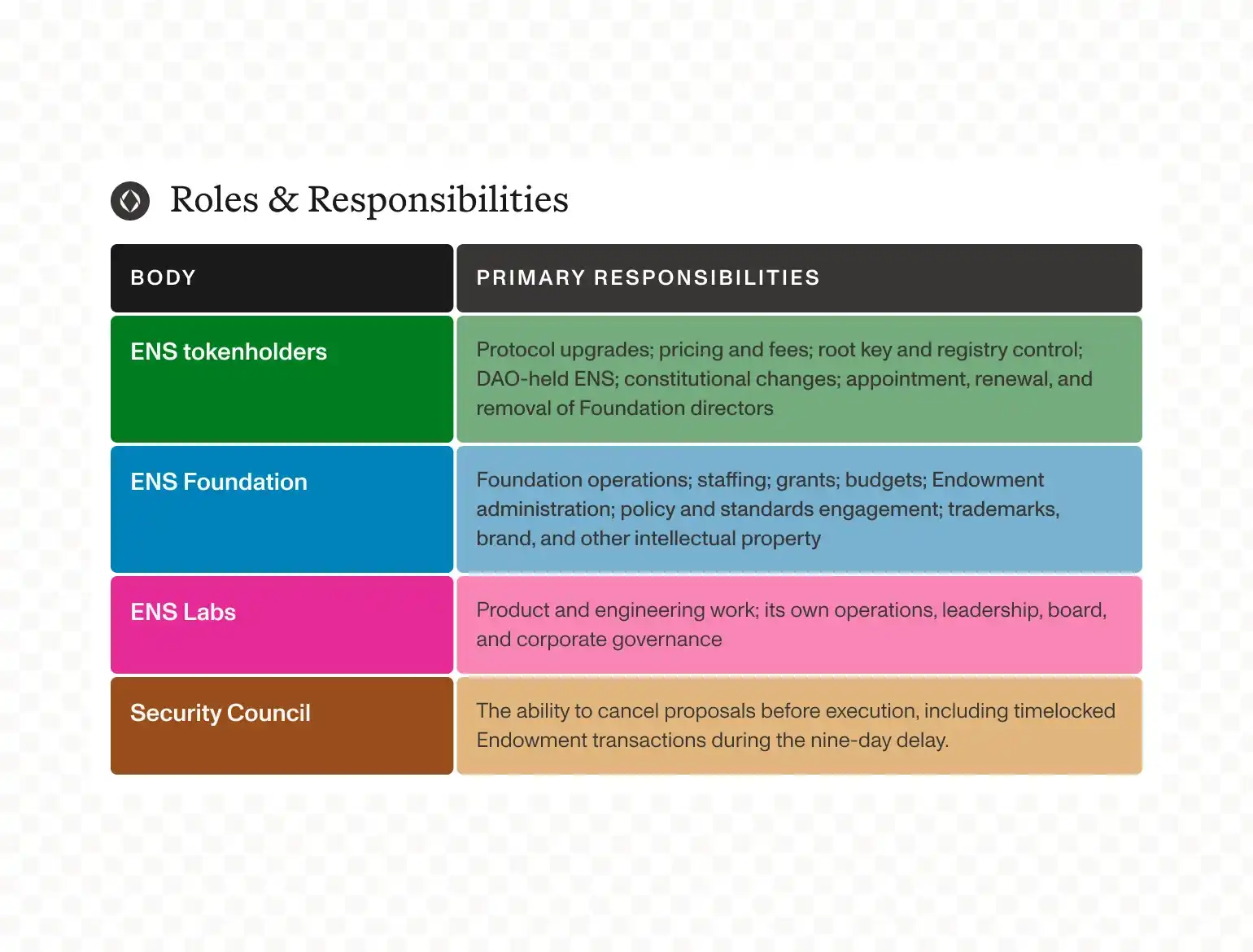
ENS Labs continues to lead core development of the ENS protocol, which is governed by token holders. Token holders also oversee the institutions representing them, including through the power to appoint or remove Foundation directors. The Foundation handles the off-chain work necessary to support the protocol, with its board responsible for overseeing operations and ensuring sustainable funding for ecosystem contributors, including ENS Labs. ENS Labs, the DAO, and the Foundation play different but complementary roles, aligned around the long-term stewardship of ENS. This symbiotic relationship makes ENS stronger while helping the on-chain protocol remain credibly neutral.

Foundation Board of Directors

The inaugural five-member board of the Foundation consists of:

  • Alexander Urbelis, Executive Director. Career spans cybersecurity law, DNS threat intelligence, and policy: former General Counsel & Chief Information Security Officer at ENS Labs, former Chief Information Security Officer at the NFL, former Chief Compliance Officer at Richemont.
  • Nick Johnson, Director. Founder of ENS, CEO of ENS Labs, previously at the Ethereum Foundation and Google.
  • Kartik Talwar, Independent Director. General Partner at A.Capital Ventures, Co-founder of ETHGlobal.
  • Brett Sun, Independent Director. Co-founder of Prelude, previously led technical work at Aragon, including early ENS integration AragonID.
  • Anthony Leutenegger, Independent Director. CEO of Aragon, a key ENS integrator, and also a delegate for Lido and Morpho.

Independent directors serve two-year terms, renewable by token holders. Each director brings distinct experience needed by ENS in this first term.

What Happens Next

Existing commitments will continue according to their agreed terms: stewards, active funding streams, grants, and current term commitments will persist. The Foundation will work with relevant parties to develop transition plans for grant programs, SPP3, and the current working group structure. Foundation positions will be publicly posted as staffing needs become clear.

With the proposal executed, the Foundation can begin fulfilling its approved operational, financial, policy, and institutional responsibilities. ENS Labs will continue to operate under its own management and governance, building ENSv2 and the products and infrastructure supporting the ENS protocol, while token holders retain control over protocol decisions and oversight of Foundation directors.

ENS aims to demonstrate that critical internet infrastructure can be credibly neutral, publicly governed, and outlast any single company. The complete governance record can be viewed in the executable proposal, on-chain votes, and execution transactions.


Cryptos en tendance

Questions liées

QWhat is the primary purpose of establishing the ENS Foundation as a legal entity?

ATo formally represent the ENS protocol in institutional settings, enabling it to engage in regulatory discussions, standard-setting organizations (like ICANN, IETF, W3C), and negotiate for the .ens top-level domain, which the DAO itself lacked the legal and operational capacity to do.

QHow does the new governance structure ensure that ENS token holders retain ultimate control over the protocol and the Foundation?

AToken holders control the core protocol contracts, treasury, and pricing via the DAO. They also have the power to appoint or remove the Foundation's Board of Directors. A 9-day timelock and the ENS Security Committee provide oversight for treasury transactions, and the Foundation must operate under a publicly approved budget with transparent financial reporting.

QWhat specific new capabilities does the ENS Foundation gain that the ENS DAO or ENS Labs could not previously perform?

AThe Foundation can now: 1) Actively participate in standard-setting bodies like ICANN to pursue the .ens TLD. 2) Engage directly with regulators and policymakers. 3) Hold and defend ENS trademarks and intellectual property against scams. 4) Hire full-time employees for operations and grant management. 5) Serve as a legal counterparty for courts, registries, and other institutions.

QWhat is the relationship between the ENS Foundation, ENS Labs, and the ENS DAO according to the new proposal?

AThey are three independent but complementary entities aligned around protecting and extending the ENS protocol. ENS Labs focuses on core protocol development (like ENSv2). The ENS DAO, governed by token holders, controls the protocol and treasury. The Foundation handles off-chain institutional representation and operations, overseen by a Board appointed by the DAO. The Foundation does not own or govern Labs.

QHow are the assets of the ENS DAO's endowment fund managed under the new structure, and what safeguards are in place?

AThe endowment fund, funded by .eth registration fees, remains under DAO control. Transactions now require a 9-day timelock, during which the ENS Security Committee can cancel any transaction deemed outside the Foundation's mandate. The Foundation spends only according to its publicly approved budget and undergoes annual audits and quarterly reporting.

Lectures associées

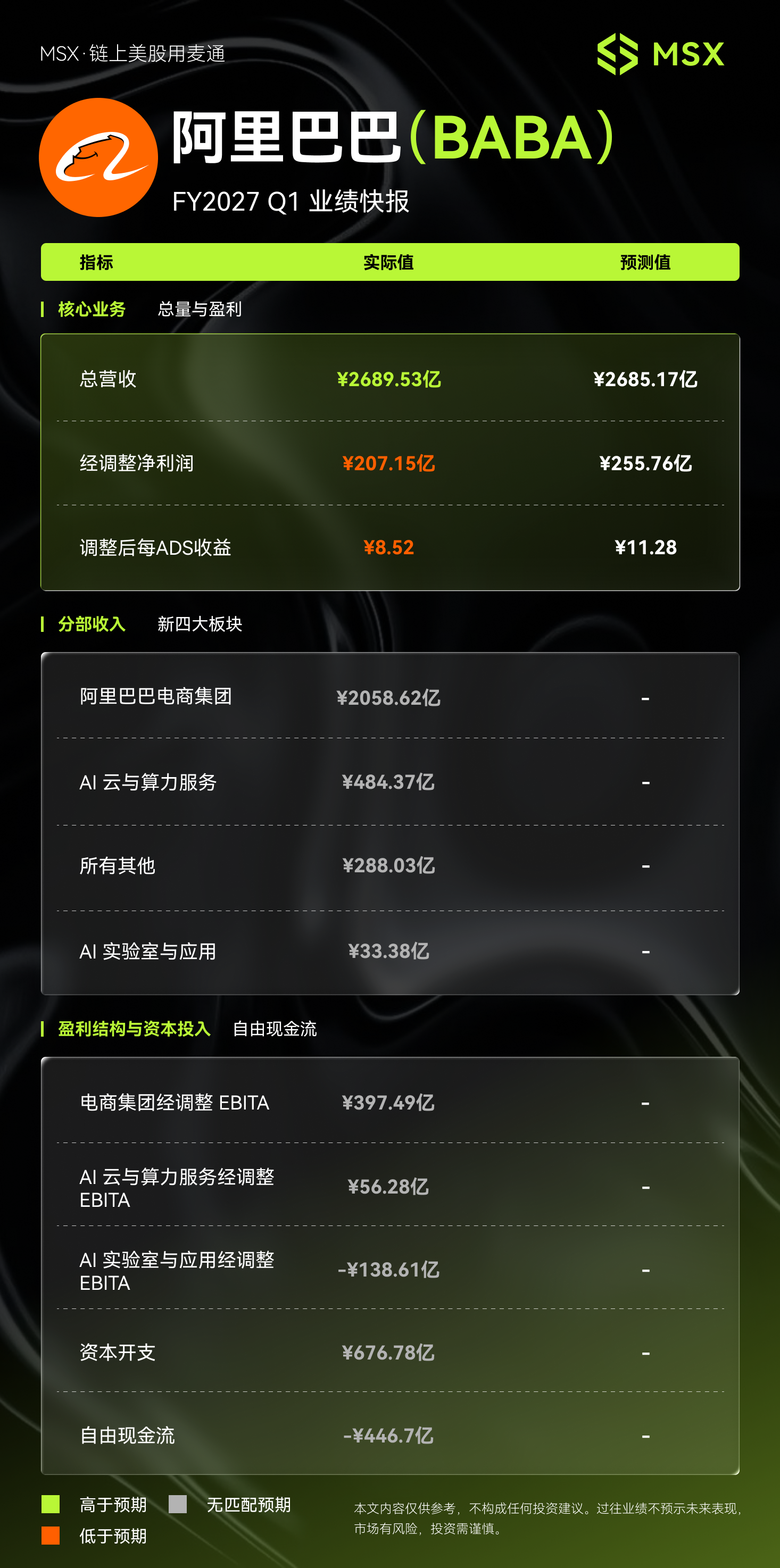
MSX Analyse Quotidienne du Marché Actions US : Rapport Financier Q1 FY2027 d'Alibaba : La croissance du chiffre d'affaires du Cloud IA atteint un nouveau record, le Cloud IA a déjà bouclé la boucle de rentabilité

**Résumé quotidien de MSX sur les actions américaines : Rapport financier Q1 FY2027 d'Alibaba : La croissance des revenus du Cloud IA atteint un record, et la boucle de profit est validée** Le rapport du Q1 FY2027 d'Alibaba montre des revenus légèrement supérieurs aux attentes, mais le bénéfice net ajusté et le bénéfice par action (BPA) sont nettement inférieurs. Cette baisse s'explique principalement par des investissements accrus dans l'IA et deux éléments non récurrents : une provision pour amende de l'UE (5,5 milliards d'euros) et une dépréciation d'actifs (44,58 milliards de yuans). La structure opérationnelle révèle une divergence claire. Le segment **Cloud IA & Services de Calcul** est le point fort : ses revenus ont augmenté de 45% en glissement annuel, tandis que son EBITA ajusté a bondi de 133%, avec une marge passant à 12%. Cela indique que cette activité a atteint une viabilité commerciale avec des effets d'échelle. Du côté du **commerce électronique**, la performance est mitigée. Le commerce de détail instantané en Chine (+45%) compense largement le déclin du commerce électronique traditionnel (-8%), permettant au EBITA ajusté du groupe de ne reculer que de 1%. Les dépenses en capital ont explosé (+75% sur un an), entraînant un flux de trésorerie disponible négatif de 446,7 milliards de yuans. Cependant, le flux de trésorerie opérationnel reste positif et en croissance (+11%), indiquant que cette consommation de trésorerie est un choix stratégique pour alimenter la croissance future, et non le signe d'une détérioration opérationnelle. L'enjeu clé pour Alibaba sera de maintenir la vitesse d'amélioration de la rentabilité de son Cloud IA à un rythme supérieur à celui de l'amortissement de ses lourds investissements en capacité de calcul.

Odaily星球日报Il y a 35 mins

MSX Analyse Quotidienne du Marché Actions US : Rapport Financier Q1 FY2027 d'Alibaba : La croissance du chiffre d'affaires du Cloud IA atteint un nouveau record, le Cloud IA a déjà bouclé la boucle de rentabilité

Odaily星球日报Il y a 35 mins

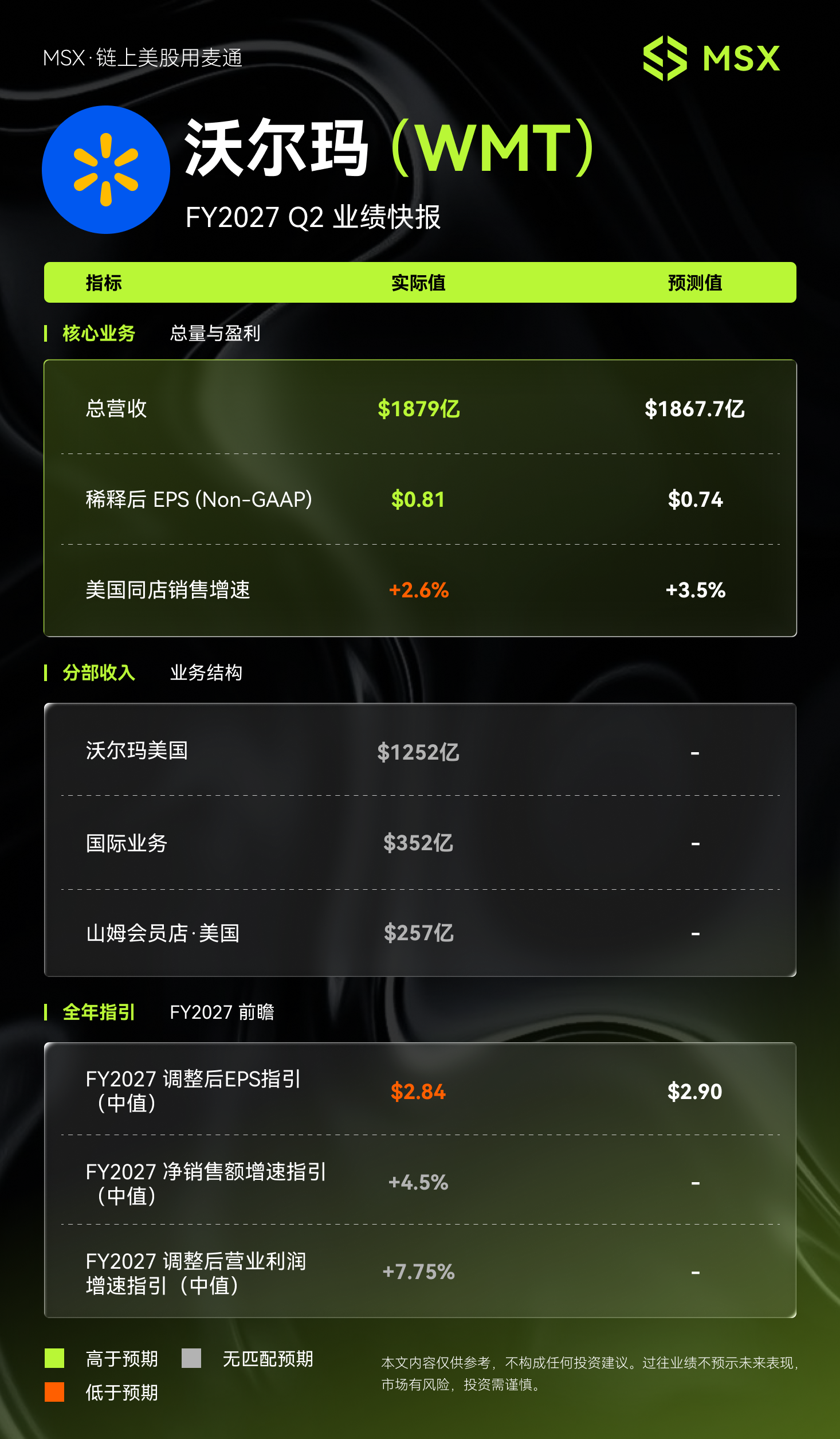
Observation Quotidienne de MSX sur les Actions US : Rapport Q2 de Walmart FY2027 : Revenus et bénéfices dépassent les attentes, la croissance comparable des ventes aux États-Unis atteint son plus bas niveau depuis plus de six ans

**MSX Observer Quotidien sur les Actions Américaines : Rapport Q2 FY2027 de Walmart : Revenus et bénéfices dépassent les attentes, mais croissance des ventes en magasin identiques aux États-Unis à son plus bas en plus de six ans** Le rapport trimestriel de Walmart présente un tableau contrasté. Bien que le chiffre d'affaires total (187,9 milliards USD, +5,9%) et le bénéfice ajusté par action (0,81 USD, +19%) aient tous deux dépassé les attentes du marché, la croissance des ventes en magasin identiques aux États-Unis a ralenti à seulement 2,6%, son rythme le plus faible depuis plus de six ans. L'entreprise attribue ce ralentissement en partie à la déflation des prix des produits pharmaceutiques. Les segments à plus forte marge affichent une performance robuste : le commerce électronique mondial a progressé de 23% et les activités publicitaires mondiales de 38%. Le bénéfice d'exploitation ajusté a augmenté plus vite que le chiffre d'affaires. Walmart a relevé ses prévisions annuelles pour les ventes et les bénéfices. Cependant, le plafond de sa nouvelle fourchette de bénéfice ajusté par action (2,87 USD) reste légèrement inférieur aux attentes du consensus du marché (2,90 USD). La société a indiqué avoir commencé à recevoir des remboursements de droits de douane, qu'elle utilisera pour réduire les prix pour les clients. En résumé, si les résultats du trimestre sont solides et que la qualité des bénéfices s'améliore, le ralentissement de la croissance de base aux États-Unis et des prévisions encore prudentes tempèrent l'enthousiasme, soulignant un changement potentiel dans le comportement des consommateurs.

Odaily星球日报Il y a 35 mins

Observation Quotidienne de MSX sur les Actions US : Rapport Q2 de Walmart FY2027 : Revenus et bénéfices dépassent les attentes, la croissance comparable des ventes aux États-Unis atteint son plus bas niveau depuis plus de six ans

Odaily星球日报Il y a 35 mins

Trading

Spot

Articles tendance

Comment acheter ENS

Bienvenue sur HTX.com ! Nous vous permettons d'acheter Ethereum Name Service (ENS) de manière simple et pratique. Suivez notre guide étape par étape pour commencer votre parcours crypto.Étape 1 : Création de votre compte HTXUtilisez votre adresse e-mail ou votre numéro de téléphone pour ouvrir un compte sur HTX gratuitement. L'inscription se fait en toute simplicité et débloque toutes les fonctionnalités.Créer mon compteÉtape 2 : Choix du mode de paiement (rubrique Acheter des cryptosCarte de crédit/débit : utilisez votre carte Visa ou Mastercard pour acheter instantanément Ethereum Name Service (ENS).Solde :utilisez les fonds du solde de votre compte HTX pour trader en toute simplicité.Prestataire tiers :pour accroître la commodité d'utilisation, nous avons ajouté des modes de paiement populaires tels que Google Pay et Apple Pay.P2P :tradez directement avec d'autres utilisateurs sur HTX.OTC (de gré à gré) : nous offrons des services personnalisés et des taux de change compétitifs aux traders.Étape 3 : stockage de vos Ethereum Name Service (ENS)Après avoir acheté vos Ethereum Name Service (ENS), stockez-les sur votre compte HTX. Vous pouvez également les envoyer ailleurs via un transfert sur la blockchain ou les utiliser pour trader d'autres cryptos.Étape 4 : tradez des Ethereum Name Service (ENS)Tradez facilement Ethereum Name Service (ENS) sur le marché Spot de HTX. Il vous suffit d'accéder à votre compte, de sélectionner la paire de trading, d'exécuter vos trades et de les suivre en temps réel. Nous offrons une expérience conviviale aux débutants comme aux traders chevronnés.

430 vues totalesPublié le 2024.12.10Mis à jour le 2026.06.02

Comment acheter ENS

Discussions

Bienvenue dans la Communauté HTX. Ici, vous pouvez vous tenir informé(e) des derniers développements de la plateforme et accéder à des analyses de marché professionnelles. Les opinions des utilisateurs sur le prix de ENS (ENS) sont présentées ci-dessous.

活动图片