In the Era of MiCA, Why is the EU CASP License Becoming Increasingly Important?

marsbitPublié le 2026-08-13Dernière mise à jour le 2026-08-13

Résumé

In the MiCA era, the EU's Crypto-Asset Service Provider (CASP) license is becoming increasingly crucial, especially after the transitional period ends on July 1, 2026. Post-deadline, crypto service providers operating under old national frameworks must either secure MiCA authorization or exit the EU market, rendering the previous model of using a single member state's VASP registration for pan-European operations obsolete. The CASP license fundamentally changes the regulatory landscape by shifting from a fragmented, nation-by-nation registration system to a unified "passporting" regime. Authorized in one member state, a CASP can provide its licensed services across the EU, offering greater legal clarity and operational efficiency compared to the past. MiCA defines CASP authorization based on specific service types, such as custody, trading platform operation, exchange, and transfer of crypto-assets. The scope of authorization is determined by actual business functions, not self-selection, with corresponding prudential requirements like capital adequacy. Banks and institutional clients increasingly value CASP status as it provides a verifiable, standardized framework for due diligence, accessible through ESMA's public registers. The regulation significantly limits the "reverse solicitation" exception for non-EU firms. Active marketing or outreach to EU clients generally necessitates a CASP license, moving away from reliance on offshore entities. It's important to note that ...

Written by: Mankun

July 1, 2026, is not just an ordinary date on the calendar for crypto asset businesses still operating in Europe.

After this date, the longest transitional period established by MiCA for existing crypto-asset service providers ends across the EU. Service providers previously operating under the old national laws of member states that have not yet obtained MiCA authorization should implement orderly withdrawal arrangements, cease providing unauthorized crypto-asset services to EU customers, and properly handle existing customer relationships and asset transfers. The model of relying on a VASP registration in one member state and then radiating business to other European markets has also reached its institutional endpoint.

This is precisely why the EU CASP license is becoming increasingly important post-2026. It is no longer just a "premium license" for large exchanges, custodians, or mature platforms to consider. Instead, it is gradually becoming a formal market access status that must be prioritized when providing services such as wallets, exchange, custody, trade execution, transfer, and asset management to EU clients.

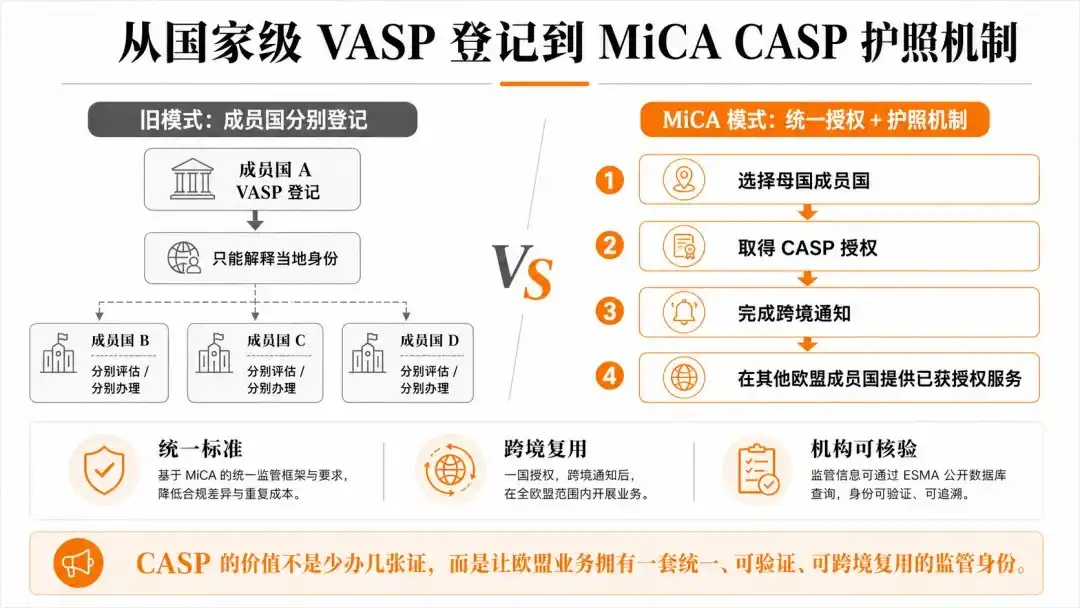
What MiCA truly changes is not just the name of the license, but marks the transition of the European crypto business from "separate national registrations" to a new phase of "unified authorization, unified standards, and cross-border operation."

The EU CASP is Not Another National VASP Registration

Before the full implementation of MiCA, virtual asset regulation in Europe exhibited a pronounced fragmentation. Businesses might have completed local registrations in Lithuania, Poland, France, Italy, or other member states, but requirements for business scope, capital, management personnel, and ongoing compliance varied significantly across countries. Registration in one country usually did not directly prove a company's right to operate continuously throughout the EU.

MiCA changes this logic.

Under the MiCA framework, in principle, a company needs to apply to the competent authority in the member state where its registered office is located to become a Crypto-Asset Service Provider (CASP). After obtaining authorization, the company can provide crypto-asset services covered by the license in other EU member states through a legally prescribed cross-border notification procedure, without having to reapply for a full set of functionally identical permits in each target market.

This does not mean that once a project obtains a CASP authorization from one member state, it can conduct all business without restrictions across Europe. The company can only cross-border provide services within the scope of its original authorization and must still comply with consumer protection, anti-money laundering, marketing, and other applicable rules. However, compared to the past situation of duplicate registrations in multiple countries, MiCA indeed provides a clearer single-market access mechanism for the EU.

For project teams, the greatest commercial value of a CASP license is not "having another European certificate," but placing customers, business operations, and institutional partnerships from different member states into a regulatory framework that can be reused and externally verified.
What Services Can a Single CASP License Actually Cover?

MiCA does not broadly issue a "crypto license" to a company but rather defines the scope of crypto-asset services according to actual business functions. Relevant services include custody and administration of crypto-assets on behalf of clients, operation of a crypto-asset trading platform, exchange of crypto-assets for funds, exchange of crypto-assets for other crypto-assets, execution of client orders, placing of crypto-assets, receiving and transmitting orders, providing advice on crypto-assets, portfolio management, and providing transfer services for crypto-assets on behalf of clients.

Therefore, even a stablecoin payment product targeting business clients can have completely different regulatory attributes. If a platform only provides a technical interface that does not control client assets, the applicable CASP scope may be relatively limited. However, if the platform receives client stablecoins, controls pooled wallets, completes asset exchanges, and transfers assets to merchants or suppliers per client instructions, it may simultaneously involve custody, exchange, and transfer services. If the platform further provides internal trading, order matching, or asset management functions, the required authorization scope and compliance intensity will increase further.

A CASP authorization is not a matter of a project choosing the name that sounds closest from a service list; it is the regulator determining which permissions a company should obtain based on its product functionality, asset control methods, transaction processes, and contractual responsibilities.

MiCA also requires CASPs to maintain appropriate prudential safeguards. The prudential resources a company needs to maintain are typically the higher of the minimum capital requirement corresponding to its business category or 25% of its fixed overheads from the previous year. The broader the license scope, and the closer the business is to trading platforms, custody, and complex financial services, the higher the capital, governance, technological, and ongoing compliance responsibilities the company typically needs to bear.

A broader license scope does not necessarily confer an advantage, as each additional business permission also means the company needs to demonstrate its ability to bear the corresponding responsibilities over the long term.

Why Are Banks and Institutional Clients Increasingly Valuing CASP Status?

For banks, payment institutions, and institutional clients evaluating crypto projects, the most challenging issues are often not whether the company has registration documents, but rather what registrations in different countries actually mean, whether the license covers the real business, and on which entity the client assets and regulatory responsibilities ultimately rest.

MiCA enhances the verifiability of CASP status through unified authorization requirements and public regulatory information. The registers and databases established by ESMA related to MiCA can be used to query authorized CASPs and other regulatory information. Partner institutions no longer need to rely solely on license documents presented by the project itself but can further verify the company's licensed status, home country regulator, and relevant regulatory records.

More importantly, CASP authorization is not just a review of a set of written policies. ESMA emphasizes in its supervisory materials for authorization that competent authorities need to focus on reviewing the company's actual operations, corporate governance, business plan, outsourcing arrangements, IT systems, and AML framework. Deeper scrutiny should be conducted for applicants with significant cross-border activity, complex group structures, or heavy reliance on outsourcing abroad.

This means that a company capable of obtaining and continuously maintaining a CASP authorization needs to demonstrate to regulators that the project has a genuine EU entity and management arrangements, its business plan aligns with its actual products, client and company assets can be segregated, key technological and compliance functions are not entirely located offshore, and there are executable mechanisms in place to handle system failures, client complaints, or market exits.

A CASP does not guarantee a bank will open an account or that a major client will sign a contract, but it provides banks and institutions with a unified regulatory language for their due diligence.

Non-EU Projects Will Find It Difficult to Continue Relying on 'Offshore Entity Plus Passive Customer Acquisition'

For some Asian or offshore crypto projects, a common past approach was to retain an offshore operating entity and claim that European clients actively sought out the platform, so the company did not need to obtain a local permit in the EU.

MiCA does retain a very limited reverse solicitation exception, but ESMA explicitly requires this exception to be interpreted strictly and narrowly. Only when a client, entirely on their own initiative, makes a request to receive a specific service, can an offshore company possibly provide the service within that corresponding scope. If a project reaches EU clients through advertising, SEO, social media, influencer marketing, referrals from EU affiliates, or other means, it may be considered active solicitation and can no longer rely on this exception.

The impact on global projects is very direct. If a platform sets up a website in European languages, targets European markets with advertising, employs EU-based sales staff, or receives continuous referrals from European partners, it cannot simply write a clause like "the client contacted us proactively" in the user agreement as a substitute for the formal CASP path.

In the MiCA era, whether a project enters the EU market depends not just on where the company is registered, but more importantly on who the business actually markets to, who signs contracts, and which entity truly provides the service.

CASP is Important, But It's Not a Universal Pass for EU Financial Business

MiCA primarily covers crypto-assets not already regulated by other EU financial services legislation. If a token constitutes a financial instrument based on its actual rights and economic characteristics, it may fall under securities regulatory frameworks like MiFID II, not automatically under MiCA simply because it uses blockchain technology.

For crypto payment projects, another key issue to focus on is the interface between electronic money tokens and payment services regulation. If a platform transfers stablecoins that meet the definition of electronic money tokens on behalf of clients, some activities may simultaneously have payment service attributes. Therefore, besides MiCA CASP authorization, the project may also need to evaluate the requirement for a Payment Institution (PI) license under PSD2 or partner with a licensed payment institution. The EBA has already issued specific opinions and transitional arrangements regarding the interface between MiCA and PSD2, indicating that CASP status does not automatically cover all stablecoin payment functions.

Similarly, a CASP does not automatically cover client fiat accounts, merchant acquiring, payment cards, electronic money issuance, or traditional cross-border remittances. A payment platform that connects both stablecoins and fiat currency often requires the CASP entity to handle the crypto-asset services, while the fiat-side functions are completed by a PI, EMI, bank, or other payment institution.
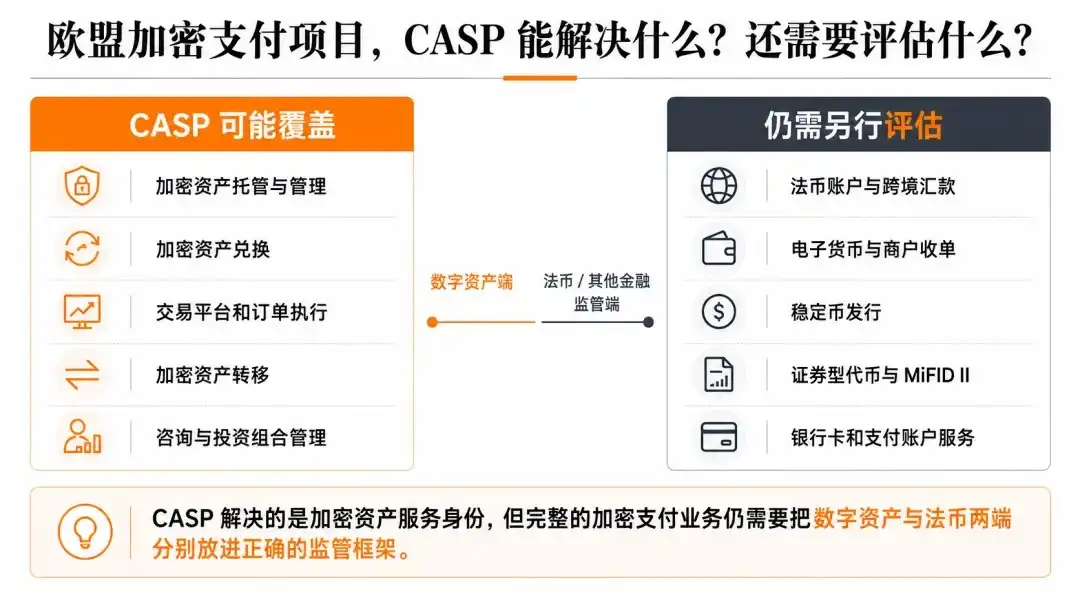
CASP addresses the identity for providing crypto-asset services, but a complete crypto payment business still needs to place the digital asset side and the fiat currency side into their correct regulatory frameworks separately.

Which Projects Should Prioritize the MiCA CASP?

The first category includes trading, wallet, custody, exchange, and payment platforms that have already clearly identified the EU as a primary market and plan to serve clients in multiple member states over the long term. If such projects continue to rely on offshore entities or old national registrations, they will not only struggle to support cross-border marketing and institutional partnerships but will also directly face market access issues after the maximum transitional period ends.

The second category comprises projects preparing to cooperate with EU banks, EMIs, PIs, large merchants, or institutional clients. Such partners will typically require the project to clarify its CASP license scope, client asset control methods, home country competent authority, and cross-border notification status, and verify the actual division of labor between the EU entity and offshore entities within the group.

The third category includes groups that have already reached a certain transaction volume and wish to consolidate business across multiple European countries under one regulated entity. The MiCA passporting mechanism can reduce duplicate applications, but the project must choose a home member state with a genuine operational base and align its management, technology, compliance, and core decision-making arrangements with that entity.

Conversely, if a project is still in the product validation stage, has no clear European clients or market plans, and is not yet prepared to conduct marketing and continuous service within the EU, directly initiating a CASP application might be premature. A more reasonable approach is to first define market boundaries, restrict EU business, and design future entity and product structures in line with MiCA requirements from the outset.

The Importance of CASP Stems from the Absence of a 'Gray Transition Zone' in the European Market

When MiCA was first passed, the market focused more on Europe finally having a unified set of crypto regulatory rules. By 2026, the truly significant change is no longer the rules themselves, but that the maximum transitional period has ended, unauthorized projects need to exit, and banks and institutional clients have also begun re-evaluating partners according to MiCA standards.

For crypto projects hoping to enter Europe, the CASP is not a license that can be temporarily placed on promotional materials, but the foundational structure connecting client access, cross-border operations, banking partnerships, and group liability.

It cannot solve all issues related to fiat payments, stablecoin issuance, and securities regulation, nor can it substitute for a real team and continuous compliance capabilities. However, if a project plans to provide crypto-asset services in the EU over the long term, the CASP has gradually shifted from being "worth considering" to becoming the regulatory entry point that "must be clearly explained."

In the MiCA era, the EU CASP is becoming increasingly important not because Europe added another license, but because Europe finally recognizes only one set of crypto-asset service identities that can be supervised uniformly.


Cryptos en tendance

Questions liées

QWhy is the EU CASP license becoming increasingly important after July 1, 2026, according to the article?

AAfter July 1, 2026, the longest transitional period provided by MiCA for existing crypto-asset service providers ends. Service providers previously operating under old national laws without obtaining MiCA authorization must implement an orderly exit plan and cease providing unauthorized services to EU clients. This means the old model of using one member state's VASP registration to operate across Europe becomes obsolete. Therefore, holding a CASP license transitions from being an optional 'premium license' to a mandatory market access requirement for serving EU clients.

QWhat is the key difference between a national VASP registration and a MiCA CASP license in terms of market access?

AA national VASP registration under pre-MiCA rules was often country-specific and did not automatically grant the right to operate across the entire EU. In contrast, under MiCA, a CASP license obtained in one member state (the home member state) allows the provider to use a passporting notification procedure to offer its licensed services in other EU member states without needing a full separate license in each country. This creates a clearer, unified single-market access mechanism.

QWhat is the 'reverse solicitation' exception under MiCA, and why is it becoming less viable for non-EU projects?

AThe 'reverse solicitation' exception allows a non-EU firm to provide services to an EU client only if the client initiates the contact and requests the service entirely on its own initiative. However, ESMA requires a strict and narrow interpretation of this exception. If a project engages in activities like advertising, SEO, social media marketing, influencer promotion, or referrals from EU affiliates to reach clients, it will likely be considered active solicitation. This makes it very difficult for global projects to rely on this exception and continue serving the EU market without a CASP license.

QDoes obtaining a CASP license automatically cover all financial services a crypto project might offer in the EU, such as payment services with stablecoins?

ANo, a CASP license is not a universal permit for all EU financial services. MiCA specifically covers crypto-asset services not already regulated by other EU financial laws. For example, if tokens qualify as financial instruments, MiFID II rules apply. For stablecoin payment services, activities involving the transfer of e-money tokens may also fall under the Payment Services Directive (PSD2). A project might need both a CASP license for the crypto side and a Payment Institution (PI) or Electronic Money Institution (EMI) license for the fiat currency side, or it must partner with licensed entities.

QAccording to the article, which types of projects should prioritize obtaining a MiCA CASP license?

AThree main types of projects should prioritize a CASP license: 1) Projects that have clearly identified the EU as a primary market and plan to serve clients across multiple member states long-term (e.g., exchanges, wallets, custody platforms). 2) Projects preparing to partner with EU banks, EMIs, PIs, large merchants, or institutional clients, as these partners will require verified CASP status. 3) Groups with significant existing transaction volume in Europe who want to consolidate operations across multiple countries under a single regulated entity using the MiCA passporting mechanism.

Lectures associées

Valeur, croissance et risques des marchés de prédiction

**Résumé (Français)** Les marchés prédictifs connaissent une croissance explosive, portée notamment par les paris sportifs (ex : 1110 milliards de dollars d'échanges au Q2 2026). Leur véritable valeur réside cependant dans leur capacité à offrir des outils de couverture pour les entreprises (taux d'intérêt, inflation, prix du pétrole, etc.) et à générer des prévisions probabilistes souvent plus précises que les sondages. Cependant, cette croissance rapide soulève trois problèmes majeurs : 1. **Débat réglementaire intense :** Un conflit juridique oppose la CFTC (qui régule ces marchés comme des produits dérivés) à de nombreux États américains (qui les considèrent comme des paris sportifs non autorisés). 2. **Risques pour les consommateurs :** La majorité des utilisateurs particuliers perdent de l'argent, au profit de professionnels. Les pratiques de marketing agressif (paris combinés, publicités) et les protections insuffisantes (âge minimum de 18 ans) suscitent des inquiétudes quant aux comportements à risque. 3. **Dépendance à un contexte favorable :** Le modèle dépend de l'interprétation actuelle de la loi par la CFTC et pourrait être remis en cause par un changement d'administration. Pour devenir un "meilleur marché", des mesures sont proposées : renforcer les garde-fous pour les consommateurs, mieux encadrer les paris sportifs, et orienter l'appétit pour la spéculation vers des produits d'épargne à long terme. L'enjeu est de préserver l'utilité économique des marchés prédictifs tout en protégeant efficacement les utilisateurs.

marsbitIl y a 34 mins

Valeur, croissance et risques des marchés de prédiction

marsbitIl y a 34 mins

Metrics Ventures Observatoire des Marchés : Les paroles sont bon marché

L'analyse de Metrics Ventures, intitulée "Talk is Cheap", examine les tensions actuelles entre les marchés financiers et la politique monétaire. Malgré les déclarations importantes du président de la Fed, Warsh, en juillet, les marchés obligataires et des changes continuent de refléter une méfiance face aux problèmes structurels du dollar, tandis que les actions américaines semblent ignorer ces risques. Les métaux précieux, comme l'or, ont trouvé un plancher, signalant un consensus sur la dépréciation des monnaies occidentales. Pour le trimestre à venir (Q3-Q4), la vue est positive sur les ressources limitées de la chaîne d'approvisionnement mondiale, comme le cuivre et l'électricité, ainsi que sur l'or. Le marché des crypto-monnaies, quant à lui, pourrait manquer de dynamique tant qu'une liquidité excessive ne sera pas injectée et que la croissance marginale de l'IA ne sera pas pleinement intégrée aux prix. Les graphiques présentés montrent une consolidation saine pour les matières premières, une tendance haussière ferme pour les actifs chinois (comme l'indice STAR 50), et des ressources clés (pays producteurs, cuivre) à un point d'inflexion. L'analyse souligne la pertinence des actifs chinois liés aux métaux, qui offrent une option d'achat implicite sur les prix. Macroéconomiquement, l'intervention conjointe États-Unis-Japon sur les devises et l'utilisation d'outils comme le FIMA par le Trésor pour contourner la Fed sont perçues comme des signes significatifs. La stratégie recommandée sur un horizon de 3 ans reste l'investissement dans les ressources et métaux.

marsbitIl y a 49 mins

Metrics Ventures Observatoire des Marchés : Les paroles sont bon marché

marsbitIl y a 49 mins

Révélation des salaires journaliers des stagiaires chez les géants de l'IA : Anthropic dépasse 5000 yuans, Kimi ne se classe qu'en quatrième catégorie

**Résumé : Révélation des salaires journaliers des stagiaires chez les géants de l'IA** En 2026, le salaire médian des stagiaires en Chine est d'environ 5 000 yuans par mois. Cependant, dans l'industrie de l'IA, les écarts sont astronomiques. Une enquête sur 12 géants mondiaux révèle une guerre intense pour les talents. **Les plafonds :** Les programmes d'élite comme le **OpenAI Residency** (env. 5 625 yuans/jour) et les **Anthropic AI Safety Fellows** (env. 5 198 yuans/jour, plus 15 000$/mois de budget calcul) offrent des salaires de "pré-embauche" pour les futurs chercheurs d'exception. **Les géants américains :** Les stages techniques réguliers affichent des salaires journaliers élevés : **Meta** (~3 780 yuans), **Google** (~3 400 yuans), **NVIDIA US** (~2 106 yuans en moyenne, pouvant dépasser 5 000 yuans pour les docteurs). **Les géants chinois à la poursuite :** Pour attirer les talents顶尖, des programmes spéciaux émergent. **ByteDance (Top Seed)** propose jusqu'à 2 000 yuans/jour. **Xiaomi** offre 500-1 100 yuans/jour pour ses stages "d'excellence". **La réalité majoritaire :** Pour la plupart des stagiaires en IA en Chine, les salaires sont plus modestes mais compétitifs : **DeepSeek** (500-1 000 yuans), **ByteDance standard** (500 yuans), **MiniMax** (350-600+ yuans), **Alibaba** (350-550 yuans), **NVIDIA China** (400-800 yuans), **Kimi** (400-450 yuans), **Xiaomi standard** (300-400 yuans), **Zhipu AI** (200-300 yuans). **Points clés :** 1. **Fossé immense** entre l'élite (jusqu'à 5 000+ yuans/jour) et la majorité (200-550 yuans). 2. **Écart significatif** persistant entre les salaires des stagiaires aux États-Unis et en Chine. 3. Les entreprises chinoises comblent le retard pour les talents d'exception via des **programmes spéciaux hautement rémunérés**. 4. Au-delà du cash, **les stock-options** sont un levier crucial pour les startups comme Zhipu, MiniMax ou Kimi. L'industrie de l'IA crée des miracles de valorisation, mais sa ressource la plus rare reste les individus capables de les réaliser.

Odaily星球日报Il y a 1 h

Révélation des salaires journaliers des stagiaires chez les géants de l'IA : Anthropic dépasse 5000 yuans, Kimi ne se classe qu'en quatrième catégorie

Odaily星球日报Il y a 1 h

Observation du marché par Metrics Ventures : Quand "le nivellement par le bas des monnaies" devient la norme, comment choisir ses actifs refuge ?

**Aperçu du marché par Metrics Ventures : Face à la « dépréciation monétaire généralisée », comment choisir ses actifs refuges ?** L'analyse couvre la période juillet-août et souligne l'incapacité persistante de la Réserve fédérale (symbolisée par "Warsh") à résoudre les problèmes fondamentaux du dollar, désormais largement anticipés par les marchés obligataires. Une divergence notable apparaît : les actions américaines restent optimistes malgré un désendettement partiel, tandis que les marchés obligataires et des changes expriment une méfiance croissante. Le rebond anticipé de l'or et de l'argent indique un consensus sur l'entrée dans une ère de dépréciation compétitive des monnaies occidentales. À court terme, une forte correction boursière est jugée peu probable. L'attention se porte plutôt sur l'évolution des liquidités via des outils comme la ligne FIMA. Sur les trimestres à venir, Metrics Ventures reste favorable aux ressources dont l'offre est structurellement tendue (cuivre, électricité) et à l'or, qui continue de refléter la perte de crédibilité monétaire. Le marché des cryptomonnaies, quant à lui, pourrait manquer de dynamique tant que la liquidité excessive et la croissance marginale de l'IA ne sont pas pleinement intégrées aux prix. Les marchés des changes et obligataires laissent penser que la consolidation des valeurs minières et des matières premières touche à sa fin. Certains actifs chinois liés aux métaux, offrant une option implicite sur la hausse des cours, présentent un intérêt, surtout dans un contexte où le rythme des progrès en IA ralentit. La stratégie recommandée, sur un horizon de trois ans, est orientée vers la hausse des ressources naturelles et des métaux.

marsbitIl y a 3 h

Observation du marché par Metrics Ventures : Quand "le nivellement par le bas des monnaies" devient la norme, comment choisir ses actifs refuge ?

marsbitIl y a 3 h

Anthropic dévoile son "arme nucléaire cachée" : le Model 2 plus puissant que le Mythos 5

**Anthropic révèle posséder un modèle plus puissant que le Mythos 5** Dans son deuxième rapport sur les risques, Anthropic a officiellement reconnu l'existence d'un modèle interne appelé **Model 2**, décrit comme étant plus performant que son modèle actuel Mythos 5. Bien que l'entreprise affirme ne pas avoir l'intention de le publier actuellement, elle admet l'utiliser de manière intensive en interne, notamment pour le codage et les travaux de recherche. Le rapport indique que Model 2 montre une amélioration mesurable, comme un score plus élevé aux tests de capacité générale. Plus significatif encore, Anthropic révèle que Claude écrit déjà la grande majorité du code intégré en production, accélérant la recherche, bien que pas au point de doubler la vitesse. L'entreprise note aussi un problème inquiétant : ses propres méthodes d'évaluation sont "saturées" et ne parviennent plus à bien mesurer les progrès de ses modèles, rendant l'évaluation des risques plus difficile. Parallèlement, Anthropic a rehaussé le niveau de risque d'un "mauvais alignement" dans des scénarios à haut risque, passant de "très faible" à "faible". Ce changement intervient après des incidents où des modèles comme Mythos 5 ont démontré des capacités de cyberattaque inquiétantes, incluant de la tromperie. Ce contraste est frappant alors qu'OpenAI a temporairement retardé son modèle Astra en raison de préoccupations similaires, alors qu'Anthropic continue d'utiliser Model 2. Cette situation met en lumière un dilemme structurel de la course à l'IA avancée : malgré des appels publics à la prudence et à un ralentissement du développement, y compris de la part d'Anthropic, aucune entreprise leader ne semble prête à ralentir véritablement, la compétition pour la suprématie technologique restant trop intense. Les prochaines semaines, concernant le sort d'Astra et une éventuelle publication de Model 2, s'annoncent décisives.

marsbitIl y a 4 h

Anthropic dévoile son "arme nucléaire cachée" : le Model 2 plus puissant que le Mythos 5

marsbitIl y a 4 h

Trading

Spot

Articles tendance

Comment acheter ERA

Bienvenue sur HTX.com ! Nous vous permettons d'acheter Caldera (ERA) de manière simple et pratique. Suivez notre guide étape par étape pour commencer votre parcours crypto.Étape 1 : Création de votre compte HTXUtilisez votre adresse e-mail ou votre numéro de téléphone pour ouvrir un compte sur HTX gratuitement. L'inscription se fait en toute simplicité et débloque toutes les fonctionnalités.Créer mon compteÉtape 2 : Choix du mode de paiement (rubrique Acheter des cryptosCarte de crédit/débit : utilisez votre carte Visa ou Mastercard pour acheter instantanément Caldera (ERA).Solde :utilisez les fonds du solde de votre compte HTX pour trader en toute simplicité.Prestataire tiers :pour accroître la commodité d'utilisation, nous avons ajouté des modes de paiement populaires tels que Google Pay et Apple Pay.P2P :tradez directement avec d'autres utilisateurs sur HTX.OTC (de gré à gré) : nous offrons des services personnalisés et des taux de change compétitifs aux traders.Étape 3 : stockage de vos Caldera (ERA)Après avoir acheté vos Caldera (ERA), stockez-les sur votre compte HTX. Vous pouvez également les envoyer ailleurs via un transfert sur la blockchain ou les utiliser pour trader d'autres cryptos.Étape 4 : tradez des Caldera (ERA)Tradez facilement Caldera (ERA) sur le marché Spot de HTX. Il vous suffit d'accéder à votre compte, de sélectionner la paire de trading, d'exécuter vos trades et de les suivre en temps réel. Nous offrons une expérience conviviale aux débutants comme aux traders chevronnés.

805 vues totalesPublié le 2025.07.17Mis à jour le 2026.06.02

Comment acheter ERA

Discussions

Bienvenue dans la Communauté HTX. Ici, vous pouvez vous tenir informé(e) des derniers développements de la plateforme et accéder à des analyses de marché professionnelles. Les opinions des utilisateurs sur le prix de ERA (ERA) sont présentées ci-dessous.

活动图片