What is a 'Secure Element'? How it Protects Hardware Wallets

cryptonews.ruPublié le 2026-08-07Dernière mise à jour le 2026-08-07

Résumé

A "secure element" is a specialized, tamper-resistant hardware chip designed to protect sensitive information. In hardware wallets, it acts as a vault for private keys, keeping them isolated from the main processor and the internet. Its core function is to sign cryptocurrency transactions internally; the private key never leaves the chip's protected environment—only the final digital signature is output. This prevents malware on a connected computer from stealing the key. Secure elements also defend against physical attacks, using hardware-level countermeasures to detect and resist tampering, voltage manipulation, and side-channel attacks. They contain dedicated hardware random number generators (RNGs) to ensure strong, unpredictable private keys are generated during wallet setup. Importantly, many secure elements undergo rigorous independent security evaluations (like Common Criteria certification) to verify their resistance to sophisticated attacks. However, a secure element is not an absolute shield. It cannot protect against user errors like approving fraudulent transactions or mishandling seed phrases. Its primary role is to raise the cost and complexity of attacks to impractical levels for most threats. Therefore, it is one critical layer within a broader security strategy that includes secure backup practices and transaction verification. Today, secure elements are a standard and vital component in hardware wallets, forming a crucial barrier for securing digital ass...

Most people never see it, never interact with it, and rarely hear about it. Yet this specialized chip is responsible for protecting the private keys that give owners control over their digital assets. Without it, many modern hardware wallets would be much more vulnerable to physical theft and sophisticated attacks. Understanding what a secure element is and how it actually works helps explain why hardware wallets have become one of the most secure ways to store cryptocurrency.

Secure Elements Were Created to Protect Secrets

A secure element is a specialized computer chip designed for one primary purpose: protecting extremely confidential information.

Unlike the processor in a regular laptop or smartphone, a secure element is built specifically for storing secret information and performing cryptographic operations without revealing the protected data. Instead of trying to perform many different computational tasks, it focuses on isolating confidential data from everything else inside the device.
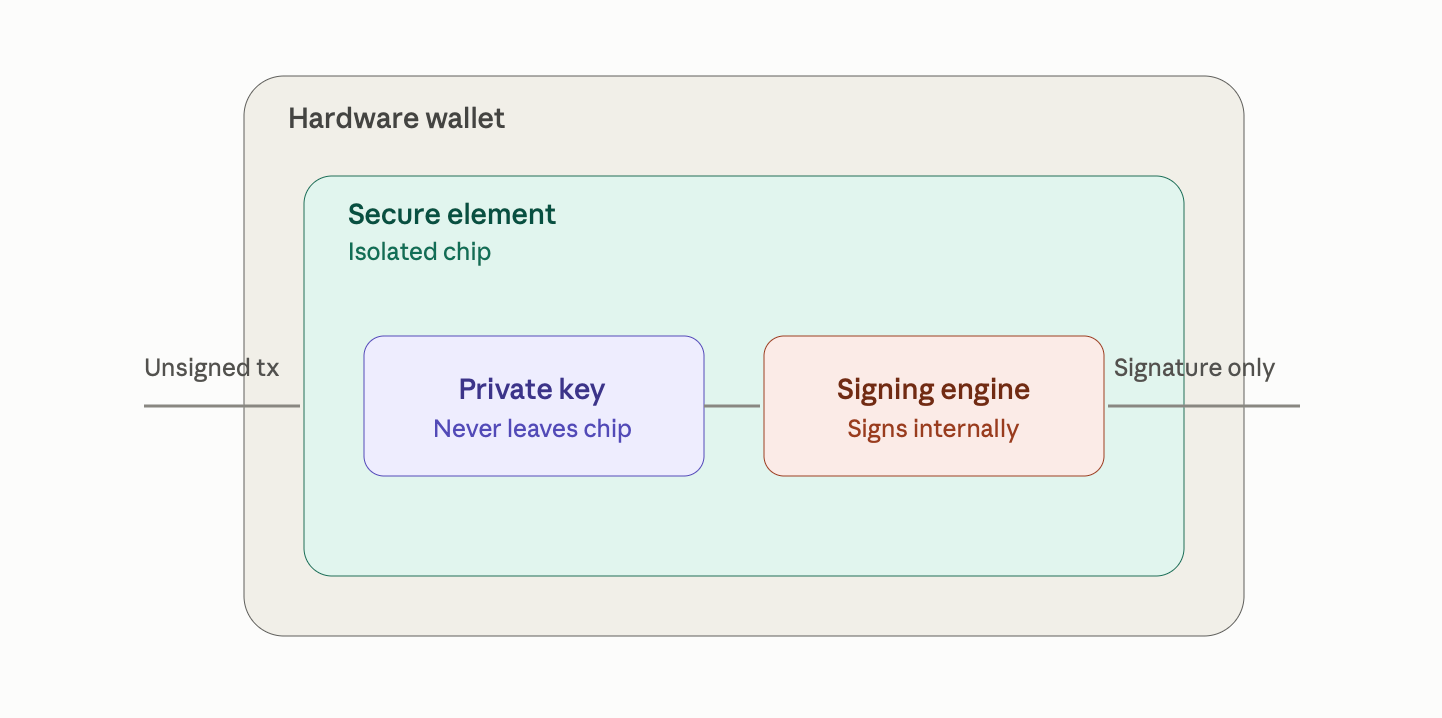
A simplified visualization of the secure element process in a hardware wallet. An unsigned transaction enters the chip, but the private key itself never leaves—it simply remains inside the secure element and performs the signing internally. Only the finished signature is output, so malware on the connected computer cannot simply intercept the key, even if it compromises other parts of the device.

This particular technology didn't originate with cryptocurrencies. Secure elements have been used for a long time in payment cards, SIM cards, electronic passports, and government identification systems. These industries faced the same problem many years ago: protecting digital credentials even if the device is physically taken.

Hardware wallets apply the same concept to cryptocurrencies.

Why Hardware Wallets Need It

Any cryptocurrency wallet depends on private keys.

A private key is essentially the secret that proves ownership of digital assets. Anyone with access to this key can authorize transactions and transfer funds. Protecting it is the most important task of any wallet.

Software wallets store keys on internet-connected devices, making them vulnerable if the computer or smartphone is infected with malware. Hardware wallets largely solve this problem by keeping the private key in a separate device isolated from the internet. The secure element enhances this protection by creating an additional layer of isolation within the hardware wallet itself.

Instead of allowing the wallet's main processor to directly access the private key, the secure element keeps the secret locked away within its own protected environment. Even other components inside the wallet cannot simply read the key at any time at will.

Storing Private Keys Inside the Secure Element

One of the most common misconceptions about hardware wallets concerns how transactions are signed.

When someone sends cryptocurrency, the wallet does not copy the private key to the computer before authorizing the transaction. Instead, the unsigned transaction is sent to the hardware wallet for verification.

After the owner confirms the transaction details on the wallet's trusted screen, the secure element internally performs the signing mathematical operation. Only the finished digital signature leaves the chip. The private key itself never leaves the chip. This separation significantly reduces the chance that malware running on the connected computer can steal the information needed to access the funds.

Built to Defend Against Physical Attacks

Isolating the private key is only part of the job. The secure element is also engineered to make stealing that information extremely difficult, even if someone gets hold of the hardware wallet itself.

Unlike a regular computer chip, a secure element includes protective features built directly into its silicon die. These protections are designed to detect or slow down attempts to tamper with the chip, probe its internal circuits, or manipulate its operation. If the chip detects unusual conditions, such as abnormal voltage, unexpected temperatures, or other signs of tampering, it may shut down, reset, or protect the information stored inside.

Another threat comes from attacks aimed at obtaining secret information by meticulously measuring the chip's behavior while performing computations. Researchers call such attacks 'side-channel attacks' because they analyze parameters like power consumption, timing characteristics, or electromagnetic signals, instead of attacking the software directly.

Secure elements are specifically designed to make applying these methods significantly more difficult by masking or randomizing the information attackers try to track.

Randomness Matters More Than Most People Think

Security begins long before the first transaction is signed.

During the initial setup of a hardware wallet, it must generate the seed phrase, upon which all the private keys used by the wallet will ultimately be based. This process depends on randomness. If the random numbers are weak or predictable, then the resulting keys can also become predictable. A recent vulnerability in the Coldcard hardware wallet shed much brighter light on this problem due to a firmware defect that completely bypassed hardware entropy.

To prevent such situations, secure elements contain hardware random number generators that extract entropy from physical processes inside the chip, rather than relying solely on software. Some wallet models also combine multiple sources of randomness, further reducing the likelihood that a single failure could weaken the security of the generated keys.

Independent Testing Adds Another Layer of Confidence

A secure element is not simply declared secure by its manufacturer.

Many chips used to protect confidential information undergo independent security evaluations as part of an international system known as Common Criteria. During this process, specialized testing laboratories attempt to bypass the chip's security using advanced methods before it can be certified.

Secure element certification is not self-proclaimed—it undergoes an independent testing process before receiving an EAL rating. This flowchart shows a simplified process.

Many secure elements used in hardware wallets receive EAL 5+ or EAL 6+ security evaluation level certificates, indicating they have been tested for resistance to sophisticated attack methods within a defined scope. These certificates do not guarantee that the chip cannot be hacked. Instead, they show that independent experts have evaluated the claimed security features using rigorous testing standards.

The Secure Element Is Not a Magic Shield

Despite the high level of protection, secure elements cannot eliminate all possible risks.

If someone is tricked or even coerced into approving a fraudulent transaction, if a person voluntarily reveals their recovery phrase or stores backups in an insecure manner, the secure element cannot prevent these mistakes. Similarly, no commercial security technology can promise complete protection against highly specialized laboratory attacks conducted by well-funded adversaries with unlimited time and resources.

The secure element is designed to raise the cost and complexity of an attack so high that it becomes impractical for the vast majority of real-world criminals. It is just one layer in a broader security strategy, not a complete solution on its own.

Robust Security Depends on Multiple Layers

The greatest security of a hardware wallet comes from the combination of several protective measures, not reliance on any single feature.

Using a strong passphrase, carefully verifying transaction details on the device's screen, protecting recovery phrase backups, and employing additional security measures like a multi-signature scheme—all of this helps reduce risks. The secure element complements these measures by providing isolation for the wallet's most confidential information throughout its normal operation.

Why Secure Elements Remain Important

As the number of cryptocurrency owners grows and the value of digital assets increases, malicious actors continue to search for new ways to hack wallets. This has made secure elements an increasingly important part of modern hardware wallet design. Older hardware wallets from earlier models might not have used secure elements, but currently it has become the standard.

Their task is simple but critical. They generate confidential secret keys, protect them in a secure environment, and perform cryptographic operations without revealing the information that gives owners control over their funds. While no security technology is perfect, secure elements significantly raise the barrier for those attempting to steal private keys through physical or technical attacks.

For those choosing cold storage via a hardware wallet, understanding the role of the secure element provides a clearer picture of how modern self-custody works. The chip does not make users invulnerable, but it is one of the most crucial components for protecting digital assets, allowing people to control their cryptocurrency while keeping the most important keys secure behind specialized hardware protection mechanisms.

end-content

Cryptos en tendance

Questions liées

QWhat is the primary purpose of a Secure Element in the context of hardware wallets?

AThe primary purpose of a Secure Element is to protect highly confidential information, specifically by storing private keys and performing cryptographic operations within its isolated, secure environment. It prevents the private key from ever leaving the chip, thereby safeguarding it from physical theft and sophisticated attacks.

QHow does a Secure Element protect against software-based attacks, such as malware on a connected computer?

AIt protects by ensuring the private key never leaves the Secure Element chip. When a transaction needs to be signed, the unsigned transaction is sent to the hardware wallet. The Secure Element internally performs the signing operation and only the finished digital signature is sent out. Since the private key itself remains inside the chip, malware on the connected computer cannot intercept it.

QBesides software isolation, what other types of attacks are Secure Elements designed to resist?

ASecure Elements are specifically designed to resist physical attacks and side-channel attacks. They have tamper-resistant features built into their silicon to detect and respond to physical probing, abnormal voltage, or temperature changes. They are also engineered to mask or randomize data to counter side-channel attacks that analyze power consumption, timing, or electromagnetic emissions to deduce secrets.

QWhat role does a Secure Element play during the initial setup of a hardware wallet?

ADuring the initial setup, the Secure Element is crucial for generating the secure seed phrase. It uses a dedicated hardware random number generator to harvest entropy from physical processes within the chip, ensuring the initial randomness is strong and unpredictable. This prevents the resulting private keys from being weak or guessable due to poor random number generation.

QDoes having a certified Secure Element guarantee absolute security for a hardware wallet? Why or why not?

ANo, it does not guarantee absolute security. A Secure Element is not a 'magic shield.' It cannot protect against user errors like approving fraudulent transactions under duress, revealing the seed phrase, or insecure backup storage. Also, no commercial technology can promise immunity from highly sophisticated, well-funded laboratory attacks. The Secure Element's purpose is to raise the cost and complexity of an attack to impractical levels for most real-world threats, serving as one critical layer within a broader security strategy.

Lectures associées

Le Bitcoin se maintient autour des 64 000 dollars, les sponsors de BTCPay promettant une prime pour 3 vulnérabilités dans le BTC

Le Bitcoin se maintient autour de 64 000 dollars alors que les sponsors de BTCPay ont promis une récompense allant jusqu'à 3 BTC pour la restitution de fonds volés suite à une faille critique dans le logiciel de paiement open-source BTCPay Server. Cet incident, qui a affecté certains nœuds Lightning, n'a pas ébranlé le réseau Bitcoin ni son prix, les traders le considérant comme une menace pour les utilisateurs spécifiques et non pour le protocole de base. Le 7 août, BTCPay a signalé une vulnérabilité liée à la compromission possible des identifiants d'administration (macaroon) LND sur les versions antérieures à la 2.4.2, permettant à des attaquants de prendre le contrôle des portefeuilles Lightning connectés. Des entités comme Foundation et Citadel21 ont été touchées. Pour aider les victimes, les soutiens de BTCPay offrent une prime de 10% des fonds restitués, plafonnée à 3 BTC, et la fondation du projet a versé des récompenses aux chercheurs en sécurité. La mise à jour vers la version 2.4.2 est cruciale, et les opérateurs doivent également régénérer leurs identifiants Lightning car les anciens restent valides. Une faille d'authentification à deux facteurs sans rapport a également été corrigée. L'analyse indique que l'incident concerne l'infrastructure applicative, non le consensus Bitcoin. Alors que des milliers de nœuds Lightning restent actifs, cet événement met en lumière l'impact croissant de l'IA, capable d'accélérer la découverte de failles tant par les défenseurs que par les attaquants, soulignant les risques qui dépassent le simple code compromis.

cryptonews.ruIl y a 5 mins

Le Bitcoin se maintient autour des 64 000 dollars, les sponsors de BTCPay promettant une prime pour 3 vulnérabilités dans le BTC

cryptonews.ruIl y a 5 mins

Le patrimoine de Satoshi Nakamoto diminue de 67 milliards de dollars en raison de la chute du Bitcoin

Le cours du bitcoin a chuté de 48 % par rapport à son record historique, réduisant la fortune estimée de son créateur présumé, Satoshi Nakamoto. Selon Arkham, les portefeuilles qui lui sont attribués contiennent environ 1,096 million de BTC. Alors que leur valeur atteignait 138 milliards de dollars au pic (126 198 $ par bitcoin), elle est tombée à environ 71,19 milliards de dollars en août 2026 avec un cours proche de 65 000 $, soit une perte théorique d'environ 67 milliards. Les bitcoins n'ayant pas été déplacés, ces pertes ne sont pas réalisées. Le bitcoin se négocie actuellement à des niveaux similaires à ceux de septembre 2024. Bien que la baisse actuelle soit moins sévère que lors des cycles précédents (où les corrections ont atteint près de 80 %), le marché reste morose. Raphael Schultze-Kraft de Glassnote souligne des volumes au comptant et un taux de rotation quotidien très bas, indiquant un faible intérêt des investisseurs. L'activité des ETF spot sur bitcoin a également diminué. Les sentiments "baissiers" dominent, malgré des perspectives de reprise à long terme. Par ailleurs, Strategy a continué de vendre ses réserves de BTC, cédant 1 690 bitcoins entre le 3 et le 9 août pour racheter ses actions, portant ses réserves en dollars à 4,65 milliards de dollars et réduisant son stock de bitcoins à 840 447 BTC.

cryptonews.ruIl y a 8 mins

Le patrimoine de Satoshi Nakamoto diminue de 67 milliards de dollars en raison de la chute du Bitcoin

cryptonews.ruIl y a 8 mins

Achat d'USDT : les banques commencent à demander aux entreprises des explications sur leurs opérations en crypto

Les banques russes augmentent leur contrôle sur les achats d'USDT par les entreprises, en leur demandant des explications détaillées sur ces opérations en crypto-monnaies. Les établissements bancaires exigent de connaître le sens économique de la transaction et le statut du contrepartie, qui devrait en théorie être inscrit sur un registre des opérateurs de change de devises numériques. Cependant, ce registre, préparé par la Banque centrale, n'existe pas encore. Ces demandes anticipent la future réglementation et relèvent aussi du contrôle habituel dans le cadre de la loi 115-FZ sur la lutte contre le blanchiment d'argent. Les banques considèrent les opérations en crypto-monnaies comme à haut risque, notamment le Tether (USDT), souvent utilisé pour les paiements internationaux en raison de sa stabilité liée au dollar US. Les experts conseillent aux entreprises de répondre sérieusement à ces demandes, car les ignorer pourrait entraîner des restrictions bancaires. Avant l'entrée en vigueur de la nouvelle loi, l'inscription du contrepartie au registre n'est pas obligatoire, mais les banques évaluent l'ensemble des informations disponibles. L'article explique également ce qu'est l'USDT, ses usages, et les méthodes pour l'acheter (places boursières, échanges, P2P), tout en soulignant l'importance de la sécurité et du choix du réseau de transfert (ERC-20, TRC-20, BEP-20) pour éviter les pertes de fonds.

cryptonews.ruIl y a 8 mins

Achat d'USDT : les banques commencent à demander aux entreprises des explications sur leurs opérations en crypto

cryptonews.ruIl y a 8 mins

Les banques locales retardent l'adoption de la loi « sur la transparence » à cause des récompenses en stablecoins

Bien que la question des récompenses en stablecoins semblait réglée dans le projet de loi CLARITY (loi sur la transparence des marchés d'actifs numériques), elle a refait surface récemment sous la pression des banques locales. Ces établissements, plus petits que les grandes banques nationales, craignent que l'adoption du texte dans sa forme actuelle n'affaiblisse leur capacité à collecter des dépôts et, par conséquent, à accorder des crédits. Un lobbying intense de ces banques a alerté des sénateurs républicains, qui ont des liens directs avec le secteur. Des élus comme Mike Rounds expliquent que les arguments portent car ils connaissent personnellement ces banquiers. Brad Bolton, dirigeant d'une banque communautaire, insiste sur le rôle crucial de ces petits établissements pour alerter sur les conséquences concrètes de la loi. Si les récompenses pour la détention de stablecoins ont été exclues du compromis actuel entre banques et industrie crypto, les incitations à leur utilisation comme moyen de paiement restent autorisées. Des sénateurs républicains, dont Josh Hawley et Jerry Moran, menacent de s'opposer au texte sans modification sur ce point. Cette controverse s'ajoute à un autre obstacle majeur : une disposition éthique en cours de négociation avec la Maison Blanche. Malgré un vote prévu en septembre par le leader de la majorité sénatoriale, John Thune, les chances d'adoption du projet de loi CLARITY diminuent face à ces désaccords persistants entre partis.

cryptonews.ruIl y a 10 mins

Les banques locales retardent l'adoption de la loi « sur la transparence » à cause des récompenses en stablecoins

cryptonews.ruIl y a 10 mins

Trading

Spot

Articles tendance

Comment acheter PEOPLE

Bienvenue sur HTX.com ! Nous vous permettons d'acheter ConstitutionDAO (PEOPLE) de manière simple et pratique. Suivez notre guide étape par étape pour commencer votre parcours crypto.Étape 1 : Création de votre compte HTXUtilisez votre adresse e-mail ou votre numéro de téléphone pour ouvrir un compte sur HTX gratuitement. L'inscription se fait en toute simplicité et débloque toutes les fonctionnalités.Créer mon compteÉtape 2 : Choix du mode de paiement (rubrique Acheter des cryptosCarte de crédit/débit : utilisez votre carte Visa ou Mastercard pour acheter instantanément ConstitutionDAO (PEOPLE).Solde :utilisez les fonds du solde de votre compte HTX pour trader en toute simplicité.Prestataire tiers :pour accroître la commodité d'utilisation, nous avons ajouté des modes de paiement populaires tels que Google Pay et Apple Pay.P2P :tradez directement avec d'autres utilisateurs sur HTX.OTC (de gré à gré) : nous offrons des services personnalisés et des taux de change compétitifs aux traders.Étape 3 : stockage de vos ConstitutionDAO (PEOPLE)Après avoir acheté vos ConstitutionDAO (PEOPLE), stockez-les sur votre compte HTX. Vous pouvez également les envoyer ailleurs via un transfert sur la blockchain ou les utiliser pour trader d'autres cryptos.Étape 4 : tradez des ConstitutionDAO (PEOPLE)Tradez facilement ConstitutionDAO (PEOPLE) sur le marché Spot de HTX. Il vous suffit d'accéder à votre compte, de sélectionner la paire de trading, d'exécuter vos trades et de les suivre en temps réel. Nous offrons une expérience conviviale aux débutants comme aux traders chevronnés.

777 vues totalesPublié le 2024.12.12Mis à jour le 2026.06.02

Comment acheter PEOPLE

Discussions

Bienvenue dans la Communauté HTX. Ici, vous pouvez vous tenir informé(e) des derniers développements de la plateforme et accéder à des analyses de marché professionnelles. Les opinions des utilisateurs sur le prix de PEOPLE (PEOPLE) sont présentées ci-dessous.

活动图片