The Launch Event Became a Make-up Ceremony? Why Hasn't Pools.trade Spawned a High-Market-Cap Meme Coin Yet?

marsbitPublié le 2026-08-07Dernière mise à jour le 2026-08-07

Résumé

Uniswap's new token launchpad, Pools.trade, debuted on Robinhood Chain but was overshadowed by pre-launch trading, raising fairness concerns. Despite generating over $150M in pre-launch volume and becoming a top platform by daily trade volume, it has failed to produce a high-market-cap meme coin. Key features include Instant and Crowd Launch modes, with a low 0.25% transaction fee (vs 1% on rivals), most of which is auto-reinvested into liquidity. However, its top two tokens by market cap, FRONG (~$7M) and POOLS (~$1.8M), were both minted days before the official announcement, leading to accusations of insider advantage ("sniping") and dampening community enthusiasm. The article concludes that while Pools.trade has Uniswap's infrastructure and Robinhood Chain's hype, a perceived lack of a fair launch has prevented a breakout meme coin. Success may hinge on the next token with a compelling narrative and a clean, uncontested launch.

Author | Asher(@Asher_ 0210)
The 'P Army' had already memed hard even before the Pools.trade frontend officially opened.

At 00:00 on August 5th, with a 24-hour countdown to the official launch of Uniswap's Pools.trade beginning. During this countdown period, the community found the platform's early-deployed contracts ahead of time, directly trading the already-issued tokens on-chain. By the time the Pools.trade frontend officially opened, these early contracts had already accumulated over $150 million in trading volume.

Regarding this, Uniswap founder Hayden Adams stated that the massive volume of early transactions forced the team to re-adjust the website and data indexing, simultaneously making it compatible with both test and final version contracts, which disrupted the originally planned launch schedule.

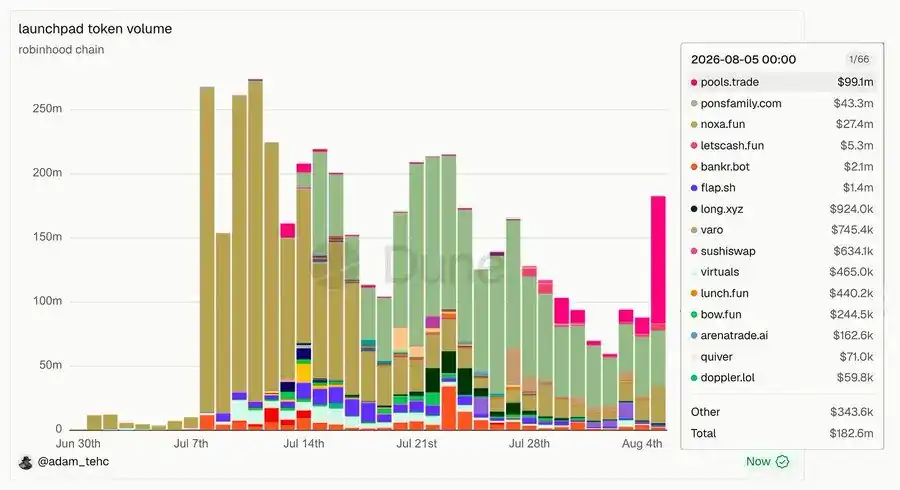
This sense of disarray shown by a DeFi veteran like Uniswap felt somewhat 'amateurish,' yet the trading data was undeniably high. Dune data shows that on August 5th alone (the frontend didn't officially open until the morning of August 6th Beijing time, with most of this volume generated pre-launch), Pools.trade trading volume reached $99.1 million, accounting for approximately 54.2% of the total trading volume on the Robinhood Chain token launch platform that day, far exceeding the previously top-ranked Pons for two weeks.
Pools.trade: The Token Launch Platform Introduced by Uniswap Itself

Project Overview

Pools.trade is a token launch platform launched by Uniswap Labs on Robinhood Chain. Officially positioned as a Meme coin launchpad, users can create new tokens, discover new coins, and trade—all on the same page. Each token has a fixed total supply of 1 billion tokens, ultimately entering Uniswap v4 with liquidity permanently locked.

Tokens launched on Pools.trade are immediately integrated into the Uniswap web interface, wallet, Launches page, and Trading API, reaching MetaMask, Ledger, and multiple DEX aggregators. Compared to new platforms starting from scratch to find trading entry points, Pools.trade launched with Uniswap's ready-made user base and distribution channels.

Two Launch Methods

Pools.trade offers Instant Launch and Crowd Launch modes, respectively:

  • Instant Launch: Launch immediately. After the creator fills in the name, ticker, image, and description, the token opens for trading directly. The price fluctuates with market buying and selling, with no minimum market cap requirement or fixed end time.
  • Crowd Launch: Employs a four-hour launch window. Participants submit budgets in advance, with orders executed progressively throughout the remaining time—typically the earlier the participation, the lower the price. After the launch ends, if the token's FDV reaches $10,000, it enters trading; if it fails to meet the threshold, all participating funds are refunded. This mode primarily aims to reduce the impact of bot front-running and bundle transactions at launch.

The Platform's Most Prominent Feature: Trading Fees Only a Quarter of Pons and Flap

Pools.trade does not charge additional launchpad fees. Each transaction incurs a 0.25% Uniswap v4 pool fee. If the creator enables the fee split, 0.05% goes to the creator, and 0.20% is automatically reinvested into the permanently locked liquidity pool. Uniswap Labs does not take a share.

Trading fees for both Pons and Flap are 1%. Calculating with $10 million in trading volume: Pools.trade generates $25,000 in fees, with the token creator receiving $5,000; Pons generates $100,000 in fees, and based on a 70% creator share, the token creator would receive $70,000.

Pools.trade lowers transaction costs and keeps most of the fees within the liquidity; Pons and Flap offer higher direct income incentives for token creators. The former benefits trading more, while the latter provides more direct motivation for creators.

For a detailed introduction, recommended reading: "Uniswap Launches Token Launch Platform Pools.trade, Reshuffling the Robinhood Launchpad Ecosystem?".

Only Two Tokens Surpass $1 Million Market Cap, Early Minting Raises Fairness Concerns

Compared to the impressive number of token launches and platform trading volume, Pools.trade has not yet produced a high-market-cap Meme coin. As of now, only two tokens on Pools.trade have a market cap above $1 million, namely FRONG and POOLS; additionally, tokens with a market cap above $400,000 include HOOKR, UNIPEG, CHWDR, and PosM.
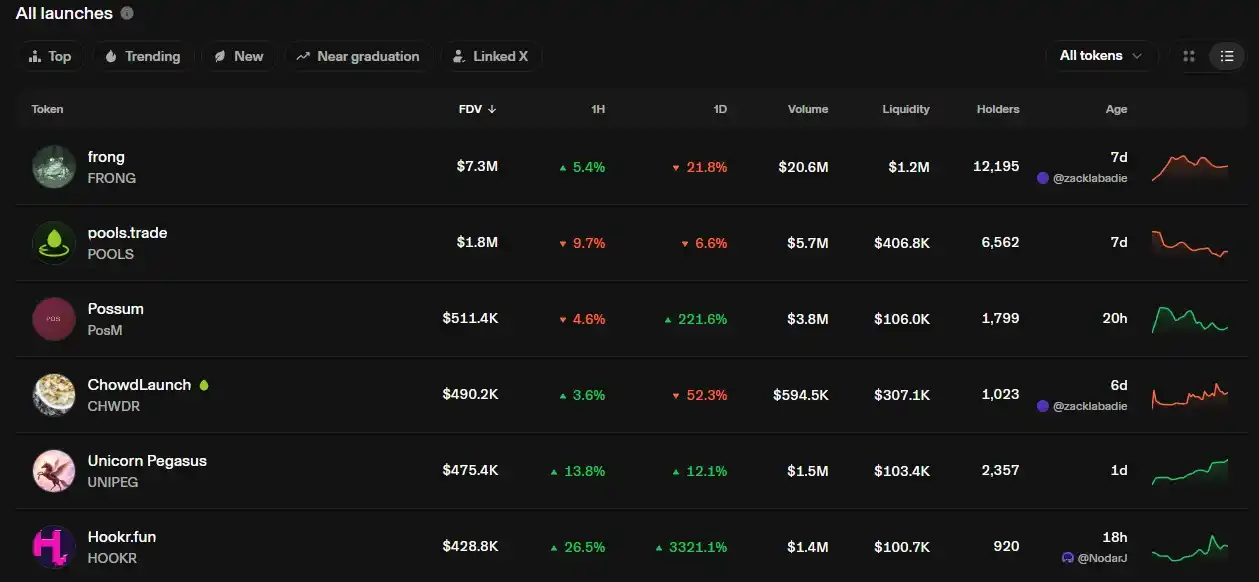
FRONG: Market Cap Once Touched $18 Million

FRONG is currently the highest-market-cap Meme on Pools.trade. At 00:00 on August 5th, Uniswap's official Twitter account began the 24-hour countdown for Pools.trade's launch, posting a video of a frog "playing" by a pond.

After the tweet was posted, the community quickly noticed the frog-themed Meme coin—FRONG—issued through the Pools.trade early contract and began to view it as the platform's mascot concept coin. Driven by this FOMO sentiment, FRONG's market cap briefly touched $18 million.
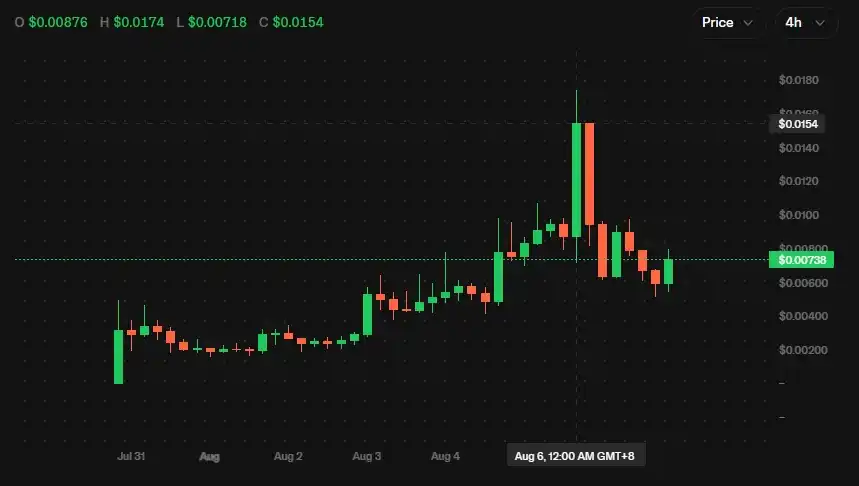
However, FRONG had already been minted via contract before Uniswap even started the Pools.trade launch countdown. On-chain records show that FRONG was minted and a trading pool was established as early as July 30th, five days before Uniswap's countdown announcement; related contracts were even deployed roughly three weeks prior, at that time with no indication of affiliation with Uniswap or Pools.trade.

As this time gap was discovered, questions arose about the fairness of FRONG's launch, and its market cap rapidly retreated from its highs. Even after Pools.trade officially launched yesterday at 00:00, FRONG did not receive strong community enthusiasm, its market cap remaining below $10 million, currently reported at around $7 million.

POOLS: Market Cap Once Broke $4 Million

POOLS, currently the second-highest market cap token on Pools.trade, shares a similar situation with FRONG—it was also a Meme coin minted before the platform's official launch.

Compared to FRONG's "frog mascot" narrative, POOLS's logic is more direct—its name matches the platform, so the community treated it as the Pools.trade concept coin. Its market cap once exceeded $4 million before falling back to around $1.8 million.
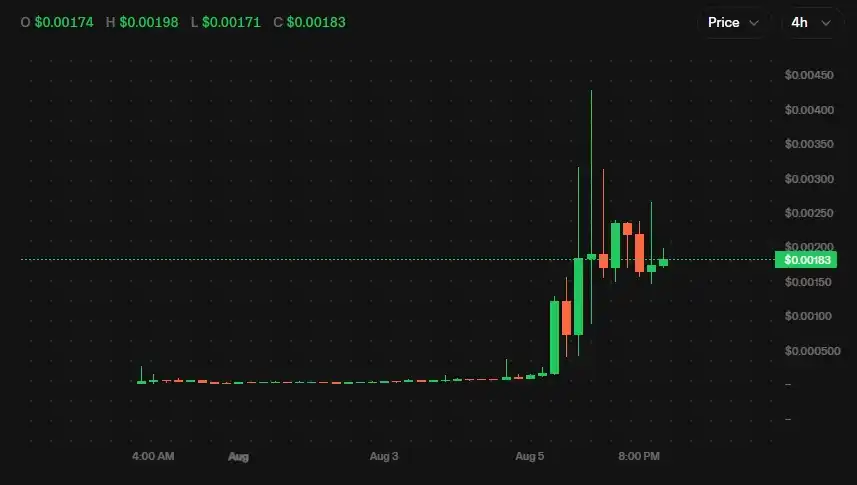
FRONG relied on the "frog mascot" narrative, POOLS on the platform's namesake—both should have had higher market cap expectations. However, both faced diminished community FOMO sentiment due to the "insider trading" controversy arising from early minting, resulting in market caps below $10 million.

The most fundamental logic of Meme coins is that everyone wants to believe they are starting from the same line. Once fairness is questioned, even the best token narrative struggles to sustain spontaneous community propagation. This is perhaps why Pools.trade, despite impressive data, has yet to produce a high-market-cap Meme coin.

However, Uniswap stands behind Pools.trade, and Robinhood Chain is one of the most discussed public chains for Memes at the moment. Currently, the platform lacks not for traffic, but for a new narrative that is intriguing enough and free from "insider trading" controversy. The first "speedrun" on Pools.trade might not be far off.


Cryptos en tendance

Questions liées

QWhat was the main reason why Pools.trade's launch did not go as planned according to the article?

AThe main reason was that the community discovered and started trading tokens on the early deployed contracts before the official front-end launch, generating over $150 million in volume and forcing Uniswap to scramble to adjust the site and data indexing, disrupting the planned launch schedule.

QWhat are the two token launch modes offered by Pools.trade?

APools.trade offers two modes: Instant Launch (immediate token creation and trading with no minimum market cap or fixed end time) and Crowd Launch (a 4-hour launch window where orders are filled progressively, with a $10,000 FDV threshold for the token to go live post-launch).

QHow does the transaction fee structure of Pools.trade compare to platforms like Pons and Flap?

APools.trade charges a 0.25% fee per transaction (0.05% to the creator and 0.20% auto-reinvested into the permanently locked liquidity pool), while Pons and Flap charge a 1% fee, which offers creators a higher direct revenue share.

QAccording to the article, why haven't any high-market-cap meme coins emerged on Pools.trade despite its high volume?

AThe primary reason is that the early high-profile tokens like FRONG and POOLS were minted before the official platform announcement, leading to 'fair launch' controversies and 'rat warehouse' accusations, which severely dampened community FOMO and trust, undermining their potential for sustained growth.

QWhat key advantage does Pools.trade have over new token launch platforms, as mentioned in the article?

APools.trade's key advantage is that it launches with immediate access to Uniswap's existing user base, distribution channels, and integrations (like the Uniswap web interface, wallet, Launches page, Trading API, MetaMask, Ledger, and DEX aggregators).

Lectures associées

Le cours des actions bondit de 655 %, deux frères du Sichuan créent une introduction en bourse de 50 milliards dans les semi-conducteurs

La société chinoise de composants pour équipements semi-conducteurs, Chengdu Superpure Applied Materials Co., Ltd. (Superpure Yingcai), a été introduite en bourse à Shenzhen. Son cours a grimpé de 655% par rapport au prix d'émission de 65,99 yuans, portant sa capitalisation boursière à plus de 50 milliards de yuans. Fondée en 2005 et basée dans le Sichuan, l'entreprise est un fournisseur clé de pièces à revêtement spécial et de composants optiques de précision pour les équipements de fabrication de semi-conducteurs, y compris pour les procédés avancés de 5 nm et moins. Elle détient la première part de marché parmi les acteurs locaux dans son segment. Entre 2023 et 2025, ses revenus sont passés de 169 millions à 496 millions de yuans, les pièces à revêtement spécial représentant plus de 95% de son chiffre d'affaires en 2025. Ses principaux clients incluent des géants de l'équipement comme North Microelectronics (client A) et AMEC (client B). La société, contrôlée par les frères Chai Jie (PDG) et Chai Lin (directeur technique), a levé environ 1,68 milliard de yuans lors de son IPO, dépassant son objectif initial. Les fonds seront utilisés pour développer ses capacités de production et la R&D. Cette introduction en bourse intervient dans un contexte de forte poussée pour la substitution des importations dans la chaîne d'approvisionnement des semi-conducteurs en Chine, où les acteurs étrangers dominent encore le marché des composants d'équipement.

marsbitIl y a 25 mins

Le cours des actions bondit de 655 %, deux frères du Sichuan créent une introduction en bourse de 50 milliards dans les semi-conducteurs

marsbitIl y a 25 mins

Claude lance les « filigranes invisibles » sous les critiques : le nouveau modèle les intègre entièrement, marquant tous les textes

Anthropic annonce que ses nouveaux modèles Claude intégreront désormais un « filigrane invisible » dans tous les textes générés, une mesure appliquée globalement suite à la signature du code de conduite européen sur la transparence de l’IA. Ce marquage, inséré directement dans le texte, serait indétectable à l’œil nu et persisterait même après copie ou modification légère. Il s’accompagne de métadonnées de signature pour les fichiers image, selon le standard C2PA. La société travaille également sur un outil de détection, tout en reconnaissant les limites du système : la présence du filigrane n’atteste pas à coup sûr de la paternité par l’IA, et son absence ne garantit pas une origine humaine. Si Anthropic ne détaille pas la technique employée, des méthodes existent déjà, comme l’utilisation de caractères Unicode invisibles. La firme avait déjà été épinglée pour avoir discrètement marqué les sorties destinées aux utilisateurs chinois via Claude Code. Cette initiative, bien que présentée comme sans impact sur la qualité des réponses, suscite de vives critiques. En réaction, des propositions émergent pour créer des outils supprimant ces filigranes, et certains utilisateurs se tournent déjà vers d’autres assistants comme Kimi pour contourner la mesure.

marsbitIl y a 29 mins

Claude lance les « filigranes invisibles » sous les critiques : le nouveau modèle les intègre entièrement, marquant tous les textes

marsbitIl y a 29 mins

Opinion : Les altcoins peuvent encore être sauvés, mais les jetons VC n'ont vraiment aucun avenir

Auteur : Haotian Discussion avec des experts de la blockchain : le marché est passé de « l'écoute des récits et de la spéculation sur les anticipations » à « l'analyse des flux de trésorerie et de la concrétisation réelle ». Règles essentielles pour investir (à titre indicatif) : 1) Privilégier les actifs capables de capturer de la valeur réelle. En période de ralentissement, seuls les flux de trésorerie tangibles et les programmes de rachats/destructions comptent. Exemples : plateformes de lancement comme $UNI, $PUMP, $PONS, ou le roi du rachat $HYPE. 2) Choisir des projets ayant atteint la product-market fit (PMF) et formant un cycle économique complet. Les récits futurs se concentreront sur la « tokenisation d’actifs » et « l'économie agentique ». Priorité aux projets avec des utilisateurs réels, des transactions vérifiables et des revenus avérés, comme $ONDO, $VVV, $VIRTUAL, en surveillant leurs volumes et leurs frais générés. 3) Opter pour des actifs bénéficiant d’un fort « consensus » durable, développé naturellement et capable de traverser les cycles. Exemples : memes anciens comme $DOGE, $PEPE, $PEOPLE, ou leaders de niche comme $ZEC et $TAO, soutenus par des communautés organiques et une liquidité résiliente. 4) Éviter les tokens purement soutenus par du capital-risque (VC). Leur structure à haute valorisation, faible circulation et déblocages massifs réguliers les rend vulnérables : après le lancement, en l’absence de création de valeur, ils subissent souvent des ventes massives, décourageant les petits investisseurs. Remarque : Ces points sont le fruit d'échanges personnels et les exemples cités ne constituent pas des conseils en investissement.

marsbitIl y a 55 mins

Opinion : Les altcoins peuvent encore être sauvés, mais les jetons VC n'ont vraiment aucun avenir

marsbitIl y a 55 mins

Trading

Spot

Articles tendance

Comment acheter CAP

Bienvenue sur HTX.com ! Nous vous permettons d'acheter Cap (CAP) de manière simple et pratique. Suivez notre guide étape par étape pour commencer votre parcours crypto.Étape 1 : Création de votre compte HTXUtilisez votre adresse e-mail ou votre numéro de téléphone pour ouvrir un compte sur HTX gratuitement. L'inscription se fait en toute simplicité et débloque toutes les fonctionnalités.Créer mon compteÉtape 2 : Choix du mode de paiement (rubrique Acheter des cryptosCarte de crédit/débit : utilisez votre carte Visa ou Mastercard pour acheter instantanément Cap (CAP).Solde :utilisez les fonds du solde de votre compte HTX pour trader en toute simplicité.Prestataire tiers :pour accroître la commodité d'utilisation, nous avons ajouté des modes de paiement populaires tels que Google Pay et Apple Pay.P2P :tradez directement avec d'autres utilisateurs sur HTX.OTC (de gré à gré) : nous offrons des services personnalisés et des taux de change compétitifs aux traders.Étape 3 : stockage de vos Cap (CAP)Après avoir acheté vos Cap (CAP), stockez-les sur votre compte HTX. Vous pouvez également les envoyer ailleurs via un transfert sur la blockchain ou les utiliser pour trader d'autres cryptos.Étape 4 : tradez des Cap (CAP)Tradez facilement Cap (CAP) sur le marché Spot de HTX. Il vous suffit d'accéder à votre compte, de sélectionner la paire de trading, d'exécuter vos trades et de les suivre en temps réel. Nous offrons une expérience conviviale aux débutants comme aux traders chevronnés.

506 vues totalesPublié le 2026.06.26Mis à jour le 2026.06.26

Comment acheter CAP

Discussions

Bienvenue dans la Communauté HTX. Ici, vous pouvez vous tenir informé(e) des derniers développements de la plateforme et accéder à des analyses de marché professionnelles. Les opinions des utilisateurs sur le prix de CAP (CAP) sont présentées ci-dessous.

活动图片