Japanese and Korean Stock Markets Crashed! Nikkei Plummets Over 4%, KOSPI Plunges 8%, Market Panics Ahead of AI Giants' Earnings Week

marsbitPublié le 2026-07-28Dernière mise à jour le 2026-07-28

Résumé

Japanese and South Korean stock markets plunged sharply in early Tuesday trading, with the Nikkei 225 down over 4% and the KOSPI index tumbling 8%, triggering a circuit breaker. The sell-off was led by semiconductor and equipment stocks like Tokyo Electron, Kioxia, Samsung Electronics, and SK Hynix, the latter dropping as much as 30%. The primary driver is mounting investor concern over the sustainability of the AI boom. Worries intensified following news related to Nvidia's major AI supply agreements and rising debt insurance costs. Analysts point to fears over excessive capital expenditure, crowded trades in AI-related stocks, and high corporate debt levels. Market sentiment has soured ahead of key earnings reports from major tech firms, including Meta and SK Hynix. While SK Hynix is expected to post record results, its recent 38% price drop from June highs reflects deep skepticism about whether AI infrastructure spending can maintain its pace and deliver returns. The sell-off appears more driven by a sharp deterioration in sentiment than by immediate fundamental changes.

On Tuesday morning, dragged down by concerns related to Nvidia's (NVDA.O) significant AI supply agreements and intensifying market competition, investor sentiment was hit, causing Japanese and Korean stock markets to open lower and extend losses.

As of the time of writing, the Nikkei 225 Index had plunged over 4% intraday, hitting its lowest level since May 22; the TOPIX Index saw its biggest drop of 2.7%. South Korea's KOSPI Index widened its losses to 8%, triggering a trading halt for 20 minutes. The Korea Exchange had also earlier activated the KOSPI sidecar mechanism, temporarily suspending program sell orders on the KOSPI.

Semiconductor and equipment stocks like Tokyo Electron, Kioxia, Samsung Electronics, and SK Hynix led the declines, all falling more than 9%. Among them, SK Hynix's stock price plummeted as much as 30%, marking its biggest single-day drop in history; Kioxia's stock price fell up to 18%, its largest decline since last November. As the global sell-off in semiconductor stocks intensified, investor sentiment regarding the sustainability of the AI boom continued to deteriorate.

Amid a wave of AI-related deals totaling over $750 billion, the cost of debt default insurance for Nvidia surged, triggering a decline in tech stocks. Hideyuki Ishiguro, Chief Strategist at Nomura Asset Management, stated that following reports on Nvidia's significant investment deals, the rise in its credit risk is being viewed by investors as a negative signal.

Additionally, Ishiguro pointed out that China's progress in the semiconductor manufacturing equipment sector poses a threat to Japanese suppliers—who have long held a competitive advantage in this field.
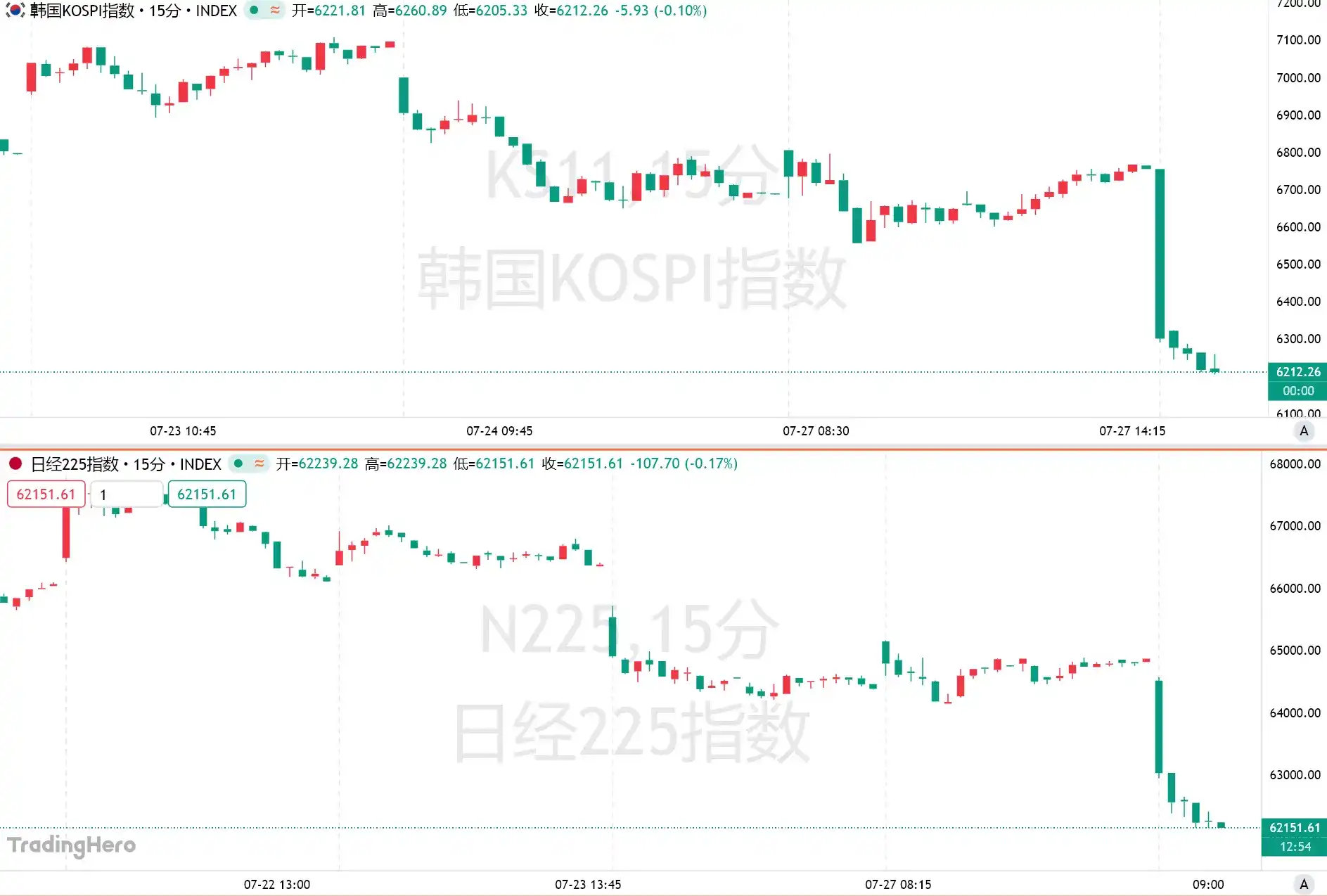
These declines point to deepening concerns in the market regarding crowded stock positioning and rising corporate debt levels as AI infrastructure development advances.

"The recent sell-off in semiconductor stocks seems to be driven more by sharply deteriorating market sentiment than by any immediate change in fundamentals," said Jung In Yun, CEO of Fibonacci Asset Management Global. "Investors are increasingly questioning whether the pace of AI infrastructure spending can be sustained."

Chris Larkin of Morgan Stanley E*Trade said: "This week is packed with potential surprises, both good and bad. Geopolitics and oil prices could be the biggest variables, but an optimistic reaction to strong earnings from the Magnificent Seven is not a given, especially if AI spending levels continue to surprise."

Kyle Rodda, Senior Analyst at Capital.com, wrote in a note to clients: "These companies embody the key themes currently affecting market sentiment—excessive capital expenditure and spending by AI companies, which investors worry will erode returns."

This week, several top tech companies, including Meta Platforms Inc. (META), are set to release key earnings. News earlier this month that Meta planned to sell excess AI computing capacity had already sparked concerns about demand. Apple Inc. (AAPL) has issued warnings about cost pressures, and reports indicate it is lobbying for approval to purchase memory components from competitors.

Investors are also awaiting the full results for Samsung Electronics' June quarter. Kim Minji, a portfolio manager at Seoul's Must Asset Management, said the world's largest traditional memory chipmaker is catching up to SK Hynix in the HBM field.

Furthermore, although SK Hynix is expected to announce another quarter of record-breaking earnings on Wednesday, investor sentiment has clearly weakened. The core market concern is that continuously rising memory prices may force customers to reduce purchases and seek lower-cost alternatives.

Since hitting a historic high in June, SK Hynix's stock price has cumulatively fallen 38%, with market worries about overcrowded trading and leverage amplifying price volatility. In this round of adjustment, the company's market capitalization shrinkage is second only to SpaceX (SPCX) globally.

In just over a month, approximately $470 billion in market value has evaporated from SK Hynix. The South Korean memory chipmaker, once seen as one of the world's hottest AI trades, is now becoming one of the most contentious holdings in investor portfolios.

Shawn Oh, Head of Korea Cash Equities Business at NH Investment & Securities, stated in a research report that, considering the current attractive valuation and the ongoing deleveraging by Korean retail investors, SK Hynix remains "an extremely attractive buying opportunity." However, he also noted that the market is reducing stock positions ahead of the U.S. tech company earnings season.

The market expects SK Hynix's June quarter sales to more than double year-on-year, reaching about $57 billion; operating profit is projected to increase sixfold year-on-year. But James Ooi, a market strategist at Tiger Brokers, said the significance of SK Hynix's earnings may transcend the company itself.

"SK Hynix's performance could also become a sentiment barometer for the global AI hardware sector," he said, adding that market expectations have largely been priced in already, so "even a slight miss could trigger a sharp reaction."

Hebe Chen, Senior Market Analyst at Vantage Global Prime, said: "The recent sell-off in chipmakers shows that doubts about spending, returns, and valuations are deepening, not subsiding. With several major catalysts approaching, the hesitation to buy the dip suggests investors are waiting for stronger evidence before rebuilding risk exposure."


Cryptos en tendance

Questions liées

QWhat were the main factors cited as causing the sharp decline in Japanese and South Korean stock markets on Tuesday morning?

AThe main factors were investor concerns about NVIDIA's major AI supply agreement and increasing market competition, which negatively impacted sentiment. Specific triggers included a surge in NVIDIA's debt default insurance costs within the large AI-related deal wave and worries about competition from China in semiconductor manufacturing equipment for Japanese firms.

QWhat specific market mechanisms were triggered in the South Korean market due to the sell-off, and for what key stock index?

AFor the South Korean KOSPI index, the decline widened to 8%, triggering a market-wide circuit breaker which halted trading for 20 minutes. The Korea Exchange also initiated a sidecar mechanism for the KOSPI, temporarily suspending program selling.

QWhich semiconductor and equipment stocks were mentioned as leading the declines, and what were some of their significant losses?

ATokyo Electron, Kioxia, Samsung Electronics, and SK Hynix were mentioned as leading the declines. Specific notable losses included SK Hynix's stock plunging as much as 30% (its biggest-ever daily drop) and Kioxia's stock falling up to 18% (its largest drop since November of the previous year).

QAccording to analysts cited in the article, what is the core investor worry regarding the current AI boom that is driving the market sell-off?

AThe core investor worry, as stated by analysts, is skepticism about the sustainability of AI infrastructure spending and capital expenditure. Investors are increasingly questioning whether the pace of AI-related spending can continue, fearing it will erode company returns. The sell-off reflects deepening concerns over crowded stock positions and rising corporate debt levels in the AI build-out.

QWhy is SK Hynix's upcoming earnings report considered significant beyond the company's own performance, and what potential market reaction is anticipated?

ASK Hynix's earnings report is seen as a potential sentiment barometer for the global AI hardware sector. The market has largely priced in high expectations, so even a slight miss in earnings could trigger a significant and volatile negative reaction across related stocks. Its performance is being watched for clues about the broader health and trajectory of AI demand.

Lectures associées

Gumi et SBI lancent un fonds de crypto-monnaie de 3 milliards de yens, et le Japon ouvre la porte aux ETF au comptant

La société japonaise Gumi Inc., spécialisée dans le développement de jeux et les technologies blockchain, s'est associée au groupe financier SBI pour lancer le SBI Crypto Fund I, qui débutera ses activités le 1er août 2026. Ce fonds vise à lever 3 milliards de yens (environ 18,3 millions de dollars) et sera géré via des méthodes comme le staking, la couverture et la réallocation d'actifs. SBI Financial Services détiendra 51% des parts, et gC Labs (filiale de Gumi) 49%. Le fonds investira exclusivement dans le Bitcoin et d'autres altcoins majeurs cotés sur des plateformes reconnues. Ce lancement intervient dans un contexte de réforme réglementaire au Japon. Le Parlement a approuvé de nouvelles lois reclassant les cryptomonnaies comme instruments financiers plutôt que simples moyens de paiement, ouvrant la voie à de futurs ETF sur le Bitcoin. Les amendements, qui entreront en vigueur en 2027, prévoient également des pénalités plus sévères pour les activités non enregistrées et un projet de réduction de la fiscalité sur les plus-values de 55% à 20% à partir de 2028. Parallèlement, le marché japonais montre des signes de croissance. La plateforme d'échange SBI VC Trade, détenue par SBI Holdings, a dépassé les 2 millions de comptes enregistrés. Les entreprises montrent un intérêt accru pour le Bitcoin et le XRP, notamment pour diversifier leurs réserves face à la faiblesse du yen. L'ajout de stablecoins comme l'USDC et le JPYSC (premier stablecoin lié au yen) a également contribué à cette dynamique. Bien que plus petit que les marchés américain ou sud-coréen, l'écosystème crypto japonais gagne en maturité.

cryptonews.ruIl y a 2 mins

Gumi et SBI lancent un fonds de crypto-monnaie de 3 milliards de yens, et le Japon ouvre la porte aux ETF au comptant

cryptonews.ruIl y a 2 mins

La société Hyperscale Data a vendu 100 BTC pour financer un centre de données d'IA de 3 milliards de dollars

La société Hyperscale Data, cotée sous le ticker GPUS, a vendu 100 BTC pour financer partiellement un centre de données pour l'intelligence artificielle (IA) d'une valeur potentielle de 3 milliards de dollars. Basée à Las Vegas, la société a initialement bâti son activité sur le minage de Bitcoin et détient un important stock de cryptomonnaies. Le produit de la vente, évalué à environ 6,5 millions de dollars au prix du Bitcoin à ce moment-là, sera investi dans la construction d'une infrastructure de 617 000 pieds carrés à Dowagiac, dans le Michigan. Ce site, anciennement utilisé pour le minage, hébergera désormais des capacités de calcul pour l'IA via un contrat de 10 ans avec un fournisseur de services californien. Ce contrat, qui pourrait générer plus de 1,2 milliard de dollars, inclut une option pour des capacités supplémentaires portant le revenu total potentiel à plus de 3 milliards de dollars. Pour préserver ses réserves restantes de Bitcoin (environ 1 006 BTC), Hyperscale Data a également obtenu une ligne de crédit garantie par ces actifs. La direction a présenté cette stratégie comme un rééquilibrage du bilan et a réaffirmé sa conviction à long terme sur le Bitcoin. Cette décision s'inscrit dans une tendance plus large parmi les mineurs de Bitcoin, comme Marathon Digital et Bitdeer, qui réorientent leurs infrastructures vers l'IA et le calcul haute performance (HPC) pour des revenus potentiellement plus stables. Les prochaines étapes clés à surveiller sont l'exercice de l'option par le client, le déploiement des capacités initiales et l'utilisation de la nouvelle ligne de crédit par Hyperscale Data.

cryptonews.ruIl y a 5 mins

La société Hyperscale Data a vendu 100 BTC pour financer un centre de données d'IA de 3 milliards de dollars

cryptonews.ruIl y a 5 mins

Trading

Spot

Articles tendance

Comment acheter 4

Bienvenue sur HTX.com ! Nous vous permettons d'acheter 4 (4) de manière simple et pratique. Suivez notre guide étape par étape pour commencer votre parcours crypto.Étape 1 : Création de votre compte HTXUtilisez votre adresse e-mail ou votre numéro de téléphone pour ouvrir un compte sur HTX gratuitement. L'inscription se fait en toute simplicité et débloque toutes les fonctionnalités.Créer mon compteÉtape 2 : Choix du mode de paiement (rubrique Acheter des cryptosCarte de crédit/débit : utilisez votre carte Visa ou Mastercard pour acheter instantanément 4 (4).Solde :utilisez les fonds du solde de votre compte HTX pour trader en toute simplicité.Prestataire tiers :pour accroître la commodité d'utilisation, nous avons ajouté des modes de paiement populaires tels que Google Pay et Apple Pay.P2P :tradez directement avec d'autres utilisateurs sur HTX.OTC (de gré à gré) : nous offrons des services personnalisés et des taux de change compétitifs aux traders.Étape 3 : stockage de vos 4 (4)Après avoir acheté vos 4 (4), stockez-les sur votre compte HTX. Vous pouvez également les envoyer ailleurs via un transfert sur la blockchain ou les utiliser pour trader d'autres cryptos.Étape 4 : tradez des 4 (4)Tradez facilement 4 (4) sur le marché Spot de HTX. Il vous suffit d'accéder à votre compte, de sélectionner la paire de trading, d'exécuter vos trades et de les suivre en temps réel. Nous offrons une expérience conviviale aux débutants comme aux traders chevronnés.

688 vues totalesPublié le 2025.10.20Mis à jour le 2026.06.02

Comment acheter 4

Discussions

Bienvenue dans la Communauté HTX. Ici, vous pouvez vous tenir informé(e) des derniers développements de la plateforme et accéder à des analyses de marché professionnelles. Les opinions des utilisateurs sur le prix de 4 (4) sont présentées ci-dessous.

活动图片