Storj Labs Files for Bankruptcy Protection: Can Token Holders Exchange for Company Equity?

Foresight NewsPublié le 2026-07-27Dernière mise à jour le 2026-07-27

Résumé

Storj Labs, parent company of decentralized cloud storage platform Storj, filed for Chapter 11 bankruptcy protection on July 26 in the U.S. District Court for the Northern District of West Virginia. The company stated its network will operate normally and token functions will be unaffected. Notably, Storj plans to propose a mechanism in its reorganization plan allowing STORJ token holders a path to equity in the restructured company—an unprecedented offer in the crypto industry. However, its feasibility depends on whether any residual value remains after creditor repayments, as token holders are low in the legal priority hierarchy. Founded in 2014, Storj is an early decentralized infrastructure project. It reported a 7x increase in Annual Recurring Revenue (ARR) to approximately $30 million in 2024. In October 2025, it was acquired by Inveniam Capital Partners. Less than a year later, the merged entity entered bankruptcy proceedings. Storj attributed the filing to historical debts from past operations and acquisitions, stating they were too large to be absorbed by business growth. The company also plans to refocus on its core decentralized storage business, likely divesting Valdi, a GPU computing company acquired in 2024. The proposed token-to-equity conversion faces significant legal hurdles. Under U.S. bankruptcy law, creditors are paid before equity holders, and utility token holders are not automatically recognized as equity members. The details—such as eligibility, all...


Written by: ChandlerZ, Foresight News


Storj Labs, the parent company of the decentralized cloud storage platform Storj, filed for Chapter 11 bankruptcy protection in the U.S. Bankruptcy Court for the Northern District of West Virginia on July 26.
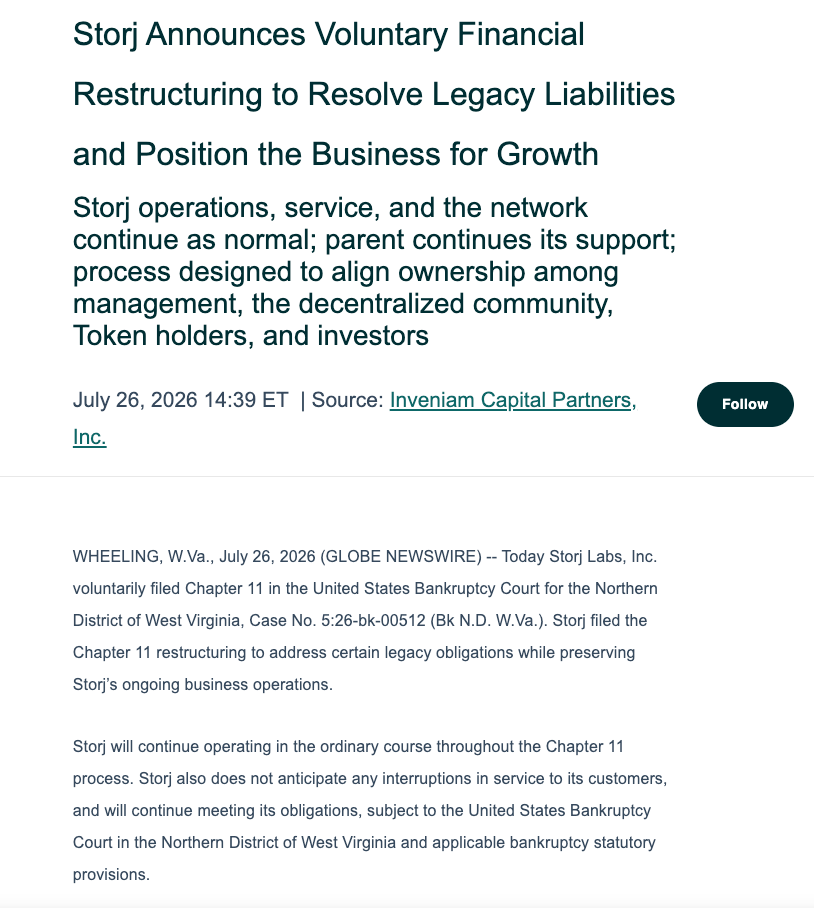


Storj stated that the network will continue to operate normally, token functionality will remain unaffected, and it plans to include in its reorganization plan a path for STORJ token holders to obtain equity in the restructured company. This proposed token-to-equity swap is unprecedented in the crypto industry, and its implementation hinges on whether there is residual value after creditors are repaid.


Bankruptcy Within a Year of Acquisition


Storj was founded in 2014 and is one of the earliest decentralized infrastructure projects in the crypto industry. Its core business is building a distributed cloud storage network via blockchain incentive mechanisms, encouraging global node operators to contribute idle hard drive space as an alternative to centralized storage services like Amazon S3. Users pay for storage and bandwidth with the STORJ token, and node operators are rewarded in STORJ.


In its early stages, the project received seed funding from Google Ventures, Qualcomm Ventures, and Techstars. It raised approximately $30 million through a token sale in 2017. In 2024, Storj achieved a 7x growth in Annual Recurring Revenue (ARR), reaching about $30 million, with a team size of 81 people. That same year, Storj also acquired GPU computing company Valdi, expanding its business from pure storage to compute power leasing.


In October 2025, Inveniam Capital Partners, focused on data assetization, acquired Storj through a reverse triangular merger. CEO Colby Winegar remained in his position, and Executive Chairman Ben Golub joined the Inveniam board. On the day the acquisition was announced, the STORJ token fell by 18%. Less than a year later, the merged entity entered bankruptcy proceedings.


In a public letter, Storj attributed the bankruptcy to historical debts, stating that the liabilities primarily stemmed from previous operations and acquisitions, predating the current business strategy, and were too large to be naturally absorbed through business growth. The company claimed its current operations are streamlined, but the burdens of the past can only be resolved through a court-supervised reorganization. The company also stated it would divest non-core businesses brought in by previous acquisitions during the restructuring to refocus on its core decentralized storage business.


The GPU computing company Valdi, acquired in July 2024, is the most likely asset to be divested. Valdi brought Storj a compute network of over 16,000 GPUs globally, originally the core of Storj's expansion into AI computing. However, from a bankruptcy restructuring perspective, this acquisition itself may be one of the sources of increased debt. Divesting Valdi means Storj will return to the pure storage track, abandoning its previous positioning as a full-stack distributed cloud platform.


Token-to-Equity Swap: Promise or Empty Promise?


The most notable proposal in the official public letter is providing a path for token holders to company equity. Storj management indicated plans to propose a mechanism in the reorganization plan allowing token holders to participate in the equity distribution of the restructured company, realigning company ownership among management, the decentralized community, token holders, and investors.


Kaloyan Raev, Director of Software Engineering at Storj, was quite measured in his wording in the public letter, stating the company would give users a seat and sincere intent, not a guaranteed outcome. The company has not yet disclosed eligibility criteria (whether a token snapshot or lock-up is required), the proportion of equity available for distribution, or the specific participation mechanisms. All terms need to be formulated during the reorganization process and approved by the court.


The core obstacle to this proposal lies in the priority rules of bankruptcy law. In Chapter 11 reorganization, creditor repayment takes precedence over equity holders. Token holders are legally closest to the position of equity holders, at the very end of the repayment sequence. Only after creditors are fully or proportionally repaid can residual value potentially flow to token holders.


There is no bankruptcy precedent in the crypto industry for a token-to-equity swap. In the WTT lawsuit involving crypto miner Giga Watt's bankruptcy after raising about $22 million via an ICO, the court ruled that utility token holders did not qualify as members of the company. This means token holders cannot automatically gain equity status; separate rights must be created through the reorganization plan. The FTX bankruptcy case set precedents in crypto asset valuation but dealt with creditor claims, which is entirely different from the token-to-equity path proposed by Storj.


Another noteworthy variable is the concentration of token holdings. The total STORJ supply is 425 million tokens, with approximately 30% (about 130 million) still held by Storj Labs. If the company's own token holdings also participate in the equity conversion, there is a potential conflict of interest between management and external token holders.


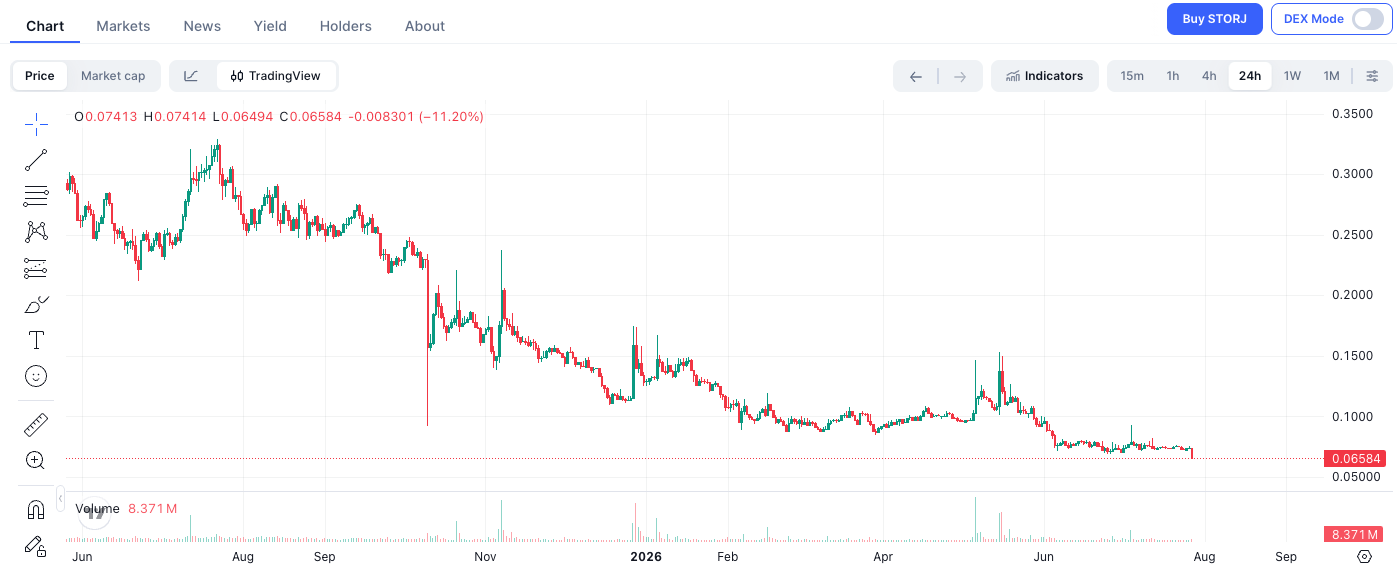
The STORJ token is currently priced around $0.06584, with a total market capitalization of approximately $27.97 million. The price fell 11.2% in the 24 hours following the news announcement.


A Marginal Player in the Decentralized Storage Race


Storj's scale in the decentralized storage sector is far smaller than its top competitors. Filecoin's current market capitalization is approximately $607 million, nearly 20 times that of STORJ, with a network capacity exceeding 1.8 EiB. In early 2026, Filecoin officially launched its Onchain Cloud roadmap, supporting automated data repair, perpetual renewals, and liquid staking of storage power via the Filecoin Virtual Machine (FVM), positioning itself as a decentralized alternative to AWS. Arweave follows another path, capturing the market for NFT metadata and blockchain historical state storage with its one-time payment for permanent storage model.


In comparison, Storj's advantage lies in retrieval speed. Storj uses Erasure Coding to split files into over 80 fragments distributed across global nodes, requiring only 29 fragments to reconstruct a file, achieving millisecond-level retrieval latency, performance close to that of centralized cloud providers. This gives Storj some competitiveness in hot data storage (video streaming, application data), but its market share is far behind Filecoin's.


During bankruptcy restructuring, whether node operators and enterprise clients will migrate to Filecoin or Arweave due to uncertainty is a real risk for the Storj network. For STORJ token holders, the key variables to monitor include: the specific terms of the token-to-equity swap in the reorganization plan and court approval progress, how the company's 30% token holdings will be handled, and whether the post-Valdi-divestiture business can support valuation.

Cryptos en tendance

Questions liées

QWhat is the main reason Storj Labs cited for filing for Chapter 11 bankruptcy protection?

AStorj Labs cited historical legacy debts from previous operations and acquisitions, which were incurred prior to the current business strategy. The company stated that the scale of this debt was too large to be digested through natural business growth.

QWhat unprecedented proposal has Storj made for its STORJ token holders during the restructuring process?

AStorj has proposed creating a path for STORJ token holders to potentially acquire equity in the restructured company. This is presented as an effort to realign company ownership among management, the decentralized community, token holders, and investors. However, this is an unprecedented proposal in the crypto industry and its implementation is not guaranteed.

QAccording to the article, what is the major legal hurdle for Storj's proposal to convert tokens to equity?

AThe major legal hurdle is the priority rules in bankruptcy law. In Chapter 11 restructuring, creditors are paid before equity holders. Token holders are positioned similarly to equity holders at the end of the payment priority sequence. They would only receive any value after creditors are fully or partially satisfied.

QWhat key non-core asset acquired in 2024 is Storj likely to divest during its restructuring?

AStorj is likely to divest Valdi, a GPU computing company acquired in July 2024. This acquisition was part of Storj's expansion into AI computing, but divesting it means the company will refocus on its core decentralized storage business.

QHow does Storj's market position in decentralized storage compare to its main competitor, Filecoin?

AStorj is a much smaller player compared to Filecoin. Filecoin's market capitalization is approximately $607 million, which is nearly 20 times larger than STORJ's market cap of around $28 million. Filecoin's network capacity exceeds 1.8 EiB, and it is positioning itself as a decentralized alternative to AWS.

Lectures associées

Hong Kong prépare les banques aux menaces quantiques dans le cadre de l'essor de la tokenisation

L'Autorité monétaire de Hong Kong (HKMA) a publié un cadre pour évaluer la préparation des banques aux menaces posées par l'informatique quantique, alors que la ville développe l'utilisation des dépôts tokenisés, des actifs numériques et du règlement par blockchain. Un livre blanc et un premier Indice de Préparation Quantique (QPI) ont été introduits, attribuant au secteur un score de préparation de seulement 2,3 sur 10. Environ la moitié des institutions interrogées n'avaient aucun plan formel post-quantique. La HKMA vise un score maximal de 10 d'ici 2030. Cette initiative intervient dans un contexte de forte poussée vers la tokenisation à Hong Kong, avec notamment l'émission d'obligations vertes tokenisées et l'avancement du projet Ensemble pour les dépôts tokenisés. Le livre blanc souligne que les applications de registre distribué et les réseaux de paiement reposent sur la cryptographie, et pourraient être gravement perturbés si celle-ci était compromise par des ordinateurs quantiques capables de casser les algorithmes actuels comme RSA. La HKMA encourage donc les banques à commencer dès maintenant l'inventaire, l'évaluation des risques et la planification de la migration vers une cryptographie résistante au quantique, un processus qui peut prendre des années. Cette transition est cruciale pour sécuriser les signatures numériques, l'authentification et la confiance dans les systèmes financiers de plus en plus tokenisés.

cointelegraphIl y a 19 mins

Hong Kong prépare les banques aux menaces quantiques dans le cadre de l'essor de la tokenisation

cointelegraphIl y a 19 mins

Regard serein sur les lithographes chinois : 5 machines livrées, quelle distance nous sépare encore du défi lancé à ASML ?

L'auteur souligne qu'une entreprise d'État chinoise a commencé une production en petit lot d'un lithographe DUV par immersion, avec une livraison prévue de 5 machines en 2025 et un objectif de 20 unités pour 2027. Ces équipements, destinés à des fondeurs comme SMIC, visent une technologie de 28 nm. L'article nuance fortement l'optimisme de certains titres évoquant un "moment DeepSeek" pour la lithographie chinoise. Il rappelle que ces progrès concernent le DUV, une technologie antérieure à l'EUV, clé pour les nœuds avancés (5 nm, 3 nm). Bien que cruciale pour la sécurité de la chaîne d'approvisionnement, cette percée ne résout pas le défi de l'EUV, encore au stade de prototype. Les 5 machines prévues représentent un volume très faible face aux 130+ unités DUV par immersion vendues annuellement par ASML. L'accent est mis sur la nécessité de valider leur stabilité, leur débit et leur fiabilité en conditions réelles de production avant de conclure à un succès industriel. L'auteur conseille aux investisseurs de suivre des indicateurs concrets comme l'acceptation par les clients, les taux de disponibilité et l'émergence de commandes répétées. Il conclut que cette étape, bien que significative, marque un début de validation client plutôt qu'un bouleversement du marché mondial dominé par ASML.

marsbitIl y a 20 mins

Regard serein sur les lithographes chinois : 5 machines livrées, quelle distance nous sépare encore du défi lancé à ASML ?

marsbitIl y a 20 mins

Le gros coup de 800x, le « tirage de cartes » sauve le trading NFT

Le protocole Fake World Assets (FWA), lancé récemment sur Ethereum, connaît un succès fulgurant avec plus de 1,3 million de dollars de revenus en une semaine. Son token, $FWA, a vu sa valorisation multiplier par 800. Le protocole fonctionne comme une machine à sous (« loterie » ou « gacha ») pour NFT : les utilisateurs déposent des NFT et de l'ETH pour créer des pools. D'autres paient pour « tirer » un NFT au hasard. S'ils ne l'aiment pas, ils peuvent le revendre instantanément au déposant avec une décote de 15%, générant ainsi des revenus pour ce dernier. La particularité est que pour obtenir $FWA, il faut impérativement participer à ces tirages, créant une demande d'achat intégrée au jeu. La majorité des joueurs choisissent d'être payés en $FWA lors de la revente rapide, alimentant un cycle spéculatif où de nouveaux entrants font monter le prix pour les détenteurs existants. Ce mécanisme a propulsé FWA devant un projet similaire comme Collector Cards, dont le token a une utilité limitée. Cependant, l'article souligne que ce modèle dépend fortement de la hausse continue du prix de $FWA. Une fois que celle-ci s'arrête et que le coût des tirages n'est plus couvert par les gains potentiels, l'engouement risque de s'effondrer rapidement. La leçon est que la rentabilité seule est un narratif fragile en crypto ; l'attention et les mécanismes de transformation en demande d'achat sont des moteurs plus puissants à court terme.

marsbitIl y a 47 mins

Le gros coup de 800x, le « tirage de cartes » sauve le trading NFT

marsbitIl y a 47 mins

La menace de l'informatique quantique se rapproche, les cryptomonnaies pourraient être les premières exposées avant les banques

L'informatique quantique représente une menace potentielle pour tous les systèmes cryptographiques, des banques aux réseaux gouvernementaux. Toutefois, en raison de sa nature décentralisée et de son registre public, la cryptomonnaie pourrait être la première technologie réellement mise à l'épreuve, telle « un canari dans une mine de charbon ». Des experts estiment qu'un ordinateur quantique capable d'exécuter l'algorithme de Shor pour casser la cryptographie à courbe elliptique (comme ECDSA) pourrait apparaître vers 2029, une estimation avancée par des progrès récents en matériel et algorithmes. Le risque principal pour des blockchains comme Bitcoin ne réside pas tant dans la cryptographie elle-même, que dans la lenteur de leurs processus de gouvernance décentralisés. Contrairement aux institutions financières traditionnelles qui peuvent migrer rapidement vers des standards post-quantiques, les blockchains publiques nécessitent un large consensus parmi des millions de participants anonymes pour toute mise à niveau majeure. Des recherches montrent que même dans des conditions idéales, la migration sécurisée de toutes les transactions existantes (UTXO) nécessiterait au minimum 76 jours de traitement, sans compter le temps pour parvenir à un accord communautaire. Par ailleurs, la menace ne doit pas être vue comme un événement binaire (le « Q-Day »). Dès qu'un ordinateur quantique aura une capacité suffisante pour déchiffrer une clé privée avant que les actifs correspondants ne perdent leur valeur (en quelques mois plutôt qu'en temps réel), le risque devient concret. Environ un tiers des bitcoins, dont la clé publique est déjà exposée sur la chaîne, sont ainsi vulnérables à une « attaque statique ». La cryptomonnaie sert donc de système d'alerte précoce. Si elle venait à être compromise, elle révélerait une vulnérabilité partagée par l'ensemble des infrastructures financières mondiales, tout en mettant en lumière le défi que la décentralisation pose pour une adaptation coordonnée et rapide à une menace technologique existentielle.

marsbitIl y a 59 mins

La menace de l'informatique quantique se rapproche, les cryptomonnaies pourraient être les premières exposées avant les banques

marsbitIl y a 59 mins

Trading

Spot

Articles tendance

Comment acheter STORJ

Bienvenue sur HTX.com ! Nous vous permettons d'acheter STORJ (STORJ) de manière simple et pratique. Suivez notre guide étape par étape pour commencer votre parcours crypto.Étape 1 : Création de votre compte HTXUtilisez votre adresse e-mail ou votre numéro de téléphone pour ouvrir un compte sur HTX gratuitement. L'inscription se fait en toute simplicité et débloque toutes les fonctionnalités.Créer mon compteÉtape 2 : Choix du mode de paiement (rubrique Acheter des cryptosCarte de crédit/débit : utilisez votre carte Visa ou Mastercard pour acheter instantanément STORJ (STORJ).Solde :utilisez les fonds du solde de votre compte HTX pour trader en toute simplicité.Prestataire tiers :pour accroître la commodité d'utilisation, nous avons ajouté des modes de paiement populaires tels que Google Pay et Apple Pay.P2P :tradez directement avec d'autres utilisateurs sur HTX.OTC (de gré à gré) : nous offrons des services personnalisés et des taux de change compétitifs aux traders.Étape 3 : stockage de vos STORJ (STORJ)Après avoir acheté vos STORJ (STORJ), stockez-les sur votre compte HTX. Vous pouvez également les envoyer ailleurs via un transfert sur la blockchain ou les utiliser pour trader d'autres cryptos.Étape 4 : tradez des STORJ (STORJ)Tradez facilement STORJ (STORJ) sur le marché Spot de HTX. Il vous suffit d'accéder à votre compte, de sélectionner la paire de trading, d'exécuter vos trades et de les suivre en temps réel. Nous offrons une expérience conviviale aux débutants comme aux traders chevronnés.

150 vues totalesPublié le 2024.12.12Mis à jour le 2026.06.02

Comment acheter STORJ

Discussions

Bienvenue dans la Communauté HTX. Ici, vous pouvez vous tenir informé(e) des derniers développements de la plateforme et accéder à des analyses de marché professionnelles. Les opinions des utilisateurs sur le prix de STORJ (STORJ) sont présentées ci-dessous.

活动图片