HIP-4 Enables Permissionless Deployment, Can Hyperliquid Kill Polymarket?

marsbitPublié le 2026-07-20Dernière mise à jour le 2026-07-20

Résumé

Hyperliquid announced that its HIP-4 prediction markets will soon support permissionless deployments, similar to its successful HIP-3 model for perpetual contracts. This move aims to ignite growth in its underperforming prediction market segment by allowing third parties to create their own prediction markets upon staking 500,000 HYPE (worth approximately $30 million), with the potential to earn up to 50% fee shares. While this strategy mirrors the approach that propelled HIP-3 and platforms like Trade.xyz to dominance in tokenized trading, the article raises significant challenges for HIP-4. Its current performance is weak, with only $216 million in total volume over three months—pales in comparison to Polymarket's $4.6 billion monthly volume. The high staking barrier may exclude smaller teams, potentially limiting innovation and event diversity. Furthermore, Hyperliquid missed the crucial timing window of the 2026 World Cup, a major catalyst for prediction market activity, which competitors like Polymarket capitalized on heavily. The success of HIP-3 was partly due to perfect timing, such as during the U.S.-Iran conflict when traditional markets were closed. Without a similar catalytic event and facing an established leader like Polymarket, it remains uncertain whether Hyperliquid's "decentralized" strategy can successfully disrupt the prediction market landscape.

Original | Odaily Planet Daily (@OdailyChina)

Author | Golem (@web3_golem)
Just after the World Cup ended, Hyperliquid dropped a "nuclear bomb" into the prediction market sector.

On July 20th, Hyperliquid announced that HIP-4 will support permissionless deployment in the future, just like HIP-3. The staking requirement for HIP-4 deployers is also 500,000 HYPE, which will be locked for 6 months. HIP-4 deployers can set a fee share of up to 50% in the markets they deploy. This feature will first be available on the testnet and then launched on the mainnet.
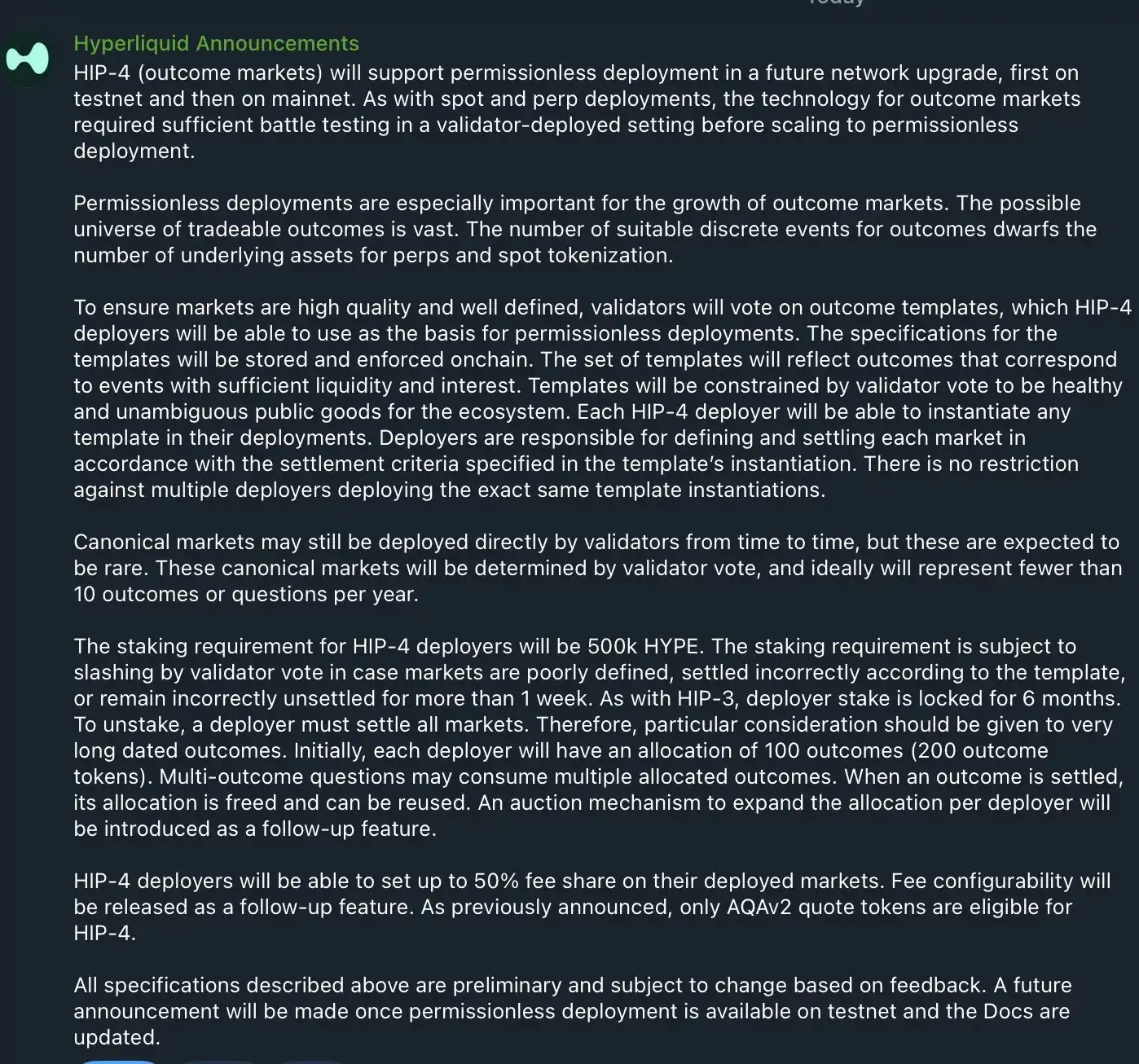
Hyperliquid Announces HIP-4 Open Permissionless Deployment

Although this announcement from Hyperliquid is just a preliminary notice, with the specific opening time for HIP-4 permissionless deployment not yet confirmed, the market has already gotten excited following the news.

Hyperliquid's current status as the world's largest platform for stock tokens and on-chain commodity perpetual contracts, even outpacing traditional financial markets in pricing enterprise IPOs, is largely thanks to its launch of HIP-3 and opening of third-party permissionless creation of perpetual contract markets in October 2025.

Therefore, this time, investors believe Hyperliquid can once again rely on the power of "decentralization" to surpass all the frontrunners in the prediction market sector.

Who Will Be the Next Trade.xyz?

Hyperliquid launched the HIP-4 market on May 2nd, 2026, marking its official entry into the prediction market sector. Before the HIP-4 market went live, the market was generally optimistic that it would become Hyperliquid's next core narrative. However, nearly three months after its launch, its performance can be described as poor.

According to official Hyperliquid data, the cumulative trading volume of the HIP-4 market over the past 3 months is only $216 million, with a daily average trading volume of just $10 million. The peak daily active users reached only 7,000, and the total fee revenue is a mere $442.38. In contrast, DeFiLlama data shows Polymarket's trading volume over the past month reached $4.587 billion, with fees amounting to $50 million.
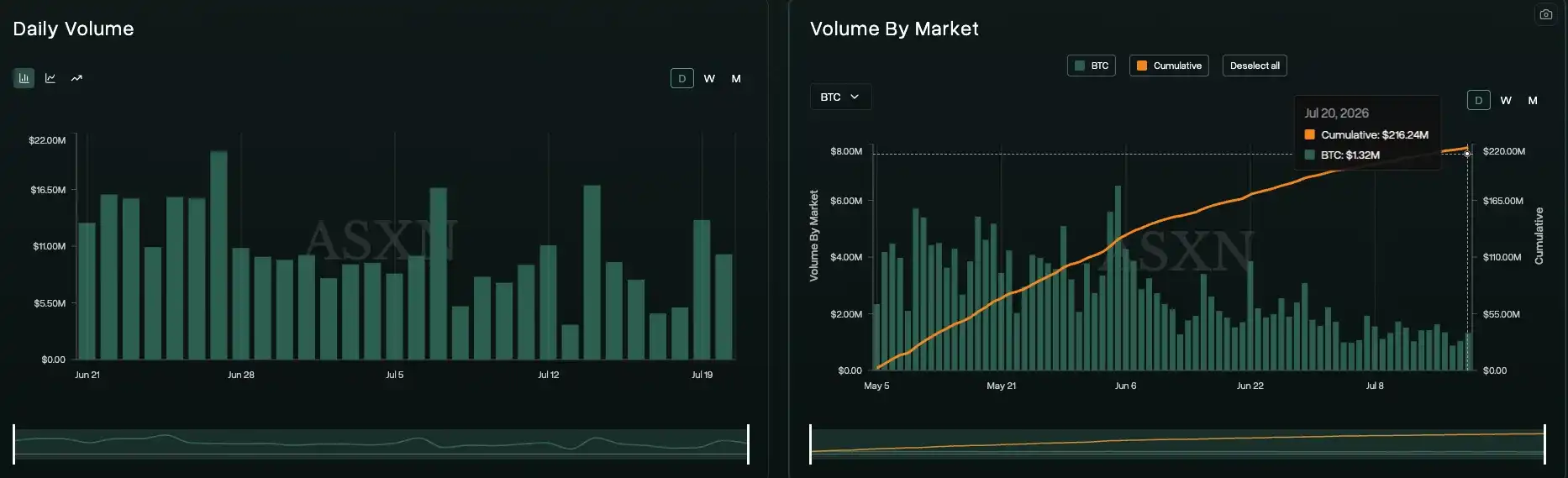
HIP-4 Daily Average Trading Volume and Total Trading Volume

Not only are there few users and low trading volume, but the number of events with resolvable outcomes on HIP-4 is also very limited. Currently, the entire HIP-4 market has only 6 predictive markets, which is a drop in the bucket compared to Polymarket in terms of both quantity and variety.
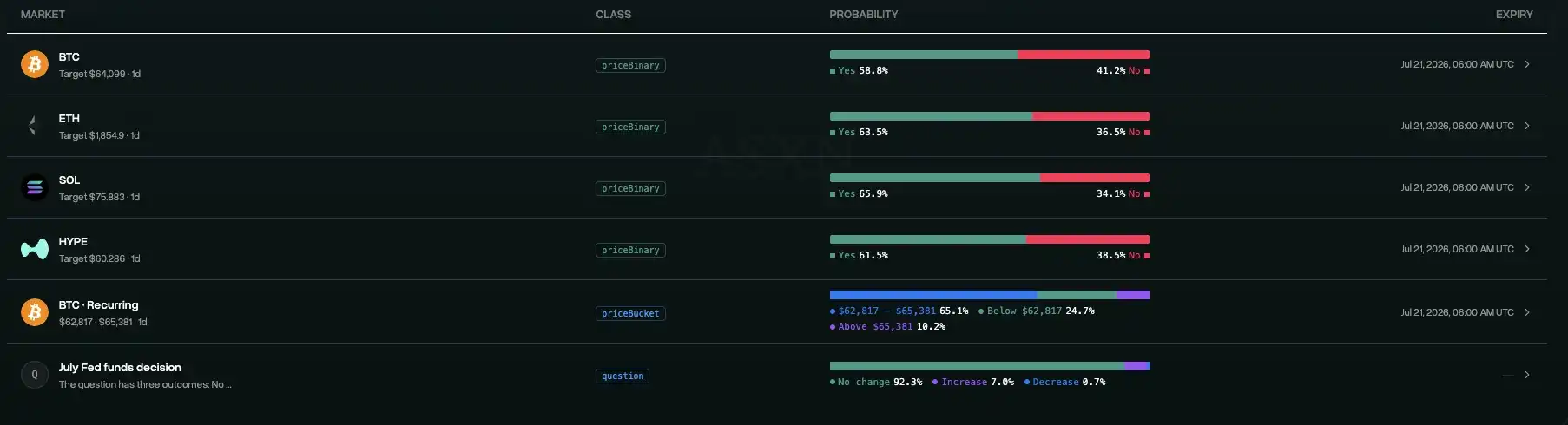
Currently Tradable Events on HIP-4

Given such a vast disparity in scale, Hyperliquid chose to follow the path of dependency, adhering to the successful experience of HIP-3. Since they couldn't build it up themselves, they would give the stage to the community, aiming to create another Trade.xyz within HIP-4.

Hyperliquid opening permissionless deployment for the HIP-4 market is equivalent to Polymarket allowing users to autonomously create predictive market events. Hyperliquid founder Jeff also stated that permissionless deployment is particularly important for the growth of outcome markets (HIP-4) because the scope of outcomes that can be traded is extremely vast. The number of independent events suitable for outcome trading far exceeds the number of underlying assets used for derivatives and real-world asset tokenization.

Moreover, having the community or third parties deploy predictive market events offers greater flexibility. Currently, the creation of predictive market contracts is mainly initiated by the team or reviewed after community proposals. This process is not decentralized enough, and team members cannot possibly pay attention to every niche across all fields. Especially for trending real-world events, this model slows down the time from market reaction to final execution and launch.

On the HIP-4 market, as long as a third party stakes enough HYPE tokens, they can list predictive market events according to their own standards without Hyperliquid team review. Hyperliquid also stipulates that it will not restrict multiple deployers from simultaneously deploying identical events. This will also incentivize healthy competition within the HIP-4 market, as only those who provide users with a wider range of events and deeper liquidity will prevail in the competition.

Hyperliquid's product philosophy has always adhered to a win-win strategy. The HIP-3 market has already nurtured the giant Trade.xyz, which holds over 90% of the HIP-3 market share. The first 10 perpetual contract listings it launched each exceeded $10 billion in trading volume.

Perhaps many teams are already gearing up. On the day Hyperliquid's mainnet opens HIP-4 for permissionless deployment, we will witness a lively "War of the Gods."

Can Hyperliquid Disrupt the Prediction Market Landscape?

But can Hyperliquid really "use one trick to conquer all"?

Firstly, Hyperliquid is no longer what it used to be. The HYPE price remains stable above $60. The requirement for HIP-4 market deployers to stake 500,000 HYPE (approximately $30 million) actually bars small startup teams from entering. Nowadays, a single funding round for a crypto project might not even reach $30 million. And prediction market projects capable of raising $30 million might prefer to develop their own prediction market platforms.

Therefore, the excessively high staking threshold for HIP-4 deployers might drastically reduce the number of third-party competitors. In the end, only "well-funded" prediction market projects would come to attract traffic. The number of tradable independent events would also be limited, severely hampering the innovation momentum of the entire HIP-4 market.

Secondly, Hyperliquid's timing for launching HIP-4 permissionless deployment missed even the last bus. One main reason why 2026 became a year of opportunity for the prediction market sector's development is the recent concentration of major sporting events, especially coinciding with the once-every-four-years World Cup. Various prediction markets were focusing their efforts around World Cup matches. For example, on Polymarket, the total trading volume for the Argentina vs. Spain match event on July 20th alone reached $83.75 million.

But Hyperliquid completely missed this crucial World Cup time window, which is undoubtedly a huge strategic oversight. Even the success of the HIP-3 market was a combination of favorable timing, location, and people. The US-Iran conflict in February this year, which caused fluctuations in international crude oil prices, became a significant catalyst for the HIP-3 market's development. The first day of the war fell on a weekend. With traditional markets closed, traders urgently needing to adjust positions and hedge had to find new tradable markets, and Hyperliquid's HIP-3 market became the first choice.

When Hyperliquid launched HIP-3, it did not emphasize that it was built for stock tokens and commodity tokenization. Yet, it ultimately gave rise to Trade.xyz and Hyperliquid's current leading position in the tokenized trading market. If Hyperliquid had not seized the opportunity presented by the US-Iran conflict, perhaps Hyperliquid would have no place in today's tokenized trading market.

Similarly, having missed the World Cup opportunity, how much confidence can we have that Hyperliquid can now disrupt the prediction market giants?


Cryptos en tendance

Questions liées

QAccording to the article, what major feature is Hyperliquid planning to implement for HIP-4, and what was the similar feature that contributed to its previous success?

AHyperliquid is planning to implement permissionless deployment for HIP-4, which will allow third parties to create prediction markets. A similar feature, the permissionless creation of perpetual contract markets under HIP-3, was a key factor in Hyperliquid's previous success, particularly leading to the rise of Trade.xyz.

QWhat are the current performance metrics of Hyperliquid's HIP-4 prediction market according to the article, and how do they compare to its main competitor, Polymarket?

AOver the past three months, Hyperliquid's HIP-4 market had a cumulative trading volume of only $216 million, with an average daily volume of around $10 million, a peak daily active user count of 7,000, and total fee revenue of just $442.38. In contrast, in just the past month, Polymarket achieved a trading volume of $45.87 billion and generated $50 million in fees, demonstrating a massive disparity in scale.

QWhat potential issue does the article identify regarding the staking requirement for HIP-4 deployers?

AThe article suggests that the staking requirement for HIP-4 deployers is too high. It requires a stake of 500,000 HYPE (worth approximately $30 million), which could exclude smaller entrepreneurial teams and lead to a significant reduction in potential third-party competitors. This, in turn, might limit the number and variety of tradable independent events and hinder innovation within the HIP-4 ecosystem.

QWhat significant timing opportunities did Hyperliquid miss for the launch of its HIP-4 market, and why were these opportunities important?

AHyperliquid missed the opportunity to launch its HIP-4 market during the recent World Cup, a major event that drove significant activity on competing prediction platforms like Polymarket. The article compares this to the successful timing of HIP-3's launch, which coincided with the US-Iran conflict when traders needed alternative markets. Missing such critical timing windows is seen as a major strategic oversight that could impact HIP-4's ability to compete.

QHow does the article characterize the logic behind Hyperliquid's decision to enable permissionless deployment for HIP-4, and what existing success story is cited as a model?

AThe article characterizes the decision as one of 'path dependence' and a strategic reliance on the successful model of decentralization from HIP-3. Since its own efforts on HIP-4 have performed poorly, Hyperliquid is giving the stage to the community, aiming to replicate the success of Trade.xyz—a major player that emerged from HIP-3's permissionless model—within the prediction market space.

Lectures associées

L'affaire de divorce de Chey Tae-won finalisée : Révélations sur les lignes cachées de succession derrière le conglomérat de mille milliards de SK Hynix

L'affaire de divorce de Chey Tae-won, président du groupe SK, s'est conclue par un jugement historique, mettant en lumière les complexités successorales derrière le géant SK Hynix, dont la valorisation a dépassé 1 000 billions de wons. Contrairement aux scénarios traditionnels de succession des chaebols sud-coréens, qui privilégient l'aîné masculin, les trois enfants de Chey Tae-won suivent des trajectoires distinctes et modernes. L'aînée, Chey Yun-jeong, considérée comme la successeure la plus probable, occupe un poste de direction au sein de SK Inc. et dirige des projets stratégiques dans la biopharmacie, alliant formation scientifique et compétences en consulting. La seconde fille, Chey Min-jeong, ancienne officière de marine et ex-employée de SK Hynix aux États-Unis, a fondé une startup dans la santé numérique et épousé un ancien officier du Corps des Marines américain, incarnant les dimensions géopolitiques de l'industrie des semi-conducteurs. Le fils cadet, Chey In-geon, bien que suivant un parcours académique et professionnel classique (Brown University, McKinsey), reste discret et ne détient aucun rôle opérationnel visible au sein du groupe. Leur héritage est marqué par le divorce très médiatisé et coûteux de leurs parents, mais aussi par la transformation de SK Hynix en un acteur mondial de l'ère de l'IA. La succession ne se résume plus à une simple transmission d'actions ou de titre ; elle exige des héritiers qu'ils prouvent leurs compétences dans un paysage où la technologie, la politique internationale et l'innovation disruptive redéfinissent les règles du pouvoir.

marsbitIl y a 2 jours 09:14

L'affaire de divorce de Chey Tae-won finalisée : Révélations sur les lignes cachées de succession derrière le conglomérat de mille milliards de SK Hynix

marsbitIl y a 2 jours 09:14

2 mois pour passer de 8,8 à 68 milliards d'euros d'évaluation ! La plus grande plateforme de transit d'IA, OpenRouter, sur le point d'être rachetée

**Résumé en français :** Stripe, le géant du paiement en ligne, négocierait l'acquisition d'OpenRouter, une place de marché et couche d'IA de type "routeur" ou "agrégateur", pour près de 100 milliards de dollars. Cette valorisation représente une multiplication par près de sept par rapport à l'évaluation d'OpenRouter il y a deux mois (13 milliards de dollars). Fondée en 2023 par Alex Atallah (cofondateur d'OpenSea), OpenRouter agit comme un intermédiaire crucial pour les développeurs d'applications d'IA. Sa plateforme permet d'accéder via une seule API à plus de 400 grands modèles de langage (comme GPT, Claude, et de nombreux modèles open source) et choisit automatiquement le modèle le plus adapté à chaque tâche en fonction du coût, des performances et de la vitesse. Cela permet aux applications en aval de réduire leurs factures de "réflexion" (inference) sans que l'utilisateur final ne voie la différence. Pour Stripe, cette acquisition stratégique s'inscrit dans une volonté de devenir l'infrastructure de paiement et de gestion de la consommation pour l'économie de l'IA. Fin 2025, Stripe avait déjà acquis Metronome, une plateforme de facturation à l'usage pour l'IA. En combinant OpenRouter (choix du modèle) et Metronome (facturation précise), Stripe cherche à offrir une solution intégrée pour le routage, la mesure et le paiement de la consommation d'IA, consolidant ainsi son rôle de "caisse" et de "centre de régulation" de cette nouvelle économie.

链捕手Il y a 2 jours 09:04

2 mois pour passer de 8,8 à 68 milliards d'euros d'évaluation ! La plus grande plateforme de transit d'IA, OpenRouter, sur le point d'être rachetée

链捕手Il y a 2 jours 09:04

D'OpenSea à OpenRouter : le scénario de la « sortie en haut de cycle » d'Alex Atallah se répète ?

**OpenRouter, la plateforme d'agrégation de modèles d'IA fondée par Alex Atallah, pourrait être rachetée par Stripe pour près de 100 milliards de dollars**, selon le Wall Street Journal. Cette transaction potentielle, si elle se concrétise, marquerait le deuxième succès d'Atallah à construire une entreprise valorisée à des dizaines de milliards, après avoir cofondé la place de marché NFT OpenSea. OpenRouter, décrit comme le "Stripe de l'IA", sert de point d'accès unifié à plus de 400 modèles d'IA pour environ 10 millions d'utilisateurs. Sa croissance a été fulgurante, passant d'une valorisation de 1,3 milliard de dollars en mars 2026 à une évaluation potentielle de 100 milliards aujourd'hui. L'article souligne un parallèle avec le parcours d'Atallah chez OpenSea, qu'il a quittée avant le refroidissement du marché NFT. Aujourd'hui, face à une concurrence croissante dans l'agrégation de modèles d'IA et à une activité essentiellement basée sur des frais de plateforme (5-5,5%), la vente à un géant comme Stripe pourrait apparaître comme un choix stratégique pour "sortir au sommet". La valeur réelle d'OpenRouter pour un acquéreur résiderait moins dans ses revenus actuels que dans les vastes quantités de données d'utilisation réelle de l'IA qu'elle a accumulées. Ces informations sur les performances, les préférences des développeurs et la dynamique du marché sont un atout unique. La transaction, si elle aboutit, pose la question : s'agit-il d'une juste reconnaissance de la valeur des infrastructures d'IA ou d'un possible signal de sommet pour le secteur ?

链捕手Il y a 2 jours 08:47

D'OpenSea à OpenRouter : le scénario de la « sortie en haut de cycle » d'Alex Atallah se répète ?

链捕手Il y a 2 jours 08:47

Trading

Spot

Articles tendance

Comment acheter 4

Bienvenue sur HTX.com ! Nous vous permettons d'acheter 4 (4) de manière simple et pratique. Suivez notre guide étape par étape pour commencer votre parcours crypto.Étape 1 : Création de votre compte HTXUtilisez votre adresse e-mail ou votre numéro de téléphone pour ouvrir un compte sur HTX gratuitement. L'inscription se fait en toute simplicité et débloque toutes les fonctionnalités.Créer mon compteÉtape 2 : Choix du mode de paiement (rubrique Acheter des cryptosCarte de crédit/débit : utilisez votre carte Visa ou Mastercard pour acheter instantanément 4 (4).Solde :utilisez les fonds du solde de votre compte HTX pour trader en toute simplicité.Prestataire tiers :pour accroître la commodité d'utilisation, nous avons ajouté des modes de paiement populaires tels que Google Pay et Apple Pay.P2P :tradez directement avec d'autres utilisateurs sur HTX.OTC (de gré à gré) : nous offrons des services personnalisés et des taux de change compétitifs aux traders.Étape 3 : stockage de vos 4 (4)Après avoir acheté vos 4 (4), stockez-les sur votre compte HTX. Vous pouvez également les envoyer ailleurs via un transfert sur la blockchain ou les utiliser pour trader d'autres cryptos.Étape 4 : tradez des 4 (4)Tradez facilement 4 (4) sur le marché Spot de HTX. Il vous suffit d'accéder à votre compte, de sélectionner la paire de trading, d'exécuter vos trades et de les suivre en temps réel. Nous offrons une expérience conviviale aux débutants comme aux traders chevronnés.

653 vues totalesPublié le 2025.10.20Mis à jour le 2026.06.02

Comment acheter 4

Discussions

Bienvenue dans la Communauté HTX. Ici, vous pouvez vous tenir informé(e) des derniers développements de la plateforme et accéder à des analyses de marché professionnelles. Les opinions des utilisateurs sur le prix de 4 (4) sont présentées ci-dessous.

活动图片