Hyperliquid First Discloses HIP-4 Permissionless Deployment Specifications: Threshold Aligns with HIP-3, but Adds a Template Approval Layer

Foresight NewsPublié le 2026-07-20Dernière mise à jour le 2026-07-20

Résumé

Hyperliquid founder Jeff Yan announced plans for permissionless deployment of HIP-4 outcome markets in a future network upgrade, moving from testnet to mainnet. This follows the initial, validator-voted deployment phase on mainnet that began in May. The announcement details key mechanisms for the permissionless phase. The staking requirement is set at 500,000 HYPE (locked for 6 months), matching HIP-3. A core new feature is a "template system": validators will vote on and store standardized market templates on-chain, and deployers can only create markets by instantiating these pre-approved templates. This aims to ensure market quality and clarity. Deployers will also have an initial quota of 100 outcomes (200 tokens), which refreshes after settlements. The reasoning for permissionless deployment is the vast potential universe of tradable events for prediction markets, which far exceeds the finite assets available for perpetual contracts. While HIP-4 has seen $370M in volume over 78 days, its market share remains small compared to established players. The model mirrors HIP-3's successful expansion of perpetual contracts after opening deployment. Rules include slashing stakes for unclear definitions or incorrect/delayed settlements. This incentivizes short-duration markets, as long-term settlements would lock capital and quota for extended periods. The template system addresses definition clarity but does not prevent potential liquidity fragmentation or market concentration,...


Author:angelilu, Foresight News


Hyperliquid founder Jeff Yan posted an announcement about HIP-4 on his Discord, stating that outcome markets will support permissionless deployment in an upcoming network upgrade, first on testnet and then on mainnet.


The wording of the announcement is that, just like the deployment of spot and perpetual contracts, this outcome markets technology needs to undergo sufficient real-world testing in an environment deployed by validators before it can be expanded to permissionless deployment.
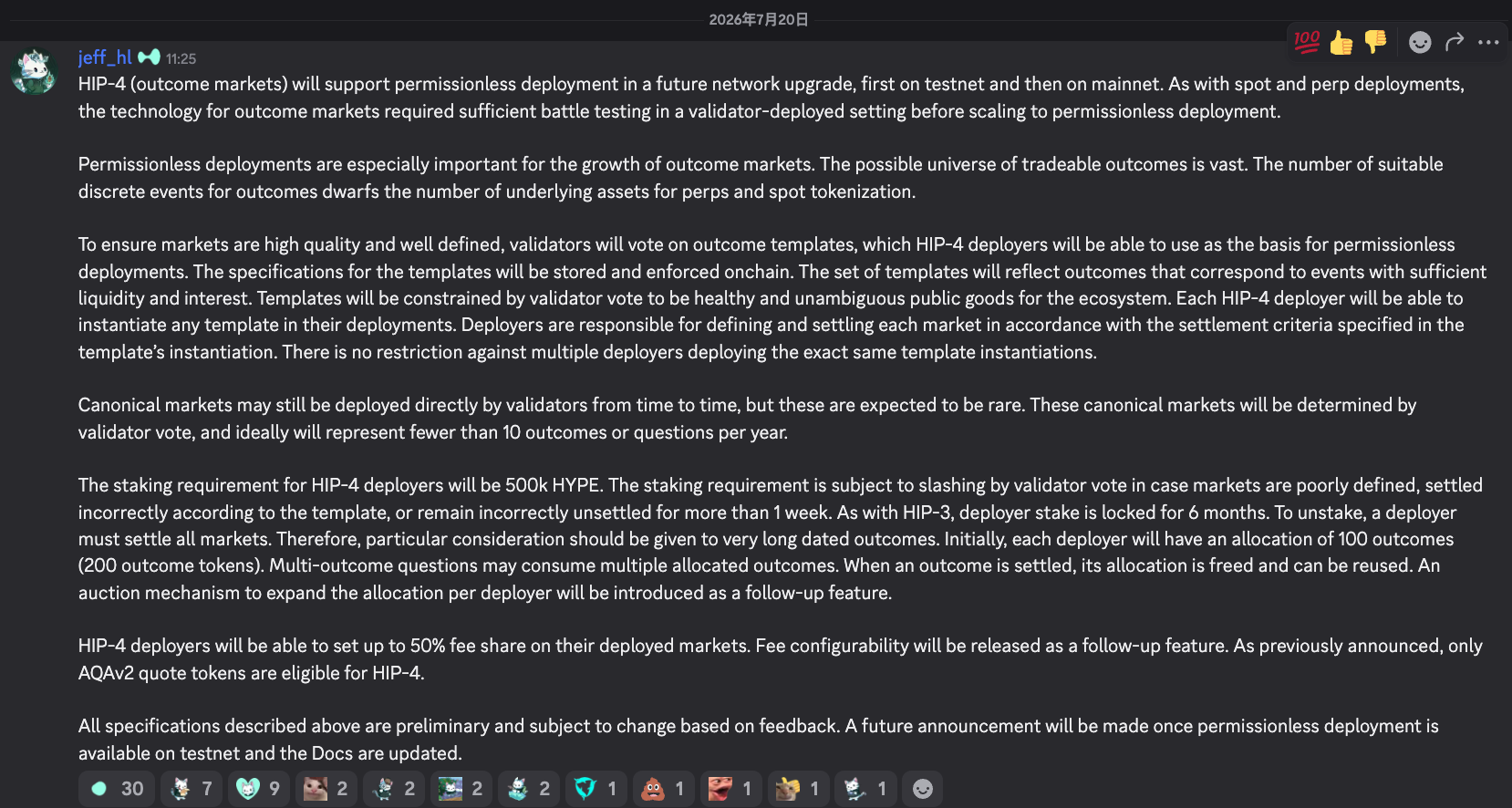


The announcement did not give a specific date and noted at the end that all specifications are preliminary and may be adjusted based on feedback. However, it disclosed a set of mechanism details that had not been made public in detail before.


What Stage Has HIP-4 Reached Now?


On February 2, 2026, the Hyperliquid team announced HIP-4, introducing a new primitive called "Outcome Trading." According to the official documentation definition, outcome contracts are fully collateralized, with settlement prices falling within a fixed range. They are suitable for prediction markets and bounded option-like instruments, introducing nonlinear characteristics and dated contracts, and involve no leverage or liquidation. Each outcome market has two directions, each corresponding to a token, typically labeled Yes and No, with their order books merged to share liquidity. A "question" is a collection of outcomes, where exactly one outcome will settle as Yes.


In the same month, HIP-4 went live on testnet. On May 2nd, it officially launched on mainnet, with the first market being a cyclic binary outcome market, settling daily at 06:00 UTC based on the BTC mark price on HyperCore, with zero fees for opening positions. Subsequently, Hyperliquid extended outcome markets to off-chain events, with the first off-chain market being "May CPI YoY."


However, this mainnet phase is "validator-deployed." Which markets to open are decided by validator votes, and external parties cannot launch markets themselves. Therefore, this new announcement is about the upcoming next phase.


Why Is Permissionless Deployment Necessary?


The reason given by Hyperliquid founder Jeff Yan in the announcement is straightforward: within outcome markets, the universe of tradable outcomes is extremely vast. The number of discrete events suitable for outcome contracts far exceeds the number of underlying assets for perpetual contracts and spot tokenization. The underlying assets for perpetual contracts are finite - coins, stocks, commodities, indices - they can be counted. However, real-world events that can be bet on are infinite. Relying on validators to vote on listing them one by one can never keep up with supply and demand.


To understand the urgency of permissionless deployment, one must first look at the actual performance of HIP-4 on mainnet over these two and a half months.


Over 78 days since HIP-4 launch, cumulative trading volume reached $370 million, with a cumulative number of trades reaching 7 million. The peak daily volume occurred on June 27th, at $12.96 million.

https://hl.eco/hip4
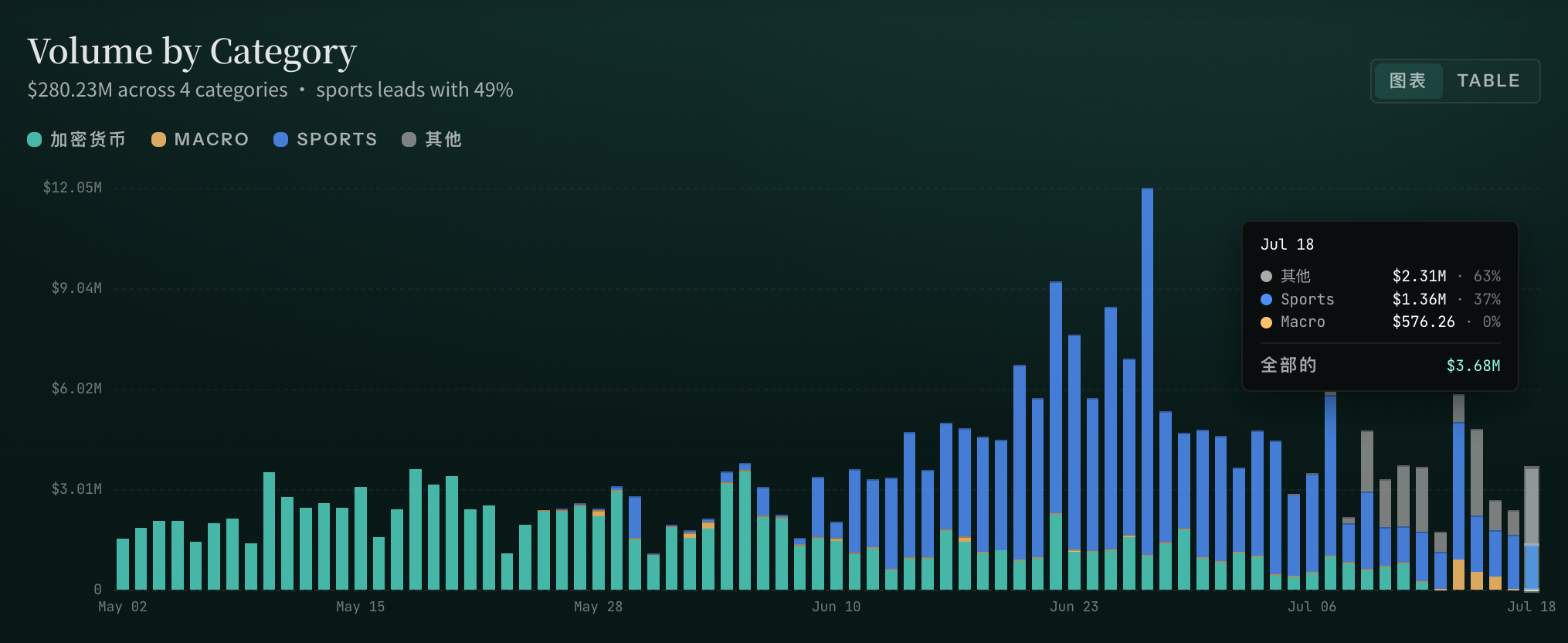

From May 2nd to early June, trading was almost entirely from cryptocurrency categories, with daily volume between $1 million and $3.5 million. When the World Cup started on June 11th, sports categories instantly took over, pushing volume to three to four times the previous baseline.
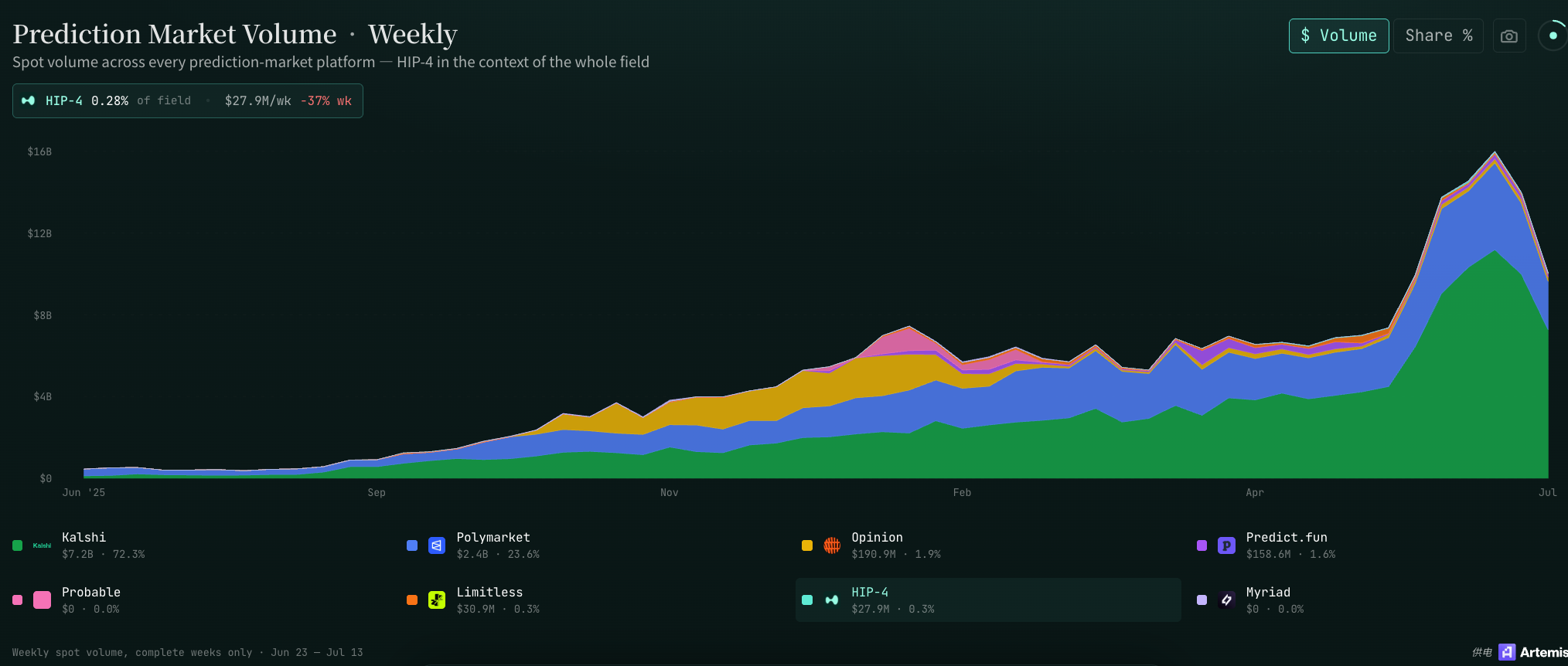


The figures from competitors during the same period are of another order of magnitude. Taking weekly data as an example, for the week of July 13th (during the World Cup), the weekly trading volumes for Kalshi and Polymarket were $7.2 billion and $2.4 billion respectively, while HIP-4's trading volume was $27.9 million. HIP-4's market share in prediction markets was only 0.3%.


But this logic has already been successfully validated once on Hyperliquid. HIP-3 allowed anyone to deploy perpetual contract markets after staking HYPE. It launched on October 13, 2025, and subsequently listed Nvidia, Tesla, gold, crude oil, S&P 500, and other underlying assets.


According to HIP-3 Ecosystem data, as of the time of writing, HIP-3's historical trading volume is $387.72 billion, and open interest has grown from about $790 million in January 2026 to $3.43 billion in July; HIP-3's share of Hyperliquid's trading volume reached 47.2% at the time of writing. Opening up the supply side indeed brought explosive growth.


Several New Mechanisms for HIP-4


Therefore, at the end of the World Cup, when all prediction markets are exploring new underlying assets, Hyperliquid announced several new mechanisms for HIP-4 at this time.


Staking Threshold is 500,000 HYPE Tokens


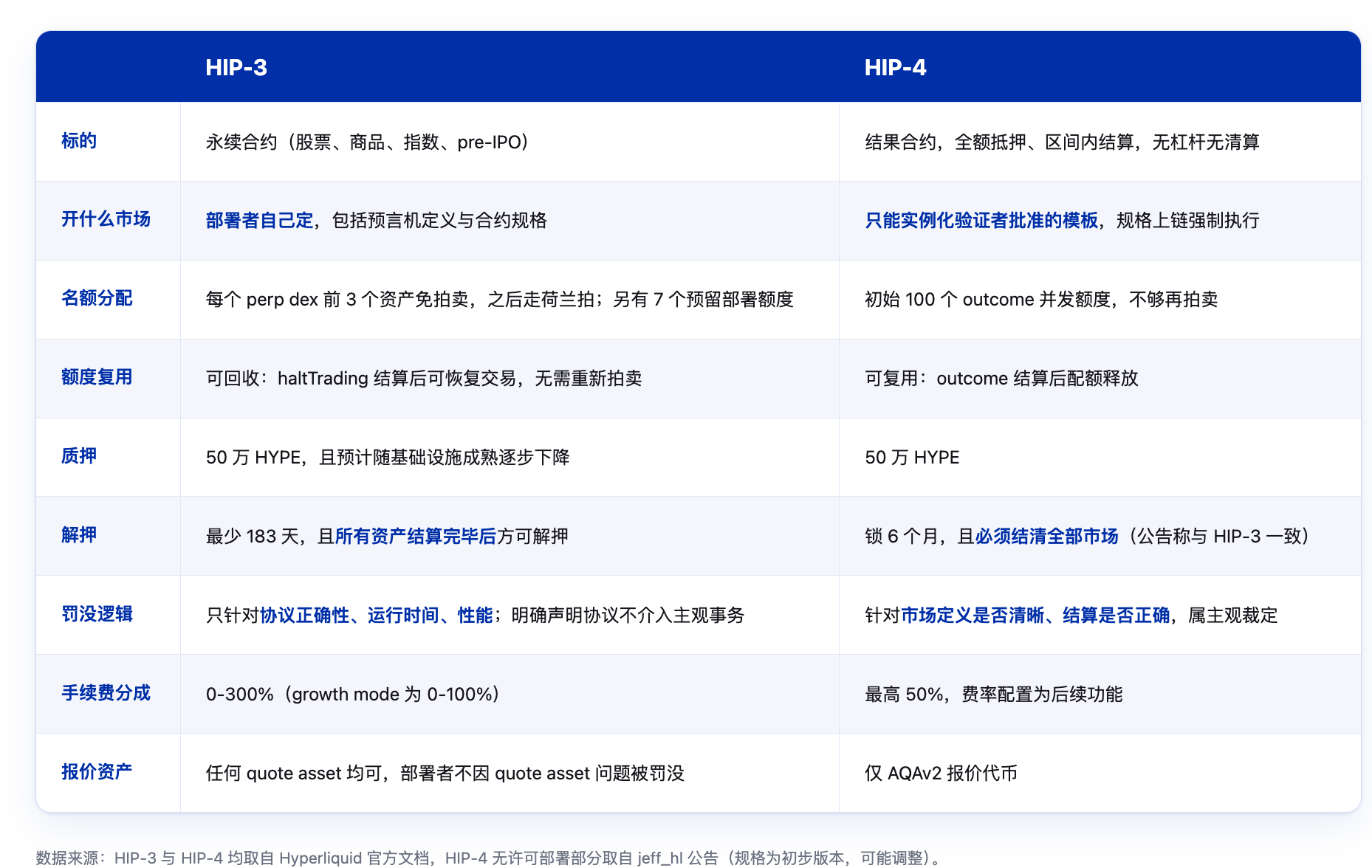
As for the staking threshold for HIP-4 deployers, this announcement is the first time Hyperliquid has publicly explained the staking requirements for HIP-4 permissionless deployment. Previously, community speculation placed the number at 1 million HYPE, twice that of HIP-3. This announcement states it's 500,000 HYPE, aligning with HIP-3. Staked tokens will be locked for 6 months and may be slashed if market definitions are unclear or settlements are delayed.


Template System


The template system is the core of this design. To ensure market quality and clear definitions, validators will vote on "outcome templates." Template specifications are stored on-chain and enforced. HIP-4 deployers can only perform permissionless deployment based on these templates, filling in parameters themselves to instantiate specific markets. The announcement requires that templates must be "healthy and unambiguous public goods for the ecosystem" and that corresponding events must have sufficient liquidity and attention. Deployers are responsible for defining and settling each market according to the settlement criteria specified when instantiating the template. The announcement explicitly does not restrict multiple deployers from deploying identical template instances.


Why add this layer? It's related to the product form. Perpetual contracts have continuous prices; if the market is off, it corrects itself. Outcome contracts settle at a definite value upon expiration; once the settlement is judged incorrectly, money is directly awarded to the wrong side.


Quota System


The quota system is another new element. Each deployer is initially allocated 100 outcomes (200 outcome tokens). One outcome corresponds to YES and NO two tokens. Multi-outcome questions consume multiple outcomes; for example, a five-choice question is split into five binary outcomes, occupying five. The quota is released and can be reused after an outcome settles; this is a concurrent upper limit, not a lifetime limit. The announcement states that an auction mechanism will be introduced later to expand an individual deployer's quota.


Slashing and Locking


Slashing and locking determine what this market will ultimately become. Stakes can be slashed by validator vote for three reasons: unclear market definition, failure to settle correctly according to the template, and failure to settle correctly for over a week. As with HIP-3, deployer stakes are locked for 6 months, and all markets must be settled before unstaking. The announcement itself warns that special caution is needed for very long-term outcomes.


The consequence of this rule is very practical. Launching a market that settles two years later means 500,000 HYPE is locked for two years, and the quota is also occupied the entire time. Rational deployers will only create markets with short cycles and frequent settlements. The difference in product form between HIP-4 and Polymarket is not entirely a strategic choice; it's also a result pushed by the mechanism.


Additionally, deployers can set up to 50% fee share for the markets they deploy; fee rate configuration will be released as a subsequent feature; only AQAv2 quote tokens can be used for HIP-4; validators may still occasionally deploy outcome markets directly, but it is expected to be very rare, aiming for fewer than 10 outcomes or questions per year.


Issues Not Addressed by the Template System


From the HIP-3 experience, there are aspects worth HIP-4 being cautious about.


hl.eco shows HIP-3 currently has 8 active deployers and 204 markets, but Trade.XYZ alone accounts for over 90% of all HIP-3 open interest. Some analyses indicate that this high concentration by a single deployer may constitute a structural/centralization risk for Hyperliquid.
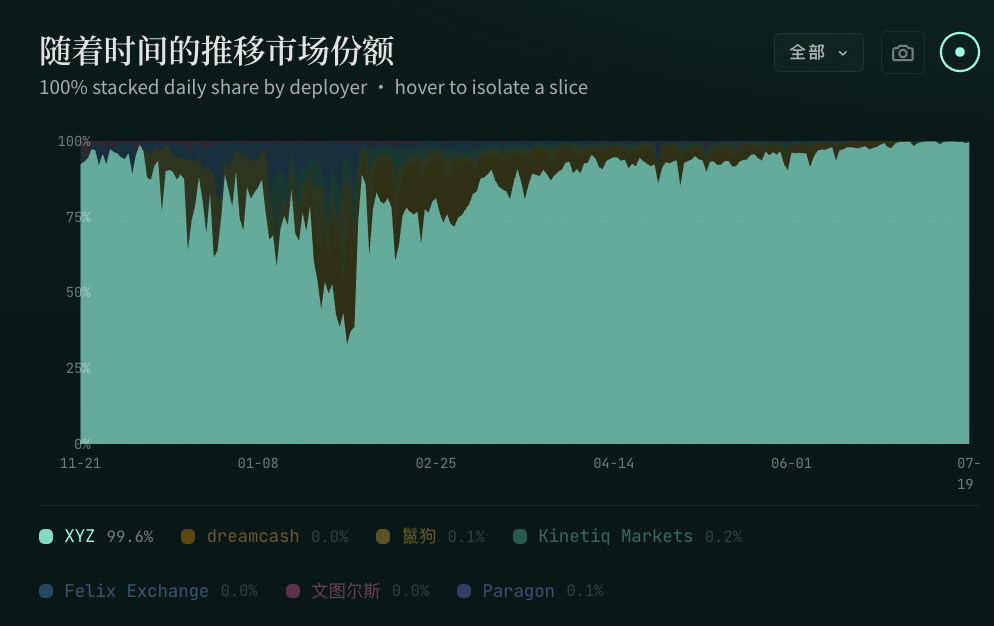


The template system in these new HIP-4 rules governs market quality, not market share. Where users trade depends on depth. HIP-4 explicitly allows multiple deployers to instantiate identical templates, which sounds like encouraging competition. However, if the same question is opened as five identical markets, liquidity will only be further fragmented, ultimately still converging towards the deepest pool.


Cryptos en tendance

Questions liées

QWhat is the main announcement regarding HIP-4 made by Hyperliquid founder Jeff Yan?

AJeff Yan announced that Outcome Markets (HIP-4) will support permissionless deployment in an upcoming network upgrade, first on testnet and then on mainnet. This will allow external users to deploy their own markets.

QWhat are the two key reasons provided in the article for HIP-4 needing permissionless deployment?

AFirst, the universe of tradable outcomes for prediction markets is vast and practically infinite, far exceeding the finite number of underlying assets for perpetual contracts. Second, the success of HIP-3's permissionless deployment for perpetual contracts demonstrated that opening up the supply side leads to explosive growth.

QWhat is the staking requirement for a HIP-4 deployment, and how does it compare to HIP-3?

AThe staking requirement for HIP-4 permissionless deployment is 500,000 HYPE, which is the same as the requirement for HIP-3. The staked tokens will be locked for 6 months and are subject to slashing for issues like unclear market definitions or delayed settlements.

QWhat is the 'template system' for HIP-4, and what is its primary purpose?

AThe template system requires validators to vote on and approve 'outcome templates' which are stored on-chain. HIP-4 deployers can then use these approved templates to create specific markets by filling in parameters. Its purpose is to ensure market quality, definition clarity, and that events have sufficient liquidity and attention.

QAccording to the article, what is a potential issue that the new HIP-4 rules do not solve, based on experience with HIP-3?

AThe new rules, including the template system, focus on market quality but do not address the potential problem of market concentration. Similar to HIP-3 where a single deployer dominates the open interest, liquidity in HIP-4 might still consolidate into a few deep markets even if multiple identical markets are allowed, leading to fragmented liquidity.

Lectures associées

Après trois trimestres consécutifs de baisse, le marché des cryptomonnaies pourra-t-il connaître une fenêtre de stabilisation au troisième trimestre ?

Le marché des cryptomonnaies a enregistré son pire trimestre depuis 2022, avec une capitalisation totale chutant de 12,6% à 2 100 milliards de dollars. Tous les indicateurs clés (volume des échanges, valeur des stablecoins) montrent une sortie nette de capitaux. Le Bitcoin a perdu 14,2% et l'Ethereum 25,4% sur le trimestre, rompant sa corrélation antérieure avec les actions technologiques. Les ETF spot américains sur le Bitcoin ont subi des rachats massifs, avec une sortie nette de 4,67 milliards de dollars au Q2, indiquant une pression de vente continue. Le resserrement de la politique de la Fed et les ventes d'entreprises comme Strategy ont accentué la déleveragisation du secteur. L'attention du marché se porte désormais presque exclusivement sur la réunion de la Fed fin juillet. Une position accommodante pourrait stabiliser le Bitcoin entre 68 000 et 84 000 dollars, tandis qu'un ton hawkish pourrait le faire osciller autour de 50 000-56 000 dollars. Parallèlement, la progression du *CLARITY Act*, une loi cruciale pour la clarté réglementaire, est au point mort au Sénat, réduisant les chances d'adoption en 2026 et maintenant une prime de risque élevée sur l'ensemble du secteur. Malgré ce contexte difficile, quelques secteurs résistent : les marchés de prédiction ont vu leur volume nominal augmenter de 48,7% et les biens collectionnables tokenisés ont progressé d'environ 143%. La tokenisation d'actifs du monde réel (RWA) continue également sa croissance régulière, portée par des fondamentaux indépendants du cycle crypto. Les bases d'un effondrement extrême semblent absentes, mais le marché est désormais guidé par les politiques monétaires, les prix et les attentes de taux, plutôt que par le simple récit haussier. La fin des sorties massives des ETF et le retour des achats des détenteurs à long terme pourraient indiquer une phase de stabilisation potentielle.

marsbitIl y a 34 mins

Après trois trimestres consécutifs de baisse, le marché des cryptomonnaies pourra-t-il connaître une fenêtre de stabilisation au troisième trimestre ?

marsbitIl y a 34 mins

The SpaceX Trade, Unlocked: SPCXON Débarque sur WEEX

En juin 2026, SpaceX a réalisé la plus grande introduction en bourse de l'histoire, mais l'accès à l'action a été limité pour de nombreux investisseurs en raison de restrictions régionales et de frictions liées aux courtiers. La plateforme WEEX propose désormais une solution via SPCXON/USDT, un instrument tokenisé sur le marché au comptant qui permet d'obtenir une exposition au cours de SpaceX en utilisant l'USDT, sans nécessiter de compte de courtage américain. SPCXON est un produit tokenisé construit sur l'infrastructure d'Ondo, conçu pour refléter l'économie de la détention d'actions SpaceX pour les traders éligibles en dehors des États-Unis, avec des dividendes réinvestis. Le cas d'investissement repose sur la croissance des revenus de Starlink et les progrès de Starship, malgré un valorisation déjà élevée et des risques liés à un flottant public réduit et à des déblocages d'actions internes à venir. Il est important de noter que SPCXON offre une exposition, et non la propriété directe d'actions ou de droits de vote. Son prix peut évoluer avec une prime ou une décote par rapport à la valeur liquidative. WEEX propose également d'autres produits tokenisés comme MSTRON et MUON dans un compte unifié, permettant une rotation entre crypto-monnaies et actions traditionnelles sans transfert de fonds. La plateforme souligne ainsi comment les barrières entre la finance traditionnelle et les actifs numériques s'estompent.

TheNewsCryptoIl y a 42 mins

The SpaceX Trade, Unlocked: SPCXON Débarque sur WEEX

TheNewsCryptoIl y a 42 mins

BIT Trading Moment : Le BTC reste sous la pression de l'EMA 200 hebdomadaire, un rejet pourrait relancer la baisse, les actions de stockage et de semi-conducteurs qui ont bondi cette nuit ont baissé en séance de nuit

**Résumé des marchés : Bitcoin sous pression, actions technologiques en réajustement** Le marché crypto poursuit son rebond, avec Bitcoin évoluant autour de 66 000 $. Il fait face à une résistance clé vers 68 000 $, niveau correspondant au coût moyen des investisseurs sur cinq mois. Les traders surveillent les moyennes mobiles clés (200 MA à ~63 333 $ et 200 EMA à ~68 328 $ en hebdomadaire). Une rupture au-dessus de 68 000 $ ouvrirait la voie à une hausse, tandis qu'un échec pourrait entraîner un retest des 63 000 $. L'analyse suggère que la dynamique actuelle ressemble à un rebond estival à faible liquidité plutôt qu'au début d'un véritable marché haussier. Sur le marché actions américain, après une forte séance mardi portée par les semi-conducteurs et les titres du stockage (Micron, AMD, Intel...), les contrats à terme indiquent une ouverture en baisse. Les secteurs ayant récemment bondi, comme les semi-conducteurs et le stockage, reculent en séance de nuit. Certaines valeurs se démarquent néanmoins, comme Super Micro Computer (SMCI), en hausse après des résultats et des perspectives robustes liées à la demande de serveurs IA. Des vents contraires persistent : les prix du pétrole (Brent >91$) et les rendements des obligations d'État américaines grimpent, ravivant les craintes inflationnistes. En Asie, les marchés ont suivi le rebond technologique américain, mais de manière hésitante. La tension reste forte sur le yen japonais, qui atteint son plus bas niveau depuis des décennies. **Points clés à surveiller :** * **Crypto :** Niveaux techniques de Bitcoin (68k$/63k$), flux des ETF spot. * **Actions :** Saison des résultats (Tesla, Alphabet, Intel...), activité d'AMD sur l'IA. * **Économie :** Données américaines sur l'emploi, décision de la BCE, tensions géopolitiques et prix de l'énergie.

marsbitIl y a 42 mins

BIT Trading Moment : Le BTC reste sous la pression de l'EMA 200 hebdomadaire, un rejet pourrait relancer la baisse, les actions de stockage et de semi-conducteurs qui ont bondi cette nuit ont baissé en séance de nuit

marsbitIl y a 42 mins

Gate Research Institute : La vague de « Wall Streetisation » des produits financiers cryptographiques, concurrence ou fusion ?

Le titre de l'article est : "Gate Institute : La vague de 'Wall Street-isation' des produits financiers cryptos, est-ce une compétition ou une fusion ?" Résumé en français (environ 1400 caractères) : Il y a dix-sept ans, Bitcoin fut créé avec une vision décentralisée et anti-establishment financier. Aujourd'hui, paradoxalement, son adoption massive passe souvent par des ETF émis par des géants comme BlackRock. Cet article analyse cette "Wall Street-isation" apparente des actifs cryptos : les institutions traditionnelles s'emparent-elles du pouvoir d'émission, de tarification, de garde et de distribution ? La réalité est plus nuancée. C'est une convergence à double sens. D'un côté, les plateformes cryptos comme Gate.io étendent leurs services aux actions traditionnelles (états-uniennes, hongkongaises, sud-coréennes), aux CFD et aux produits tokenisés, offrant un compte unifié. De l'autre, des courtiers traditionnels comme Robinhood intègrent les cryptomonnaies et explorent la tokenisation d'actions sur blockchain. Cette fusion vise à créer le "super-compte" financier de demain, où actions, cryptos, ETF et obligations tokenisées (RWA) coexistent dans une même interface, comblant les faiblesses de chaque écosystème. Les RWA, notamment les obligations d'État tokenisées, agissent comme une couche intermédiaire unificatrice. En conclusion, Wall Street n'a pas conquis la crypto, et la crypto n'a pas contourné Wall Street. Ils construisent ensemble une nouvelle forme de marché des capitaux, plus efficace et mondial, où l'idéal décentralisé persiste dans les protocoles, tandis qu'une expérience utilisateur unifiée émerge à l'interface.

marsbitIl y a 1 h

Gate Research Institute : La vague de « Wall Streetisation » des produits financiers cryptographiques, concurrence ou fusion ?

marsbitIl y a 1 h

Trading

Spot

Articles tendance

Comment acheter 4

Bienvenue sur HTX.com ! Nous vous permettons d'acheter 4 (4) de manière simple et pratique. Suivez notre guide étape par étape pour commencer votre parcours crypto.Étape 1 : Création de votre compte HTXUtilisez votre adresse e-mail ou votre numéro de téléphone pour ouvrir un compte sur HTX gratuitement. L'inscription se fait en toute simplicité et débloque toutes les fonctionnalités.Créer mon compteÉtape 2 : Choix du mode de paiement (rubrique Acheter des cryptosCarte de crédit/débit : utilisez votre carte Visa ou Mastercard pour acheter instantanément 4 (4).Solde :utilisez les fonds du solde de votre compte HTX pour trader en toute simplicité.Prestataire tiers :pour accroître la commodité d'utilisation, nous avons ajouté des modes de paiement populaires tels que Google Pay et Apple Pay.P2P :tradez directement avec d'autres utilisateurs sur HTX.OTC (de gré à gré) : nous offrons des services personnalisés et des taux de change compétitifs aux traders.Étape 3 : stockage de vos 4 (4)Après avoir acheté vos 4 (4), stockez-les sur votre compte HTX. Vous pouvez également les envoyer ailleurs via un transfert sur la blockchain ou les utiliser pour trader d'autres cryptos.Étape 4 : tradez des 4 (4)Tradez facilement 4 (4) sur le marché Spot de HTX. Il vous suffit d'accéder à votre compte, de sélectionner la paire de trading, d'exécuter vos trades et de les suivre en temps réel. Nous offrons une expérience conviviale aux débutants comme aux traders chevronnés.

625 vues totalesPublié le 2025.10.20Mis à jour le 2026.06.02

Comment acheter 4

Discussions

Bienvenue dans la Communauté HTX. Ici, vous pouvez vous tenir informé(e) des derniers développements de la plateforme et accéder à des analyses de marché professionnelles. Les opinions des utilisateurs sur le prix de 4 (4) sont présentées ci-dessous.

活动图片