JP Morgan Tokenized Fund Surges 250% in TVL in One Month, Institutional Funds Are Treating Ethereum as the Default Underlying Layer

marsbitPublié le 2026-07-07Dernière mise à jour le 2026-07-07

Résumé

JPMorgan's tokenized money market fund, JLTXX, has seen its on-chain total value locked (TVL) surge approximately 250% in a month, reaching nearly $700 million from an initial $200 million since its launch seven weeks ago. The fund, which invests in short-term U.S. Treasuries and repos, operates exclusively on the public Ethereum mainnet, signaling growing institutional acceptance of Ethereum as a foundational layer for compliant financial products. A key driver of this growth is its inclusion as reserve assets for stablecoins like USDG, meeting requirements under U.S. stablecoin legislation. Simultaneously, despite a significant price decline—ETH has fallen over 50% from its 2025 high—institutional accumulation continues. BitMine Immersion Technologies, led by Tom Lee, purchased an additional $73 million worth of ETH last week, bringing its holdings to roughly 4.8% of Ethereum's circulating supply. The article highlights a divergence: while the tokenization of real-world assets and stablecoin reserves is driving long-term institutional adoption of Ethereum's infrastructure, short-term price action remains pressured by market sentiment and ETF outflows. This suggests that institutional on-chain activity, though a positive fundamental development, may not serve as a reliable signal for near-term price bottoms.

Author: Claude, Deep Tide TechFlow

Deep Tide Introduction: If you're still holding Ethereum, with its price more than halved this year, you might be wondering who's buying at these levels.

The answer is the most conservative money on Wall Street. JP Morgan's tokenized money market fund, JLTXX, has seen its on-chain size surge from $200 million to nearly $700 million in seven weeks, growing about 250% in one month, and it runs exclusively on Ethereum. In the same week, BitMine, led by Tom Lee, purchased another $73 million worth of ETH, bringing its total holdings to about 4.8% of Ethereum's circulating supply. The ETH price is falling, but institutions are accumulating; these two things are happening simultaneously.
JP Morgan has quietly turned a tokenized fund into one of the fastest-growing products in recent years.

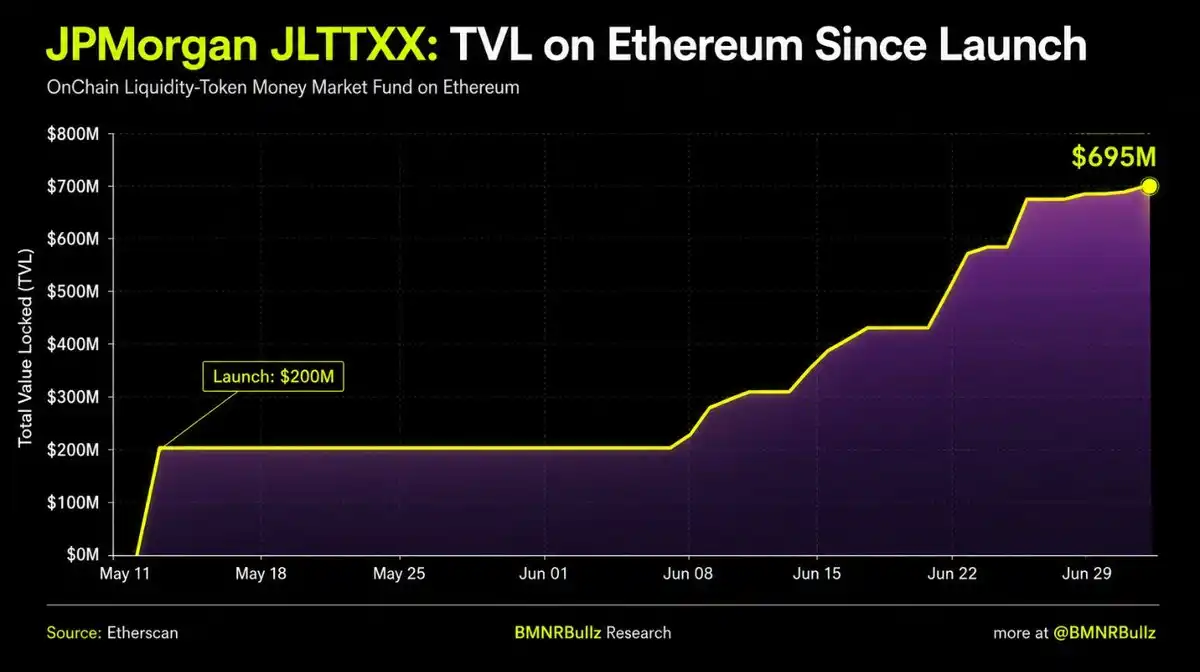
According to The Defiant, the on-chain management scale of JP Morgan's OnChain Liquidity Token Money Market Fund (ticker: JLTXX) grew by approximately 250% over the past month, based on data from blockchain analytics platform Token Terminal. This fund operates only on Ethereum.

From $200M to Nearly $700M in Seven Weeks, JP Morgan Seeded with Its Own Capital

JLTXX launched on May 13th. JP Morgan initially seeded it with $100 million of its own capital, and custodian Anchorage Digital also participated in the initial subscription. The on-chain total value locked (TVL) on the first day was about $200 million. According to a post by ethereuminsti on X, this number reached $695 million seven weeks later, a 248% increase, closely matching Token Terminal's ~250% figure.

The fund's investments are anything but aggressive, consisting entirely of short-term U.S. Treasury bills and overnight repurchase agreements fully collateralized by Treasuries or cash, identical to the safest assets in traditional money market funds. What's truly different is where it runs. JP Morgan has its own private settlement network called Kinexys, but JLTXX, like the bank's first tokenized fund MONY launched last December, chose the public Ethereum mainnet over its own chain. The fact that a bank with its own blockchain infrastructure places its product on a public chain is a signal in itself.

For ETH holders, the implication here is: Ethereum is gradually transforming from a speculative asset into an underlying ledger for compliant financial products in the eyes of institutions. This type of demand has little relation to short-term price fluctuations but will solidify into long-term network usage.

Stablecoin Reserve Needs Behind the Growth

The rapid growth of JLTXX is partly because it's being used as a reserve for stablecoins.

According to disclosures by a Dune analysis account, this fund has been added to the reserve asset pool for the USDG stablecoin, alongside BlackRock's BUIDL and Superstate's STBXX. This points to a growing demand: stablecoin issuers need on-chain Treasury exposure that complies with the rules of the GENIUS Act. The GENIUS Act, U.S. stablecoin legislation passed in 2025, specifies the conditions that stablecoin reserve assets must meet, and tokenized Treasury money market funds fit perfectly into this niche.

JP Morgan designed JLTXX to accept subscriptions both in cash and stablecoins, effectively positioning the fund at the intersection of regulated finance and crypto-native infrastructure. It's not alone in this race. BlackRock has filed documents with the SEC for two tokenized money market products, one of which involves tokenizing a share class of its existing $6.1 billion BlackRock US Treasury Fund on Ethereum. BlackRock's BUIDL is currently the world's largest tokenized fund, with assets under management surpassing $2.8 billion in early 2026 and spanning eight blockchains.

Observers can discern the direction from this: stablecoin reserves are a cake that is definitely growing, and institutions are almost unanimously choosing Ethereum as the foundational layer for that cake.

BitMine Buys Another $73M in a Week, Holdings Approach 5% of Circulating Supply

While traditional finance approaches Ethereum from the asset side, accumulation on-chain hasn't stopped.

According to a holdings update released on Monday by BitMine Immersion Technologies (NYSE: BMNR), the Ethereum treasury company chaired by Fundstrat's Tom Lee purchased 42,197 ETH over the past week, valued at approximately $73 million at the time. This purchase brings BitMine's total ETH holdings to 5,742,237, accounting for about 4.8% of Ethereum's circulating supply. BitMine's own accounts list its crypto and other asset total value at $11.1 billion, including its ETH position valued at $1,800 per ETH, 206 BTC, a $180 million stake in Beast Industries, a $71 million stake in Eightco Holdings, and $527 million in cash and marketable securities.
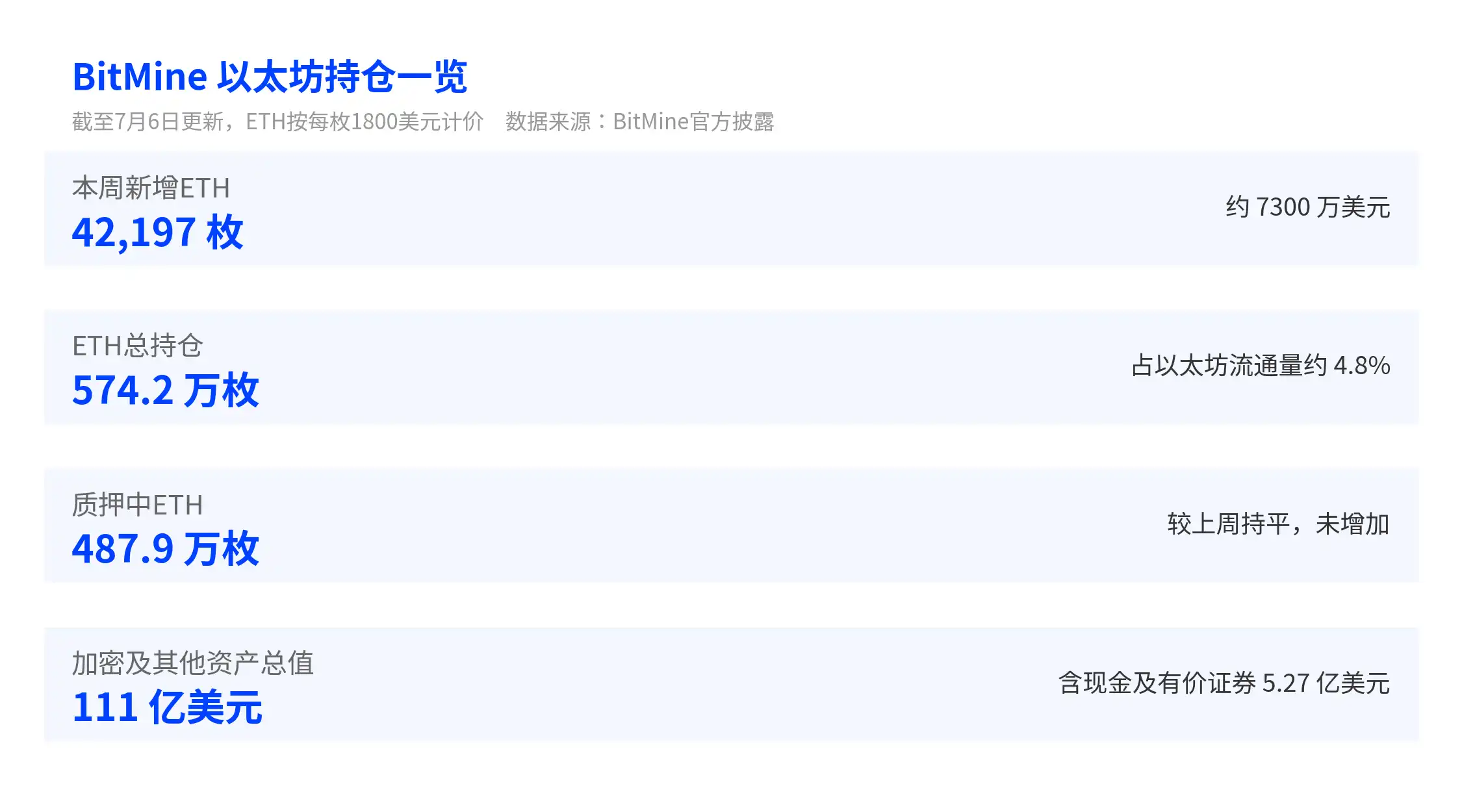
One detail worth noting for holders: BitMine's staked ETH amount remained flat at 4,879,157, meaning the newly acquired coins this week were not staked. The company's publicly stated goal is to control 5% of Ethereum's total supply, and its weekly accumulation is approaching that threshold.

A risk note is warranted here: BitMine's holding value is highly dependent on the coin price. Its accounts value ETH at $1,800, while as of July 6th, the spot ETH price was around $1,747, already below its valuation benchmark. In June this year, insiders also warned that the company faced a cash shortfall of about $30 million, which Tom Lee publicly denied as a financing crisis. For those following such treasury companies to go long on ETH, the double leverage of the company's stock price and the coin price is a double-edged sword.

Price Falls, Institutions Buy: How to Read This Divergence

Putting the two threads together paints a contradictory picture: institutions are accelerating their entry while the coin price is moving down.

Ethereum has had a tough year. According to multiple market data sources, ETH has fallen over 50% from its all-time high of around $4,900 in August 2025. It closed the first three quarters of 2026 with three consecutive quarterly declines, the first recorded three-quarter losing streak. Spot Ethereum ETFs also recorded net outflows in June. On-chain activity is declining too. According to Glassnode data, the 14-day moving average of active addresses dropped from about 795,000 in early February to about 420,000 in June, a decline of about 46%.

Therefore, the growth in JP Morgan's fund size and BitMine's holdings tells a different story from the secondary market price action. Institutions are buying into Ethereum's long-term position as a settlement layer and compliant asset infrastructure, betting on the stablecoin reserve and tokenized asset trend. The secondary market is selling based on short-term liquidity, sentiment, and ETF fund flows. These two narratives can diverge for a long time, and there's no certainty about which will materialize first.

For holders or potential entrants, the operational implication here is: institutional accumulation and the tokenization narrative are real, fundamental changes, but they do not constitute a short-term price floor. Historically, concentrated buying by large holders hasn't always been a clean buy signal; a local top followed the whale accumulation in February. It's valid to consider institutional entry as a long-term logic, but caution is advised when using it as a basis for timing a market bottom.


Cryptos en tendance

Questions liées

QWhat is the growth rate of JPMorgan Chase's tokenized fund JLTXX in terms of on-chain TVL over the past month, and on which blockchain does it operate?

AJPMorgan Chase's tokenized money market fund JLTXX has seen its on-chain Total Value Locked (TVL) increase by approximately 250% over the past month. It operates exclusively on the Ethereum blockchain.

QAccording to the article, what is the primary traditional asset composition of the JLTXX fund, and what new demand is driving its growth?

AThe JLTXX fund is invested in conservative, traditional assets such as short-term U.S. Treasury bills and overnight repurchase agreements fully collateralized by Treasuries or cash. Its growth is partly driven by its inclusion as a reserve asset for stablecoins, meeting the requirements of U.S. regulations like the GENIUS Act for on-chain Treasury exposure.

QHow much ETH did BitMine Immersion Technologies purchase in the week prior to the article's publication, and what is the company's stated long-term goal regarding Ethereum's supply?

ABitMine Immersion Technologies purchased 42,197 ETH (worth approximately $73 million at the time) in the week before the article's publication. The company's publicly stated goal is to control 5% of Ethereum's total supply.

QWhat contradictory market trends regarding Ethereum does the article highlight between institutional activity and price action?

AThe article highlights a contradiction where institutional activity is increasing (e.g., JPMorgan's growing tokenized fund and BitMine's accumulating ETH holdings), while Ethereum's price is declining significantly, having fallen over 50% from its 2025 highs. This suggests institutions are betting on Ethereum's long-term utility as a settlement layer, while short-term market prices are driven by different factors like sentiment and ETF flows.

QName one other major financial institution mentioned in the article that is also active in the tokenized fund space, and what is the name of its flagship product?

ABlackRock is another major financial institution active in the tokenized fund space mentioned in the article. Its flagship tokenized fund is called BUIDL, which was the world's largest tokenized fund with over $2.8 billion in assets under management as of early 2026.

Lectures associées

Décryptage du cycle altcoin 2026 : Le capital se détourne-t-il des cryptos à forte capitalisation ?

Le rotation des capitaux ne montre pas de signes clairs d'un cycle altcoin plus large. Les données on-chain révèlent que les altcoins connaissent leur plus forte sous-performance historique face au Bitcoin, indiquant que la liquidité se concentre sur quelques secteurs de conviction plutôt que de se répandre sur l'ensemble du marché. Bien que la capitalisation totale du marché altcoin ait progressé de 4% au T3, 40% des altcoins évoluent toujours sous leurs sommets historiques. La dominance d'Ethereum a augmenté de plus de 4% ce trimestre, un signal technique souvent interprété comme le prélude à un cycle altcoin. Cependant, la sous-performance persistante des altcoins soulève la question de savoir si cette liquidité se cantonne à quelques actifs majeurs. Les analystes invitent à la sélectivité, notant que même les grandes capitalisations comme Ethereum et Solana restent bien en dessous de leurs records. Les indicateurs comme l'explosion de la valeur totale verrouillée (TVL) sur Robinhood Chain (+150% en 24h) contrastent avec la faiblesse de la TVL sur de nombreux écosystèmes de haut de marché. Cela renforce l'idée d'une rotation des capitaux vers des récits spécifiques plutôt qu'un rallye généralisé. La force récente d'Ethereum semble donc davantage technique que fondamentale, et la pression pourrait persister sur les altcoins à grande capitalisation si la liquidité reste sélective au second semestre.

ambcryptoIl y a 8 mins

Décryptage du cycle altcoin 2026 : Le capital se détourne-t-il des cryptos à forte capitalisation ?

ambcryptoIl y a 8 mins

AxBlade × AWS Hong Kong Summit : Définir la responsabilité pour l'IA Physique

AxBlade, la couche de responsabilisation pour l'IA autonome, a co-organisé un événement exclusif intitulé "De l'IA agentique à l'IA physique : Qu'est-ce qui est financé après la vague des modèles ?" lors du AWS Summit Hong Kong. Cette réunion privée a rassemblé plus de 100 fondateurs, chercheurs, dirigeants d'entreprise et investisseurs d'institutions de premier plan pour examiner le déficit critique d'infrastructure entre les démonstrations d'IA et son déploiement réel. Le consensus des panels fut clair : sans identité vérifiable, exécution de confiance et enregistrements d'activité prouvables cryptographiquement, l'IA physique ne peut passer du laboratoire à la production. Les discussions ont porté sur les tendances de financement vers les infrastructures de conformité, ainsi que sur les défis de responsabilité, de sécurité et de gouvernance lorsque les agents IA interagissent avec des systèmes physiques. AxBlade s'est présenté comme la seule infrastructure native blockchain de l'événement, démontrant comment sa blockchain publique de couche 2, combinant identité IA décentralisée (DID), environnements d'exécution de confiance (TEE) et preuve à divulgation nulle de comportement (PoB), répond directement à ce déficit de responsabilisation. "Nous ne construisons pas de modèles d'IA. Nous construisons l'infrastructure de confiance qui les rend auditable

TheNewsCryptoIl y a 4 h

AxBlade × AWS Hong Kong Summit : Définir la responsabilité pour l'IA Physique

TheNewsCryptoIl y a 4 h

Trading

Spot

Articles tendance

Comment acheter LAYER

Bienvenue sur HTX.com ! Nous vous permettons d'acheter Solayer (LAYER) de manière simple et pratique. Suivez notre guide étape par étape pour commencer votre parcours crypto.Étape 1 : Création de votre compte HTXUtilisez votre adresse e-mail ou votre numéro de téléphone pour ouvrir un compte sur HTX gratuitement. L'inscription se fait en toute simplicité et débloque toutes les fonctionnalités.Créer mon compteÉtape 2 : Choix du mode de paiement (rubrique Acheter des cryptosCarte de crédit/débit : utilisez votre carte Visa ou Mastercard pour acheter instantanément Solayer (LAYER).Solde :utilisez les fonds du solde de votre compte HTX pour trader en toute simplicité.Prestataire tiers :pour accroître la commodité d'utilisation, nous avons ajouté des modes de paiement populaires tels que Google Pay et Apple Pay.P2P :tradez directement avec d'autres utilisateurs sur HTX.OTC (de gré à gré) : nous offrons des services personnalisés et des taux de change compétitifs aux traders.Étape 3 : stockage de vos Solayer (LAYER)Après avoir acheté vos Solayer (LAYER), stockez-les sur votre compte HTX. Vous pouvez également les envoyer ailleurs via un transfert sur la blockchain ou les utiliser pour trader d'autres cryptos.Étape 4 : tradez des Solayer (LAYER)Tradez facilement Solayer (LAYER) sur le marché Spot de HTX. Il vous suffit d'accéder à votre compte, de sélectionner la paire de trading, d'exécuter vos trades et de les suivre en temps réel. Nous offrons une expérience conviviale aux débutants comme aux traders chevronnés.

383 vues totalesPublié le 2025.02.11Mis à jour le 2026.06.02

Comment acheter LAYER

Discussions

Bienvenue dans la Communauté HTX. Ici, vous pouvez vous tenir informé(e) des derniers développements de la plateforme et accéder à des analyses de marché professionnelles. Les opinions des utilisateurs sur le prix de LAYER (LAYER) sont présentées ci-dessous.

活动图片