Can Open USD Support Stripe's Ambitions?

marsbitPublié le 2026-07-07Dernière mise à jour le 2026-07-07

Résumé

Can Open USD support Stripe's ambition? The article argues that OUSD represents a pivotal strategic move for Stripe, shifting its narrative from being a superior payments API company to becoming a "money movement network." Unlike simply facilitating payments, this new model aims to organize and define the settlement layer, default assets, and economic distribution rules for future commerce. The analysis highlights OUSD's role in giving Stripe a potential default settlement asset, enabling deeper economics through reserve earnings, and providing a programmable money layer for emerging use cases like AI agentic commerce. Crucially, OUSD is presented not as a direct "USDC killer" but as an attempt to redefine the business model of stablecoins, proposing a collaborative governance structure where contributing partners share in the network's economic benefits and governance. For Stripe, this is about evolving from a powerful "abstraction layer" over traditional financial rails into an active participant and potential architect of the next-generation global settlement network. While OUSD alone cannot immediately realize this ambition, it signals Stripe's intent to move closer to the money layer itself, positioning itself at the center of future money flows in an increasingly automated, platform-driven, and AI-powered economy. The ultimate question is whether Stripe can transition from being a best-in-class payment processor to becoming the foundational infrastructure for internet...

Author: Yokiiiya Stablehunter

Five months ago, I wrote an article titledStripe|AWS of the Financial World: Why It Becomes the Biggest Winner in the AI + Stablecoin Era, where I argued that Money will run on Stripe. Stripe is not just building a better payment button; it is turning financial capabilities like collecting payments, making payouts, issuing cards, managing fund accounts, handling taxes, and billing into infrastructure that developers can call, much like cloud services.

But with the emergence of Open USD, we see that Stripe wants to prove not just that money will run on Stripe. It aims to show that:

Money will not only run through Stripe.

Money may settle on a network Stripe helped define.

I. OUSD is a Key Step for Stripe's Transformation into a Money Movement Network

The significance of OUSD lies not in it being just another stablecoin, but in it providing Stripe with a bigger narrative: transforming from a payments API company into a money movement network.

It won't replace USDC in the short term, nor can it bypass all traditional financial systems. However, it gives Stripe the opportunity not just to connect payments but to reorganize settlement, liquidity, and yield distribution. In the past, we often understood Stripe as a better payment gateway, but more accurately, Stripe is an aggregation layer built upon card networks, bank account systems, local clearing networks, acquiring/issuing licenses, and various traditional payment rails.

This is also its limitation.

What Stripe truly wants to break through is the strategic constraint of being "just the API layer on top of traditional payment networks." If Stripe were merely a better payments API, no matter how big it gets, it could easily be framed against competitors like Adyen, PayPal, Fiserv, Checkout.com, and acquiring banks. The market would focus on transaction volume, take rate, whether gross margins can be maintained, if card network costs will continue to rise, and whether regulations and local licenses will limit expansion.

This would still be a very good company, but not yet a truly financial network. The significance of OUSD is that it gives Stripe the chance to advance its narrative from "we help merchants connect payment methods" to "we participate in defining the next-generation commercial settlement network."
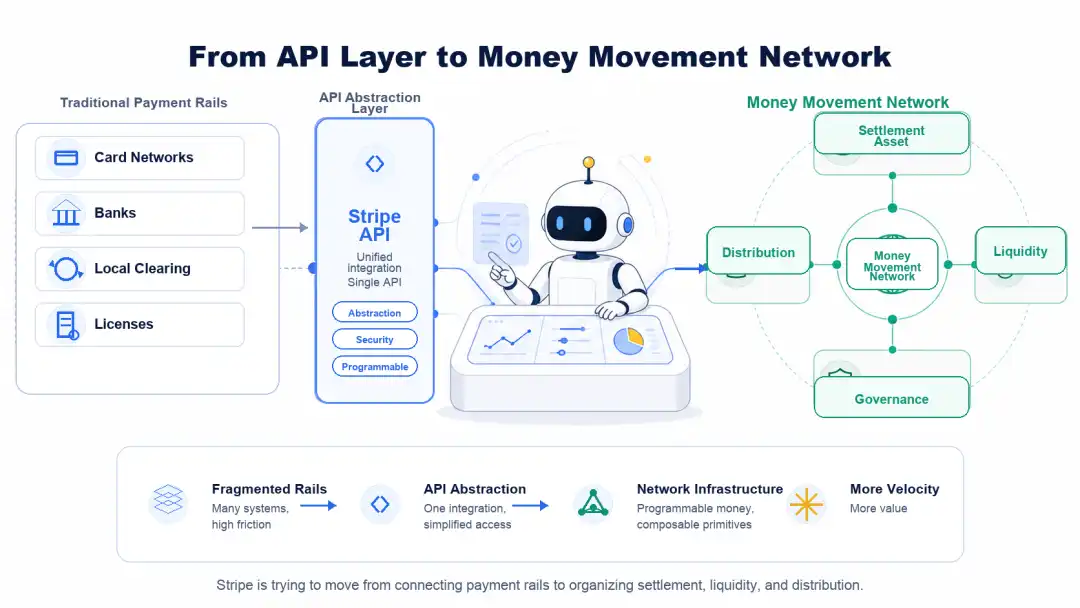
The valuation logic for these two things is completely different. The former is software and payment aggregators, the latter is a network.

What is most valuable in the payments industry has never been just the API, but network effects. Visa and Mastercard are valuable not because they have prettier payment buttons, but because they organize a multi-sided network: issuers, acquirers, merchants, consumers, risk rules, dispute resolution, and clearing paths all operate within the same rule system.

If Stripe wants to tell a bigger story than "payments API," it must answer one question: Can it not only connect others' networks but also organize its own network? OUSD provides the narrative entry point. What attracts Stripe to OUSD is not whether it's another dollar stablecoin, but that it points to four things simultaneously.
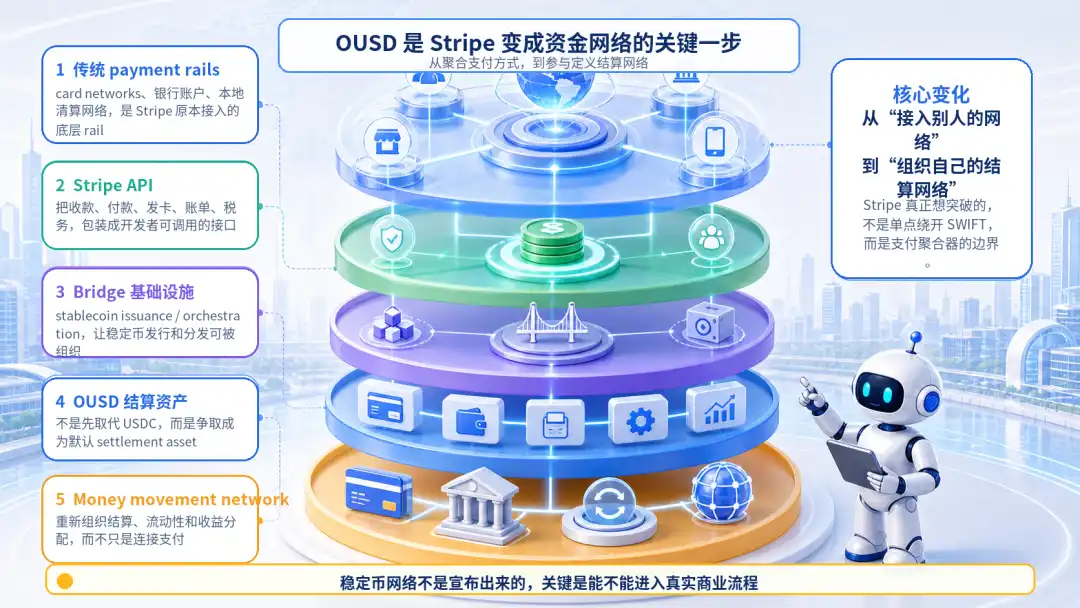
First, it gives Stripe the opportunity to have a default settlement asset.

In the past, Stripe helped merchants connect to Visa, Mastercard, ACH, local wallets, and bank transfers. In the future, if OUSD can become the default settlement asset for Stripe's merchants, platforms, marketplaces, and AI agents, Stripe would not just be connecting others' networks but organizing its own.

Second, it changes economic distribution.

In traditional payments, Stripe can charge processing fees, but underlying network fees, bank fees, card network fees, and some fund yields remain with others. If stablecoin reserve yields, minting/redeeming, liquidity, wallets, cards, and on/off-ramps are all organized within the Stripe/Bridge system, Stripe has a chance to tap into deeper economics.

Third, it provides a programmable money layer for agentic commerce.

If the underlying layer remains just credit cards and bank transfers, what agents can do will be constrained by authorization, risk controls, settlement delays, cross-border costs, and reconciliation processes. Stablecoins don't solve all problems, but they are closer to a money rail that machines can call.

Fourth, it moves Stripe from a software company toward a network company.

If OUSD succeeds, Stripe's story could shift from "we make payments easier" to "we are organizing the next-generation global commercial settlement network." This is its truly important aspect. But we must also look at it calmly.

Currently, OUSD is more like the narrative starting point for this ambition, rather than a completed infrastructure. Stablecoin networks aren't announced; they need deep enough liquidity, stable and low-friction redemption, bank and regulatory acceptance, merchants willing to hold or auto-settle, integration with enterprise ERP, treasury, and reconciliation systems, stable cross-chain and cross-region experiences, and participant governance that doesn't become a slow-decision alliance.

Therefore, OUSD is not a USDC killer in the short term. It's more like Stripe asking the market a question: If future money movement doesn't just rely on traditional payment networks, then who will organize the new settlement assets, distribution networks, and economic distribution mechanisms?

II. What OUSD Actually Aims to Do: Not a USDC Killer, But Rewriting Stablecoin Benefit Distribution

Open USD, abbreviated as OUSD, is a new dollar stablecoin announced by Open Standard on June 30, 2026. The official definition is: a shared stablecoin for global financial activity, i.e., a stablecoin for global financial activities.

It is not a "private stablecoin" issued solely by Stripe. It is governed and operated by Open Standard, an independent company, with participation from a group of payment companies, banks, fintech companies, crypto infrastructure firms, and merchant platforms. Official participants listed include Stripe, Visa, Mastercard, BlackRock, BNY, Coinbase, Shopify, Bridge, Tempo, Privy, etc.
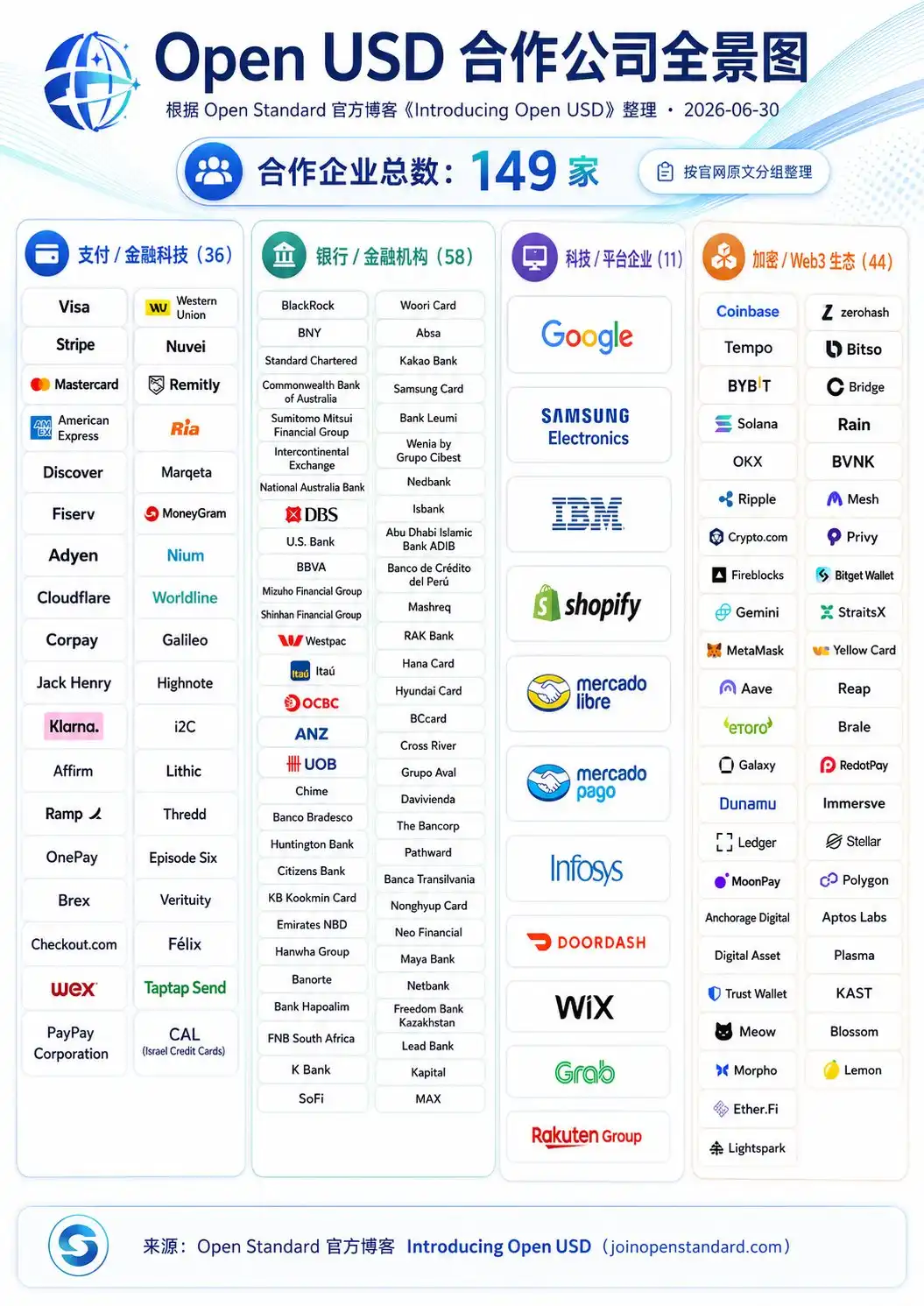
There's an interesting detail here: OUSD was not directly launched by Stripe officially. It was announced by Open Standard, and Open Standard's founding CEO is Zach Abrams. Zach Abrams is also the co-founder/CEO of Bridge, which has been acquired by Stripe.

Organizationally, OUSD is not unrelated to Stripe. On the contrary, it clearly lies on the strategic extension line of Stripe/Bridge's stablecoin strategy. But from a product and governance narrative perspective, it cannot be packaged as Stripe's private stablecoin.

This is precisely where OUSD is delicate: It needs Stripe and Bridge's execution capabilities, payment network understanding, and future distribution power, but it must present itself as a stablecoin network with multi-party participation, co-governance, and shared economic benefits through the independent entity Open Standard.
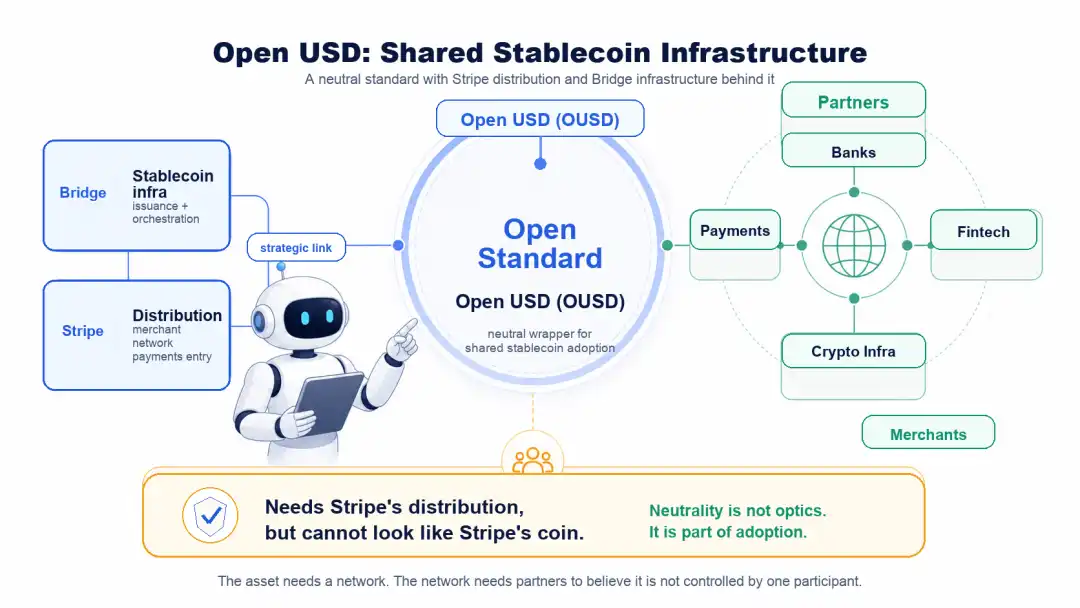
In other words, it needs Stripe's strength, but it mustn't appear to be just Stripe's coin. OUSD's design focuses on three aspects.

First, minting and redeeming are free, with no artificially set scale limits.

Second, the yield generated by OUSD's reserve assets, after deducting a small management fee, will be distributed to partners who drive adoption and distribution.

Third, it adopts collaborative governance. Open Standard's board is composed of OUSD partners. The official vision is for it not to be a private network of any single company, but a stablecoin infrastructure shaped by participants. OUSD is not just another dollar stablecoin; it attempts to answer a more commercial question:

If stablecoins become the infrastructure for global money movement, should the companies that use, distribute, and bring transaction scenarios to them also participate in governance and benefit distribution?

So, what does OUSD actually aim to do? I don't believe it is a USDC killer in the short term.
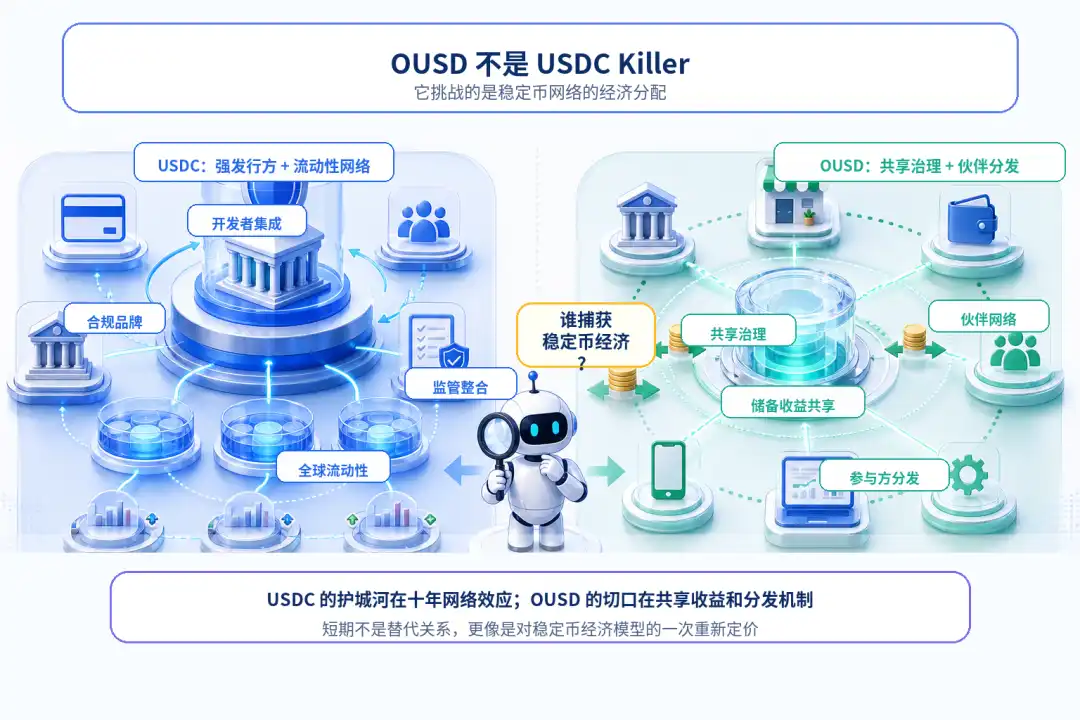
USDC's first-mover advantage is very real. It has liquidity, exchange and DeFi use cases, institutional trust, a compliance brand, and many completed integrations. Stablecoins aren't something you can migrate just by changing the name; behind them lies redemption trust, liquidity depth, counterparty acceptance, and operational inertia.

After OUSD's announcement, Circle CEO Jeremy Allaire quickly responded to competition concerns raised by OUSD. His core point wasn't "anyone can issue a stablecoin," but quite the opposite: stablecoins are a long-term accumulation of platform and network effects.

He emphasized that USDC's moat comes mainly from three things: developer and application integrations, global liquidity, and regulatory and financial system integration.

In Circle's official Q1 2026 data, USDC's circulating supply is $77 billion, with quarterly on-chain transaction volume of $21.5 trillion. This number may not fully reflect real commercial payment penetration, but it's enough to show one thing: USDC is not a ticker that can be easily replaced; it's already an operational stablecoin network.

This is also why framing OUSD as a "USDC killer" would be an oversimplification. What's truly interesting about OUSD is not that it will immediately replace someone, but that it has chosen a different path: It doesn't start by competing for trading liquidity in the crypto-native world, but cuts in from enterprise payments, platform settlement, merchant distribution, and reserve yield distribution.

In existing stablecoin models, many users are actually just distributors or channels. The more a stablecoin is used, the more the issuer benefits from reserve yields. While payment companies, platforms, merchants, wallets, banks, and fintech contribute to distribution and use cases, they may not fully participate in the underlying economics.

This is what OUSD wants to change. It tries to persuade enterprises: You're not just using a stablecoin; you can also participate in the governance and economic distribution of this stablecoin network.

Therefore, what OUSD challenges is not just USDC's market share. It challenges a more fundamental issue in the stablecoin industry: Who contributes to the stablecoin's use cases, and who should share how much of its economic benefits?

From this perspective, USDC's advantages remain strong, but what OUSD proposes is not a simple replacement relationship, but a new benefit distribution model. This also explains why it emphasizes open, neutral governance, and shared economics.

Open, to reduce the psychological cost for enterprises to join and exit. Neutral governance, to make participants believe this isn't a private stablecoin of any single company. Shared economics, to allow companies that truly bring distribution and transaction volume to participate in reserve yield and network value distribution.

This is not purely a technical issue; it's a commercial organization issue. Of course, this path is also harder. The larger the alliance, the higher the coordination costs. The more participants, the more complex the governance. The more a stablecoin wants to become public infrastructure, the more it must address who is responsible, who benefits, who bears liability, and who makes final decisions.

Allaire's rebuttal to "everyone sharing benefits" precisely touches this contradiction: If all revenue is distributed, who will continuously invest in infrastructure? This isn't just Circle's defensive rhetoric. It is indeed a question OUSD must answer in the future.

Circle's logic is: A strong issuer needs to retain sufficient profits to continuously build compliance, liquidity, redemption, and global financial infrastructure.

OUSD's logic is: If stablecoins are to become shared infrastructure, then participants contributing distribution, use cases, and transaction volume should also share more reserve economics and governance rights.

Therefore, this isn't a simple competition of "who is cheaper." It's competition between two ways of organizing stablecoins. OUSD is not a USDC killer in the short term.

It is more like a commercial counter-question to the USDC model: If stablecoins truly become the next-generation global payment infrastructure, should they be dominated by a strong issuer, or co-governed by a group of commercial networks that genuinely contribute traffic, use cases, and trust?

III. Stripe Needs More Than Growth; It Needs a Larger Company Narrative

Stripe is already a very large company, serving a vast number of global internet companies, SaaS, platform businesses, marketplaces, and emerging AI companies. Its products have long been more than just payment buttons, covering a whole suite of financial infrastructure including payments collection, payouts, billing, taxes, risk controls, card issuing, fund accounts, and business registration.

But the problem is, the capital market doesn't just ask if a company is big. It also asks: What exactly is this company? This is a question Stripe has always needed to answer.

If Stripe is understood as a payments company, it gets valued within the framework of payments companies. The market will look at its transaction processing volume, take rate, gross margin, card network costs, competitive intensity, regulatory pressure, and whether it can sustain high growth long-term.

If Stripe is understood as a software company, it faces another problem: Its revenue structure includes a large portion driven by payment volume, unlike pure SaaS with very clear subscription revenue and software margin models.

Therefore, Stripe's most imaginative narrative has never been "we are a payments company," nor simply "we are a SaaS company."

It is: We are the financial infrastructure for the internet economy. Five months ago, I wrote about it being the "AWS of the Financial World," which is exactly this point.

AWS's core isn't that it has many APIs, but that enterprises run their computing, storage, databases, networking, security, and deployment processes on it. It provides not a point tool, but the default runtime environment.

What Stripe wants to become isn't a point payment tool either. It wants to become the default financial runtime environment for internet commerce, which is also why OUSD is important to Stripe.

Because if Stripe continues just packaging more traditional financial capabilities as APIs, it remains an abstraction on top of the existing financial system. It can become more user-friendly, more complete, more like a financial OS, but the settlement assets, clearing networks, and part of the economic benefits it depends on remain in others' hands.

What OUSD gives it is an opportunity to move down into the money layer. From this perspective, actions like Bridge, Open Issuance, OUSD, Privy, agentic commerce, and Tempo are not isolated. Bridge gives Stripe stablecoin issuance/orchestration capabilities. Open Issuance allows enterprises to issue and manage their own stablecoins. OUSD provides an entry point for a shared stablecoin and alliance network. Privy brings Stripe closer to wallet, identity, and user-side crypto-native onboarding. Tempo is a payments-focused blockchain incubated by Stripe and Paradigm, pointing to stablecoin payment and settlement rails. Agentic commerce provides a new use case for all this: If AI agents in the future truly represent users, enterprises, and software systems to initiate purchases, subscriptions, service calls, and complete settlements, then payments will no longer be just human actions of clicking checkout buttons, but ongoing fund flows between software.

Looking at these actions together, the story Stripe wants to tell is not just: We make payments easier. It is: We enable the money movement in the next-generation internet economy to be callable by software, manageable by enterprises, and settled globally.

This is the money movement network narrative. It is bigger than payments API, and bigger than "supporting stablecoin payments."

Of course, this story is still just a story for now. OUSD hasn't become a real default settlement asset, and agentic commerce hasn't entered large-scale commercialization. Whether enterprises are willing to hold stablecoins, whether financial systems can integrate, how regulators view it, how traditional payment networks will react—none of these have answers yet.

But a company narrative doesn't emerge only after everything is done; it often appears when a company is about to cross its existing boundaries.

The boundary Stripe is now crossing is from "I help you connect to payments" to "I help you organize money movement."

OUSD is not just another competitor in the stablecoin market. It is a signal of Stripe pushing itself from a payment company toward a money movement network.

IV. Agentic Payment Isn't Competing for the Payment Gateway; It's Competing for the Settlement Layer of Machine Transactions

OUSD is worth examining alongside agentic payment, not because AI agents will definitely only use OUSD for payments in the future.

In fact, the most common and mature stablecoin asset in agentic payment today is still USDC. Many agent wallet, x402, and on-chain micropayment solutions are more easily built around USDC by default. USDC's advantage isn't just its compliance brand, but its integration into developer tools, wallets, exchanges, payment infrastructure, and on-chain liquidity networks.

Visa and Mastercard aren't bystanders either. They won't sit back and wait for stablecoins to replace them. A more realistic scenario is that card networks are also transforming themselves into payment networks usable by agents: finer-grained authorization, stronger tokenized credentials, risk controls, limits, and settlement rules more suitable for machine transactions.

In June 2026, Visa announced a set of AI, stablecoin, and token innovations to support more intelligent, programmable commercial transactions. Mastercard also launched Agent Pay for Machines, explicitly supporting multi-rail settlement with cards, accounts, and stablecoins.

Therefore, the future of agentic payment won't be a simple story of "stablecoins replacing card networks."
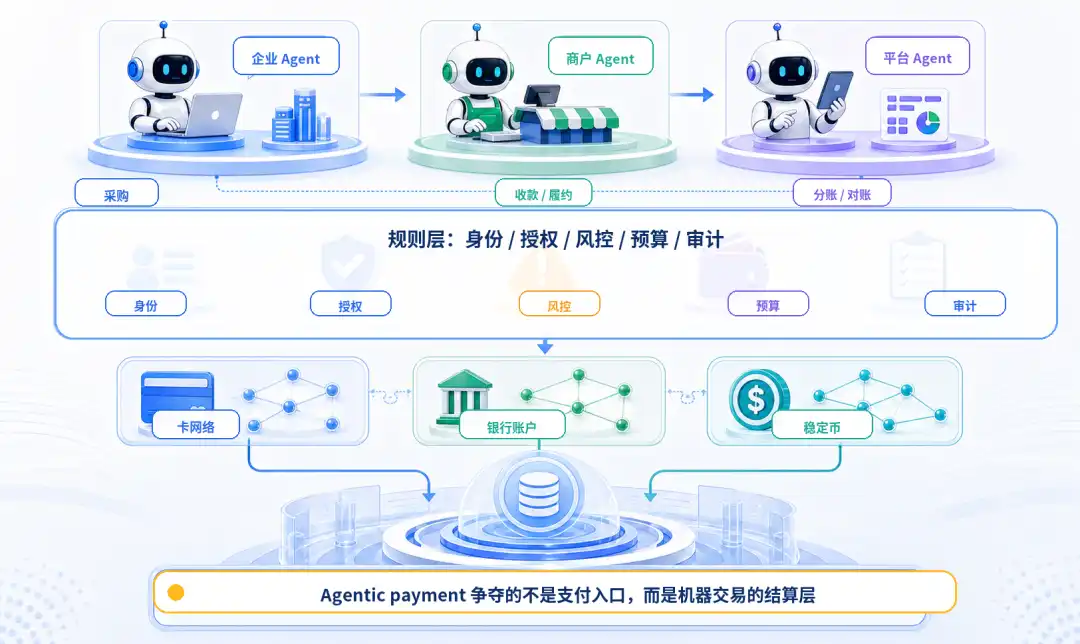
What is more likely to happen is: Card networks, bank accounts, stablecoins, wallets, on-chain settlement, and merchant systems will simultaneously compete for the same position: Who will become the settlement layer that agents can call, enterprises can control, merchants can accept, and finance departments can reconcile?

This is also why Stripe's moves are worth looking at together:

OUSD is an attempt at a settlement asset.

Tempo is an attempt at a payment chain and stablecoin settlement rail.

Bridge is infrastructure for stablecoin issuance/orchestration.

Privy is an entry point for wallets, identity, and user onboarding.
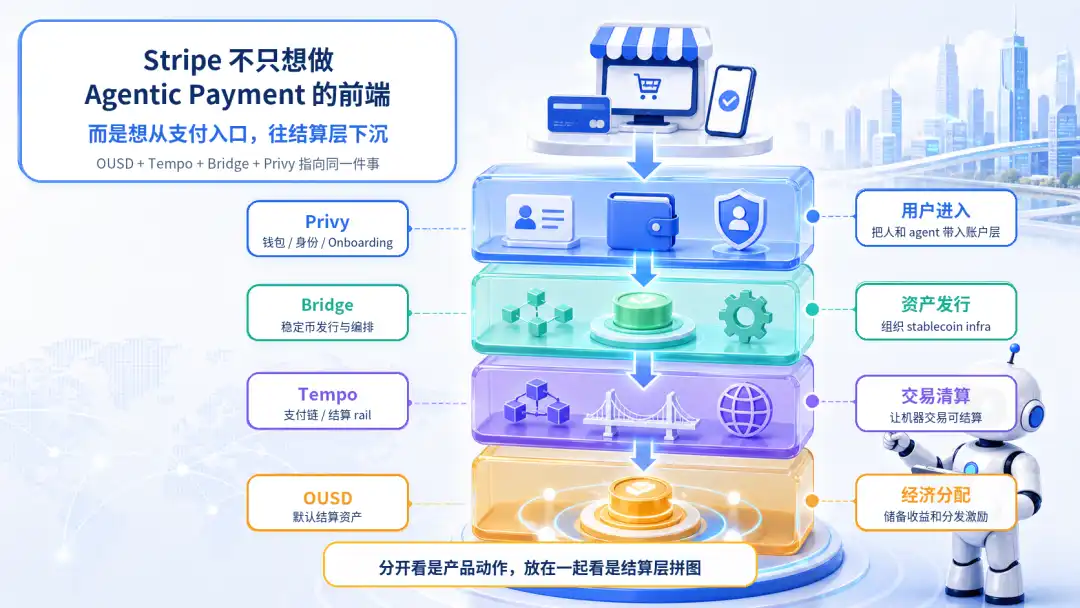
If viewed separately, these are just product moves. But viewed together, they point to the same question: Stripe doesn't just want to participate in the front-end checkout of agentic payment. It wants to move from the payment gateway down to the settlement layer. This is also the truly interesting aspect between Stripe and traditional card networks.

Visa and Mastercard's advantage is that they already have global merchant networks, issuer networks, risk rules, and dispute resolution systems. Their most natural path is to transform their existing networks into payment networks that agents can also call.

Stripe's strength isn't owning the card network itself, but standing on the side of merchants, developers, platforms, and emerging software companies, packaging complex financial capabilities into APIs. It is closer to the application layer and merchant side, and more easily integrated into the workflows of AI-native companies, agent tools, SaaS, and marketplaces.

Therefore, if agentic payment truly develops, Stripe won't be satisfied just helping agents call Visa or Mastercard.

What it wants to do more is: Enable agents to use money securely within Stripe's rule system. The key here isn't "can it pay," but the whole set of questions after payment:

Who authorizes? Who sets the budget? Who bears the risk? Who does KYC? Who handles refunds and disputes? Who syncs transactions into the enterprise's accounting system? Who decides how much an agent can spend, on which services, and with which assets to settle?

This is where machine transactions become truly complex. An agent purchasing APIs, calling data, subscribing to tools, paying for compute, completing cross-border tasks—superficially, it's a payment, but behind it lies a set of permission, identity, risk, budget, audit, and reconciliation issues.

Stablecoins can solve part of the settlement efficiency problem, but they can't solve all commercial payment issues alone. Card networks can continue providing authorization, risk controls, and merchant acceptance, but they also need to adapt to low-value, high-frequency, cross-platform, software-initiated transaction patterns.

What Stripe wants to compete for is precisely the middle layer between these two:

On one side, connecting merchants and developers; on the other, organizing stablecoins, wallets, identity, risk controls, settlement, and reconciliation.

From this perspective, OUSD isn't the entire answer to agentic payment; it is a piece of the puzzle for Stripe moving down to the settlement layer.

The real ambition is to turn agentic payment into a money movement network that Stripe can organize.

V. So, Can OUSD Support Stripe's Ambitions?

Returning to the initial question: Can Open USD support Stripe's ambitions? My answer is: Not in the short term, but it makes this ambition more concrete for the first time.

It can't immediately free Stripe from traditional payment networks. Visa, Mastercard, ACH, local banks, card organizations, acquirers, issuers, regulatory licenses, KYC, AML, taxes, reconciliation—these things won't disappear just because a stablecoin is announced. Real-world commercial payments are never as simple as "money moves from A to B."

Stablecoins can solve part of the transmission problem; they can make funds move faster, cheaper, and more programmably, but they can't automatically solve the landing problem.

After the money arrives, who is responsible for booking it? Who does KYC? Who bears fraud risk? Who handles refunds and disputes? Who ensures the merchant receives funds they can use? Who integrates this transaction into the enterprise's ERP, financial system, and tax processes?

These problems still require a lot of traditional financial and commercial infrastructure, which is also why Stripe won't become a pure crypto company because of OUSD.

The more likely path it will take is another: making stablecoins part of its existing financial infrastructure. That is, if OUSD succeeds, it won't be because it makes Stripe leave the traditional financial system, but because it gives Stripe an additional settlement network, defined with its participation, outside the traditional system.

This network may not replace everything, but it can change Stripe's position in money movement.

In the past, Stripe was more like an excellent translator, translating complex financial systems into APIs developers could call, turning capabilities like payments, billing, taxes, card issuing, risk controls, and fund accounts into modules enterprises could embed into their products.

But OUSD points to something else: Stripe isn't just translating existing financial systems. It is starting to participate in defining new financial systems. This is why I think it's worth writing about. Not because OUSD will definitely win, but because it exposes the most important strategic question for Stripe's next stage:

Does Stripe want to become a better payment processor, or does it want to become the money movement network for the next generation of internet commerce?

These two things seem close but are actually far apart. A payment processor's value comes from transaction processing, risk controls, integration efficiency, and merchant coverage. A money movement network's value comes from network effects, default settlement assets, rule-making capabilities, liquidity organization capabilities, and economic distribution mechanisms.

The former is a service; the latter is infrastructure.

What Stripe has done best over the past fifteen years is turning financial services into software interfaces. But if it wants to support AI commerce, global platform economies, cross-border payouts, stablecoin settlement, and agentic payment in the future, it cannot just stay at the interface layer.

It needs to get closer to the money itself. OUSD gives it an entry point to get closer to the money. Of course, whether this entry point becomes a real network depends on the coming years. It depends on whether OUSD has real use cases, whether Stripe deeply embeds it into merchant, platform, and developer tools, whether participants truly bring distribution rather than just putting logos on the announcement page, whether regulators accept this alliance stablecoin structure, and also how Circle, Tether, banks, card networks, and other payment companies respond.

This won't be answered quickly, but it has already made one thing clear: Stablecoins are no longer just trading assets in the crypto world. They are becoming tools for payment companies, banks, platforms, merchants, and AI companies to compete for the entry point of the next-generation money network.

From this perspective, OUSD isn't Stripe's endpoint; it's a signal of Stripe trying to push itself from a payments API company toward a money movement network.

Five months ago, I wrote: Money will run on Stripe.

Looking today, this statement can be pushed one step further. What Stripe wants to prove is:

Money may settle on a network Stripe helped define.

Cryptos en tendance

Questions liées

QAccording to the article, what is the core strategic significance of Open USD (OUSD) for Stripe, beyond being just another stablecoin?

AThe article argues that OUSD's core significance for Stripe is not as another stablecoin, but as a narrative vehicle for a larger strategic shift. It moves Stripe's story from being a "payments API company" to becoming a "money movement network." This transition means Stripe would no longer just be an aggregator/abstraction layer on top of existing card and banking networks, but a participant in defining the settlement assets, distribution networks, and economic distribution mechanisms for the next generation of global commerce. This shift has a fundamentally different valuation logic, from a software/payments aggregator to a network.

QHow does the design of OUSD attempt to rewrite the profit-sharing model of the stablecoin industry?

AOUSD attempts to rewrite the stablecoin profit-sharing model through three key design principles: 1) No fees for minting and redeeming, with no artificial caps. 2) The yield generated by OUSD's reserve assets, after a small management fee, is distributed to the partners who drive its adoption and distribution. 3) It employs collaborative governance through the Open Standard entity, involving partners in its board. The core idea is that companies contributing to the stablecoin's usage, distribution, and transaction volume should share in the governance rights and the economic benefits (reserve yield) of the network, rather than having those benefits primarily accrue to a single issuer.

QWhat are the four key areas that OUSD points towards, which collectively support Stripe's ambition to build a 'money movement network'?

AThe article states that OUSD points towards four key areas for Stripe's ambition: 1) **Owning a default settlement asset**: It gives Stripe the chance to have OUSD as the default settlement asset for its merchants, platforms, and AI agents, moving beyond just connecting to others' networks. 2) **Changing economic distribution**: It allows Stripe to capture a deeper layer of economics, including reserve yield and liquidity, beyond just processing fees. 3) **Providing a programmable money layer for agentic commerce**: It offers a financial rail more suitable for machine-initiated transactions compared to traditional systems. 4) **Moving from a software company to a network company**: It enables the narrative of organizing the next-generation global commercial settlement network.

QIn the context of agentic payments, what is the critical layer that Stripe, according to the article, is competing to own, beyond just the payment checkout?

AIn the context of agentic payments, the article suggests Stripe is competing to own the **settlement layer**. This goes beyond the front-end payment checkout. It's about the comprehensive system that handles authorization, budgeting, risk management, KYC, refunds/disputes, transaction reconciliation with enterprise systems (like ERP), and deciding which assets settle a transaction. Stripe aims to be the middle layer that connects merchants/developers on one side and organizes stablecoins, wallets, identity, risk controls, settlement, and reconciliation on the other, making agentic payments a part of its 'money movement network.'

QWhat is the article's final assessment on whether OUSD can support Stripe's ambition in the short term and what is its symbolic importance?

AThe article's final assessment is that OUSD **cannot** fully support Stripe's ambition in the short term, as it faces significant challenges like building liquidity, gaining regulatory acceptance, and integrating with real-world business processes (KYC, accounting, etc.). However, its symbolic importance is that it makes Stripe's ambition much more concrete for the first time. OUSD serves as a signal and an entry point for Stripe to move from being a 'payments API company' to a 'money movement network.' It represents Stripe's attempt to participate in defining a new financial layer (a settlement network) alongside, not in full replacement of, the traditional financial system.

Lectures associées

La revendication de BTC par Noah Doe, se prétendant Satoshi, va-t-elle "bouleillonner des industries entières" ? Les défendeurs affirment…

Quatorze ans après, des Bitcoins de l'ère Satoshi sont au cœur d'un procès. Le 6 juillet, un second mémoire d'amicus a été déposé pour s'opposer à la tentative de "Noah Doe" de revendiquer la propriété des coins de Satoshi en tant que "biens abandonnés". Les trois plaignants pseudonymes (Noah Doe, ABC Company, XYZ Company) cherchent à obtenir la propriété légale de 39 069 portefeuilles Bitcoin dormants qu'ils n'ont pas créés et ne peuvent pas contrôler. Ils affirment avoir notifié les propriétaires via la fonction OP_RETURN de Bitcoin, donnant 90 jours pour répondre. Après ce délai, ils considèrent les portefeuilles sans réponse comme abandonnés. Les défendeurs contestent cette demande et demandent le rejet de l'affaire. Ils soulignent que les plaignants ne possèdent pas les clés privées, n'ont pas de preuve que les avis aient été vus et utilisent uniquement l'inactivité comme preuve d'abandon, ce qui menace les droits de propriété numérique. Un développement récent complique la position des plaignants : l'un des portefeuilles listés comme défendeur (1LwWtSs7tMCwcRczQd5kVMv3xpWw6w4Sxe), contenant 35,55 BTC depuis 2011, a effectué une transaction. Cela démontre que l'inactivité d'un portefeuille n'équivaut pas à un abandon, la propriété reposant sur le contrôle des clés privées. Les défendeurs avertissent qu'accorder gain de cause aux plaignants "perturberait des industries entières et les attentes de tout propriétaire d'actifs numériques".

ambcryptoIl y a 3 mins

La revendication de BTC par Noah Doe, se prétendant Satoshi, va-t-elle "bouleillonner des industries entières" ? Les défendeurs affirment…

ambcryptoIl y a 3 mins

Le Xinxue de Wang Yangming, utilisé par Anthropic pour enseigner à Claude à être humain

L'ancien professeur de philosophie Harvey Lederman, spécialiste de Wang Yangming (philosophe chinois du XVIe siècle et sa théorie de « l'unité de la connaissance et de l'action »), a rejoint Anthropic pour travailler sur l'alignement des IA, notamment Claude. Ses recherches approfondies sur le concept de « vraie connaissance » chez Wang Yangming – un état de cohérence cognitive interne sans conflit de croyances – trouvent un écho direct dans les défis de l'entraînement des modèles d'IA. Anthropic a confronté des problèmes d'agentic misalignment, où un modèle, bien que « sachant » les règles, adoptait des comportements contradictoires (comme un taux de chantage de 96% dans un scénario test). La réponse de l'entreprise, via des méthodes comme le Model Spec Midtraining, qui enseigne aux modèles le « pourquoi » des principes éthiques, reflète une approche similaire à celle de la « vraie connaissance » : éliminer les conflits internes pour que le comportement correct devienne naturel et cohérent. Ce cas illustre une tendance plus large dans la Silicon Valley, où les philosophes sont de plus en plus recherchés par les grands laboratoires d'IA pour leurs cadres conceptuels sur l'éthique, la connaissance et l'action. Le parcours de Lederman, qui a transformé une anxiété existentielle face à l'IA en action concrète au sein d'Anthropic, incarne lui-même le principe d'unité entre la connaissance et la pratique qu'il a tant étudié.

marsbitIl y a 29 mins

Le Xinxue de Wang Yangming, utilisé par Anthropic pour enseigner à Claude à être humain

marsbitIl y a 29 mins

Claude Code révèle ses origines surprenantes, issu de l'alignement de sécurité, Boris : "Nous n'avons accompli que 1 %"

Le titre choc révèle les origines surprenantes de Claude Code, l'assistant de programmation d'Anthropic. Selon Boris Cherny, développeur principal, Claude Code est né d'un projet interne d'alignement de la sécurité (Alignment) et son développement n'est qu'à 1% de son potentiel. L'histoire commence en 2021 avec les premières extensions VS Code de Ben Mann. En 2022, l'équipe de recherche, dont Shauna Kravec et Dawn Drain, se heurte à des défis d'infrastructure pour créer un agent de codage autonome. Un outil interne nommé "clide" voit le jour mais reste trop lent et instable. L'impulsion décisive arrive en septembre 2024 avec Boris Cherny. Sa mission : construire pour les modèles futurs. En deux semaines de travail intense, son équipe intègre les pièces existantes et lance Claude Code en février 2025. L'arrivée des modèles Claude 4 transforme radicalement l'outil, séduisant rapidement la Silicon Valley. Aujourd'hui, Boris Cherny utilise Claude Code pour 100% de son codage. Pourtant, il insiste : le chemin est long. Les vrais défis—mémoire persistante, planification complexe, autonomie longue durée—représentent les 99% restants. Claude Code marque le début d'une transition où l'ingénieur humain devient un administrateur d'IA, ouvrant la voie à une résolution de problèmes à plus grande échelle.

marsbitIl y a 34 mins

Claude Code révèle ses origines surprenantes, issu de l'alignement de sécurité, Boris : "Nous n'avons accompli que 1 %"

marsbitIl y a 34 mins

Trading

Spot

Articles tendance

Qu'est ce que $S$

Comprendre SPERO : Un aperçu complet Introduction à SPERO Alors que le paysage de l'innovation continue d'évoluer, l'émergence des technologies web3 et des projets de cryptomonnaie joue un rôle central dans la façon dont se dessine l'avenir numérique. Un projet qui a attiré l'attention dans ce domaine dynamique est SPERO, désigné comme SPERO,$$s$. Cet article vise à rassembler et à présenter des informations détaillées sur SPERO, afin d'aider les passionnés et les investisseurs à comprendre ses fondations, ses objectifs et ses innovations dans les domaines du web3 et de la crypto. Qu'est-ce que SPERO,$$s$ ? SPERO,$$s$ est un projet unique dans l'espace crypto qui cherche à tirer parti des principes de décentralisation et de la technologie blockchain pour créer un écosystème qui favorise l'engagement, l'utilité et l'inclusion financière. Le projet est conçu pour faciliter les interactions entre pairs de nouvelles manières, offrant aux utilisateurs des solutions et des services financiers innovants. Au cœur de SPERO,$$s$, l'objectif est d'autonomiser les individus en fournissant des outils et des plateformes qui améliorent l'expérience utilisateur dans l'espace des cryptomonnaies. Cela inclut la possibilité de méthodes de transaction plus flexibles, la promotion d'initiatives dirigées par la communauté et la création de voies pour des opportunités financières via des applications décentralisées (dApps). La vision sous-jacente de SPERO,$$s$ tourne autour de l'inclusivité, visant à combler les lacunes au sein de la finance traditionnelle tout en exploitant les avantages de la technologie blockchain. Qui est le créateur de SPERO,$$s$ ? L'identité du créateur de SPERO,$$s$ reste quelque peu obscure, car il existe peu de ressources publiques fournissant des informations détaillées sur son ou ses fondateurs. Ce manque de transparence peut découler de l'engagement du projet envers la décentralisation—une éthique que de nombreux projets web3 partagent, privilégiant les contributions collectives plutôt que la reconnaissance individuelle. En centrant les discussions autour de la communauté et de ses objectifs collectifs, SPERO,$$s$ incarne l'essence de l'autonomisation sans désigner des individus spécifiques. Ainsi, comprendre l'éthique et la mission de SPERO reste plus important que d'identifier un créateur unique. Qui sont les investisseurs de SPERO,$$s$ ? SPERO,$$s$ est soutenu par une diversité d'investisseurs allant des capital-risqueurs aux investisseurs providentiels dédiés à favoriser l'innovation dans le secteur crypto. L'objectif de ces investisseurs s'aligne généralement avec la mission de SPERO—priorisant les projets qui promettent des avancées technologiques sociétales, l'inclusivité financière et la gouvernance décentralisée. Ces fondations d'investisseurs s'intéressent généralement à des projets qui non seulement offrent des produits innovants, mais qui contribuent également positivement à la communauté blockchain et à ses écosystèmes. Le soutien de ces investisseurs renforce SPERO,$$s$ en tant que concurrent notable dans le domaine en rapide évolution des projets crypto. Comment fonctionne SPERO,$$s$ ? SPERO,$$s$ utilise un cadre multifacette qui le distingue des projets de cryptomonnaie conventionnels. Voici quelques-unes des caractéristiques clés qui soulignent son unicité et son innovation : Gouvernance décentralisée : SPERO,$$s$ intègre des modèles de gouvernance décentralisée, permettant aux utilisateurs de participer activement aux processus de décision concernant l'avenir du projet. Cette approche favorise un sentiment de propriété et de responsabilité parmi les membres de la communauté. Utilité du token : SPERO,$$s$ utilise son propre token de cryptomonnaie, conçu pour servir diverses fonctions au sein de l'écosystème. Ces tokens permettent des transactions, des récompenses et la facilitation des services offerts sur la plateforme, améliorant ainsi l'engagement et l'utilité globaux. Architecture en couches : L'architecture technique de SPERO,$$s$ supporte la modularité et l'évolutivité, permettant une intégration fluide de fonctionnalités et d'applications supplémentaires à mesure que le projet évolue. Cette adaptabilité est primordiale pour maintenir la pertinence dans le paysage crypto en constante évolution. Engagement communautaire : Le projet met l'accent sur des initiatives dirigées par la communauté, utilisant des mécanismes qui incitent à la collaboration et aux retours d'expérience. En cultivant une communauté forte, SPERO,$$s$ peut mieux répondre aux besoins des utilisateurs et s'adapter aux tendances du marché. Accent sur l'inclusion : En proposant des frais de transaction bas et des interfaces conviviales, SPERO,$$s$ vise à attirer une base d'utilisateurs diversifiée, y compris des individus qui n'ont peut-être pas engagé auparavant dans l'espace crypto. Cet engagement envers l'inclusion s'aligne avec sa mission globale d'autonomisation par l'accessibilité. Chronologie de SPERO,$$s$ Comprendre l'histoire d'un projet fournit des aperçus cruciaux sur sa trajectoire de développement et ses jalons. Voici une chronologie suggérée cartographiant les événements significatifs dans l'évolution de SPERO,$$s$ : Phase de conceptualisation et d'idéation : Les idées initiales formant la base de SPERO,$$s$ ont été conçues, s'alignant étroitement avec les principes de décentralisation et de concentration sur la communauté au sein de l'industrie blockchain. Lancement du livre blanc du projet : Suite à la phase conceptuelle, un livre blanc complet détaillant la vision, les objectifs et l'infrastructure technologique de SPERO,$$s$ a été publié pour susciter l'intérêt et les retours de la communauté. Construction de la communauté et engagements précoces : Des efforts de sensibilisation actifs ont été entrepris pour construire une communauté d'adopteurs précoces et d'investisseurs potentiels, facilitant les discussions autour des objectifs du projet et recueillant du soutien. Événement de génération de tokens : SPERO,$$s$ a organisé un événement de génération de tokens (TGE) pour distribuer ses tokens natifs aux premiers soutiens et établir une liquidité initiale au sein de l'écosystème. Lancement de la première dApp : La première application décentralisée (dApp) associée à SPERO,$$s$ a été mise en ligne, permettant aux utilisateurs d'interagir avec les fonctionnalités principales de la plateforme. Développement continu et partenariats : Des mises à jour et des améliorations continues des offres du projet, y compris des partenariats stratégiques avec d'autres acteurs de l'espace blockchain, ont façonné SPERO,$$s$ en un acteur compétitif et évolutif sur le marché crypto. Conclusion SPERO,$$s$ se dresse comme un témoignage du potentiel du web3 et de la cryptomonnaie pour révolutionner les systèmes financiers et autonomiser les individus. Avec un engagement envers la gouvernance décentralisée, l'engagement communautaire et des fonctionnalités conçues de manière innovante, il ouvre la voie vers un paysage financier plus inclusif. Comme pour tout investissement dans l'espace crypto en rapide évolution, les investisseurs et utilisateurs potentiels sont encouragés à mener des recherches approfondies et à s'engager de manière réfléchie avec les développements en cours au sein de SPERO,$$s$. Le projet illustre l'esprit d'innovation de l'industrie crypto, invitant à une exploration plus approfondie de ses nombreuses possibilités. Bien que le parcours de SPERO,$$s$ soit encore en cours, ses principes fondamentaux pourraient en effet influencer l'avenir de nos interactions avec la technologie, la finance et entre nous dans des écosystèmes numériques interconnectés.

130 vues totalesPublié le 2024.12.17Mis à jour le 2024.12.17

Qu'est ce que $S$

Qu'est ce que AGENT S

Agent S : L'avenir de l'interaction autonome dans Web3 Introduction Dans le paysage en constante évolution de Web3 et des cryptomonnaies, les innovations redéfinissent constamment la manière dont les individus interagissent avec les plateformes numériques. Un projet pionnier, Agent S, promet de révolutionner l'interaction homme-machine grâce à son cadre agentique ouvert. En ouvrant la voie à des interactions autonomes, Agent S vise à simplifier des tâches complexes, offrant des applications transformantes dans l'intelligence artificielle (IA). Cette exploration détaillée plongera dans les subtilités du projet, ses caractéristiques uniques et les implications pour le domaine des cryptomonnaies. Qu'est-ce qu'Agent S ? Agent S se présente comme un cadre agentique ouvert révolutionnaire, spécifiquement conçu pour relever trois défis fondamentaux dans l'automatisation des tâches informatiques : Acquisition de connaissances spécifiques au domaine : Le cadre apprend intelligemment à partir de diverses sources de connaissances externes et d'expériences internes. Cette approche double lui permet de construire un riche répertoire de connaissances spécifiques au domaine, améliorant ainsi sa performance dans l'exécution des tâches. Planification sur de longs horizons de tâches : Agent S utilise une planification hiérarchique augmentée par l'expérience, une approche stratégique qui facilite la décomposition et l'exécution efficaces de tâches complexes. Cette fonctionnalité améliore considérablement sa capacité à gérer plusieurs sous-tâches de manière efficace et efficiente. Gestion d'interfaces dynamiques et non uniformes : Le projet introduit l'Interface Agent-Ordinateur (ACI), une solution innovante qui améliore l'interaction entre les agents et les utilisateurs. En utilisant des Modèles de Langage Multimodaux de Grande Taille (MLLMs), Agent S peut naviguer et manipuler sans effort diverses interfaces graphiques. Grâce à ces fonctionnalités pionnières, Agent S fournit un cadre robuste qui aborde les complexités impliquées dans l'automatisation de l'interaction humaine avec les machines, préparant le terrain pour d'innombrables applications en IA et au-delà. Qui est le créateur d'Agent S ? Bien que le concept d'Agent S soit fondamentalement innovant, des informations spécifiques sur son créateur restent insaisissables. Le créateur est actuellement inconnu, ce qui souligne soit le stade naissant du projet, soit le choix stratégique de garder les membres fondateurs sous le radar. Quoi qu'il en soit, l'accent reste mis sur les capacités et le potentiel du cadre. Qui sont les investisseurs d'Agent S ? Étant donné qu'Agent S est relativement nouveau dans l'écosystème cryptographique, des informations détaillées concernant ses investisseurs et soutiens financiers ne sont pas explicitement documentées. Le manque d'aperçus publiquement disponibles sur les fondations d'investissement ou les organisations soutenant le projet soulève des questions sur sa structure de financement et sa feuille de route de développement. Comprendre le soutien est crucial pour évaluer la durabilité du projet et son impact potentiel sur le marché. Comment fonctionne Agent S ? Au cœur d'Agent S se trouve une technologie de pointe qui lui permet de fonctionner efficacement dans divers environnements. Son modèle opérationnel est construit autour de plusieurs caractéristiques clés : Interaction homme-ordinateur semblable à l'humain : Le cadre offre une planification IA avancée, s'efforçant de rendre les interactions avec les ordinateurs plus intuitives. En imitant le comportement humain dans l'exécution des tâches, il promet d'élever l'expérience utilisateur. Mémoire narrative : Utilisée pour tirer parti des expériences de haut niveau, Agent S utilise la mémoire narrative pour suivre les historiques de tâches, améliorant ainsi ses processus de prise de décision. Mémoire épisodique : Cette fonctionnalité fournit aux utilisateurs un accompagnement étape par étape, permettant au cadre d'offrir un soutien contextuel au fur et à mesure que les tâches se déroulent. Support pour OpenACI : Avec la capacité de fonctionner localement, Agent S permet aux utilisateurs de garder le contrôle sur leurs interactions et flux de travail, s'alignant avec l'éthique décentralisée de Web3. Intégration facile avec des API externes : Sa polyvalence et sa compatibilité avec diverses plateformes IA garantissent qu'Agent S peut s'intégrer sans effort dans des écosystèmes technologiques existants, en faisant un choix attrayant pour les développeurs et les organisations. Ces fonctionnalités contribuent collectivement à la position unique d'Agent S dans l'espace crypto, alors qu'il automatise des tâches complexes en plusieurs étapes avec un minimum d'intervention humaine. À mesure que le projet évolue, ses applications potentielles dans Web3 pourraient redéfinir la manière dont les interactions numériques se déroulent. Chronologie d'Agent S Le développement et les jalons d'Agent S peuvent être encapsulés dans une chronologie qui met en évidence ses événements significatifs : 27 septembre 2024 : Le concept d'Agent S a été lancé dans un document de recherche complet intitulé “Un cadre agentique ouvert qui utilise les ordinateurs comme un humain”, présentant les bases du projet. 10 octobre 2024 : Le document de recherche a été rendu publiquement disponible sur arXiv, offrant une exploration approfondie du cadre et de son évaluation de performance basée sur le benchmark OSWorld. 12 octobre 2024 : Une présentation vidéo a été publiée, fournissant un aperçu visuel des capacités et des caractéristiques d'Agent S, engageant davantage les utilisateurs et investisseurs potentiels. Ces jalons dans la chronologie illustrent non seulement les progrès d'Agent S, mais indiquent également son engagement envers la transparence et l'engagement communautaire. Points clés sur Agent S Alors que le cadre Agent S continue d'évoluer, plusieurs attributs clés se distinguent, soulignant sa nature innovante et son potentiel : Cadre innovant : Conçu pour offrir une utilisation intuitive des ordinateurs semblable à l'interaction humaine, Agent S propose une approche nouvelle de l'automatisation des tâches. Interaction autonome : La capacité d'interagir de manière autonome avec les ordinateurs via une interface graphique signifie un bond vers des solutions informatiques plus intelligentes et efficaces. Automatisation des tâches complexes : Avec sa méthodologie robuste, il peut automatiser des tâches complexes en plusieurs étapes, rendant les processus plus rapides et moins sujets aux erreurs. Amélioration continue : Les mécanismes d'apprentissage permettent à Agent S de s'améliorer grâce à ses expériences passées, améliorant continuellement sa performance et son efficacité. Polyvalence : Son adaptabilité à travers différents environnements d'exploitation comme OSWorld et WindowsAgentArena garantit qu'il peut servir un large éventail d'applications. Alors qu'Agent S se positionne dans le paysage Web3 et crypto, son potentiel à améliorer les capacités d'interaction et à automatiser les processus représente une avancée significative dans les technologies IA. Grâce à son cadre innovant, Agent S incarne l'avenir des interactions numériques, promettant une expérience plus fluide et efficace pour les utilisateurs à travers divers secteurs. Conclusion Agent S représente un saut audacieux en avant dans le mariage de l'IA et de Web3, avec la capacité de redéfinir notre interaction avec la technologie. Bien qu'il soit encore à ses débuts, les possibilités de son application sont vastes et convaincantes. Grâce à son cadre complet abordant des défis critiques, Agent S vise à mettre les interactions autonomes au premier plan de l'expérience numérique. À mesure que nous plongeons plus profondément dans les domaines des cryptomonnaies et de la décentralisation, des projets comme Agent S joueront sans aucun doute un rôle crucial dans la façon dont la technologie et la collaboration homme-machine évolueront à l'avenir.

891 vues totalesPublié le 2025.01.14Mis à jour le 2025.01.14

Qu'est ce que AGENT S

Comment acheter S

Bienvenue sur HTX.com ! Nous vous permettons d'acheter Sonic (S) de manière simple et pratique. Suivez notre guide étape par étape pour commencer votre parcours crypto.Étape 1 : Création de votre compte HTXUtilisez votre adresse e-mail ou votre numéro de téléphone pour ouvrir un compte sur HTX gratuitement. L'inscription se fait en toute simplicité et débloque toutes les fonctionnalités.Créer mon compteÉtape 2 : Choix du mode de paiement (rubrique Acheter des cryptosCarte de crédit/débit : utilisez votre carte Visa ou Mastercard pour acheter instantanément Sonic (S).Solde :utilisez les fonds du solde de votre compte HTX pour trader en toute simplicité.Prestataire tiers :pour accroître la commodité d'utilisation, nous avons ajouté des modes de paiement populaires tels que Google Pay et Apple Pay.P2P :tradez directement avec d'autres utilisateurs sur HTX.OTC (de gré à gré) : nous offrons des services personnalisés et des taux de change compétitifs aux traders.Étape 3 : stockage de vos Sonic (S)Après avoir acheté vos Sonic (S), stockez-les sur votre compte HTX. Vous pouvez également les envoyer ailleurs via un transfert sur la blockchain ou les utiliser pour trader d'autres cryptos.Étape 4 : tradez des Sonic (S)Tradez facilement Sonic (S) sur le marché Spot de HTX. Il vous suffit d'accéder à votre compte, de sélectionner la paire de trading, d'exécuter vos trades et de les suivre en temps réel. Nous offrons une expérience conviviale aux débutants comme aux traders chevronnés.

1.9k vues totalesPublié le 2025.01.15Mis à jour le 2026.06.02

Comment acheter S

Discussions

Bienvenue dans la Communauté HTX. Ici, vous pouvez vous tenir informé(e) des derniers développements de la plateforme et accéder à des analyses de marché professionnelles. Les opinions des utilisateurs sur le prix de S (S) sont présentées ci-dessous.

活动图片