Latest Speech by Dan Bin: Do Not Miss Out on a Great Era

链捕手Publié le 2026-07-02Dernière mise à jour le 2026-07-02

Résumé

Dan Bin, Chairman of Dongfang Harbor, delivered a keynote speech titled "Don't Miss a Great Era" at the Glonghui "2026—All in Silicon-Based New纪元" Mid-Year Strategy Summit on June 29th. Addressing concerns about an AI bubble, he argued from an industrial cycle perspective that the risk of missing an entire epoch far outweighs the risk of short-term泡沫. He positioned humanity at the dawn of the AI era, which he views as potentially more disruptive than the electronic, internet, and mobile internet eras. Dan Bin suggested the AI wave is unlikely to end in just three to four years. Drawing a parallel to the internet era's decade-long cycle starting from the 1994 Netscape IPO, he indicated that with ChatGPT's late-2022 launch as a marker, a key risk assessment point might not arrive until around 2033. He emphasized that technological progress is the primary driver of long-term capital market growth, with factors like trade wars and interest rates being secondary. Expanding his perspective to a civilizational scale, Dan Bin presented a thought experiment on silicon-based life potentially replacing carbon-based life as a direction for延续 Earth's civilization, especially given cosmic timescales and interstellar travel challenges. He noted AI's必然 weaponization, citing examples from the Russia-Ukraine war, and stated that neither the U.S. nor China can afford to lose the AI race, with each having distinct competitive advantages. Reflecting on investment lessons, he mentioned Warren B...

Author: Dan Bin

On June 29th, Dan Bin, Chairman of Oriental Harbor, delivered a keynote speech titled Do Not Miss Out on a Great Era at the Gelonghui "2026--All in Silicon-based New Era" Mid-Term Strategy Summit.

Addressing market concerns about AI bubbles from an industry cycle perspective, Dan Bin pointed out:"The risk of missing an entire era may be greater than the risk of worrying about short-term bubbles."

In his view, humanity is standing at the starting point of the artificial intelligence era—this era may be even more disruptive than the electronic era, the internet era, and the mobile internet era.

He judges that the AI wave is unlikely to conclude in just three or four years. At the industry level, it might follow the ten-year rhythm of the internet era. With the release of ChatGPT at the end of 2022 as the starting point, a key reference point for risk assessment could be around 2033.

He pointed out that the "primary driver" of long-term capital market growth is technological progress, while factors like trade wars, interest rate hikes, and wars are secondary. He also discussed the long-term logic of silicon-based life replacing carbon-based life from the perspective of human civilization, emphasizing the importance of focusing on primary drivers, respecting corporate innovation, and market fundamentals in investment.

Finally, he stressed the importance of not failing this great era.

"The tide never turns back, the wheel of the era rolls forward silently. Being born in such times is a great fortune itself; don't let hesitation trap your steps, don't let short-sightedness waste the years—never miss this magnificent, grand era that belongs to us."

The following are excerpts from Dan Bin's speech compiled by Gelonghui, shared with everyone.
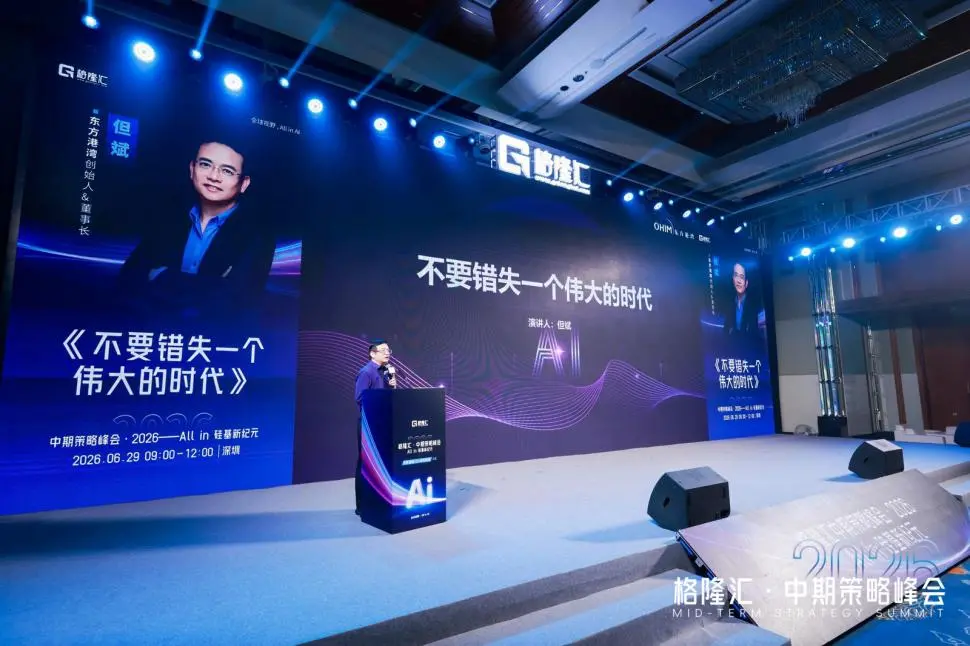
01 From an Industry Cycle Perspective, the Risk of Missing the AI Era is Greater Than the Risk of Worrying About Short-Term Bubbles

Recently, people keep asking: Is there a bubble in AI? What's the short-term view?

Dan Bin's response is: From the perspective of long-term industry development, for market participants, the risk of missing an entire era may be greater than the risk you worry about regarding short-term bubbles. Of course, in the face of short-term volatility and uncertainty, investors also need to make independent judgments based on their own investment horizon and risk tolerance.

Looking back at the 55-year history of Nasdaq from its establishment in 1971 to the present, the core driving force that has truly propelled long-term capital market growth is technological progress, not short-term factors like interest rates or macroeconomic policies.
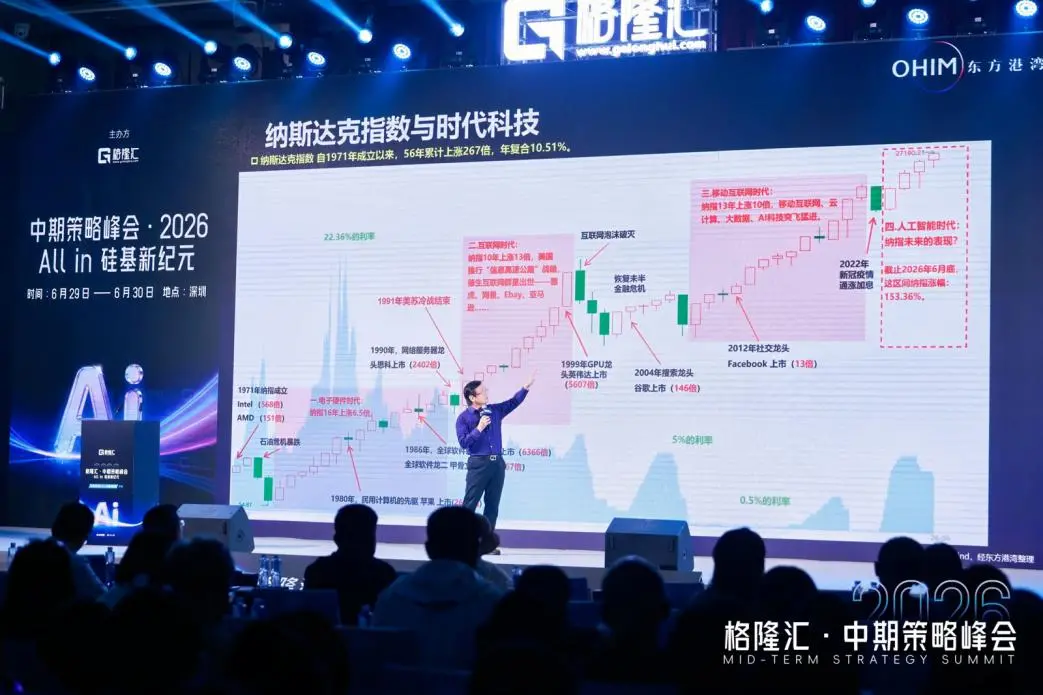
Some worry that a high-interest-rate environment will cause market collapse.

Let's look at history: The US benchmark interest rate once reached as high as 22% in the 1970s, yet the electronic hardware era gained 6.5x over 16 years; the internet era experienced a full interest rate cut-hike cycle and surged for a full 10 years; the same was true for the mobile internet era. Interest rates have never been the primary cause; technological progress is the primary driver.

02 The AI Era is More Disruptive Than the Previous Three Eras; Its Industry Cycle Might Follow the Ten-Year Rhythm of the Internet Era

He further pointed out that at last year's annual meeting, he predicted that 2026 might resemble 1994—forming a cross-star pattern followed by a significant rise. The years '23, '24, and '25 have already seen three years of strong gains, and this year continues to show strong industry momentum.

"Why? Because the AI era is more disruptive than the previous three eras—the electronic era, the internet era, and the mobile internet era."

Dan Bin's basic judgment is: The artificial intelligence era will have a relatively long industry cycle, similar to the internet eraChatGPT was released at the end of 2022. If we reference the historical "ten-year" rhythm of the internet, that point (around 2033) is likely a reference window when risk needs to be examined. Before that, the industry development of AI is unlikely to conclude in just three or four years. However, short-term market fluctuations and local bubbles objectively exist, and investors still need to make rational assessments based on their own situations.

03 The Long-Term Vision of Silicon-Based Life: A Thought Experiment from a Civilizational Perspective

Dan Bin presented two videos, shifting the perspective from capital markets to the dimension of human civilization.

His viewpoint is highly imaginative: Silicon-based life replacing carbon-based life is a highly probable direction. If Earth's civilization is to continue, silicon-based life will likely replace carbon-based life or become the dominant productive force.

He provided a set of vastly different time coordinates:

In 4.1 billion years, the Sun may expand into a red giant and engulf Earth, or it may collapse into a white dwarf.

The Voyager spacecraft has been flying for 77 years and still has about 70,000 light-years to go before leaving the solar system.

In 10 billion years, the Andromeda Galaxy may collide with the Milky Way—by then, humanity must fly out of the Milky Way.

"Carbon-based life cannot fly out of the Milky Way. But silicon-based life—it is a million times smarter than us, thinking and working non-stop 24/7. The revolutionary changes it brings may propel civilization far beyond our understanding."

Dan Bin stated that this is not a short-term investment judgment but provides a framework for thought: The economic growth paradigm brought about by silicon-based intelligence may have infinite possibilities and a longer industry chain. Understanding this helps to transcend immediate distractions and examine long-term trends.

04 Technology Rewrites the Rules of War; Neither China Nor the US Can Afford to Lose the AI Competition

Dan Bin showed a recent example from the Russia-Ukraine battlefield: a Russian soldier was captured by a Ukrainian drone and robot.

"The weaponization of AI is an exponential change, an inevitable process."

He believes that neither China nor the United States can afford to lose this AI race. The US has a first-mover advantage in foundational technology and top talent, while China has formed differentiated competitive strengths in application scenarios, data scale, and industry chain completeness. Both sides are continuously increasing their long-term AI investments.

05 Buffett's "Regret" and Oriental Harbor's Evolution in Cognition

Dan Bin compared the portfolio changes of the "old-timers" in China and the US.

Buffett bought Google in the third quarter of last year and continued to add to the position this year. Google has now entered Berkshire Hathaway's top five holdings.

"Before his passing, Charlie Munger said in an interview that in his era, he should have made $100 billion or even $1 trillion. He had such a close relationship with Bill Gates, yet he only symbolically bought 100 shares of Microsoft. Microsoft rose 7,000 times."

"If he had taken $100 million from Coca-Cola to buy Microsoft, that would have become $700 billion, more than all the money he ever made."

Dan Bin admitted that these historical fragments cannot predict the future, but they remind us that investment requires constantly breaking cognitive boundaries. Oriental Harbor is also iterating and evolving: our company's research team continues to conduct in-depth tracking in AI foundational computing power, storage, and other areas.

06 Settle the Mind, Maintain Perspective, and Rationally Grasp the Chips Endowed by the Era

Dan Bin concluded with a poem he wrote:

"The tide never turns back, the wheel of the era rolls forward silently.

Some are trapped in the immediate noise and details; some stand above the cycles, gazing at the starry river.

Don't dwell on momentary ups and downs, don't blindly follow fleeting trends of heat or cold.

Mountains and rivers are reborn amidst upheavals; opportunities blossom through prolonged perseverance.

Being born in such times is a great fortune itself; don't let hesitation trap your steps, don't let short-sightedness waste the years.

Live well, move forward earnestly, and never miss this magnificent, grand era that belongs to us."


Cryptos en tendance

Questions liées

QAccording to Dan Bin's speech, what is the primary driver of long-term capital market growth, and how does it compare to short-term factors like interest rates?

AAccording to Dan Bin, technological progress is the primary driver of long-term capital market growth. He argues that short-term factors like interest rates, trade wars, or macro policies are secondary influences. Historical examples from the Nasdaq show that markets have experienced significant growth during periods of high interest rates when driven by major technological eras like electronics, the internet, and mobile internet.

QWhat is Dan Bin's perspective on the AI bubble concern? What does he believe is the greater risk?

ADan Bin believes that the risk of missing out on the AI era is far greater than the risk of short-term market bubbles. From an industrial cycle perspective, he argues that fearing short-term泡沫 and staying on the sidelines could mean missing a transformative technological shift. While acknowledging short-term volatility exists, he emphasizes that the potential cost of missing the era outweighs bubble concerns.

QHow does Dan Bin characterize the AI era in comparison to previous technological eras like the internet?

ADan Bin characterizes the AI era as more disruptive than previous technological eras, including the electronics era, the internet era, and the mobile internet era. He suggests it has the potential to be the most transformative period yet.

QWhat is the long-term, civilization-level vision that Dan Bin discusses regarding the future of intelligence?

ADan Bin discusses a long-term vision where silicon-based life (AI/advanced intelligence) may replace or become the dominant form of productivity compared to carbon-based life (humans). He frames this within a cosmic timescale, suggesting that for Earth's civilization to persist and expand beyond the solar system and galaxy, silicon-based intelligence, with its superior capabilities for continuous work and problem-solving, is a probable and necessary evolutionary direction.

QWhat historical investment example does Dan Bin use to illustrate the importance of adapting to new technological paradigms?

ADan Bin uses the example of Warren Buffett and Charlie Munger missing the massive opportunity in Microsoft. He mentions that Munger, despite being close friends with Bill Gates, only bought 100 shares of Microsoft symbolically. Dan Bin calculates that if Berkshire Hathaway had invested just $100 million from Coca-Cola into Microsoft early on, it could have grown to $700 billion—far surpassing many of their other gains—highlighting the cost of not fully embracing a transformative tech shift.

Lectures associées

Anthropic crée un « Code pénal » pour les jailbreaks de l'IA : vos requêtes, quatre manières de mourir

Anthropic, la société derrière l'IA Claude, a dévoilé un système de classification strict nommé CJS (Cyber Jailbreak Severity) pour évaluer et contrer les tentatives de "jailbreak" (contournement des garde-fous) de ses modèles. Ce cadre classe les requêtes des utilisateurs en quatre catégories de risque, des activités malveillantes (bloquées) aux activités bénignes (autorisées). Cependant, sa sensibilité excessive entraîne de nombreux faux positifs, bloquant des demandes légitimes comme du débogage. Le système CJS évalue la gravité d'un jailbreak sur quatre axes : le gain de capacité, l'étendue des capacités, la difficulté de weaponisation et la découvrabilité. Un score total de 0 à 10 détermine la réponse appropriée, de l'ignorance à la désactivation du modèle. Ce cadre vise à fournir une métrique objective, mais soulève des questions car Anthropic, qui développe également des modèles avancés comme Mythos réservés à des partenaires, définit seule les règles. Cette initiative intervient après que le modèle Fable 5 a été temporairement retiré suite à une demande de conformité aux contrôles à l'exportation américains, marquant une extension de ces régulations aux API d'IA. Ainsi, le CJS n'est pas seulement un outil technique ; il sert aussi de référence potentielle pour les décisions réglementaires futures, traçant une ligne floue entre sécurité et restriction de l'innovation, où les utilisateurs doivent constamment adapter leur langage pour éviter des blocages injustifiés.

marsbitIl y a 25 mins

Anthropic crée un « Code pénal » pour les jailbreaks de l'IA : vos requêtes, quatre manières de mourir

marsbitIl y a 25 mins

2,4k étoiles en un clin d'œil : avec une seule commande, l'IA apprend à trouver ses propres compétences

Le projet « skills » de Vercel, une sorte de gestionnaire de paquets « npm » pour les agents d'IA, connaît un succès fulgurant avec 24 000 étoiles sur GitHub. Il permet aux développeurs d'ajouter des compétences (skills) à leurs assistants IA (comme Claude Code, Cursor) via une simple commande : `npx skills add <package>`. Ces paquets encapsulent des connaissances spécifiques (bonnes pratiques React, conventions d'équipe) dans un dossier contenant un fichier SKILL.md et éventuellement des scripts. La plateforme skills.sh propose un répertoire et un classement des paquets les plus populaires, comme « find-skills » (2,3 millions d'installations). Cette « compétence » permet à l'IA de rechercher et d'installer automatiquement d'autres skills pertinents en fonction d'une demande utilisateur, agissant comme un moteur de recherche de capacités. Cependant, cette commodité s'accompagne de risques de sécurité majeurs. Des audits (comme celui de Snyk « ToxicSkills ») révèlent qu'une part significative des skills tiers contient des vulnérabilités ou des charges malveillantes, pouvant conduire à des injections de prompt, des fuites de clés ou l'exécution de code arbitraire. Contrairement à npm, les skills mélangent instructions, code et accès système, amplifiant les menaces. En somme, Vercel réplique dans l'ère de l'IA sa stratégie réussie avec Next.js : simplifier et standardiser des flux complexes en une commande. Mais l'écosystème naissant des compétences d'IA hérite aussi des pièges classiques des gestionnaires de paquets, nécessitant une vigilance accrue quant à la source et aux permissions des paquets installés.

marsbitIl y a 30 mins

2,4k étoiles en un clin d'œil : avec une seule commande, l'IA apprend à trouver ses propres compétences

marsbitIl y a 30 mins

Le développeur Claude livre enfin « Fable 5 Fén Jué » pour vous apprendre à briser le déficit d'information avec le modèle

Fable 5, depuis son lancement, a connu un parcours tumultueux, passant des attentes élevées à une interdiction par le gouvernement américain. Aujourd’hui, l’accent est remis sur la productivité. Thariq Shihipar, ingénieur chez Claude Code, a publié un guide détaillé pour utiliser efficacement Fable 5. Le cœur du problème : l’écart d’information entre l’utilisateur et le modèle. Thariq appelle cela les « inconnues » – la différence entre les instructions données (la « carte ») et la réalité de la tâche (le « territoire »). La qualité du travail dépend de notre capacité à réduire ces inconnues. Il identifie quatre types d’inconnues : - Les **connues connues** : ce que nous spécifions clairement. - Les **connues inconnues** : ce que nous savons ne pas savoir. - Les **inconnues connues** : ce qui est évident pour nous mais pas explicité. - Les **inconnues inconnues** : ce que nous ignorons totalement. Le guide propose des méthodes pour les découvrir à chaque étape : **Avant l’implémentation** : - **Scan des angles morts** : Demander à Claude d’identifier les « inconnues inconnues ». - **Brainstorming et prototypage** : Explorer des idées visuelles ou fonctionnelles pour clarifier les attentes. - **Contre-interrogatoire** : Laisser Claude poser des questions pour éliminer les ambiguïtés. - **Références** : Fournir du code ou des exemples concrets comme modèles. - **Plan d’implémentation** : Faire rédiger un plan par Claude pour valider l’approche. **Pendant l’implémentation** : - **Notes d’implémentation** : Maintenir un fichier pour documenter les décisions et écarts. **Après l’implémentation** : - **Documentation explicative** : Créer un résumé clair pour faciliter les revues et l’approbation. - **Test de compréhension** : Se faire interroger par Claude pour s’assurer de maîtriser les changements. Thariq illustre cette approche avec la création de la vidéo de lancement de Fable, entièrement éditée par Claude Code. Il a dû découvrir ses « inconnues » en matière de montage et d’étalonnage pour guider efficacement le modèle. En conclusion, plus le modèle est puissant, plus une méthode structurée pour identifier et réduire les inconnues devient cruciale. Chaque prototype, brainstorming ou question est une opportunité d’aligner la « carte » et le « territoire » avant de s’engager profondément dans la réalisation.

marsbitIl y a 34 mins

Le développeur Claude livre enfin « Fable 5 Fén Jué » pour vous apprendre à briser le déficit d'information avec le modèle

marsbitIl y a 34 mins

Les tokens dévorent 30% des salaires, la facture IA de la Silicon Valley devient incontrôlable

Les coûts liés aux jetons (tokens) d'IA, représentant désormais 30 % de la masse salariale chez certains acteurs comme SemiAnalysis, illustrent la transformation radicale de la productivité dans les services spécialisés. Si cette dépense achète une efficacité plusieurs fois supérieure au travail humain pour des tâches comme l'analyse de données, d'autres géants technologiques comme Uber ou Microsoft font face à des factures d'IA explosives et à un retour sur investissement encore incertain. Le paradoxe actuel est frappant : les investissements en IA explosent (7400 milliards de dollars en 2024), tandis que les réductions de coûts se poursuivent. Pourtant, l'impact économique mesurable reste limité. La thèse centrale de l'article est que cette phase de construction d'infrastructure précède toujours l'arrivée des bénéfices. L'optimisme repose sur une baisse structurelle des coûts. Grâce aux progrès matériels (ex: GB300 NVL72, +32x de débit) et logiciels (optimisations logicielles multipliant les performances par 14), le prix réel du traitement des jetons s'effondre. Chez SemiAnalysis, un coût affiché de 5$/million de tokens est ramené à 0.99$ grâce à un cache efficace et un ratio entrée/sortie favorable. Cette déflation devrait se poursuivre, rendant l'IA de plus en plus accessible. Le choix pour les entreprises est désormais clair : adopter dès maintenant ces outils pour gagner un avantage concurrentiel décisif, ou attendre et risquer de prendre un retard considérable.

marsbitIl y a 35 mins

Les tokens dévorent 30% des salaires, la facture IA de la Silicon Valley devient incontrôlable

marsbitIl y a 35 mins

Trading

Spot

Articles tendance

Comment acheter ERA

Bienvenue sur HTX.com ! Nous vous permettons d'acheter Caldera (ERA) de manière simple et pratique. Suivez notre guide étape par étape pour commencer votre parcours crypto.Étape 1 : Création de votre compte HTXUtilisez votre adresse e-mail ou votre numéro de téléphone pour ouvrir un compte sur HTX gratuitement. L'inscription se fait en toute simplicité et débloque toutes les fonctionnalités.Créer mon compteÉtape 2 : Choix du mode de paiement (rubrique Acheter des cryptosCarte de crédit/débit : utilisez votre carte Visa ou Mastercard pour acheter instantanément Caldera (ERA).Solde :utilisez les fonds du solde de votre compte HTX pour trader en toute simplicité.Prestataire tiers :pour accroître la commodité d'utilisation, nous avons ajouté des modes de paiement populaires tels que Google Pay et Apple Pay.P2P :tradez directement avec d'autres utilisateurs sur HTX.OTC (de gré à gré) : nous offrons des services personnalisés et des taux de change compétitifs aux traders.Étape 3 : stockage de vos Caldera (ERA)Après avoir acheté vos Caldera (ERA), stockez-les sur votre compte HTX. Vous pouvez également les envoyer ailleurs via un transfert sur la blockchain ou les utiliser pour trader d'autres cryptos.Étape 4 : tradez des Caldera (ERA)Tradez facilement Caldera (ERA) sur le marché Spot de HTX. Il vous suffit d'accéder à votre compte, de sélectionner la paire de trading, d'exécuter vos trades et de les suivre en temps réel. Nous offrons une expérience conviviale aux débutants comme aux traders chevronnés.

640 vues totalesPublié le 2025.07.17Mis à jour le 2026.06.02

Comment acheter ERA

Discussions

Bienvenue dans la Communauté HTX. Ici, vous pouvez vous tenir informé(e) des derniers développements de la plateforme et accéder à des analyses de marché professionnelles. Les opinions des utilisateurs sur le prix de ERA (ERA) sont présentées ci-dessous.

活动图片