AI Billing Black Box Exposed: 1.7 Million Overcharged, Anthropic Refunds But Doesn’t Admit Fault

marsbitPublié le 2026-06-29Dernière mise à jour le 2026-06-29

Résumé

A startup named Vaudit, founded by former Oracle director Michael Hahn, audits AI bills for companies and claims to have identified approximately $1.7 million in overcharges across 60 businesses, totaling $34 million in reviewed bills. The alleged discrepancies primarily involve charges for Anthropic's Claude Code. Common issues cited include billing for newer, more expensive models when older, cheaper ones were used; charging for failed or errored requests; and "retry storms" where AI agents silently retry failed tasks, accumulating costs unnoticed. Major clients like Panasonic, HP, and Honda were among those audited. While Vaudit reports that around 80% of the disputed charges were refunded by providers like Amazon, Google, Microsoft, Anthropic, and OpenAI after申诉, the AI companies largely deny systemic problems. Anthropic stated overcharges do not appear widespread and it does not bill for uncompleted requests or errors, while OpenAI said it found no evidence of such issues affecting its customers. The situation highlights the inherent opacity and complexity of AI billing, which is based on token usage that is difficult to track and predict, especially with multi-agent, multi-model workflows. This complexity is creating a new market for third-party AI bill auditing services like Vaudit, which charges fees based on recovered amounts. Separately, Anthropic faces a proposed class-action lawsuit alleging its high-tier subscription plans deliver far less usage than advertis...

A former Oracle director named Michael Hahn has recently started a business exposing fake AI bills.

His company, Vaudit, examined AI bills totaling approximately $34 million from 60 companies, primarily for the use of Claude Code, and identified about $1.7 million in overcharges.
The Information reported: The auditing firm Vaudit stated that it identified about $1.7 million in suspected overcharges in the corporate AI bills it handled, mainly involving Claude Code.

The audited client list included major corporations such as Panasonic, HP, and Honda.

But if you ask the two AI giants on the other side of the bills, you get a different version.

Anthropic says it does not charge for unfulfilled requests or errors, nor does it secretly route requests to older models, and overcharging does not appear to be a widespread phenomenon.

OpenAI is more direct: there is no evidence that these issues occurred with its customers.

Both sides claim there is no problem.

However, after rounds of appeals by Vaudit and its clients, about 80% of these disputed amounts were ultimately refunded by Amazon, Google, Microsoft, Anthropic, and OpenAI.

Hahn says these companies were very cooperative when issues arose, agreeing to refund the money but refusing to admit any mistake.

Thus, the situation becomes strange: the auditing firm points to the ledger saying "I found it," about 80% of the overcharges were refunded, yet the model vendors collectively shrug and say "nothing happened."

If everyone claims there's no mistake, how did these refunds come about?

How Did This 1.7 Million Become "Excess"?

First, let's see what Vaudit uncovered.

Michael listed three of the most common overcharging methods, each hidden in inconspicuous corners of the bill where no one would normally check line by line.

The first: model misassignment.

The client actually called an older, cheaper model, but the bill was calculated based on a newer, more expensive tier.

For example, you bought an economy-class seat but were charged a first-class price. It's unnoticeable once or twice, but after millions of calls, the price difference becomes apparent.

The second: paying for failure.

An agent or chatbot that fails to complete a request, or even directly returns an error, is still included in the bill.

The third is the most insidious. Hahn calls it a "retry storm." An agent task fails, and it silently retries repeatedly in the background. The user has no idea money is being burned in the background, and the costs stack up layer by layer.

None of these three are caused by the user "actively using more."

The third one is the most frightening.

In the past, when you used software, you monitored it step by step, and could immediately stop it if it went haywire.

But the selling point of AI agents is precisely "let it work on its own," with the human stepping out of the process.

This means that when an AI agent hits a wall, retries, hits another wall, and burns tokens like crazy in the background, the person who would normally call a stop doesn't know about it, and the bill doesn't arrive until the end of the month.

Anthropic, OpenAI: We Didn't Overcharge

The point of this matter is not "who cheated whom."

Vaudit found it, but Anthropic and OpenAI didn't admit it. This is just the auditing firm's version. One cannot simply label the two companies as overchargers based on the phrase "found 1.7 million."

But they did cooperate when it came to refunds. The fact that 80% was refunded at once precisely shows that this 80% shouldn't have been charged in the first place.

Refunds are error corrections. The money is back, but the account is still a mess.

The reason for this "refund without admission" stalemate lies in the inherent algorithm of the AI billing business itself.

Why AI Bills Are Inherently Incomprehensible

The problem might not be "miscalculation," but "inherently impossible to calculate clearly."

Because it charges based on token usage—the more you use, the more you pay; the more complex the usage, the more you pay. Yet tokens are essentially invisible in the infrastructure dashboards you commonly use.

What's more troublesome is that it can fluctuate wildly. Asking the same question, depending on which model is used, how the prompt is written, and how the agent is orchestrated, the tokens burned can differ by orders of magnitude.

The more models move towards being "agentic," the more tokens they consume. An agent running a task for you could involve dozens or even hundreds of model calls in the background, each burning money.

Inherently unpredictable and hard to explain—this is how the ambiguous zone of "overcharging" emerges.

Hahn's words hit the nail on the head: AI bills are becoming increasingly opaque. This statement precisely hits the soft spot of the entire industry.

AI has evolved from the earliest "per-call billing" to today's "multi-model + multi-agent + cloud intermediary," stretching the billing chain longer and longer: the model vendor charges once, the cloud vendor charges once, and the SDK agent in the middle adds another layer.

Each layer looks reasonable on its own, but when the three are stacked together, it's hard to see at a glance where the money was actually spent.

What's even more critical is that money is often not burned where you can see it.

The scenarios that truly eat up the bill are almost all hidden in the background, and each one has publicly available GitHub issues or incident reports that can be checked.
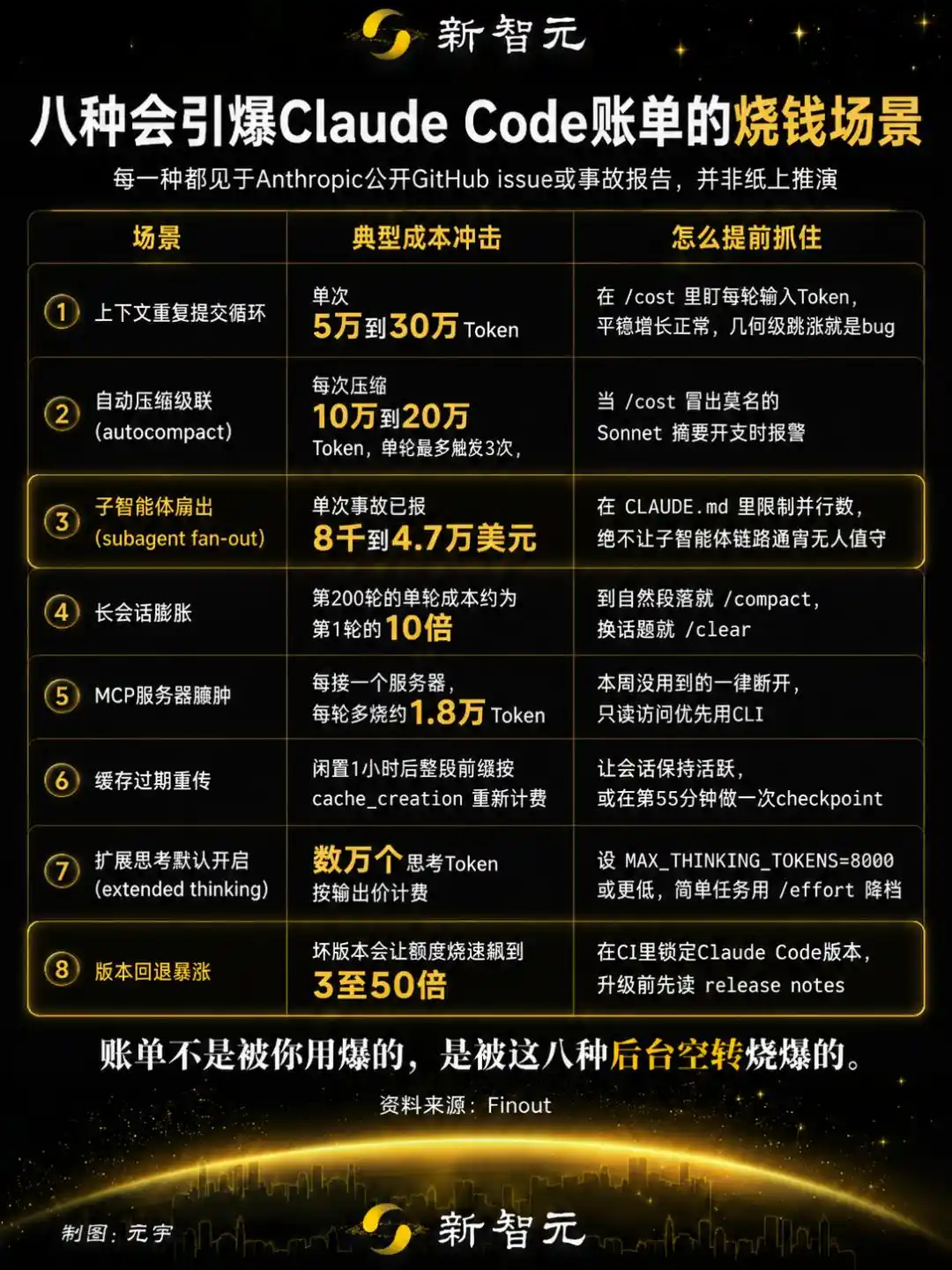
After looking at these eight scenarios, you'll find that either the context is repeatedly retransmitted, or sub-agents run idly overnight with no one watching, and the bill just grows larger and larger on its own, out of sight.

$200 Subscription, $50,000 Bill

This is not the first time Anthropic has faced challenges with AI billing.

On June 15, a client from Washington D.C., Karl Kahn, sued Anthropic in federal court, accusing it of failing to deliver on high-priced subscriptions.
According to The Wall Street Journal, Anthropic's Max 5x costs $100 per month, and Max 20x costs $200 per month. The advertised selling point was 5 times and 20 times the usage limits of the Pro plan, respectively.

But Kahn says the actual usable amount is far lower than advertised.

He upgraded to Max 20x in April this year, but within weeks, he hit the weekly usage ceiling. One 5-hour sprint directly burned through 15% of his weekly quota.

He was left with only three options: stop work, use sparingly, or pay more for additional purchases.

The basis of this lawsuit is primarily a batch of emails sent by Anthropic in July 2025 to subscribers of different tiers, which specified the approximate weekly usage for each tier.

The plaintiff used these black-and-white emails to compare against the actual quotas received, concluding they were "far below the advertised amount."

The lawsuit seeks class-action status, covering all individuals who purchased these two tiers since April 2025.

Finding Errors in AI Bills Is Becoming a Business

Vaudit, which "exposes" AI bills, was founded in 2023 and has a team of about 30 people.

Founder Hahn is a former Oracle director. His old trade was auditing bills for logistics, transportation, advertising, and cloud services—essentially, he specialized in helping people "check accounts and save money."

Earlier this year, he applied this skill directly to AI bills.
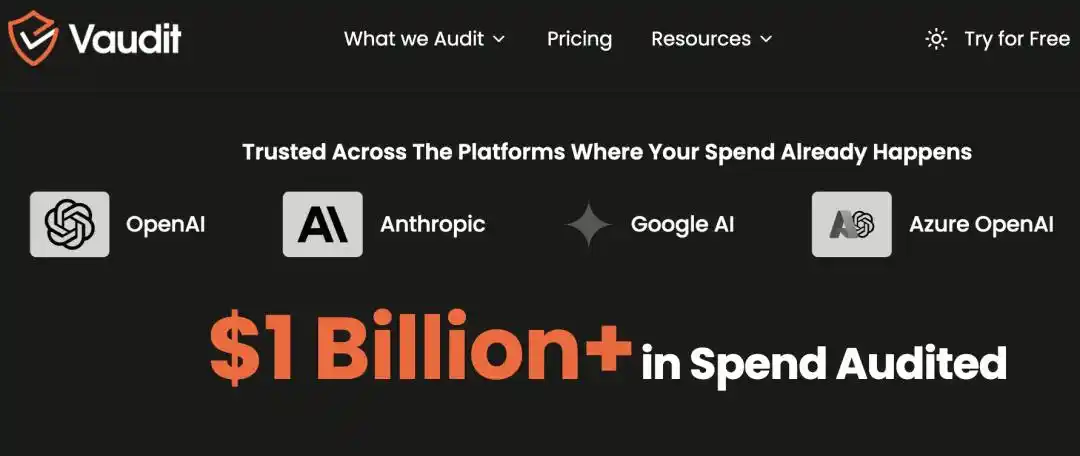
Vaudit's website states that it monitors and recovers every penny of your AI spending, having audited over $1 billion to date.

Vaudit's method is straightforward:

Clients install a piece of software into their AI environment, typically via a Software Development Kit (SDK), which quietly captures raw data on AI usage. This data is then compared line by line with invoices and bills. If they don't match, Vaudit files appeals on the client's behalf.

The fee structure is also direct: 1% of the audited amount, plus 30% of the recovered money. The more they recover for you, the more they earn themselves.

The fact that specializing in finding errors in AI bills can become a business in itself shows: AI billing has become so complex that hiring a "third-party auditor" is now necessary.

And all of this happens at a微妙 (subtle) point in time.

Both Anthropic and OpenAI are sprinting toward IPOs, rushing to pack new features for customers. On one side is the狂奔 (galloping) valuation and revenue, and on the other side are paying users frowning at incomprehensible bills.

Thus, a completely new profession has emerged: the "bill tax accountant" of the AI era.

And who has calculated that AI bill in your hand?

References:

https://www.theinformation.com/newsletters/applied-ai/anthropic-customers-find-errant-charges-auditing-startup-says?rc=epv9gi

This article is from the WeChat public account "New Zhiyuan," author: ASI Apocalypse.

Cryptos en tendance

Lectures associées

À l'ère de l'IA, que reste-t-il au Bitcoin ?

La chute récente du Bitcoin sous les 60 000 dollars relance la réflexion sur sa valeur à l'ère de l'IA. Alors que l'intelligence artificielle réduit à presque zéro le coût de production de l'information et génère des contenus (textes, images, vidéos) de plus en plus réalistes, un nouveau défi émerge : la crise de la véracité. Dans ce contexte de prolifération où le vrai et le faux sont indissociables, ce qui devient précieux n'est plus l'abondance de contenus, mais la capacité à vérifier leur authenticité, la "vérifiabilité". C'est ici que la perspective sur le Bitcoin se renverse. Souvent critiqué pour sa consommation énergétique élevée, il n'est peut-être pas simplement une machine à créer de la monnaie numérique. Son mécanisme de preuve de travail (minage) brûle de l'énergie non pas pour accélérer les calculs, mais pour rendre extrêmement coûteuse toute tentative de falsification de son registre historique, la blockchain. Ainsi, le Bitcoin produit de la "vérifiabilité". Il ne requiert pas la confiance en une institution centrale (banque, plateforme), mais permet à chacun de vérifier mathématiquement l'intégrité du grand livre des transactions. Une analogie historique éclaire cette complémentarité potentielle : à la Renaissance, l'imprimerie de Gutenberg a drastiquement réduit le coût de reproduction des connaissances, tandis que la comptabilité en partie double a structuré et fiabilisé les échanges commerciaux. Aujourd'hui, l'IA jouerait le rôle de la nouvelle presse à imprimer, inondant le monde de contenus. La blockchain, dont le Bitcoin est la première incarnation, pourrait être l'équivalent moderne de la comptabilité en partie double – un système fondamental pour l'enregistrement et la vérification indépendante dans l'univers numérique, notamment pour les actifs et leur historique. Par conséquent, l'IA et la blockchain ne seraient pas en compétition, mais plutôt les deux faces d'une même pièce : l'une abaisse le coût de la création et de la génération, l'autre le coût de la vérification et de la preuve. Dans un monde où l'IA peut tout générer, la rareté ultime pourrait bien résider non pas dans plus de contenus, mais dans plus de faits indépendamment vérifiables. Le Bitcoin, en tant que "machine à produire de la vérifiabilité", trouve peut-être ainsi une nouvelle raison d'être, au-delà des spéculations sur son prix.

链捕手Il y a 45 mins

À l'ère de l'IA, que reste-t-il au Bitcoin ?

链捕手Il y a 45 mins

Le label 'chaîne fantôme' de Cardano démystifié ? Pourquoi les 34 dApps d'ADA ne racontent pas toute l'histoire

L'article traite de l'étiquette de "chaîne fantôme" parfois attribuée à Cardano (ADA) en raison de son activité on-chain et de son nombre d'applications décentralisées (dApps) nettement inférieurs à ceux de ses principaux concurrents comme Ethereum et Solana. L'auteur définit d'abord une "chaîne fantôme" comme une blockchain techniquement opérationnelle mais avec très peu d'activité et de développement. Il passe ensuite en revue les forces des principales blockchains de couche 1 : Ethereum pour la DeFi, XRP pour les règlements transfrontaliers, Solana pour le débit, Tron pour les transferts USDT et Bitcoin comme réserve de valeur. Concernant Cardano, l'article reconnaît des signes de faiblesse : la fermeture de l'explorateur TapTools, des avertissements sur la possible disparition de projets et seulement 34 dApps. Cependant, il souligne que son activité de développement reste forte. L'explication principale avancée pour justifier le faible nombre de transactions et d'utilisateurs actifs est le modèle technique unique de Cardano, l'EUTXO (Extended Unspent Transaction Output), qui regroupe (batch) les transactions. Cette fonctionnalité, bien qu'avantageuse pour la sécurité et la détermination, sous-estime l'activité réelle sur la chaîne. La conclusion est que si Cardano affiche des métriques d'activité bien inférieures, son modèle technique spécifique et son approche méthodique axée sur la sécurité et la durabilité l'empêchent d'être simplement catalogué comme une "chaîne fantôme". Chaque blockchain sacrifie certains aspects du trilemme (décentralisation, sécurité, évolutivité) pour se spécialiser dans un créneau.

ambcryptoIl y a 1 h

Le label 'chaîne fantôme' de Cardano démystifié ? Pourquoi les 34 dApps d'ADA ne racontent pas toute l'histoire

ambcryptoIl y a 1 h

UK FCA dévoile son livre de règles pour les cryptomonnaies : Approche basée sur les risques débutant en octobre 2027

Le régulateur financier britannique (FCA) a dévoilé un nouveau cadre réglementaire pour le secteur de la cryptomonnaie, qui entrera en vigueur en octobre 2027. Plutôt qu’une approche uniforme, cette réglementation adopte une méthode basée sur les risques : les entreprises devront détenir des capitaux proportionnés à leur exposition au risque et réaliser leurs propres tests de résistance annuels. Les petites structures et celles présentant moins de risques bénéficieront d’obligations de déclaration allégées pour réduire leurs coûts de conformité. La FCA supervisera les évaluations des entreprises sans imposer de règles identiques à toutes, dans le but de renforcer la confiance sur le marché et d’attirer 3 à 4 millions d’utilisateurs supplémentaires au Royaume-Uni. Concernant les stablecoins, le cadre maintient des protections pour les consommateurs – comme la détention des réserves sous un trust légal – tout en assouplissant certaines exigences. Les émetteurs jugés systémiques pourraient toutefois faire face à une surveillance renforcée. Cette initiative vise à offrir une clarté réglementaire tout en tenant compte des spécificités du secteur, bien que certains acteurs alertent sur les risques d’appliquer des règles conçues pour la finance traditionnelle à des infrastructures décentralisées.

ambcryptoIl y a 3 h

UK FCA dévoile son livre de règles pour les cryptomonnaies : Approche basée sur les risques débutant en octobre 2027

ambcryptoIl y a 3 h

Trading

Spot

Articles tendance

Comment acheter T

Bienvenue sur HTX.com ! Nous vous permettons d'acheter Threshold Network Token (T) de manière simple et pratique. Suivez notre guide étape par étape pour commencer votre parcours crypto.Étape 1 : Création de votre compte HTXUtilisez votre adresse e-mail ou votre numéro de téléphone pour ouvrir un compte sur HTX gratuitement. L'inscription se fait en toute simplicité et débloque toutes les fonctionnalités.Créer mon compteÉtape 2 : Choix du mode de paiement (rubrique Acheter des cryptosCarte de crédit/débit : utilisez votre carte Visa ou Mastercard pour acheter instantanément Threshold Network Token (T).Solde :utilisez les fonds du solde de votre compte HTX pour trader en toute simplicité.Prestataire tiers :pour accroître la commodité d'utilisation, nous avons ajouté des modes de paiement populaires tels que Google Pay et Apple Pay.P2P :tradez directement avec d'autres utilisateurs sur HTX.OTC (de gré à gré) : nous offrons des services personnalisés et des taux de change compétitifs aux traders.Étape 3 : stockage de vos Threshold Network Token (T)Après avoir acheté vos Threshold Network Token (T), stockez-les sur votre compte HTX. Vous pouvez également les envoyer ailleurs via un transfert sur la blockchain ou les utiliser pour trader d'autres cryptos.Étape 4 : tradez des Threshold Network Token (T)Tradez facilement Threshold Network Token (T) sur le marché Spot de HTX. Il vous suffit d'accéder à votre compte, de sélectionner la paire de trading, d'exécuter vos trades et de les suivre en temps réel. Nous offrons une expérience conviviale aux débutants comme aux traders chevronnés.

572 vues totalesPublié le 2024.12.10Mis à jour le 2026.06.02

Comment acheter T

Discussions

Bienvenue dans la Communauté HTX. Ici, vous pouvez vous tenir informé(e) des derniers développements de la plateforme et accéder à des analyses de marché professionnelles. Les opinions des utilisateurs sur le prix de T (T) sont présentées ci-dessous.

活动图片