Behind the AI Report Card, Lies a Chinese 'Exam Setter'

marsbitPublié le 2026-06-20Dernière mise à jour le 2026-06-20

Résumé

Beyond the familiar performance charts like MMLU-Pro and MMMU, which major AI models strive to ace, stands a key "examiner": Chinese-Canadian researcher Wenhu Chen. An assistant professor at the University of Waterloo and founder of TIGERLab, Chen addresses the crucial need for more rigorous AI evaluation. As models like GPT-4 began scoring near-perfect results on older benchmarks like MMLU, it became difficult to distinguish their true capabilities. In response, Chen introduced MMLU-Pro in 2024, featuring harder, more reasoning-focused questions with more answer choices, successfully reintroducing meaningful performance gaps. His work extends to multi-modal evaluation with MMMU and its enhanced version, MMMU-Pro. These benchmarks test a model's ability to understand and reason with complex information from images, charts, and text across diverse academic subjects, exposing the significant challenges even top models face in genuine comprehension. Chen's background in complex QA, table reasoning, and his experience at Google DeepMind on projects like Gemini inform his approach. He understands that effective benchmarks must anticipate how models might "cheat" by memorizing data or avoiding visual analysis. His lab also actively researches video understanding and generation models (e.g., UniVideo, Vamba), ensuring his evaluation work is grounded in practical model-building challenges. Now at Meta's Super Intelligence Lab, Chen continues his focus on multi-modal data and evalua...

Each time a cutting-edge model is released, the AI community focuses on a few familiar report cards.

MMLU-Pro, MMMU, MMMU-Pro... These names might sound foreign to ordinary users, but for model companies and researchers, they have almost become the "standard subjects." GPT, Claude, Gemini, Llama, Qwen, DeepSeek continuously submit their answers on these benchmarks.

"The proof is in the pudding." How good a model is often needs to be proven by these scores.
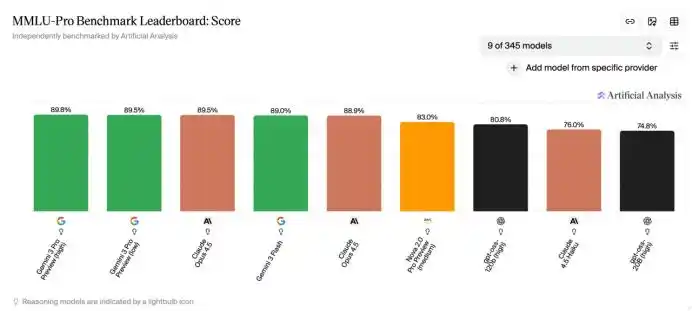
Many performance comparison charts in model launch presentations rely on them; some leaderboards on HuggingFace are also built upon these evaluation systems. It could even be said that today, when the AI industry discusses model capabilities, they are already using a common language defined by these benchmarks.

But interestingly, almost everyone focuses on the scores, yet few know who sets the questions. Behind MMLU-Pro, MMMU, and MMMU-Pro, the same name can be seen—Wenhu Chen.
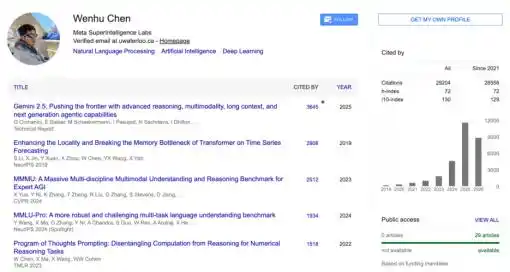
He is an Assistant Professor in the Department of Computer Science at the University of Waterloo in Canada. On Google Scholar, his papers have been cited over 30,000 times.

He is also the founder of TIGERLab. The English full name of this lab is Text and Image GEnerative Research Lab. Because the Chinese word for "tiger" is in his name, Wenhu Chen gave it a very distinctive Chinese name—Hutou Bang (Tiger Head Gang).

01

After the Old Exam Papers Lost Their Effectiveness

Wenhu Chen first caught wider attention because of MMLU-Pro.

MMLU was once one of the most commonly used benchmark evaluations for assessing the capabilities of large language models. It was like a comprehensive test paper, covering multiple subjects, used to measure a model's performance in knowledge understanding and reasoning tasks.

Early on, this paper was very useful. It could distinguish between models through scores, and the industry could also use it to observe whether large language models were truly improving.

But problems soon emerged.

As model capabilities continuously improved, MMLU gradually became "insufficiently challenging." The scores of cutting-edge models got higher and higher, and the gaps between them became smaller and smaller.
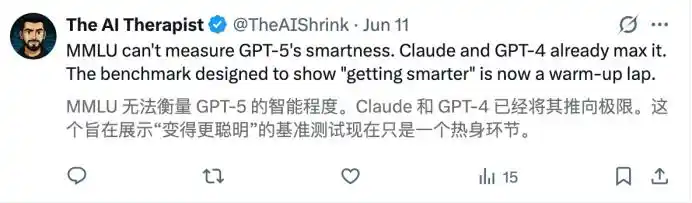
After OpenAI released o3, this problem became even more apparent. The accuracy of o3 on MMLU was already close to 100%, and other cutting-edge models also successively submitted scores approaching full marks.

This might sound like good news, but for evaluation, it actually meant trouble.

If everyone can get close to full marks on an exam paper, it becomes very difficult to continue judging who is stronger and where their strengths lie. It can still prove that models possess certain capabilities, but it is no longer suitable for measuring new progress.

The AI industry needed a harder, less easily "fooled" exam paper.

In 2024, Wenhu Chen and his team launched MMLU-Pro.

MMLU-Pro revamped this exam paper rather than simply expanding the question bank.
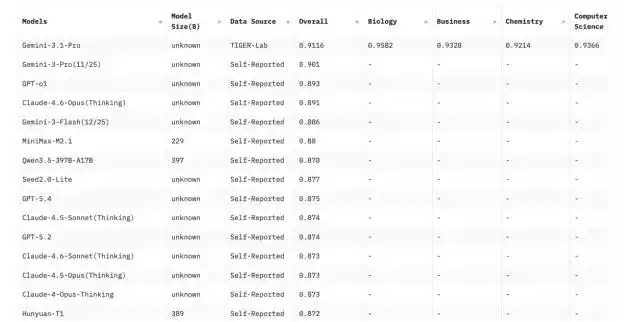
It contains 12,032 questions, covering 14 fields including mathematics, physics, chemistry, law, engineering, psychology, and health. Compared to the original MMLU, it expands the options from 4 to 10, reducing the probability of models guessing correctly. It also incorporates more reasoning-oriented questions and cleans up the original question bank of questions that were relatively simple, ambiguous, or lacked sufficient discriminative power.

The effect was direct.

The paper's results showed that model accuracy on MMLU-Pro decreased by 16% to 33% compared to the original MMLU. When the same model was tested under 24 different prompt styles, the score variation also decreased from 4% to 5% in the original MMLU to about 2%.

In other words, this new paper is not only harder but also more stable.

It reopened the gaps between models that all seemed excellent on the old exam paper. It also became easier to tell whether a model truly understands reasoning or is just better at handling old-style questions.

02

Usable Benchmark Evaluations

MMLU-Pro was quickly adopted by the industry.

MMLU-Pro later entered the NeurIPS 2024 Datasets and Benchmarks track and was also integrated into EleutherAI's lm-evaluation-harness framework. For the open-source model community, this meant it was no longer just a dataset in a paper but had entered the common evaluation toolchain.

Many models began reporting MMLU-Pro scores upon release. Some leaderboards on HuggingFace also incorporated it into their evaluation systems.

If MMLU-Pro solved the problem of the "old exam paper losing effectiveness" in language model evaluation, then MMMU pushed Wenhu Chen and TIGERLab to the center of multimodal evaluation.

The problems with multimodal models are more complex.

Language models answer questions, mainly processing text. Multimodal models, however, have to simultaneously process information in different forms like images, charts, diagrams, maps, tables, musical scores, chemical structures, etc. They not only need to understand the question stem but also truly comprehend the content in the images, and reason by integrating visual information, textual information, and domain knowledge.

The MMMU benchmark contains 11,500 multimodal questions sourced from university exams, quizzes, and textbooks, covering six major domains: Arts & Design, Business, Science, Health & Medicine, Humanities & Social Science, and Technology & Engineering, further subdivided into 30 subjects and 183 subfields.

These questions are not simply asking the model "what's in the picture." They require the model to combine image information with domain knowledge, much like a student tackling a professional problem.

When MMMU was released, the research team tested 14 open-source multimodal models, as well as representative closed-source models like GPT-4V and Gemini Ultra. Even the strongest closed-source models at the time, GPT-4V and Gemini Ultra, only achieved accuracy rates of 56% and 59% respectively.

These numbers indicate that while multimodal models appear to be progressing rapidly, they still have significant room for improvement when it comes to problems requiring genuine professional understanding and reasoning.

Later, Wenhu Chen's team released MMMU-Pro, further plugging the gaps that allowed models to bypass visual information. It filters out questions that could be answered by text-only models, expands answer choices, and introduces a vision-only setting where questions are embedded within images, requiring the model to perform both visual reading and text comprehension simultaneously.

Simply put, it prevents the model from "guessing the answer just by looking at the text."

This kind of work might sound somewhat tedious, but it is crucial. Because future multimodal models need to enter scenarios like healthcare, education, scientific research, design, and engineering; merely being able to describe a picture is not enough. They must be able to judge, reason, explain, and find the truly useful parts within complex visual information.

03

The People Behind the "Exam Papers"

Wenhu Chen's later work on MMLU-Pro and MMMU stems from his long-standing research direction.
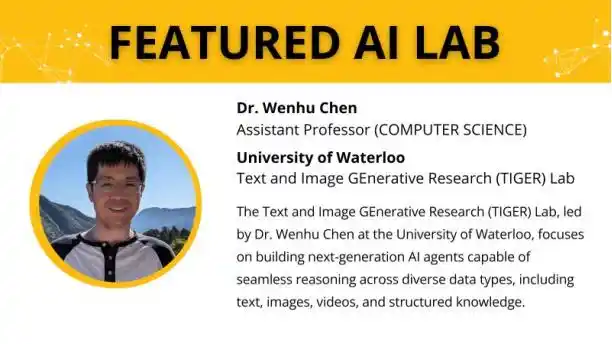
His research interests have always been related to complex information understanding, knowledge question answering, and reasoning.

He earned his bachelor's degree from Huazhong University of Science and Technology, then pursued a master's at RWTH Aachen University in Germany, followed by a Ph.D. in Computer Science from the University of California, Santa Barbara. During his Ph.D., he had already begun research in areas like complex question answering, table reasoning, and knowledge evidence localization.

These tasks share a common characteristic: the answer often does not lie within a single piece of text.

It might be hidden in a table, require combining a piece of text and an image, or might need the model to first retrieve information, then integrate, calculate, and reason. The model cannot just be good at reciting existing knowledge.

Projects Wenhu Chen participated in, such as HybridQA, TabFact, Program of Thoughts, and MAmmoTH, are all related to this line of work.

This also explains his sensitivity to loopholes in model evaluation.

A good benchmark evaluation is not simply about making questions increasingly difficult, but about anticipating where models are most likely to "guess correctly" or "appear competent."

A model might memorize the question bank, guess answers based on options, or use text to bypass visual information... Good evaluation needs to patch these loopholes well.

After his Ph.D., Wenhu Chen joined Google Research and later participated in the development and evaluation of Google DeepMind's Gemini multimodal model from 2021 to 2025. This experience was also important. Long-term exposure to cutting-edge model development gave him a clearer understanding of how model capabilities grow and made it easier to see potential biases and blind spots in evaluation.

In the fall of 2022, Wenhu Chen joined the David R. Cheriton School of Computer Science at the University of Waterloo as an Assistant Professor. The same year, he was selected as a Canada CIFAR AI Chair. Subsequently, he founded "TIGERLab" (aka Hutou Bang), continuing research focused on foundation models, multimodal capabilities, and benchmark evaluations.
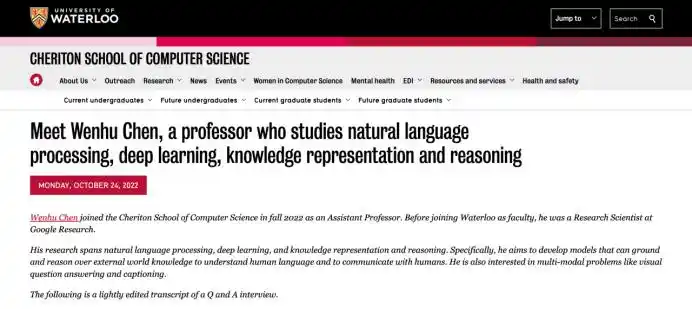
Hutou Bang doesn't just work on benchmark evaluations; they also conduct model and system research.

In the video direction, UniVideo attempts to place video understanding, generation, and editing within the same framework, allowing the model not only to generate a sequence of frames but also to understand content, respond to instructions, and complete edits. Vamba targets long video understanding, addressing the memory, computation, and training efficiency challenges posed by hour-long videos. MoCha, a collaboration with Meta's Generative AI team, focuses on talking virtual character generation, producing high-quality character videos from voice and text descriptions.
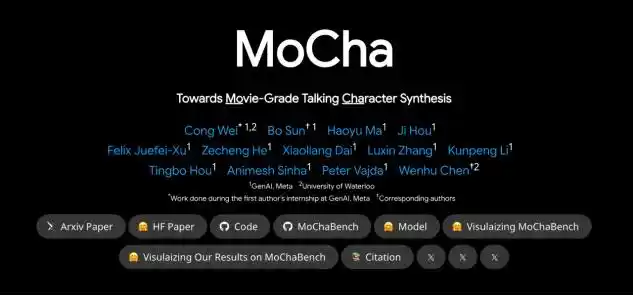
An exam setter who never takes tests themselves cannot set good questions. Building models themselves, in turn, makes them more suitable for evaluation.

Because truly good evaluation often comes from an understanding of model capability boundaries. Only by knowing how models are built and what problems they encounter in real tasks can one more easily design questions that can differentiate performance and expose weaknesses.

Now, Wenhu Chen has joined Meta's Superalignment Lab, where his work continues to focus on multimodal pretraining data and evaluation, serving Meta's foundation models.

The AI industry does not lack visible figures. Typically, the spotlight falls on entrepreneurs, star researchers, and heads of large model companies. New product launches, funding news, open-source models, and team adjustments often attract the most external attention, making these names more visible to the public.

But today, the participation of Chinese talent in the AI field extends far beyond these most conspicuous positions.

This article is from the WeChat public account "Letters AI", author: Jin Ya

Cryptos en tendance

Questions liées

QWho is the key person behind AI benchmark evaluations like MMLU-Pro and MMLU, and what is his background?

AThe key person behind AI benchmarks such as MMLU-Pro and MMLU is Wenhu Chen, an assistant professor in the Computer Science department at the University of Waterloo. He previously worked at Google Research and Google DeepMind on projects like the Gemini multimodal model. He is also the founder of TIGERLab (also known as the 'Tiger Gang'), which focuses on generative AI research for text and images.

QWhy was MMLU-Pro created, and how does it differ from the original MMLU benchmark?

AMMLU-Pro was created because the original MMLU benchmark became less effective as advanced AI models started achieving near-perfect scores, making it difficult to differentiate their capabilities. MMLU-Pro differs by expanding the number of answer choices from 4 to 10, reducing guesswork, and incorporating more reasoning-focused questions. It also removes simpler or ambiguous questions, resulting in a more challenging and stable evaluation that better distinguishes model performance.

QWhat is the MMLU benchmark designed to evaluate, and what challenges did it face over time?

AThe MMLU (Massive Multitask Language Understanding) benchmark is designed to evaluate large language models' knowledge comprehension and reasoning abilities across multiple academic subjects. Over time, as models like OpenAI's o3 achieved near-100% accuracy, MMLU became less effective at distinguishing between top-performing models, leading to the need for a more advanced benchmark like MMLU-Pro.

QWhat is the MMLU benchmark, and how does it assess multimodal AI models?

AThe MMLU (Massive Multidisciplinary Multimodal Understanding) benchmark is designed to assess multimodal AI models by testing their ability to integrate and reason with information from both text and visual inputs (e.g., images, charts, diagrams). It includes 11,500 questions from university exams and textbooks across six major fields, requiring models to combine visual understanding with domain knowledge to solve complex problems.

QHow does Wenhu Chen's work on AI benchmarks relate to his broader research interests and projects?

AWenhu Chen's work on AI benchmarks is closely tied to his broader research focus on complex information understanding, knowledge-based reasoning, and multimodal AI. His involvement in projects like HybridQA, TabFact, and UniVideo reflects his interest in tasks requiring integration of diverse data sources. By developing models himself, he gains insights into their limitations, enabling him to design more effective benchmarks that accurately assess true model capabilities.

Lectures associées

Conception de Vitalik pour un stablecoin algorithmique : Interprétation du mécanisme et des défis sous l’angle des options

Dans sa proposition récente, Vitalik explore la possibilité de créer un stablecoin algorithmique sans mécanisme de liquidation en s'appuyant sur une structure similaire aux options. L'auteur, Dan Rysk, analyse cette conception sous l'angle des produits dérivés. L'actif stable (P) dans le modèle de Vitalik fonctionne essentiellement comme un call couvert synthétique : un dépôt d'ETH est divisé en deux parts. Une part (P) conserve une valeur stable jusqu'à un prix d'exercice prédéfini, tandis que l'autre (N) capture toute la hausse au-dessus de ce niveau. Combinées, elles équivalent toujours à 1 ETH, éliminant ainsi le besoin de dette, de marge ou de liquidations. Cependant, pour que P se comporte comme une monnaie stable, il doit continuellement rouler des calls couverts profondément dans la monnaie (c'est-à-dire avec un prix d'exercie bien inférieur au prix spot). Cela introduit des défis majeurs : des coûts de report (rollover), une vulnérabilité au front-running sur des calendriers de transaction fixes, et un besoin constant de liquidité. Le principal défi est de trouver qui fournirait en permanence la liquidité pour le côté haussier (N). Ce côté représente un levier sur ETH sans financement ni risque de liquidation, mais il doit attirer des acteurs (comme des market makers) qui préféreraient cette exposition complexe à des alternatives plus simples comme les perpétuels. L'auteur compare cela à l'évolution de Rysk, une plateforme d'options DeFi. Il soutient que les options ont du mal à s'imposer en tant que produit de trading direct, mais qu'elles pourraient exceller en tant que module financier sous-jacent pour des produits plus complexes comme les stablecoins, les produits structurés ou les indices. La proposition de Vitalik valide cette vision : les options ne sont pas le produit final, mais le moteur de base pour une nouvelle génération d'actifs financiers on-chain. En résumé, le design de Vitalik est une exploration prometteuse qui repense l'utilisation des options en DeFi, mais son succès dépendra de sa capacité à résoudre les problèmes pratiques de liquidité, de report et d'attraction de capital pour le côté haussier de l'équation.

marsbitIl y a 1 h

Conception de Vitalik pour un stablecoin algorithmique : Interprétation du mécanisme et des défis sous l’angle des options

marsbitIl y a 1 h

Compte à rebours pour GPT-5.6 : Abandonnez l'illusion d'une API unique, même une évolution rapide du calcul ne résiste pas à une simple réglementation

Mi-juin 2026, trois événements majeurs (la restriction d'accès de Fable 5, l'open-sourcing de GLM-5.2, l'annonce imminente de GPT-5.6) marquent un tournant pour l'industrie de l'IA. La logique sous-jacente de la chaîne d'approvisionnement des grands modèles se réorganise. La disponibilité et la conformité surpassent désormais la simple avancée technique. Le cas de Fable 5, limité aux seuls citoyens américains pour des raisons de contrôle à l'export, prouve qu'une capacité technique de pointe peut être rendue inaccessible par la réglementation. En parallèle, le modèle open-source GLM-5.2 démontre des performances proches des leaders tout en réduisant drastiquement les coûts, offrant une alternative viable et stable pour les entreprises, notamment face aux risques géopolitiques. En réponse, les géants du modèle fermé comme OpenAI recentrent leurs efforts. Les fuites sur GPT-5.6 suggèrent un virage stratégique vers l'intelligence spatiale et les « modèles du monde », des domaines nécessitant d'immenses ressources en calcul, pour tenter de recréer un écart de génération dans des applications comme la simulation industrielle ou la robotique. La conclusion est claire : pour les développeurs d'applications, dépendre exclusivement d'une API propriétaire unique expose à des risques incontrôlables. Concevoir des architectures « agnostiques » au modèle, permettant de basculer rapidement entre solutions fermées et open-source locales, devient une condition essentielle à la continuité des activités. L'ère du choix unique basé uniquement sur la performance technique est révolue.

marsbitIl y a 4 h

Compte à rebours pour GPT-5.6 : Abandonnez l'illusion d'une API unique, même une évolution rapide du calcul ne résiste pas à une simple réglementation

marsbitIl y a 4 h

La « guerre des subventions de tokens » des géants de l'IA touche-t-elle à sa fin ?

Les grands acteurs de l'IA mènent une guerre des prix sur les tokens, en subventionnant massivement leurs utilisateurs. Des analyses montrent que, dans certains abonnements premium, la valeur réelle des tokens consommés peut être jusqu'à 70 fois supérieure au prix payé. Contrairement aux guerres de subventions de l'ère Internet (comme Uber ou Meituan), les tokens d'IA créent peu d'effet de verrouillage : les utilisateurs peuvent changer de fournisseur facilement, car l'API est standardisée. Cette guerre est structurellement déséquilibrée. Des géants comme Google, financés par d'autres activités lucratives (publicité), peuvent se permettre de baisser radicalement les prix pour concurrencer des sociétés comme OpenAI et Anthropic, qui dépendent fortement des financements des investisseurs. Bill Maris, fondateur de Google Ventures, estime qu'une baisse de 80% du prix des tokens par Google est inévitable et constituerait une arme redoutable. À long terme, deux scénarios sont possibles : soit un modèle de type "service Internet" avec monopolisation et hausse des prix ultérieure, soit un modèle de type "infrastructure de base" (eau, électricité) où les tokens deviennent une commodité standardisée, avec des marges tendant vers zéro. L'absence d'effet de verrouillage fort penche en faveur du second scénario. La compétition pourrait alors devenir un "jeu infini", où l'objectif n'est pas d'éliminer l'adversaire mais de rester à table, accélérant ainsi l'adoption et le développement de l'IA comme une utilité publique. Pour les utilisateurs, cette guerre des subventions signifie, pour l'instant, un accès à une puissance de calcul à un prix très avantageux.

marsbitIl y a 4 h

La « guerre des subventions de tokens » des géants de l'IA touche-t-elle à sa fin ?

marsbitIl y a 4 h

Trading

Spot
Futures

Articles tendance

Comment acheter EDGE

Bienvenue sur HTX.com ! Nous vous permettons d'acheter edgeX (EDGE) de manière simple et pratique. Suivez notre guide étape par étape pour commencer votre parcours crypto.Étape 1 : Création de votre compte HTXUtilisez votre adresse e-mail ou votre numéro de téléphone pour ouvrir un compte sur HTX gratuitement. L'inscription se fait en toute simplicité et débloque toutes les fonctionnalités.Créer mon compteÉtape 2 : Choix du mode de paiement (rubrique Acheter des cryptosCarte de crédit/débit : utilisez votre carte Visa ou Mastercard pour acheter instantanément edgeX (EDGE).Solde :utilisez les fonds du solde de votre compte HTX pour trader en toute simplicité.Prestataire tiers :pour accroître la commodité d'utilisation, nous avons ajouté des modes de paiement populaires tels que Google Pay et Apple Pay.P2P :tradez directement avec d'autres utilisateurs sur HTX.OTC (de gré à gré) : nous offrons des services personnalisés et des taux de change compétitifs aux traders.Étape 3 : stockage de vos edgeX (EDGE)Après avoir acheté vos edgeX (EDGE), stockez-les sur votre compte HTX. Vous pouvez également les envoyer ailleurs via un transfert sur la blockchain ou les utiliser pour trader d'autres cryptos.Étape 4 : tradez des edgeX (EDGE)Tradez facilement edgeX (EDGE) sur le marché Spot de HTX. Il vous suffit d'accéder à votre compte, de sélectionner la paire de trading, d'exécuter vos trades et de les suivre en temps réel. Nous offrons une expérience conviviale aux débutants comme aux traders chevronnés.

457 vues totalesPublié le 2026.03.31Mis à jour le 2026.06.02

Comment acheter EDGE

Discussions

Bienvenue dans la Communauté HTX. Ici, vous pouvez vous tenir informé(e) des derniers développements de la plateforme et accéder à des analyses de marché professionnelles. Les opinions des utilisateurs sur le prix de EDGE (EDGE) sont présentées ci-dessous.

活动图片