a16z Partner: Being in the Flow of Capital Is the True Moat

marsbitPublié le 2026-06-11Dernière mise à jour le 2026-06-11

Résumé

A16z Partner: Standing in the Cash Flow is the True Moat Historically, many of the strongest companies built their moats by positioning themselves within "cash flows"—facilitating value creation and transfer in a network and taking a cut. The more value flows, the larger they grow. Crypto is the first modern technology natively built for this. With open ledgers, programmable settlement, and stablecoins enabling internet-speed global value transfer, it allows startups to inherit network effects from day one. Well-designed tokens align users, developers, and the protocol towards network growth, distributing value to contributors. This model isn't new (e.g., railroads, Visa, Google, AWS) but Crypto democratizes it. It lets entrepreneurs target areas with high inefficiency and profit extraction—like traditional finance's payments, custody, FX, and settlement—to compress costs, increase speed, and redistribute value by standing in the new flow. The opportunity extends beyond finance to emerging markets like GPU/compute, AI training data, energy, and space, where new, programmable infrastructure can be built without legacy constraints. Key questions for founders: Are you already in the cash flow? Does your revenue scale 10x with network activity? Where is profit extraction highest relative to value created in your market? The strategy is clear: compress the old cost structure, position yourself in the new value stream, and let the network compound.

Editor's Note: The core judgment of this article is straightforward: the flow of capital itself is the moat. Looking back through business history, many of the most powerful companies didn't win by simply selling products; they positioned themselves in the middle of a "value flow," continuously taking a cut from every shipment, payment, transaction, ad conversion, compute call, or order flow. Railroads made money from the movement of goods, Visa charged fees from the payment network, Google and Meta captured the entry point where attention converts into commercial transactions, and AWS positioned itself at the center of compute flow. As long as value continues to flow through the network, the network itself becomes stronger.

Crypto natively gives this model to startups for the first time. Blockchains provide open ledgers and programmable settlement, stablecoins allow capital to flow globally at internet speed, and token mechanisms align users, developers, and network growth. For Crypto entrepreneurs, the real opportunity isn't just building a new application, but finding the most expensive, inefficient, and profit-extracting value channels in the old system, compressing them, reconstructing them, and positioning themselves in the new capital flow.

The article emphasizes that the most profit-extracting and inefficient parts of traditional financial services—payments, custody, lending, forex, clearing, market making, etc.—will become entry points for crypto entrepreneurs to reconstruct: compressing costs, increasing speed, and redistributing value. This type of "capital flow business" (taking a revenue share based on volume in the value flow channel) will not stop at finance; it could extend to future markets like GPU markets, AI training data, energy, robotics, space, and rare earth metals.

For founders, the most crucial questions are: Is your product already positioned in a value flow? When network activity scales 10x, does your revenue scale proportionally? Opportunities often hide where old infrastructure is least efficient but profit extraction is highest. Whoever compresses old costs and positions themselves in the new flow has the chance to turn the capital flow into their own moat.

Here is the original text:

Many of history's greatest businesses have been built by putting themselves in the "flow of capital"—they facilitate the creation and transfer of value in a network and take a portion of it. The more value that flows through the network, the larger such businesses tend to grow.

Crypto is the first modern technology that is native to this. If your startup isn't designing its product and business model around these principles, you're missing the opportunity. Especially with stablecoins, capital and value can now flow at internet speed: global settlement, running 24/7, with end-to-end programmability. The underlying rails are open, the unit economics are public, and the addressable market for capital flows is nearly every dollar moving globally.

This Model

Blockchains are network businesses by nature. Every transaction settles on a shared ledger; every new participant reinforces the same underlying infrastructure that later participants can use. As more people use and build on it, the network becomes more valuable for all its users.

Most companies spend years artificially manufacturing network effects on top of traditional infrastructure. Crypto entrepreneurs inherit this network effect from day one.

Network tokens amplify this further. A well-designed token can align users, developers, suppliers, validators, and the protocol itself to the same goal: growing the network and distributing rewards based on each participant's contribution. Protocol revenue belongs to the people actually using it. No co-op rebates, no side deals, just a positive feedback loop: value flows through the system while also flowing back to those who build and drive its growth.

This isn't a new model. Crypto just makes it easier and at a larger scale for startups to use it.

Railroads didn't make money selling locomotives; they made money on every ton of grain, coal, and steel that moved over their tracks. Standard Oil, U.S. Steel, and AT&T were companies in the flow of capital. Google and Meta didn't replace print and TV because the ads were better; they captured the crucial node where attention converts into commerce, taking a cut from trillions in commercial intent. AWS positioned itself at the center of compute flow.

The model is consistent: Find where value flows, then put yourself in the middle.
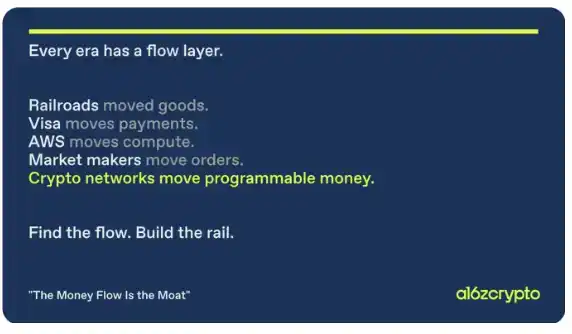
Financial markets make this pattern even clearer. Visa processed $15.7 trillion in payment volume in fiscal 2024, recording $35.9 billion in net revenue. Jane Street had $20.5 billion in net trading revenue last year, surpassing Citi and Bank of America. The top five U.S. market makers handle 87% of payment for order flow: they aren't predicting the market; they're in the middle of every order flow, earning more as trading volume grows.

These businesses share another trait: network effects. Visa becomes more useful to merchants as more cards are issued; more useful to cardholders as more merchants accept Visa. The same with order flow: each added broker narrows spreads, attracting more brokers, which attracts more order flow.

Capital flow plus network effects is one of the most durable structures in business history.

Your Margin is My Opportunity

Jeff Bezos once said, "Your margin is my opportunity." He was talking about retail, but it applies even more to traditional financial services—the world's largest pool of profit extraction. Payments, custody, lending, forex, securitization, settlement, market making—it's all true. Visa and Mastercard charge 2% to 3% interchange on a network designed in the 1960s; cross-border remittance corridors charge 6% to 9%; prime brokers and custodians take a cut of every securities transaction. Even with the U.S. moving to T+1 settlement in 2024, capital still sits idle overnight, a structural cost borne by all participants.

These profit margins are targets. Compress costs, increase velocity, and potentially expand the entire market. Stripe and Square have proven this in payments.
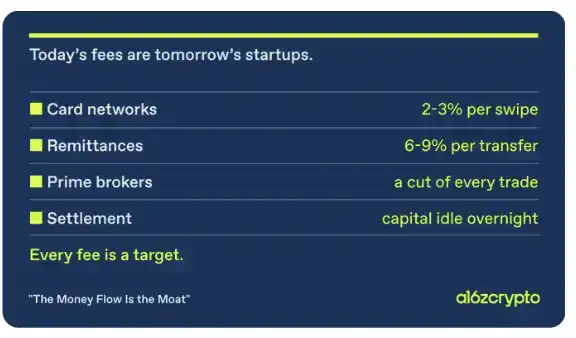
Crypto entrepreneurs have the chance to build the next version: programmable, instant, global, and natively in the flow of capital.

And this frontier extends far beyond financial services. Compute and GPU markets, memory chips, AI training data, energy, robotics, space, rare earth metals—each could see massive global flows of value, and existing infrastructure isn't built to handle that scale.

Each is an open market where capital flow businesses can be built on programmable infrastructure from day one. No legacy rails, no entrenched intermediaries, no old profits to defend.

As a founder, you should ask yourself:

1. Are you in the flow of capital today?

2. When activity value on your product grows 10x, does your revenue grow proportionally?

3. If you're building a new product, where in your target market does the highest profit extraction exist relative to the value created?
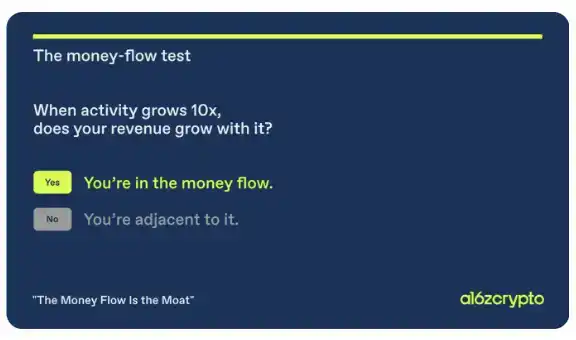
The opportunity is there. Compress it, step into the new value flow, and let the network compound from there.


Questions liées

QAccording to the article, what is the core characteristic shared by history's most powerful companies like Visa, Google, and AWS?

AThe core characteristic is that they position themselves within a 'value flow' or 'capital flow.' They don't just sell a product; they facilitate the creation and transfer of value within a network and extract a portion of the revenue from that ongoing flow. As more value moves through the network, these companies grow stronger.

QHow does the article argue that Crypto technology uniquely empowers startups compared to traditional models?

AThe article argues that Crypto provides the first modern technology that is natively designed for this 'value flow' model. It offers an open ledger, programmable settlement, and global, internet-speed money movement via stablecoins. Most importantly, token mechanisms can align all network participants (users, developers, validators) by rewarding contributions to network growth. Startups inherit network effects from day one on this open infrastructure, rather than having to build them manually.

QWhat does the article mean by 'Your margin is my opportunity' in the context of traditional financial services?

AIn this context, it means that the high profit margins (or 'rents') extracted by traditional financial intermediaries represent a major opportunity for disruption. Services like payments, custody, lending, and cross-border transfers often have high fees relative to the value provided. These inefficient, high-cost areas are prime targets for Crypto startups to compress costs, increase speed, and redistribute value by building more efficient, programmable alternatives.

QBeyond finance, what other future markets does the article suggest could be transformed by 'capital flow' businesses?

AThe article suggests that future markets like compute/GPU markets, AI training data, energy, robotics, space, and rare earth metals could see the emergence of global-scale 'capital flow' businesses. These are areas where massive value will move, and the existing infrastructure may not be designed for that scale, creating open opportunities for new, programmable platforms built from scratch.

QWhat are the three key questions the article suggests founders should ask themselves about their business?

A1. Are you already standing in a capital flow today? 2. When the value of activity on your product grows 10x, will your revenue grow alongside it? 3. If you're building a new product, where in your target market is the highest profit extraction relative to the value created?

Lectures associées

Début de Warsh : le président de la Fed le plus au fait du Crypto de l'histoire apportera-t-il des surprises ou des chocs au marché ?

**Résumé :** Kevin Warsh, nouveau président de la Réserve fédérale américaine, s'apprête à tenir sa première conférence de presse monétaire. Sa nomination est historique : il est le premier président de la Fed à détenir personnellement des actifs numériques (investissements indirects dans Solana, dYdX, etc.), montrant une compréhension unique du secteur. Son dilemme est majeur : il doit faire face à une résurgence de l'inflation, qui exige une politique monétaire stricte (position "de faucon"), tout en répondant aux pressions politiques pour des baisses de taux. Parallèlement, son attitude envers les crypto-actifs diffère fondamentalement de celle de son prédécesseur. Il ne les considère pas comme de simples actifs spéculatifs, mais plutôt comme un "bon policier" pour la politique économique et une composante de la compétitivité américaine. Son impact potentiel sur le marché crypto s'articule autour de trois axes : 1. Un changement de paradigme réglementaire, passant de la prévention à l'intégration et à l'innovation. 2. Une reprixation des actifs liée aux taux d'intérêt, où sa clarté de communication pourrait réduire la prime d'incertitude. 3. Une légitimation accrue pouvant attirer les capitaux institutionnels traditionnels. Deux scénarios principaux sont envisagés pour sa première intervention : * **Scénario "Surprise"** : Un ton modéré ("de colombe") sur les taux combiné à des signaux favorables à l'innovation numérique pourrait booster le marché. * **Scénario "Choc"** : Un message excessivement restrictif sur les taux pourrait entraîner une vente généralisée des actifs risqués, y compris les cryptos. Bien qu'il ait dû vendre ses actifs crypto pour des raisons d'éthique, la compréhension intrinsèque de Warsh pour la technologie blockchain pourrait, à long terme, poser les bases d'une intégration plus structurelle des actifs numériques dans le système financier.

marsbitIl y a 24 mins

Début de Warsh : le président de la Fed le plus au fait du Crypto de l'histoire apportera-t-il des surprises ou des chocs au marché ?

marsbitIl y a 24 mins

XRP Ledger Lance le Rebranding XRPld Avec la Mise à Niveau Version 3.2.0

La version 3.2.0 du XRP Ledger (XRPL) est désormais disponible, introduisant une refonte majeure incluant le changement de nom du logiciel principal de « rippled » à « xrpld ». Cette mise à niveau se concentre principalement sur les améliorations des performances, de la sécurité et de l'évolutivité de l'infrastructure sous-jacente, plutôt que sur de nouvelles fonctionnalités utilisateur. Les principales avancées incluent des optimisations de mémoire pouvant réduire jusqu'à 40% l'utilisation de la mémoire serveur. Sur le plan de la sécurité, la modification `fixCleanup3_2_0` renforce plusieurs modules, notamment les coffres-forts à actif unique, le protocole de prêt, les échanges décentralisés et les jetons multi-usages. De nouveaux contrôles d'invariance garantissent la cohérence du registre après la suppression de comptes. Pour les développeurs, la mise à jour permet désormais de récupérer des informations sur les définitions du protocole et du serveur XRPL sans nécessiter de connexion active, facilitant ainsi la création de portefeuilles, d'explorateurs de blockchain et d'APIs. En termes d'évolutivité et de stabilité, les améliorations comprennent des tailles de bloc configurables, un stockage de base de données optimisé via nuDB, et le support optionnel de TLS/mutual TLS pour le serveur gRPC. Le port de peering par défaut est également passé du 51235 au 2459. Divers correctifs ont été apportés aux fonctions liées aux Market Makers Automatisés, aux paiements, aux séquestres de jetons et aux carnets d'ordres. Une note importante : les invariants de transaction ont été temporairement désactivés dans la v3.2.0 en raison d'un impact sur les performances, mais cela ne présente pas de risque pour la sécurité.

TheNewsCryptoIl y a 55 mins

XRP Ledger Lance le Rebranding XRPld Avec la Mise à Niveau Version 3.2.0

TheNewsCryptoIl y a 55 mins

L'AGI n'est pas l'arrivée, nouveau document de DeepMind : Vers l'ASI, le véritable progrès de l'IA ne fait que commencer

Si l'intelligence artificielle générale (IAG) était atteinte demain, quelle serait la prochaine étape ? Une étude de Google DeepMind suggère que l'IAG n'est pas un point final, mais une étape vers une superintelligence artificielle (ISA) dépassant les collectifs d'experts humains. L'étude distingue trois concepts : l'IAG (niveau médian humain), l'ISA (supérieure aux meilleurs collectifs humains dans presque tous les domaines) et l'IA universelle (limite théorique). Elle propose quatre voies potentielles vers l'ISA : 1. **Extension des ressources** : augmentation de la puissance de calcul, des données et des modèles. 2. **Évolution algorithmique** : améliorations incrémentales ou nouveaux paradigmes (apprentissage continu, utilisation d'outils, modèles du monde). 3. **Auto-amélioration récursive** : des IA plus performantes conçoivent la génération suivante, créant une boucle de rétroaction positive. 4. **Coordination multi-agents** : des systèmes IAG collaborant atteignent une intelligence collective supérieure. L'étude identifie six principaux goulets d'étranglement : 1. **Le mur des données** : les données humaines de haute qualité pourraient s'épuiser. 2. **Pressions économiques et ressources naturelles** : coûts énergétiques et matériels. 3. **Limites des paradigmes neuronaux actuels** : problèmes d'apprentissage continu, de raisonnement robuste, d'hallucinations. 4. **Difficulté croissante de la recherche**. 5. **Barrières à l'abstraction** : difficulté à former de nouveaux concepts fondamentaux. 6. **Régulation, gouvernance et réaction sociale**. Un défi crucial est l'évaluation des capacités de l'IA au-delà du niveau humain, nécessitant de nouveaux benchmarks. L'étude conclut que la progression vers l'ISA reste incertaine, soumise à des contraintes physiques et de ressources, et appelle à un effort de recherche interdisciplinaire pour mieux anticiper cette évolution.

marsbitIl y a 2 h

L'AGI n'est pas l'arrivée, nouveau document de DeepMind : Vers l'ASI, le véritable progrès de l'IA ne fait que commencer

marsbitIl y a 2 h

Trading

Spot
Futures

Articles tendance

Comment acheter FLOW

Bienvenue sur HTX.com ! Nous vous permettons d'acheter Flow (FLOW) de manière simple et pratique. Suivez notre guide étape par étape pour commencer votre parcours crypto.Étape 1 : Création de votre compte HTXUtilisez votre adresse e-mail ou votre numéro de téléphone pour ouvrir un compte sur HTX gratuitement. L'inscription se fait en toute simplicité et débloque toutes les fonctionnalités.Créer mon compteÉtape 2 : Choix du mode de paiement (rubrique Acheter des cryptosCarte de crédit/débit : utilisez votre carte Visa ou Mastercard pour acheter instantanément Flow (FLOW).Solde :utilisez les fonds du solde de votre compte HTX pour trader en toute simplicité.Prestataire tiers :pour accroître la commodité d'utilisation, nous avons ajouté des modes de paiement populaires tels que Google Pay et Apple Pay.P2P :tradez directement avec d'autres utilisateurs sur HTX.OTC (de gré à gré) : nous offrons des services personnalisés et des taux de change compétitifs aux traders.Étape 3 : stockage de vos Flow (FLOW)Après avoir acheté vos Flow (FLOW), stockez-les sur votre compte HTX. Vous pouvez également les envoyer ailleurs via un transfert sur la blockchain ou les utiliser pour trader d'autres cryptos.Étape 4 : tradez des Flow (FLOW)Tradez facilement Flow (FLOW) sur le marché Spot de HTX. Il vous suffit d'accéder à votre compte, de sélectionner la paire de trading, d'exécuter vos trades et de les suivre en temps réel. Nous offrons une expérience conviviale aux débutants comme aux traders chevronnés.

239 vues totalesPublié le 2024.12.10Mis à jour le 2026.06.02

Comment acheter FLOW

Discussions

Bienvenue dans la Communauté HTX. Ici, vous pouvez vous tenir informé(e) des derniers développements de la plateforme et accéder à des analyses de marché professionnelles. Les opinions des utilisateurs sur le prix de FLOW (FLOW) sont présentées ci-dessous.

活动图片