When Even the Shovel Sellers Borrow to Buy Shovels: The US Stock AI Sector Evaporates Trillions in a Week, as the Market Begins Pricing AI's 'Bill'

marsbitPublié le 2026-06-11Dernière mise à jour le 2026-06-11

Résumé

Last week saw a sharp sell-off in the US AI sector, erasing trillions in market value despite companies reporting record financials. Key events included Alphabet's massive equity raise despite having over $1.2 trillion in cash, Broadcom's stock plummeting after its quarterly report, a 4% Nasdaq drop, and Oracle's stock falling even after posting record revenue and backlog. The market's focus shifted from stellar income statements to cash flow and balance sheets, questioning the massive and increasingly leveraged capital expenditures required to fund the AI infrastructure race. Analysts point out that while growth is strong, profitability and the visibility of AI monetization are now under scrutiny. The financing chain stretches from cash-rich giants like Alphabet raising debt and equity, to chipmakers like Broadcom facing margin pressure, to cloud providers like Oracle with negative free cash flow funding via debt, and finally to unprofitable AI labs like OpenAI and Anthropic—who are the ultimate customers for much of this infrastructure. The market is beginning to price the risk of this concentrated, leveraged bill coming due, with the upcoming SpaceX IPO serving as the next test for this financing ecosystem.

Author: Ada, Deep Tide TechFlow

Over the past week, the US stock AI sector presented a strange picture, with records being broken one after another and stocks being sold off one after another.

On June 1, Alphabet, sitting on hundreds of billions in cash, announced one of the largest equity financings in history; On June 3 after market close, Broadcom delivered its best-ever quarterly report, only for its stock to crash the next day; On June 5, the Nasdaq plunged 4% in a single day, with the semiconductor sector shedding roughly $1 trillion in market value in one session; On June 10 after market close, Oracle reported record revenue and backlog, yet its stock still fell; On June 11, the pricing moment arrived for what is set to be the largest SpaceX IPO in history. The financial numbers themselves are not the issue; the problem is the way these numbers are being achieved: more and more money is being borrowed into this AI infrastructure race through increasingly complex means. When the market began tallying up this bill, even record-breaking numbers couldn't save stock prices.

The Same Script: Record First, Then Get Sold Off

Broadcom went first. According to its earnings report and multiple media outlets, for its fiscal Q2 ended May 3, Broadcom's revenue reached $22.219 billion, up 48% year-over-year; AI chip revenue was $10.8 billion, surging 143% year-over-year; and earnings per share exceeded Wall Street expectations. But the market focused solely on one gap: the company's AI chip revenue guidance for the next quarter is $16 billion, below analyst expectations, and CEO Hock Tan did not raise the full-year AI revenue target, mentioning that Google might diversify its chip supply chain. Nonetheless, Broadcom's stock plummeted about 15% the next day, erasing nearly $280 billion in market value in a single day, making it one of the largest single-day market cap losses in Wall Street history.

Oracle's turn came a week later. According to its earnings report and CNBC, for its fiscal Q4 ended May 31, Oracle's revenue was $19.2 billion, up 21% year-over-year; cloud infrastructure revenue was $5.8 billion, up 93% year-over-year; adjusted EPS was $2.11, beating analyst expectations of $1.95. The backlog was even more staggering: Remaining Performance Obligations (RPO) reached $638 billion, skyrocketing 363% year-over-year, far exceeding analyst expectations of $595.7 billion. Yet the stock also didn't find favor, dropping about 9% in after-hours trading.

Sandwiched between these two earnings reports was a broad sell-off on June 5. According to TheStreet and CNBC, the Nasdaq Composite Index fell 4% that day, its worst single-day performance since the April 2025 tariff turmoil, triggered by Broadcom's cautious AI chip outlook, with AMD and Intel leading the decline across the entire semiconductor sector.

It is worth noting that the June 5 plunge wasn't solely about "AI skepticism." That day, US non-farm payrolls added 172,000 jobs, far exceeding expectations, pushing up rate hike expectations and triggering a rotation from high-valuation growth stocks into defensive sectors like healthcare and consumer staples. AI stocks, having the highest valuations, fell the hardest. In other words, macroeconomic interest rates and sector rotation were one driver, while concerns over AI capital expenditures were another. The two factors compounded, rather than having a single cause.

What's Being Sold Off Isn't the Income Statement, It's the Cash Flow Statement

Putting these three market segments together reveals a commonality: the income statement is still recording "record-breaking" numbers, but the market has already switched to reading the cash flow statement and the balance sheet. The pricing focus has shifted from "how much was earned" to "how much more will be burned and borrowed to earn this."

Oracle is the most straightforward case study. According to its earnings report, for the full FY2026, operating cash flow reached a record $32 billion, up 54% year-over-year, but free cash flow was negative $23.7 billion. For the year, the company has already raised $43 billion in debt and $5 billion in equity. What truly broke investor sentiment was its forward-looking language. According to CNBC, Oracle plans to raise approximately $40 billion more in FY2027 through a combination of debt and equity. A company that just raised nearly $50 billion, with negative free cash flow, and now forecasts another $40 billion financing round—when this appears alongside "record-breaking" numbers, the market chose to price the former.

Broadcom's logic is similar, but manifests elsewhere. According to Barron's, Broadcom lowered its Q3 gross margin guidance from 77% to 74%, attributing it to a higher revenue mix from lower-margin AI chips. Coupled with a retreat from "selling complete systems" to "selling only chips," and customers demanding chip leases to pass on financing pressure, the market sees a business with explosive growth, but deteriorating margins and capital intensity.

Goldman Sachs provided a framework for this shift. According to its research report, investors' tolerance for capital expenditure growth depends on earnings strength and the visibility of AI monetization; the same report noted that Alphabet's stock rose due to raising its profit guidance, while Meta's fell due to flat guidance. The market is no longer indiscriminately rewarding "growth," but differentiating winners from losers based on "the ability to monetize."

The Financing Chain Takes Center Stage: Even the Most Cash-Rich Players Are Borrowing

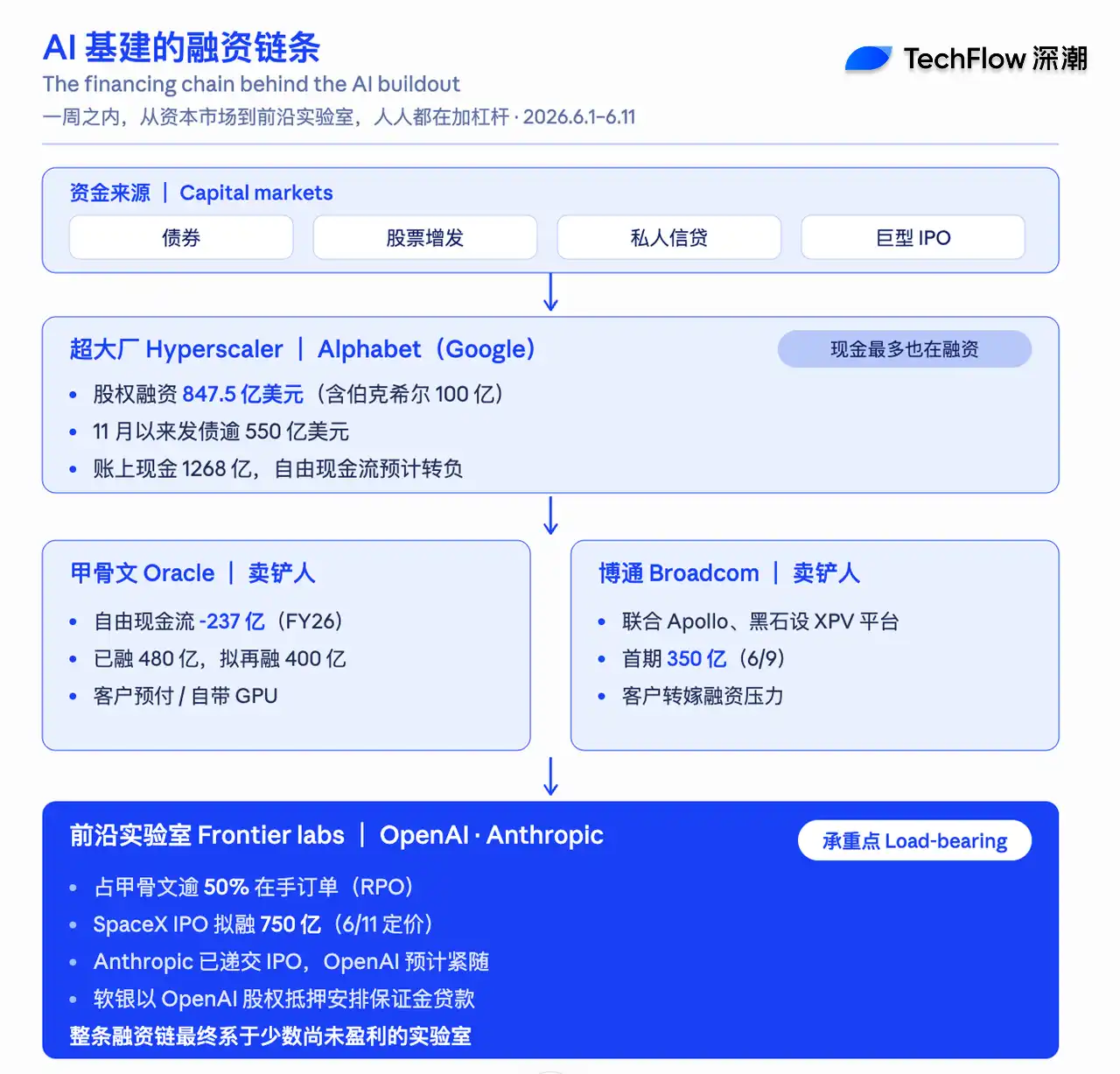
If the income statement is the surface, the financing chain is the true protagonist of this past week. From the very upstream to the very downstream, almost every link is paying for this same AI infrastructure build-out by leveraging up or diluting equity.

The most convincing case study is Alphabet. According to its SEC filing, on June 1, it announced an $80 billion equity financing; on June 2, it upsized and priced the deal at $84.75 billion, including a $10 billion private investment from Berkshire Hathaway. The anomaly is that this company is not short on cash at all. According to multiple media reports, Alphabet had $126.8 billion in cash as of March 2026, annual operating cash flow of $174 billion, and has issued over $55 billion in new debt since November. Despite this, Melius Research estimates Google's free cash flow will turn negative in the coming years. Investor Dan Niles' commentary on this is that capital is not infinite, and the fact that Google, with "the strongest technology stack in all of AI," still needs to raise massive amounts of financing precisely illustrates the intensity of this round of investment.

Looking downstream, every link on the chain is doing the same. New cloud vendor Oracle has negative free cash flow, relies on dual-track debt and equity financing, and asks customers to prepay for GPU costs or bring their own GPUs to reduce its own construction capital outlay; the chip "shovel sellers" like Broadcom, on June 9, partnered with Apollo and Blackstone to establish the AI XPV Platform, with an initial $35 billion targeting over 20 gigawatts of computing power by 2028, serving frontier labs including Anthropic and OpenAI. And at the very end of the chain, the labs are simultaneously employing even more aggressive tools: there were previous reports of SoftBank arranging margin loans secured by OpenAI equity; now SpaceX is rushing towards a Nasdaq IPO targeting $75 billion, Anthropic has confidentially filed for an IPO, and OpenAI is expected to follow closely.

The total scale of this investment is also rapidly inflating. According to CreditSights, the combined capital expenditure for mega-cap companies in 2026 is estimated at around $750 billion, up about 67% from 2025; Goldman Sachs' alternative metric puts the 2026 capex forecast for mega-caps at $518 billion, revised up from $314 billion at the start of the year. Whichever metric is used, the direction is consistent: expenditures are accelerating, the portion that can be covered by operating cash flow is shrinking, and the gap needs to be filled by capital markets.
The Chain's Pressure Point Rests on a Few Unprofitable Labs

Leverage itself isn't terrifying; what's terrifying is who the leverage ultimately rests upon. Pulling this financing chain to its end reveals that its pressure point is highly concentrated.

Oracle's $638 billion backlog seems impregnable, but according to Bank of America, over 50% comes from OpenAI alone; simultaneously, Oracle also disclosed that most of the RPO growth in the past two quarters came from large AI contracts, with customers either prepaying GPU costs or procuring GPUs themselves before handing them to Oracle. Broadcom's six major custom chip customers are similarly concentrated among a handful like Google, Meta, Anthropic, and OpenAI. In other words, from the financing of the mega-caps, to the orders of the "shovel sellers," to the injection of private credit and insurance funds, the ultimate payer for the entire chain converges onto a small group of unprofitable frontier labs like OpenAI and Anthropic, who are themselves queuing up for funding.

The record-breaking revenue is real, and the $638 billion backlog is real; but the buyers of these orders are highly concentrated, are themselves sustained by financing, and the leverage of the entire chain is being re-examined by the market. This past week, the market did not deny AI's growth; it simply started demanding to see clearly who will pay the bill for this growth, and how. SpaceX is set to price after market close on June 11 and list on the Nasdaq at $135 per share, with a valuation of approximately $1.77 trillion on June 12. Whether this largest-ever IPO can be digested smoothly will be the next stress test for this financing chain.


Cryptos en tendance

Questions liées

QWhat were the main reasons behind the significant sell-off in the AI sector of the U.S. stock market over the past week?

AThe sell-off was driven by a combination of macroeconomic factors and sector-specific concerns. The stronger-than-expected U.S. non-farm payrolls data raised interest rate expectations, triggering a rotation from high-valuation growth stocks (like AI) into defensive sectors. Simultaneously, the market began to reassess the massive capital expenditure required for AI infrastructure. Companies like Broadcom and Oracle reported record revenues but also signaled the need for continued heavy investment and financing, leading to a market focus on negative free cash flow and growing debt, which caused their stock prices to fall despite strong earnings.

QHow did the market's valuation focus shift for AI companies like Oracle and Broadcom, according to the article?

AThe market's valuation focus shifted from the income statement (profit and revenue growth) to the cash flow statement and balance sheet. Investors are no longer just rewarding 'record' earnings; they are now pricing in the significant capital required to generate those earnings. For example, Oracle's record $638 billion backlog and revenue were overshadowed by its negative free cash flow and plans for further large-scale debt and equity financing. For Broadcom, the market focused on the declining gross margin guidance and the increased capital intensity of its AI chip business, even as AI revenue soared.

QWhy did Alphabet, despite having a massive cash reserve, conduct a major equity financing round?

AAlphabet announced an $84.75 billion equity financing round even with $1268 billion in cash and strong annual operating cash flow because, according to analyst estimates (like from Melius Research), its free cash flow is projected to turn negative in the coming years due to the immense intensity of AI infrastructure investment. As noted by investor Dan Niles, this move by a company with the 'strongest technology stack in AI' highlights the enormous scale of capital required for this buildout, suggesting that even the most cash-rich players need to tap external funding to sustain the AI arms race.

QWhat is the common weak point or 'pressure point' in the AI infrastructure financing chain identified in the article?

AThe common weak point or 'pressure point' in the AI financing chain is its heavy reliance on a small group of unprofitable, frontier AI labs like OpenAI and Anthropic. A significant portion of the record orders for companies like Oracle (over 50% from OpenAI alone) and Broadcom's major custom chip customers are concentrated with these labs. These labs are themselves dependent on continued fundraising (e.g., private credit, impending IPOs) to pay their bills. This creates a concentrated risk where the entire chain's viability depends on the financial health and ability of a few non-profitable entities to keep raising capital.

QWhat upcoming event does the article suggest will be the next major test for the AI financing chain?

AThe article suggests that SpaceX's upcoming IPO, scheduled to price on June 11 and list on Nasdaq on June 12 with a target valuation of approximately $1.77 trillion, will be the next major test for the AI financing chain. As the largest IPO in history, its success in being absorbed by the market will serve as a crucial indicator of investor appetite and capacity to fund the massive capital requirements at the end of the AI infrastructure investment chain.

Lectures associées

Compte à rebours pour GPT-5.6 : Abandonnez l'illusion d'une API unique, même une évolution rapide du calcul ne résiste pas à une simple réglementation

Mi-juin 2026, trois événements majeurs (la restriction d'accès de Fable 5, l'open-sourcing de GLM-5.2, l'annonce imminente de GPT-5.6) marquent un tournant pour l'industrie de l'IA. La logique sous-jacente de la chaîne d'approvisionnement des grands modèles se réorganise. La disponibilité et la conformité surpassent désormais la simple avancée technique. Le cas de Fable 5, limité aux seuls citoyens américains pour des raisons de contrôle à l'export, prouve qu'une capacité technique de pointe peut être rendue inaccessible par la réglementation. En parallèle, le modèle open-source GLM-5.2 démontre des performances proches des leaders tout en réduisant drastiquement les coûts, offrant une alternative viable et stable pour les entreprises, notamment face aux risques géopolitiques. En réponse, les géants du modèle fermé comme OpenAI recentrent leurs efforts. Les fuites sur GPT-5.6 suggèrent un virage stratégique vers l'intelligence spatiale et les « modèles du monde », des domaines nécessitant d'immenses ressources en calcul, pour tenter de recréer un écart de génération dans des applications comme la simulation industrielle ou la robotique. La conclusion est claire : pour les développeurs d'applications, dépendre exclusivement d'une API propriétaire unique expose à des risques incontrôlables. Concevoir des architectures « agnostiques » au modèle, permettant de basculer rapidement entre solutions fermées et open-source locales, devient une condition essentielle à la continuité des activités. L'ère du choix unique basé uniquement sur la performance technique est révolue.

marsbitIl y a 2 h

Compte à rebours pour GPT-5.6 : Abandonnez l'illusion d'une API unique, même une évolution rapide du calcul ne résiste pas à une simple réglementation

marsbitIl y a 2 h

La « guerre des subventions de tokens » des géants de l'IA touche-t-elle à sa fin ?

Les grands acteurs de l'IA mènent une guerre des prix sur les tokens, en subventionnant massivement leurs utilisateurs. Des analyses montrent que, dans certains abonnements premium, la valeur réelle des tokens consommés peut être jusqu'à 70 fois supérieure au prix payé. Contrairement aux guerres de subventions de l'ère Internet (comme Uber ou Meituan), les tokens d'IA créent peu d'effet de verrouillage : les utilisateurs peuvent changer de fournisseur facilement, car l'API est standardisée. Cette guerre est structurellement déséquilibrée. Des géants comme Google, financés par d'autres activités lucratives (publicité), peuvent se permettre de baisser radicalement les prix pour concurrencer des sociétés comme OpenAI et Anthropic, qui dépendent fortement des financements des investisseurs. Bill Maris, fondateur de Google Ventures, estime qu'une baisse de 80% du prix des tokens par Google est inévitable et constituerait une arme redoutable. À long terme, deux scénarios sont possibles : soit un modèle de type "service Internet" avec monopolisation et hausse des prix ultérieure, soit un modèle de type "infrastructure de base" (eau, électricité) où les tokens deviennent une commodité standardisée, avec des marges tendant vers zéro. L'absence d'effet de verrouillage fort penche en faveur du second scénario. La compétition pourrait alors devenir un "jeu infini", où l'objectif n'est pas d'éliminer l'adversaire mais de rester à table, accélérant ainsi l'adoption et le développement de l'IA comme une utilité publique. Pour les utilisateurs, cette guerre des subventions signifie, pour l'instant, un accès à une puissance de calcul à un prix très avantageux.

marsbitIl y a 2 h

La « guerre des subventions de tokens » des géants de l'IA touche-t-elle à sa fin ?

marsbitIl y a 2 h

En dehors du terrain : le jeu spéculatif autour de la Coupe du Monde

Le tournoi de la Coupe du Monde dépasse largement le cadre sportif pour devenir un immense terrain de jeu spéculatif mondial. L'article explore comment l'événement concentre, sur un mois, un écosystème de paris et d'opportunités financières. Il passe en revue plusieurs domaines clés : Le marché des prédictions (Polymarket, Kalshi) connaît une croissance fulgurante, dépassant parfois en popularité les applications de pari traditionnelles, avec des histoires de gains et pertes spectaculaires captant l'attention. Les paris sportifs légaux restent cependant le pilier principal, avec des sommes énormes engagées, surtout si l'équipe nationale locale performe. Les marchés boursiers ne sont pas en reste, avec l'apparition d'« actions concept » liées à la consommation des fans (nourriture, bière, équipement) dont les cours fluctuent au gré des résultats des matchs. Le marché secondaire des billets est lui aussi un champ de spéculation intense, où les prix explosent pour les matches très attendus (ex: ceux de Cristiano Ronaldo) ou s'effondrent pour d'autres, avec même des pratiques proches de la vente à découvert. Les objets de collection, comme les autocollants Panini ou les maillots en édition limitée, voient leur valeur monter en flèche sur les plateformes de revente. L'univers des cryptomonnaies génère une frénésie spéculative à haut risque autour de tokens Meme non officiels, souvent liés à des équipes ou des joueurs, conduisant à des hausses vertigineuses suivies de chutes brutales. Enfin, une couche d'opportunités émerge en fournissant des informations et des outils aux spéculateurs eux-mêmes : sites de suivi des prix des billets, services d'alerte ou groupes payants de conseils de paris. Le véritable gagnant n'est pas nécessairement celui qui prédit le vainqueur, mais celui qui comprend et exploite les flux d'attention et de demande générés par le tournoi. Après le coup de sifflet final, un vaste réseau de transactions, hors du terrain, a déjà réglé ses comptes sur les marchés globaux.

marsbitIl y a 3 h

En dehors du terrain : le jeu spéculatif autour de la Coupe du Monde

marsbitIl y a 3 h

Comment Codex utilise-t-il l'ordinateur ? Trois points d'entrée et les limites d'autorisation

L'article présente les trois méthodes utilisées par Codex pour interagir avec un ordinateur : Computer Use, l'extension Chrome et le navigateur intégré à l'application. Chaque méthode correspond à des scénarios, des périmètres d'autorisation et des niveaux de confiance distincts. Computer Use offre la couverture la plus large, permettant de contrôler les applications natives macOS/Windows, les paramètres système et même de gérer des flux de travail multi-applications via l'interface graphique. Il est adapté aux processus sans API, mais est plus lent et a le périmètre de confiance le plus large. L'extension Chrome donne accès à l'état de connexion, aux cookies et aux onglets du navigateur, idéale pour les tâches liées à Gmail, LinkedIn, Salesforce ou pour des recherches nécessitant une authentification. Le navigateur intégré est isolé, sans état de connexion, et convient parfaitement au développement et au débogage web local (serveurs locaux, bugs visuels, maquettes). Le principe fondamental est de choisir l'interface la plus étroite, sécurisée et structurée possible pour une tâche donnée. Il faut privilégier les plugins ou MCP, utiliser le navigateur intégré pour le développement web, recourir à l'extension Chrome lorsque l'identité de l'utilisateur est requise, et ne recourir à Computer Use qu'en dernier recours pour les tâches GUI non couvertes par des outils structurés. Appshots est présenté comme un outil complémentaire permettant de "montrer" le contexte de l'écran à Codex pour l'input, tandis que les trois autres méthodes concernent l'action (output). Cette approche stratifiée illustre la clé de la productisation des agents IA : restreindre les permissions, clarifier les frontières et laisser à l'utilisateur le contrôle des actions critiques.

marsbitIl y a 4 h

Comment Codex utilise-t-il l'ordinateur ? Trois points d'entrée et les limites d'autorisation

marsbitIl y a 4 h

Trading

Spot
Futures

Articles tendance

Comment acheter BILL

Bienvenue sur HTX.com ! Nous vous permettons d'acheter Billions Network (BILL) de manière simple et pratique. Suivez notre guide étape par étape pour commencer votre parcours crypto.Étape 1 : Création de votre compte HTXUtilisez votre adresse e-mail ou votre numéro de téléphone pour ouvrir un compte sur HTX gratuitement. L'inscription se fait en toute simplicité et débloque toutes les fonctionnalités.Créer mon compteÉtape 2 : Choix du mode de paiement (rubrique Acheter des cryptosCarte de crédit/débit : utilisez votre carte Visa ou Mastercard pour acheter instantanément Billions Network (BILL).Solde :utilisez les fonds du solde de votre compte HTX pour trader en toute simplicité.Prestataire tiers :pour accroître la commodité d'utilisation, nous avons ajouté des modes de paiement populaires tels que Google Pay et Apple Pay.P2P :tradez directement avec d'autres utilisateurs sur HTX.OTC (de gré à gré) : nous offrons des services personnalisés et des taux de change compétitifs aux traders.Étape 3 : stockage de vos Billions Network (BILL)Après avoir acheté vos Billions Network (BILL), stockez-les sur votre compte HTX. Vous pouvez également les envoyer ailleurs via un transfert sur la blockchain ou les utiliser pour trader d'autres cryptos.Étape 4 : tradez des Billions Network (BILL)Tradez facilement Billions Network (BILL) sur le marché Spot de HTX. Il vous suffit d'accéder à votre compte, de sélectionner la paire de trading, d'exécuter vos trades et de les suivre en temps réel. Nous offrons une expérience conviviale aux débutants comme aux traders chevronnés.

286 vues totalesPublié le 2026.05.07Mis à jour le 2026.06.02

Comment acheter BILL

Discussions

Bienvenue dans la Communauté HTX. Ici, vous pouvez vous tenir informé(e) des derniers développements de la plateforme et accéder à des analyses de marché professionnelles. Les opinions des utilisateurs sur le prix de BILL (BILL) sont présentées ci-dessous.

活动图片