Tracking 'Insider Signals' from Public Data: Screening Strategies for High-Win-Rate Addresses on Polymarket

比推Publié le 2026-03-02Dernière mise à jour le 2026-03-02

Résumé

Title: Tracking "Insider Signals" from Public Data: Strategies for Identifying High-Accuracy Addresses on Polymarket Polymarket, a blockchain-based prediction market platform, offers fully transparent on-chain data, enabling users to analyze trading behaviors and identify addresses with potentially significant informational advantages. Unlike traditional financial markets, all transactions, positions, and timing are publicly accessible, but the key challenge lies in interpreting meaningful signals from vast datasets. High-performing addresses often exhibit distinct patterns: - New addresses making large, concentrated bets in low-liquidity markets. - Specialization in specific sectors (e.g., politics, crypto) rather than diversified trading. - Sudden increases in position sizes, indicating heightened conviction. - Repeatedly accurate timing, entering positions hours before major public news breaks. A systematic approach to identifying such addresses involves: 1. **Screening via Polymarket Analytics**: Filter addresses with consistent 30-day profitability, >55% win rates, and significant net gains in liquid markets. 2. **Analyzing Event-Specific Holdings**: Examine top holders in active markets, focusing on addresses that repeatedly build large positions before full market pricing. 3. **Scrutinizing Trading Behavior**: Assess entry timing (pre-news vs. post-news), concentration of buys, holding duration, and sector focus. Advanced strategies include mo...

Author: Aleiah

Compiled by: Asher

Original title: How to Systematically Track High-Win-Rate Addresses on Polymarket?


An address on Polymarket rolled $35,000 into $442,000, achieving a 12.6x return. Notably, the position was established hours before a major market movement, with the trade largely completed and cashed out before the news spread to mainstream channels. This is not an isolated incident; before the news of the "Venezuela Raid" political event became public, three addresses made early moves and collectively profited $630,000 from the same event.

If such trading occurred in traditional financial markets, one might easily think of information asymmetry. But in prediction markets, all fund flows and position changes are recorded on the public blockchain—there are no hidden accounts or private transactions.

Public does not mean without gaps. The key is not whether the trades can be seen, but whether one can discern the truly informative signals from the vast amount of data.
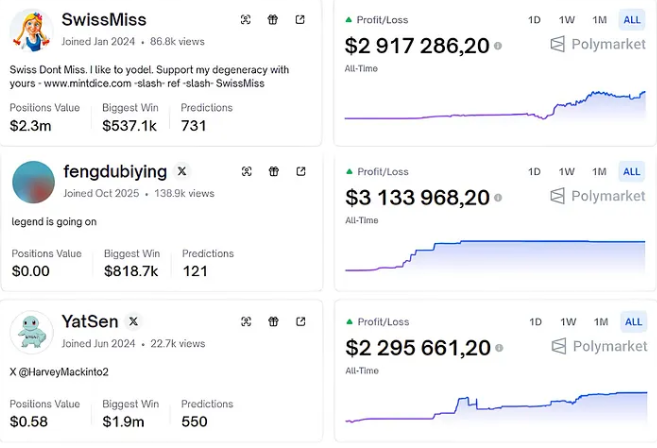
Every Trade on Polymarket is Public Data

Many prediction market participants still view Polymarket as a traditional betting platform: watch the odds, choose a direction, and bet on the outcome. But Polymarket's underlying structure is completely different from DraftKings or ordinary sports betting. All transactions occur on-chain; fund flows, position sizes, and entry/exit times are all publicly viewable. The operational paths of the most accurate and timely addresses are not post-hoc speculation but real-time on-chain records.
Polymarket's API is also open. Transaction records, market data, historical trades—anyone can directly call it; there is no permission barrier.

Therefore, the gap is not about who can see the data, but about who can extract meaning from it. On-chain information is public, but what is truly valuable are the wallets worth tracking continuously and the ability to recognize behavioral changes before prices fully reflect them.

What Characteristics Do True "Insider Addresses" Typically Have?

It is important to emphasize that not all profitable wallets imply insider information. Some traders have solid research capabilities, while others rely on quantitative models and algorithmic advantages. But when profitability is repeatedly combined with specific behavioral patterns, one can observe structural features that distinguish them from "luck."

First Type: New Addresses Combined with Unusually Large Bets

A wallet created just days ago, with very few transactions, suddenly invests a large amount of capital in a low-liquidity niche market—this behavior is not common. Especially in the absence of public catalysts, large, concentrated positions often carry stronger informational significance.

Second Type: Highly Vertical Trading Focus

Some addresses do not operate across markets but focus long-term on a specific niche, maintaining a stable and significant win rate in that area. They do not diversify across crypto prices, elections, sports, and other sectors but concentrate their firepower on a single theme, with more decisive position decisions.

Third Type: Abnormal Changes in Position Size

When an address that has been betting medium-sized amounts for a long time suddenly significantly increases its position in a certain market, this behavior often indicates a change in the strength of conviction. Position size itself is an attitude; a sudden change in scale usually reflects an upgrade in information or belief.

Fourth Type: Excessively Precise Timing

Occasional early moves can be attributed to coincidence, but if an address repeatedly completes position building hours before major news announcements, with highly consistent direction, such timing lead is difficult to simply explain as luck. Once is random; repeated occurrences are more likely to reflect an information advantage.

How to Systematically Screen for Potential "Information-Advantaged Addresses"

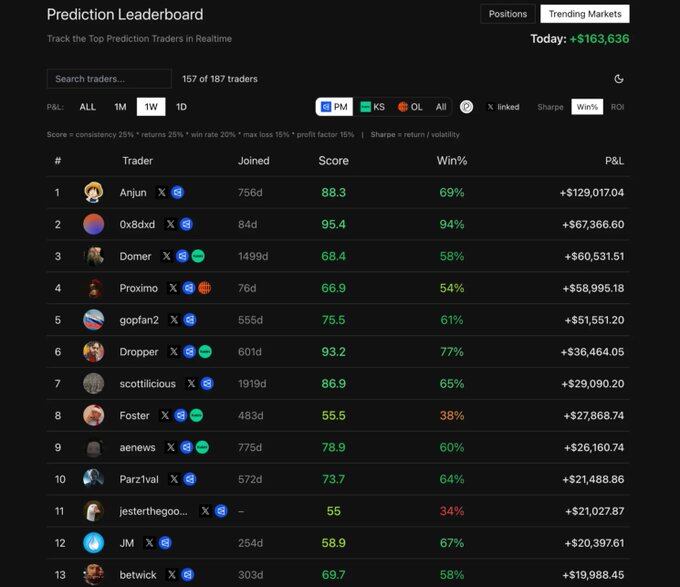
Step 1: Analyze Polymarket Leaderboard Performance

Start with the Polymarket Analytics leaderboard (link: https://polymarketanalytics.com/traders), sorted by 30-day P&L, using recent stable profitability as the first filter. Focus on wallet addresses with overall positive returns for 30 consecutive days, a win rate above 55%, and total profits significantly higher than total losses. Also, confirm that their trading is concentrated in markets with real liquidity, not low-volume prediction events with little participation.
The goal at this stage is not to directly judge whether they have an information advantage, but to establish a watchlist of addresses with sustained profitability. A stable profit record is the foundation for subsequent behavioral analysis.

Step 2: Analyze Position Structure in Specific Events

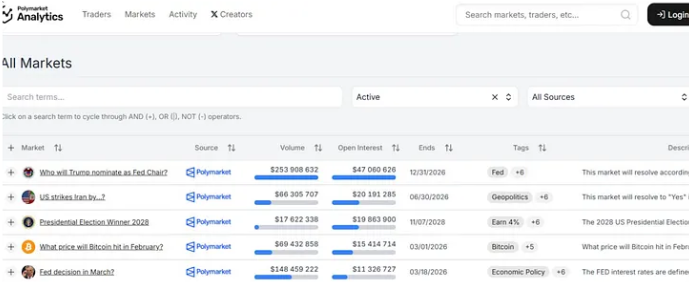
After the initial screening, drill down into specific trading events. Enter active prediction markets and check the Top Holders list for that event. Polymarket publicly displays the addresses with the largest current positions; these large positions often represent stronger conviction.
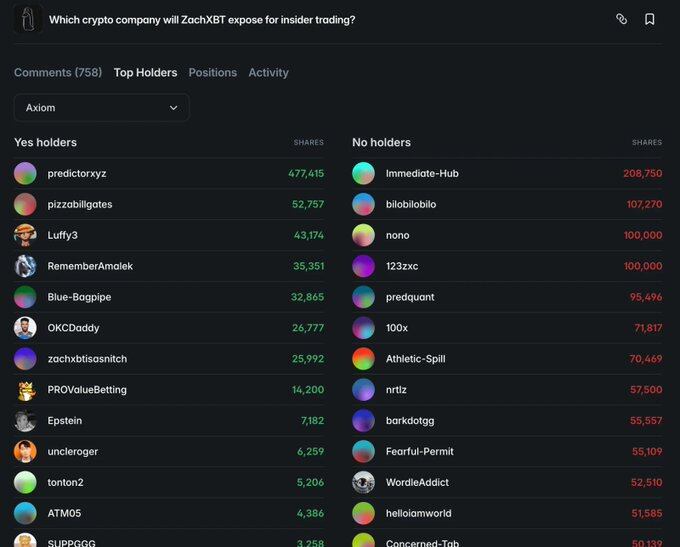
The key is not whether an address hits a single large bet, but whether its behavior is sustained. If a wallet repeatedly appears in the top holder lists of multiple important events, and these positions are built before the market has fully priced them in, then this repetition itself constitutes a signal.

A single successful bet might be偶然, but repeatedly making large, early-stage positions with consistent direction and validated outcomes often indicates a stable advantage in their judgment system.

Step 3: Analyze Trading Behavior and Position Timing

After identifying candidate addresses, further回溯 their on-chain transaction history, focusing on entry timing, position structure, and holding rhythm.
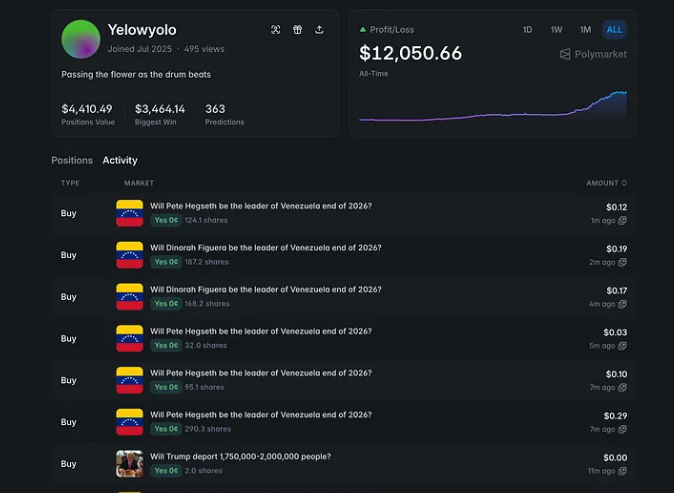
First, observe the entry time. If the purchase occurs hours before the official news release and repeats multiple times, the timing advantage itself becomes an important variable; entering after media reports is more likely to be just information following.

Second, analyze the position building method. Mature traders typically build positions in batches and add gradually, while wallets with strong information judgment often complete concentrated布局 quickly in a short time because their window is limited.

Third, pay attention to the holding period. Some high-quality addresses choose to exit during the mid-stage of行情发酵, rather than waiting for the tail end of extreme volatility, indicating their goal is to lock in the main trend rather than gamble on marginal profits.

Finally, observe their trading scope. Addresses that are highly vertical and long-term focused on a single niche are more likely to form stable information advantages; addresses that frequently operate across sectors are more likely to rely on market sentiment rather than specific domain judgment.

Advanced Address Tracking Strategies

After mastering the basic screening methods, what truly makes the difference is the further decomposition of details in fund behavior.

First, focus on exit behavior, not just entry timing. Addresses with information advantages often not only enter early but also actively reduce positions before potential negative news emerges. When a large address with long-term stable holdings suddenly significantly reduces its position without obvious catalysts, the information content is often higher than the initial buying behavior. Especially when the reduction reaches a significant proportion, this change itself is a signal.

Second, perform wallet clustering analysis using on-chain data. The relationships between addresses are not completely untraceable. Identical funding sources, similar Gas usage patterns, and transactions occurring consecutively within a very short time may reveal relationships between addresses. Many seemingly "brand new" accounts can often be traced back to a long-active old address through 2-3 fund transfers. Tracking along the fund flow path helps identify new potential high-quality accounts before the market notices.

Additionally, pay attention to abnormal volume changes in冷门 markets. If a market with usually small daily trading volume suddenly experiences significant fund inflows without public news, this structural volume increase often means some participants have already acted early. Analyzing the specific addresses driving the volume change can help build a new watchlist.

Finally, cross-verify on-chain behavior with external public information. The so-called "Pizza Index" once used abnormal order volume changes at pizza shops near the Pentagon to speculate on potential military actions. Similarly, flight tracking data, social media activity of key figures, public schedule adjustments, and other information can provide corroboration or反向验证 for on-chain position behavior. The联动 between on-chain fund flows and real-world signals can often strengthen the reliability of judgment.


Twitter:https://twitter.com/BitpushNewsCN

Bitpush TG Discussion Group:https://t.me/BitPushCommunity

Bitpush TG Subscription: https://t.me/bitpush

Original link:https://www.bitpush.news/articles/7615846

Questions liées

QWhat are the key characteristics of potentially high-performing addresses on Polymarket?

AKey characteristics include: new addresses making unusually large bets, addresses highly specialized in specific trading niches, abnormal changes in position sizes, and extremely precise timing of trades before major news breaks.

QHow can one systematically identify addresses with potential information advantages on Polymarket?

AThe process involves three steps: analyzing the Polymarket Analytics leaderboard for consistently profitable addresses, examining top holders in specific event markets for repeated early large positions, and scrutinizing on-chain transaction history for entry timing, position structure, and holding patterns.

QWhat is the fundamental difference between Polymarket and traditional betting platforms like DraftKings regarding data?

AAll transactions on Polymarket occur on-chain, making fund flows, position sizes, and entry/exit timestamps completely public and verifiable, unlike traditional platforms where such data is not transparent.

QWhat advanced strategies are suggested for tracking these addresses beyond basic screening?

AAdvanced strategies include monitoring exit behavior (not just entry), performing on-chain wallet clustering to find linked addresses, watching for abnormal volume in niche markets, and cross-referencing on-chain activity with external real-world signals.

QWhy is the timing of a trade, relative to news announcements, a significant factor in identifying an 'informed address'?

AIf an address consistently places trades hours before major news becomes public and this pattern repeats, it is less likely to be coincidental and more likely to indicate an information advantage, as opposed to trading after news dissemination which is just following public information.

Lectures associées

Guide d'inscription et de publication d'articles pour la colonne PANews

**Guide d'inscription et de publication pour les contributeurs de PANews** Cette page explique comment devenir contributeur (créer une colonne) et publier des articles sur PANews. L'accent est mis sur les contenus approfondis liés à la Crypto, au Web3, aux données et aux analyses. Les contenus principalement promotionnels ou générés massivement par IA ne seront pas approuvés. **Pour créer une colonne :** * **Sur le site web :** Allez en bas de la page d'accueil, cliquez sur "申请专栏" (Demander une colonne). Connectez-vous avec votre numéro de téléphone ou e-mail (code de vérification, pas de mot de passe). Remplissez le nom de la colonne, la description, téléchargez un avatar et fournissez des liens vers vos articles déjà publiés. * **Sur mobile :** Dans la section "我的" (Moi), accédez à "投稿与创作" (Soumettre et créer) et suivez les étapes. **Pour publier un article :** 1. Connectez-vous sur le site et allez sur votre page personnelle. 2. Accédez au "创作者中心" (Centre de création). 3. Utilisez l'éditeur pour rédiger et publier votre article. **Ajouter une vidéo :** Seul l'intégration via code embed (iframe) est supportée (ex. : Bilibili). Collez le code dans l'éditeur via le bouton "插入/编辑媒体" (Insérer/modifier un média). Ajustez la taille si nécessaire (largeur 100%, hauteur 560px recommandés). **PANews Skills (Agent IA) :** PANews propose un ensemble d'outils IA (PANews Skills) pour automatiser certaines tâches. L'outil `panews-creator` permet notamment de gérer votre colonne et de publier des articles directement via des agents IA compatibles (comme Cursor, Claude, etc.). Pour l'utiliser, vous devrez récupérer un jeton d'authentification (`sessionid`) depuis les outils de développement de votre navigateur après vous être connecté à votre compte PANews. **Rappel important :** Privilégiez les analyses de fond. Les contenus publicitaires (PR) doivent passer par la voie commerciale.

marsbitIl y a 1 mins

Guide d'inscription et de publication d'articles pour la colonne PANews

marsbitIl y a 1 mins

J'ai construit un poste de travail d'investissement personnel avec l'IA

Ces dernières semaines, j'ai exploré le « Vibe Coding », utilisant des modèles d'IA comme Codex, Claude et DeepSeek pour développer rapidement des outils personnalisés. Frustré par la nécessité de consulter plusieurs applications pour suivre mes actifs (actions, crypto, etc.), j'ai construit un tableau de bord unifié affichant l'ensemble de mon portefeuille et ses performances. Cet outil intègre désormais une surveillance des mouvements brusques, une cartographie des investissements (visualisant les écosystèmes complets) et un journal de réflexion. J'ai également créé un moniteur pour les marchés de prédiction (comme Polymarket), rassemblant les paris sur des événements futurs (valorisations d'entreprises, etc.) pour analyser leurs probabilités face à l'actualité. Un petit back-office pour gérer mes publications et un outil de mise en forme automatique pour différents plateformes complètent cet ensemble. L'essentiel n'est pas la sophistication des outils, mais la capacité nouvelle à matérialiser rapidement une idée. L'IA permet à tout investisseur de construire progressivement ses propres systèmes fondamentaux : observation d'actifs, surveillance de signaux, cartographie de secteurs et analyse rétrospective. Ce cycle rapide « idée → réalisation → utilisation → amélioration » change profondément la façon d'aborder la recherche et la gestion d'investissements pour les particuliers.

marsbitIl y a 17 mins

J'ai construit un poste de travail d'investissement personnel avec l'IA

marsbitIl y a 17 mins

Après la tokenisation des actifs, comment en sortir ?

**Synthèse : Résoudre le problème de la sortie pour les actifs tokenisés** La tokenisation résout l'entrée des actifs sur la blockchain, mais pas la sortie pour les détenteurs. Trois modèles émergent pour offrir des liquidités instantanées, différant par leur structure de fonds propres : 1. **Modèle de bilan (ex : Grove Basin)** : Une entité unique (comme Sky) utilise son propre bilan pour pré-financer les rachats. Simple et rapide pour les actifs à court terme (bons du Trésor), mais la capacité est limitée à ce bilan unique. 2. **Modèle de coffres dédiés (ex : Upshift Clear)** : Des fournisseurs de liquidités indépendants alimentent des coffres spécifiques à chaque actif. Plus évolutif, mais le capital est isolé par actif, ce qui limite l'efficacité. 3. **Couche de liquidités partagée (ex : Symbiotic Liquid Lane)** : Un pool de capital commun, géré par des trésoriers, sert au rachat de *multiples* actifs tokenisés. Entre les rachats, ces fonds génèrent des rendements ailleurs (prêts DeFi, etc.). Le prix de rachat est fixé par un marché RFQ concurrentiel. **Comparaison clé :** Alors que les deux premiers modèles lient le capital à un bilan unique ou à un actif unique, le modèle de liquidité partagée offre une meilleure efficacité capitalistique, une capacité qui s'étend avec le marché, et est particulièrement adapté aux actifs à long terme (crédit privé, immobilier) où une sortie fiable est la plus précieuse. En conclusion, pour une adoption massive, les RWA ont besoin d'une infrastructure de sortie *scalable* et partagée, et non de solutions ponctuelles. Liquid Lane vise à être cette couche de liquidité fondamentale : multi-actifs, efficace en capital et à règlement T+0.

marsbitIl y a 22 mins

Après la tokenisation des actifs, comment en sortir ?

marsbitIl y a 22 mins

Après la tokenisation d'un actif, comment en sortir ?

**Titre : Après la tokenisation des actifs, comment en sortir ?** **Résumé :** La tokenisation facilite l'émission et le transfert d'actifs réels (RWA) sur la blockchain, mais le problème de la liquidité et de la sortie (rachat) pour les détenteurs reste crucial pour une adoption plus large. Actuellement, trois modèles architecturaux principaux émergent pour fournir une liquidité de sortie instantanée ("T+0") : 1. **Le modèle de bilan (ex. : Grove Basin) :** Une entité unique et bien capitalisée (comme Sky) utilise son propre bilan pour fournir instantanément des stablecoins aux détenteurs lors d'un rachat, réglant ensuite en différé avec l'émetteur de l'actif sous-jacent. Simple et rapide, sa capacité dépend cependant d'un seul bilan. 2. **Le modèle de coffres dédiés par actif (ex. : Upshift Clear) :** Des fournisseurs de liquidités indépendants allouent du capital dans des coffres séparés, chacun dédié à un actif tokenisé spécifique. Cela diversifie les sources de capitaux mais isole la liquidité et limite l'efficacité du capital, qui ne sert qu'un seul actif à la fois. 3. **Le modèle de couche de liquidité partagée (ex. : Symbiotic Liquid Lane) :** Ce modèle introduit une infrastructure de liquidité partagée. Des fonds communs (coffres) peuvent supporter simultanément le rachat de *multiples* actifs tokenisés différents. Le capital est ainsi plus efficace, continuant à générer du rendement (par ex., via le prêt DeFi) entre les événements de rachat. Les rachats sont réglés via un marché de requêtes de prix (RFQ) concurrentiel où des teneurs de marché qualifiés soumissionnent. **Conclusion :** Alors que les modèles de bilan et de coffres dédiés offrent des solutions de sortie rapides pour des cas d'usage spécifiques (comme les obligations d'État), le modèle de couche partagée vise à construire une infrastructure de liquidité évolutive, efficace en capital et capable de supporter la diversité croissante des RWA, notamment les actifs moins liquides comme le crédit privé. Il transforme la liquidité de rachat d'un mécanisme ponctuel en une couche financière fondamentale et composable pour le marché de la tokenisation.

链捕手Il y a 35 mins

Après la tokenisation d'un actif, comment en sortir ?

链捕手Il y a 35 mins

Trading

Spot
Futures

Articles tendance

Comment acheter WIN

Bienvenue sur HTX.com ! Nous vous permettons d'acheter WINkLink (WIN) de manière simple et pratique. Suivez notre guide étape par étape pour commencer votre parcours crypto.Étape 1 : Création de votre compte HTXUtilisez votre adresse e-mail ou votre numéro de téléphone pour ouvrir un compte sur HTX gratuitement. L'inscription se fait en toute simplicité et débloque toutes les fonctionnalités.Créer mon compteÉtape 2 : Choix du mode de paiement (rubrique Acheter des cryptosCarte de crédit/débit : utilisez votre carte Visa ou Mastercard pour acheter instantanément WINkLink (WIN).Solde :utilisez les fonds du solde de votre compte HTX pour trader en toute simplicité.Prestataire tiers :pour accroître la commodité d'utilisation, nous avons ajouté des modes de paiement populaires tels que Google Pay et Apple Pay.P2P :tradez directement avec d'autres utilisateurs sur HTX.OTC (de gré à gré) : nous offrons des services personnalisés et des taux de change compétitifs aux traders.Étape 3 : stockage de vos WINkLink (WIN)Après avoir acheté vos WINkLink (WIN), stockez-les sur votre compte HTX. Vous pouvez également les envoyer ailleurs via un transfert sur la blockchain ou les utiliser pour trader d'autres cryptos.Étape 4 : tradez des WINkLink (WIN)Tradez facilement WINkLink (WIN) sur le marché Spot de HTX. Il vous suffit d'accéder à votre compte, de sélectionner la paire de trading, d'exécuter vos trades et de les suivre en temps réel. Nous offrons une expérience conviviale aux débutants comme aux traders chevronnés.

384 vues totalesPublié le 2024.12.11Mis à jour le 2025.03.21

Comment acheter WIN

Discussions

Bienvenue dans la Communauté HTX. Ici, vous pouvez vous tenir informé(e) des derniers développements de la plateforme et accéder à des analyses de marché professionnelles. Les opinions des utilisateurs sur le prix de WIN (WIN) sont présentées ci-dessous.

活动图片