Taiwan Eyes First Stablecoin Debut In 2026 As Regulatory Framework Advances

bitcoinistPublié le 2025-12-04Dernière mise à jour le 2025-12-04

Résumé

As the sector continues to gain global momentum, Taiwanese authorities have announced that a locally issued stablecoin could be launched...

Trusted Editorial content, reviewed by leading industry experts and seasoned editors. Ad Disclosure

As the sector continues to gain global momentum, Taiwanese authorities have announced that a locally issued stablecoin could be launched next year, pending the imminent approval of the country’s regulatory crypto framework and related legislation.

First Local Stablecoin To Debut Next Year

On Wednesday, Taiwan’s Financial Supervisory Commission (FSC) Chairman Peng Jin-long revealed that the island’s first regulated stablecoin could debut in the latter half of 2026, local news outlet Focus Taiwan reported.

The FSC chair affirmed that the Virtual Assets Service Act (VASA), which incorporates stablecoin regulation, could be passed during its third hearing in the next legislative session, scheduled for this week, after clearing initial reviews with a “high level of consensus.”

After the framework’s approval, stablecoin-centered regulations would be developed within six months, setting the launch of a locally issued token pegged to the New Taiwan Dollar (NTD) or the US Dollar (USD) to the second half of the year.

The VASA supports the efforts by Taiwanese authorities to establish a comprehensive crypto framework that promotes industry growth and safeguards investors. Last year, the FSC announced an overhaul of the Anti-Money Laundering (AML) framework to include crypto businesses, introducing stricter AML guidelines for Virtual Asset Service Providers (VASPs) and requiring all crypto firms to complete the AML registration by September 2025.

In January, Peng stated that investors could have a “convenient” entrance to crypto assets in the future through stablecoins, which could serve as a bridge between the country’s legal tender and virtual currency.

In March, the FSC published the finalized draft of its landmark crypto legislation, which the VASA’s draft proposed authorizing banks to issue stablecoins pegged to the New Taiwan Dollar or the US Dollar.

Meanwhile, Premier Cho Jung-tai and Central Bank Governor Yang Chin-long recently expressed support for a formal Bitcoin (BTC) policy, pledging to study the flagship cryptocurrency as a strategic reserve asset, accelerate pro-BTC rulemaking, and pilot treasury exposure through government-seized assets.

Taiwan Sets Financial Institutions’ Role

At the legislative hearing, the FSC’s chair highlighted that the bill’s draft draws from the European Union (EU)’s Markets in Crypto-Assets Regulation (MiCA). He explained that the Virtual Assets Service Act doesn’t require stablecoins to be issued exclusively by financial institutions, which has been a divisive topic in other jurisdictions.

As reported by Bitcoinist, South Korea’s long-awaited stablecoin legislation could be delayed until next year as the Korean Financial Services Commission clashes with the Bank of Korea (BOK) over the role of banks in the sector.

A local news media outlet recently noted that the BOK and regulators agree that financial institutions must be involved in the issuance of won-pegged tokens, but differ on the extent of their role.

The central bank is pushing for a consortium of banks owning at least 51% of any stablecoin issuer seeking regulatory approval. Meanwhile, regulators are concerned that giving a majority stake to banks could reduce participation from tech companies and limit the market’s innovation. Earlier this week, authorities set December 10 as the deadline for the government to deliver a draft bill.

Unlike South Korea’s financial authorities, Focus Taiwan reported that the regulator and the central bank have agreed that only financial institutions will be allowed to issue stablecoins in the initial stage to reduce risk management, suggesting that companies could join at a later stage of the project.
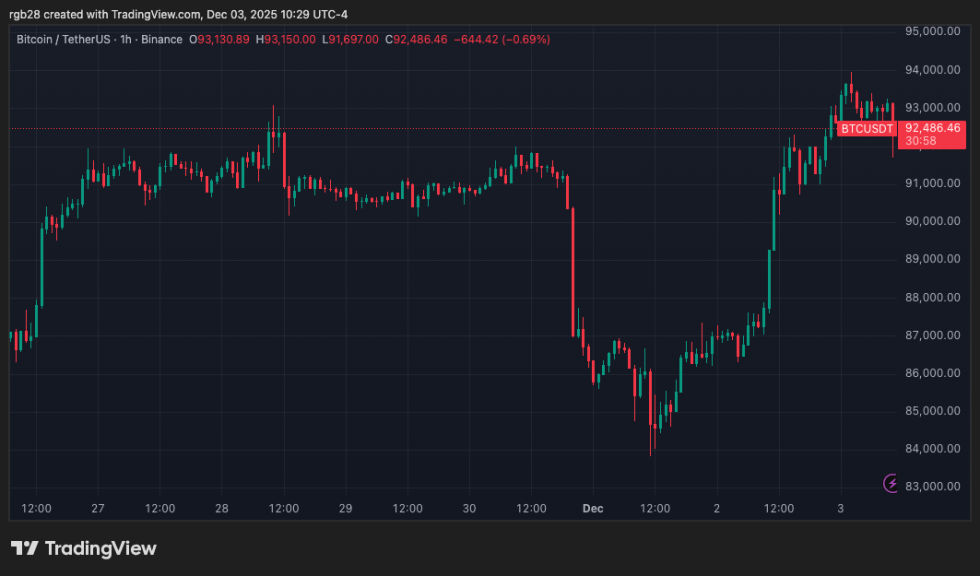
stablecoin, bitcoin, btc, btcusdt

Bitcoin (BTC) trades at $92,488 in the one-week chart. Source: BTCUSDT on TradingView
Featured Image from Unsplash.com, Chart from TradingView.com
Editorial Process for bitcoinist is centered on delivering thoroughly researched, accurate, and unbiased content. We uphold strict sourcing standards, and each page undergoes diligent review by our team of top technology experts and seasoned editors. This process ensures the integrity, relevance, and value of our content for our readers.

Rubmar is a crypto enthusiast who likes learning and improving constantly. She enjoys reporting on the latest news and developments in the crypto industry. Rubmar also enjoys scrapbooking, crafting, simulation games, and watching football.

Lectures associées

« Nous essayons de défendre le Bitcoin » : Pourquoi le BIP-110 perd le soutien de la communauté

La proposition d'amélioration Bitcoin BIP-110, un soft fork controversé, est à nouveau débattue. Adam Back, PDG de Blockstream, estime que les discussions sont alimentées par des idées fausses sur l'architecture de Bitcoin. Il reconnaît que les partisans du BIP-110 sont souvent de nouveaux venus bien intentionnés, mais il craint qu'ils ne se désillusionnent en ne comprenant pas pourquoi Bitcoin a rejeté cette proposition. Implémenté en décembre 2025, le BIP-110 visait à limiter les données arbitraires (comme les inscriptions Ordinals) pour prévenir le spam et préserver la fonction première de Bitcoin en tant que système de paiement pair-à-pair. Back admet le problème du spam mais affirme que Bitcoin le gère déjà via des mécanismes de marché (frais, incitations des mineurs, consensus décentralisé) plutôt que par des règles restrictives. Il argue également que le BIP-110 va à l'encontre de la nature sans permission de Bitcoin. Selon lui, une bifurcation basée sur cette proposition aurait peu de chances de succès, par manque de soutien communautaire et parce qu'elle contredit les principes fondamentaux du réseau. Michael Saylor rejoint ces critiques. Le soutien au BIP-110 reste faible, avec seulement 10 blocs sur 2 016 ayant appuyé une mise à niveau temporaire début juillet. Parallèlement, l'activité Ordinals a chuté à des niveaux historiquement bas, avec moins de 10 000 inscriptions quotidiennes. Le prix du Bitcoin a, quant à lui, baissé de 45% sur un an.

ambcryptoIl y a 17 mins

« Nous essayons de défendre le Bitcoin » : Pourquoi le BIP-110 perd le soutien de la communauté

ambcryptoIl y a 17 mins

Le succès de Robinhood Chain prouve qu'Ethereum n'est pas mort

Le succès de Robinhood Chain prouve qu'Ethereum est plus vivant que jamais. Contrairement aux affirmations selon lesquelles les entreprises réelles éviteraient les L1/L2, Robinhood a précisément choisi le modèle L1+L2 d'Ethereum pour sa blockchain dédiée. La plateforme utilise Ethereum pour le règlement, la disponibilité des données (via les blobs) et la sécurité, tout en adoptant ETH comme token de gaz natif. Cet exemple illustre un changement de paradigme dans la crypto : l'ère de la monétisation des tokens cède la place à une économie on-chain axée sur des modèles commerciaux en espèces réels. Les entreprises traditionnelles cherchant à optimiser leurs activités existantes privilégient désormais l'infrastructure pour ses avantages commerciaux – réduction des risques, contrôle, personnalisation et accès à la liquidité – plutôt que pour promouvoir un token natif. La structure en « haltère » d'Ethereum répond parfaitement à ces besoins : la couche L1 offre une base décentralisée, neutre et liquide, tandis que les L2 permettent un environnement d'exécution hautement performant, personnalisable et contrôlé par l'opérateur. Cette approche évite aux entreprises de supporter le coût et la complexité de créer et maintenir une L1 souveraine. Comme Robinhood et Coinbase (avec Base) l'ont démontré, le choix d'une L2 Ethereum est une décision commerciale rationnelle, et non idéologique. Cette tendance devrait renforcer le réseau Ethereum et l'utilité de l'ETH, car son intégration dans les produits grand public accroîtra sa distribution, sa liquidité et son effet de réseau monétaire. Robinhood n'est pas une exception, mais un signal fort de l'avenir des blockchains pour les entreprises réelles.

Odaily星球日报Il y a 4 h

Le succès de Robinhood Chain prouve qu'Ethereum n'est pas mort

Odaily星球日报Il y a 4 h

Trading

Spot
活动图片