$HYPER Predicted to Jump 2390% Viral Presale Nears $14M

bitcoinistPublié le 2025-09-04Dernière mise à jour le 2025-09-04

Résumé

Imagine a world where the internet was stuck in the 1990s, with dial-up speeds, clunky websites, and no streaming video....

Trusted Editorial content, reviewed by leading industry experts and seasoned editors. Ad Disclosure

Imagine a world where the internet was stuck in the 1990s, with dial-up speeds, clunky websites, and no streaming video.

That’s where Bitcoin is today when it comes to speed and scalability. While it’s the GOAT of crypto and a fortress of value, its core design is rooted in a different era. At a sluggish seven transactions per second (TPS), it’s a far cry from modern needs. Think about it: a single Taylor Swift concert ticket sale would bring the entire network to its knees.

This is about utility and speed, though. Bitcoin’s limited programming capabilities mean it’s sort of like a fancy spreadsheet for keeping track of who owns what. You can’t build complex apps or the DeFi systems of the future on it.

This bottleneck has created an opening, a massive need for a solution that can take Bitcoin from being ‘digital gold’ to the foundation of a supercharged digital economy. And here to heed the call is Bitcoin Hyper ($HYPER).

The Genius of Bitcoin Hyper ($HYPER): Supercharging the King

Bitcoin Hyper ($HYPER) is a project that isn’t trying to dethrone Bitcoin. Instead, it’s building a turbocharger for it. It’s the difference between a dial-up modem and a fiber-optic connection.

Bitcoin Hyper is a Layer-2 scaling solution that borrows the best of both worlds: the garrisonesque security of $BTC and the mind-blowing speed and programmability of the Solana Virtual Machine (SVM).
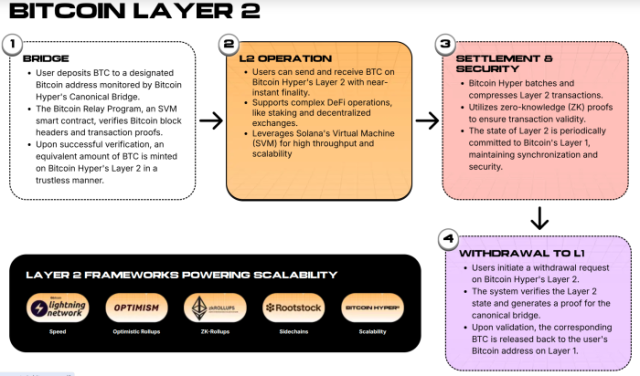
Bitcoin Hyper Layer-2 explanation.

How exactly does this happen? First, you use the Canonical Bridge, a secure two-way tunnel, to move your $BTC from the main chain to this new network. Your real Bitcoin doesn’t actually move; it’s locked in a secure location, and a wrapped version is created on Bitcoin Hyper, ready for use.

Once your wrapped Bitcoin is on the Hyper network, the SVM takes over. This is the powerful engine that enables the creation of dApps, DeFi protocols, and even new tokens and NFTs.

The SVM allows for extremely fast smart contract execution, something that’s not available on the main Bitcoin network. In a nutshell, Bitcoin Hyper ($HYPER) gives Bitcoin the programmability of Solana while keeping the core security of its original blockchain.

The native $HYPER token powers this new ecosystem, used for everything from transaction fees to network governance.

The Hype is Real: A Presale for the History Books

You know a project’s onto something when it’s moments away from hitting the $14M mark in its ongoing presale. It shows that the market wants what Bitcoin Hyper is selling. The financial side is simple: the presale price is a fraction of what the token is expected to be worth when it hits public exchanges.

Bitcoin Hyper promo post on X.

In our ‘Bitcoin Hyper ($HYPER) Price Prediction’, we think there’s a chance $HYPER could make it to the lofty heights of $0.32 by the end of 2025. If you invested today, that would give a staggering 2390% ROI, and who doesn’t want that!

This creates a powerful incentive for early birds. Plus, there are high-yield staking rewards currently sitting at 79% for those who commit to the long-term vision. It’s a classic case of supply and demand, with the demand being off the charts.

Get your $HYPER today while it’s still at $0.012855.

Why This One Hits Different: A Hybrid Revolution

This is a category-defining innovation. Unlike the other networks that primarily focus on payments, Bitcoin Hyper is building a complete, programmable ecosystem. It’s taking Bitcoin’s reputation and combining it with the developer-friendly, high-performance environment of Solana.

This hybrid approach makes it unique. It’s the best of both worlds. The project’s strategy is brilliant; it appeals to a technical crowd with its robust architecture while attracting a broader market with its vision and branding.

This combination of a solid foundation and viral marketing is why it’s standing out in a crowded space. It’s little wonder the big players have also been circling the presale. August alone saw two whales buys of $161.3K and $100.6K.

Don’t miss your chance to buy $Hyper at its current early-bird price. Want to find out how? We’ll take you through each step in our How to Buy Bitcoin Hyper ($HYPER) guide.

Hype vs. Reality

Bitcoin Hyper ($HYPER) is an exciting project, no doubt. It makes Bitcoin relevant again, and if it succeeds, it can unlock a tidal wave of new value for the OG digital gold. $HYPER’s presale success is hard to ignore.

But remember this is crypto. The hype is real, but so is the risk. Before you dive in, do your own research, and only invest what you feel comfortable losing. This isn’t financial advice, and while you may see a good return, you may also see yourself losing it all.

Authored by Ben Wallis, Bitcoinist – https://bitcoinist.com/bitcoin-hyper-predicted-to-jump-2390-presale-raises-13-7m 

Editorial Process for bitcoinist is centered on delivering thoroughly researched, accurate, and unbiased content. We uphold strict sourcing standards, and each page undergoes diligent review by our team of top technology experts and seasoned editors. This process ensures the integrity, relevance, and value of our content for our readers.

Ben is a freelance writer specializing in crypto developments (mainly altcoins) and the intricate ways global economics shape the digital asset space. His B.Ed. in Education provides a unique foundation for his writing, enabling him to distill complex crypto concepts and market shifts into clear, digestible insights. This skill is key to helping readers adapt and apply their understanding to the ever-evolving world of crypto investment. Passionate about making crypto accessible, Ben crafts content designed to educate a broad audience, from current market events to the essential foundational knowledge that underpins them. His goal is to empower readers through understanding. When he’s not immersed in crypto analysis and breaking down complex topics, Ben is an avid Pokémon fan and enjoys all things Disney.

Lectures associées

Rééquilibrage du pouvoir entre Apple et les « Microns » : Décortiquer la facture des bénéfices derrière l'iPhone

Un rapport récent analyse la répartition des profits dans l'iPhone d'Apple, démontrant un rééquilibrage du pouvoir au profit des fabricants de mémoire comme Micron. Alors qu'Apple conserve historiquement environ 25% du profit par iPhone, la part des fabricants de mémoire est passée d'environ 2% (époque iPhone X) à 12-15% du coût des matériaux (iPhone 17), leurs prix ayant considérablement augmenté. Cette inversion de tendance est principalement alimentée par la demande explosive de l'IA, qui détourne la production de mémoire (notamment le HBM et le DDR5 haut de gamme) des marchés grand public comme celui des smartphones. Le PDG d'Apple, Tim Cook, a décrit cette pression sur les coûts comme un événement sans précédent en 40 ans, conduisant à des hausses de prix sur plusieurs produits Apple. Les fabricants de mémoire, autrefois soumis à la forte pression tarifaire d'Apple, profitent désormais d'une position de force. La profitabilité record de Micron illustre ce changement. Face à cette pénurie, Apple explorerait même l'approvisionnement auprès du fabricant chinois CXMT pour diversifier ses sources. L'article conclut que l'ère de la domination absolue d'Apple sur sa chaîne d'approvisionnement en mémoire pourrait prendre fin, cédant la place à une dynamique plus équilibrée.

Odaily星球日报Il y a 1 h

Rééquilibrage du pouvoir entre Apple et les « Microns » : Décortiquer la facture des bénéfices derrière l'iPhone

Odaily星球日报Il y a 1 h

Les huit pères du Transformer, où sont-ils aujourd'hui ?

En juin 2026, Google a été marqué par le départ de deux figures clés : Noam Shazeer, co-auteur du Transformateur, et John Jumper d'AlphaFold. Ce dernier a rejoint OpenAI, ce qui a provoqué une forte réaction des marchés et des inquiétudes quant à l'exode des talents de Google. Cet événement a remis en lumière les huit co-auteurs de l'article fondateur « Attention Is All You Need » (2017), qui ont tous quitté Google. Ce modèle révolutionnaire a remplacé les réseaux neuronaux récurrents (RNN) par un mécanisme d'attention permettant le traitement parallèle, devenant la base de l'IA moderne. Aujourd'hui, leurs trajectoires sont diverses : * **Ashish Vaswani**, après avoir cofondé Adept AI et Essential AI, serait en pourparlers pour rejoindre NVIDIA. * **Noam Shazeer** a quitté Google une seconde fois pour OpenAI après avoir fondé et revendu Character.AI. * **Niki Parmar** a cofondé Essential AI avant de rejoindre Anthropic. * **Jakob Uszkoreit** a cofondé Inceptive, une entreprise de biotechnologie utilisant l'IA pour la conception de médicaments à base d'ARN. * **Llion Jones** a cofondé Sakana AI au Japon, une société axée sur des modèles collaboratifs inspirés de la nature. * **Aidan N. Gomez** a cofondé Cohere, une entreprise spécialisée dans l'IA pour les entreprises, plaidant pour la souveraineté numérique. * **Łukasz Kaiser** a rejoint OpenAI où il a contribué aux modèles de raisonnement comme o1 et GPT-4. * **Illia Polosukhin** a cofondé NEAR Protocol, une plateforme blockchain qu'il voit comme la future infrastructure pour les agents IA. En 2024, sept des huit auteurs se sont réunis lors du GTC de NVIDIA, recevant un hommage pour avoir « transformé le monde ». Pourtant, malgré leur succès, ils partagent une conviction : le Transformateur n'est pas une fin en soi. Leur héritage réside dans leur quête continue du prochain paradigme qui devra être « nettement, indéniablement meilleur ». Leurs chemins séparés continuent d'explorer les frontières de l'IA.

marsbitIl y a 1 h

Les huit pères du Transformer, où sont-ils aujourd'hui ?

marsbitIl y a 1 h

La réponse chinoise à la puissance de calcul spatial : plus efficace avec les photons, Musk et Huang Renxun prennent un chemin trop détourné

La course à la puissance de calcul spatial est devenue une véritable course aux armements. Elon Musk prédit que d'ici 2032, les satellites d'IA spatiaux alimentés à l'énergie solaire deviendront la solution informatique la plus rentable au monde. Cependant, les défis techniques dans l'espace sont bien plus rudes que sur Terre : absence de convection pour le refroidissement, exposition aux rayonnements cosmiques et contraintes énergétiques sévères. Le calcul optique, utilisant des photons plutôt que des électrons, apparaît comme une solution naturelle pour le spatial. Il offre trois avantages décisifs : une immunité naturelle aux particules énergétiques, une dissipation thermique quasi nulle et une consommation d'énergie très faible. Ces propriétés permettent d'envisager une densité de calcul supérieure pour un poids et un volume de charge utile équivalents, contournant ainsi certaines limites physiques de l'électronique traditionnelle. Le cœur de cette technologie repose sur l'exécution ultra-rapide des opérations de matrice pour l'IA via la propagation de la lumière. Malgré des défis persistants, comme l'intégration à grande échelle et la séparation mémoire/calcul, des architectures innovantes comme le calcul en mémoire photonique émergent pour les surmonter. La route vers un déploiement commercial à grande échelle reste longue, nécessitant de valider la robustesse des systèmes durant le lancement et en orbite. Si le calcul spatial parvient à atteindre un coût inférieur à celui des solutions terrestres ou à offrir des services uniques, le calcul optique, avec son potentiel de "calcul et interconnexion par la lumière", pourrait bien être la carte maîtresse pour repousser les plafonds de performance dans cette nouvelle frontière.

marsbitIl y a 2 h

La réponse chinoise à la puissance de calcul spatial : plus efficace avec les photons, Musk et Huang Renxun prennent un chemin trop détourné

marsbitIl y a 2 h

Trading

Spot
活动图片