Crypto Adoption Continues: Apple, X, Airbnb Exploring Stablecoin Integration – Report

bitcoinistPublié le 2025-06-07Dernière mise à jour le 2025-06-07

Résumé

As US lawmakers work on passing crucial crypto-related legislation, multiple tech giants are reportedly exploring the adoption of stablecoins to...

Trusted Editorial content, reviewed by leading industry experts and seasoned editors. Ad Disclosure

As US lawmakers work on passing crucial crypto-related legislation, multiple tech giants are reportedly exploring the adoption of stablecoins to lower transaction costs and streamline cross-border payments.

Apple, Airbnb, X Eye Stablecoin Integration

On Friday, Fortune reported that multiple Big Tech companies are in early conversations with crypto firms to integrate stablecoins. Sources familiar with the matter told the new media outlet that Apple, X, Airbnb, and Google are exploring the adoption of stablecoins to optimize cross-border payments and transaction costs.

According to the report, Airbnb has been in talks with crypto companies since the beginning of the year, working to reduce the cost of transaction fees from payment processors like Visa and Mastercard by adopting stablecoins.

The short-term home rental platform has allegedly discussed the stablecoin integration with Worldpay, one of its payment processors, a crypto company executive said. Notably, Worldpay recently announced that it would enable stablecoin payouts with the stablecoin infrastructure company BNVK.

An Airbnb spokesperson affirmed that, “While crypto payments aren’t something we’re focused on integrating into the platform in the near future, we’re always looking at all aspects of payments for ways to improve our community’s experience with it, including developments in digital assets and their use cases.”

Similarly, Apple has been in conversations since January to integrate stablecoins into its payment infrastructure, four sources told Fortune. These talks have reportedly included discussions with a senior director at Circle, who works as a “strategic partnerships in stablecoin payments.”

Social media platform X has also recently been in touch with crypto companies about integrating stablecoins into its new payments app, X Money. Seemingly, Elon Musk’s platform is in talks with payments processor Stripe for the integration.

Patrick Traughber, X’s former head of consumer products and payments, reportedly led the discussions before leaving the company in January to work on the Sam Altman-backed crypto project World. Now, Payam Abedi, a senior software engineer at X, is allegedly leading the conversations.

More Tech Giants Explore Crypto Adoption

Google Cloud is “arguably the furthest along on stablecoin integrations,” the report started, as the tech giant has already accepted payments from two of its customers in PayPal’s PYSUD, which recently saw the Securities and Exchange Commission (SEC) end its probe into the stablecoin with no enforcement action.

Rich Widmann, head of Web3 strategy at Google Cloud, told the news media outlet that “It’s pretty clear that this is probably one of the biggest upgrades to payments since the SWIFT network.”

“We’ve invoiced the customer like we would normally invoice them. They’ve paid that bill the way they would normally pay it. But they’ve used stablecoins to effectuate settlement,” he explained.

The report noted that other Big Tech companies, including Meta, are also exploring stablecoins. On Thursday, Uber CEO Dara Khosrowshahi stated that the company is in the “study” phase of stablecoins for global money transfers.

Meanwhile, Haun Ventures partner Chris Ahn said, “[Stablecoins] are this old idea, but finally I think we’ve got the right pieces coming together such that it’s really coming into fruition.”

It’s worth noting that, under the Trump administration, the US regulatory agencies have pivoted away from a “regulation by enforcement” approach, seeking to establish detailed guidelines and a clear framework for the crypto industry.

The recent change has pushed the industry’s adoption to new levels, with numerous Strategic Bitcoin Reserve proposals and Treasury plans making the headlines. Additionally, US lawmakers continue their bipartisan efforts to advance the Guiding and Establishing National Innovation for US Stablecoins (GENIUS) Act, a legislation aiming to allow the growth of the stablecoin industry in the US.
crypto, Bitcoin, BTC, BTCUSDT

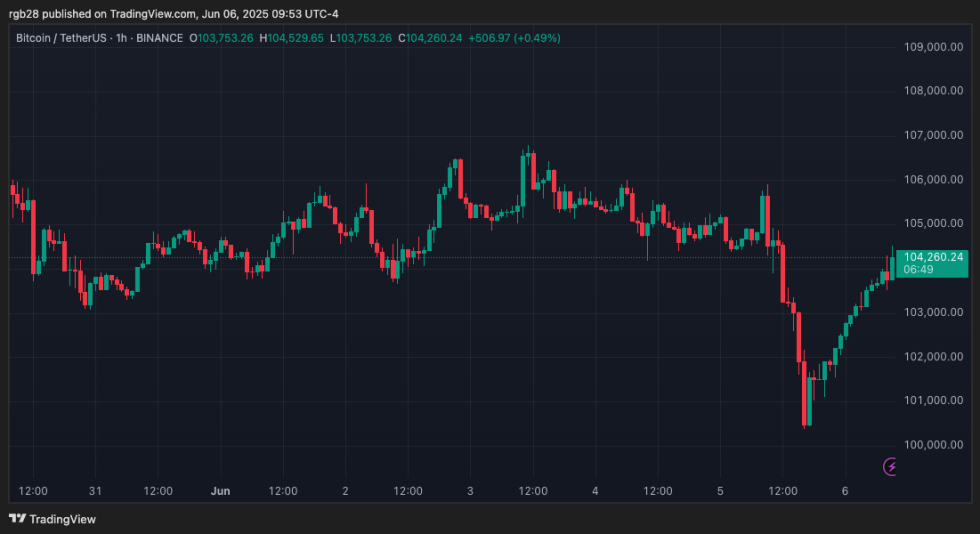
Bitcoin (BTC) trades at $104,260 in the one-week chart. Source: BTCUSDT on TradingView
Featured Image from Unsplash.com, Chart from TradingView.com
Editorial Process for bitcoinist is centered on delivering thoroughly researched, accurate, and unbiased content. We uphold strict sourcing standards, and each page undergoes diligent review by our team of top technology experts and seasoned editors. This process ensures the integrity, relevance, and value of our content for our readers.

Rubmar is a crypto enthusiast who likes learning and improving constantly. She enjoys reporting on the latest news and developments in the crypto industry. Rubmar also enjoys scrapbooking, crafting, simulation games, and watching football.

Lectures associées

Tout sur l'ajout de 454 Bitcoins par CleanSpark et ce que cela signifie

L'entreprise cotée en bourse CleanSpark a ajouté 454 Bitcoins à son trésor, portant son total à 13 924 BTC, d'une valeur de 897,1 millions de dollars. En 2026, l'entreprise a vendu 258 BTC et en a acquis 1 171. Son action a progressé d'environ 28% depuis le début de l'année, tandis que le prix du Bitcoin a baissé de 42%. Par ailleurs, le New Hampshire examine une proposition permettant à un emprunteur lié à CleanSpark d'acheter des Bitcoins avec jusqu'à 100 millions de dollars d'obligations. D'autres sociétés ont également accru leurs réserves en juin et juillet. Les entreprises publiques ont ajouté près de 9 000 BTC en juin, Strategy et Strive étant les principaux acheteurs. En juillet, Strive, American Bitcoin Corp., Boyaa Interactive et OranjeBTC ont poursuivi leurs acquisitions. Cependant, un revirement notable est survenu : Strategy, le plus grand détenteur institutionnel de Bitcoin, a vendu 3 588 BTC pour environ 216 millions de dollars, invoquant une gestion active de son bilan et non une vision baissière. En parallèle, les ETF sur Bitcoin ont enregistré des entrées de 510,7 millions de dollars et des sorties de 475,3 millions de dollars en juillet. En résumé, CleanSpark a renforcé ses réserves de BTC, suivant une tendance générale d'accumulation par les entreprises publiques, malgré la vente stratégique importante de Strategy.

ambcryptoIl y a 56 mins

Tout sur l'ajout de 454 Bitcoins par CleanSpark et ce que cela signifie

ambcryptoIl y a 56 mins

SK Hynix fuit la Corée du Sud

SK Hynix, un leader sud-coréen de la mémoire (HBM), a réalisé une introduction en bourse record de 26,5 milliards de dollars sur le Nasdaq, malgré une rentabilité exceptionnelle (77 % de marge nette au T1 2024). Cette démarche ne vise pas principalement à lever des fonds, mais à corriger sa sous-évaluation chronique sur la Bourse de Séoul, où son P/E était d'environ 8 fois, contre plus de 23 fois pour son concurrent américain Micron. Cet écart, connu sous le nom de "Korea Discount", est dû à la moindre liquidité et à l'accès limité aux capitaux mondiaux du marché sud-coréen. En se listant aux États-Unis, SK Hynix cherche à obtenir une valorisation reflétant mieux son rôle dominant dans l'ère de l'IA, où il détient 56,4 % du marché mondial des HBM, composants essentiels pour les GPU d'Nvidia. Cette migration vers le Nasdaq est aussi une nécessité stratégique face aux investissements colossaux requis par l'IA. La future génération HBM4 nécessitera des puces logiques en nano-fabrication, impliquant des coûts de R&D et de production exponentiels. Pour financer cette course technologique face à Micron et Samsung, SK Hynix a besoin d'accéder au plus grand bassin de capitaux mondiaux, plus tolérant au risque et offrant un meilleur effet de levier financier. Ainsi, SK Hynix ne "fuit" pas la Corée, où ses usines restent implantées, mais déplace le siège de sa valorisation vers le centre mondial du capital technologique. Cette décision illustre comment, dans la compétition mondiale de l'IA, l'efficacité du capital est devenue une arme aussi cruciale que l'innovation technologique.

marsbitIl y a 2 h

SK Hynix fuit la Corée du Sud

marsbitIl y a 2 h

8 billions de yuans, la seconde plus grande introduction en Bourse de l’histoire arrive

Un moment historique : SK Hynix, leader mondial de la mémoire, a fait ses débuts au Nasdaq le 10 juillet, avec une capitalisation boursière atteignant 8 300 milliards de yuans. Son introduction en bourse de 26,5 milliards de dollars est la deuxième plus importante de l'histoire, derrière SpaceX. Née en 1983 du groupe Hyundai, l'entreprise, alors au bord de la faillite, a été reprise par SK Group en 2011. Son pari sur la mémoire HBM (High Bandwidth Memory), développée dès 2013, a porté ses fruits avec l'essor de l'IA. Aujourd'hui, elle détient 58% du marché HBM et est un fournisseur clé pour NVIDIA. Le cycle du marché est exceptionnel : au premier trimestre 2026, SK Hynix a affiché une marge opérationnelle de 72%. Ses bénéfices records permettent des primes annuelles substantielles pour ses employés. Cette super-cycle, porté par la demande en calcul pour l'IA, devrait durer jusqu'en 2028. Cette dynamique profite aussi aux acteurs chinois. ChangXin Technology, le premier fabricant de DRAM de Chine, entrera en Bourse le 16 juillet, avec une valorisation potentielle de 3 000 milliards de yuans. Yangtze Memory a également initié son processus d'introduction en bourse. Bien que des écarts technologiques persistent avec les leaders mondiaux, l'ascension des champions chinois de la mémoire est en marche, marquant une nouvelle phase dans la course mondiale aux semi-conducteurs.

marsbitIl y a 2 h

8 billions de yuans, la seconde plus grande introduction en Bourse de l’histoire arrive

marsbitIl y a 2 h

Trading

Spot
活动图片