Cardano Unveils 39 Proposals Under New Budget Framework

bitcoinistPublié le 2025-06-07Dernière mise à jour le 2025-06-07

Résumé

Cardano’s governance experiment took a decisive step forward on 5 June, when Intersect—a member-based organisation tasked with stewarding the blockchain’s...

Trusted Editorial content, reviewed by leading industry experts and seasoned editors. Ad Disclosure

Cardano’s governance experiment took a decisive step forward on 5 June, when Intersect—a member-based organisation tasked with stewarding the blockchain’s transition to on-chain self-rule—published its first Budget Info Action (BIA). The nine-minute overview lays out 39 community-driven proposals that Delegated Representatives (DReps) have already signalled for funding. “The Budget Info Action brings together 39 proposals that reflect where the community sees opportunities, needs, and momentum,” Intersect explained, stressing that the roadmap was drafted “by a network of builders, researchers, developers, and contributors working together to deliver real value.”

Cardano’s Next Chapter Begins

The package reveals where Cardano’s stakeholders think resources will matter most over the next 18 months. Nearly half the proposals address performance at the protocol layer. Input Output Global (IOG) seeks continued maintenance budgets for Hydra, its off-chain state-channel suite, and Mithril, the fast-sync protocol designed to make full-node deployment as effortless as setting up a light wallet.

IOG also asks for funding to refine stake-pool-operator (SPO) incentives, overhaul fee mechanics, and roll out new developer-testing pipelines. Two experimental designs—Leios and Peras—would push finality toward sub-second territory and multiply throughput without compromising decentralisation. Tweag, best known for its Haskell and formal-verification expertise, proposes multi-year stewardship of the critical libraries on which both the consensus layer and off-chain tooling depend.

Governance tooling emerges as the second-largest theme. A refreshed “Catalyst 2.0” initiative would wire treasury voting directly into CIP-1694 governance flows, ending the separation between project funding rounds and constitutional decision-making. Complement Catalyst—a proposal from social-impact startup Socious—introduces quadratic funding weighted by on-chain reputation scores, a mechanism it says will “boost fairness, transparency, and community impact.” Cardano Builder DAO wants a smart-contract-controlled endowment that can approve application-layer grants autonomously, while the “Beyond Minimum Viable Governance” report promises the first data-driven audit of how Voltaire-era institutions are actually functioning in practice.

Developer experience and open-source infrastructure form the third pillar. MLabs asks to maintain Plutarch, CardanoOps, and Hermes, three projects it argues “remove friction for DApp teams by letting them focus on product, not plumbing.” Pallas would continue curating the Rust libraries that power lightweight indexers and explorers, while Blockfrost seeks to keep its plug-and-play API free at the point of use. NFTCDN proposes a global, cost-free content-delivery network for native assets so marketplaces can serve media files “with Web-2 latency but Web-3 integrity.”

A cluster of proposals focuses on resilience and security. Dolos, a lightweight data-node implementation, promises “high-integrity ledger queries with minimal resource overhead,” a feature aimed at mobile developers and IoT deployers. TxPipe wants to maintain its open-source RPC server that already backs dozens of wallets, explorers, and analytics dashboards. In parallel, Eternl requests funds for ongoing hardware-wallet integration, and an independent team proposes a full rewrite of Ledger’s Cardano application to unlock advanced multi-sig features. Sundae Labs and Xerberus have submitted an auditable smart-contract framework that will govern how treasury withdrawals are disbursed, exposing live dashboards so ADA holders can watch spending as it happens.

Education, outreach, and real-world adoption round out the slate. Discover Cardano plans branded pavilions at major tech expos, offering what it calls “shared spaces to amplify the voice of Cardano’s community and lower barriers for builders.” A linked proposal seeks to centralise global events marketing so that every Summit-style gathering has consistent branding and clear onboarding funnels. On the utility front, Anzens wants funds to expand access to USDA, a USD-backed stable-asset issued natively on Cardano, through exchange listings, institutional custody, and cross-border settlement pilots. Meanwhile, MLabs’ cryptography team outlines a toolkit for privacy-preserving smart contracts that could enable anonymous voting, shielded identity credentials, and confidential DeFi.

What’s Next?

Each item in the BIA is advisory for now. Under CIP-1694, ADA holders have a 30-day review window to approve or reject the bundle. If passed, Intersect will translate the document into one or more Treasury Withdrawal actions that carry hard spending authority and require a two-thirds super-majority on-chain. The organisation has floated splitting the withdrawals into tranches so that “funds are released only as milestones are met,” a safeguard meant to reassure both sceptical stakeholders and external regulators that Cardano can allocate capital with the same rigour expected of a public-sector budget.

In publishing the BIA, Intersect framed the moment as a stress-test for decentralised governance. “This isn’t just a budget,” the post reads. “It’s a signal that Cardano’s ecosystem is ready to deliver.” If the community ratifies the 39-proposal slate, Cardano will move beyond ad-hoc Catalyst rounds toward a predictable, constitutional funding cycle—transforming Voltaire’s aspirational blueprint into the network’s first working balance sheet.

At press time, ADA traded at $0.661.
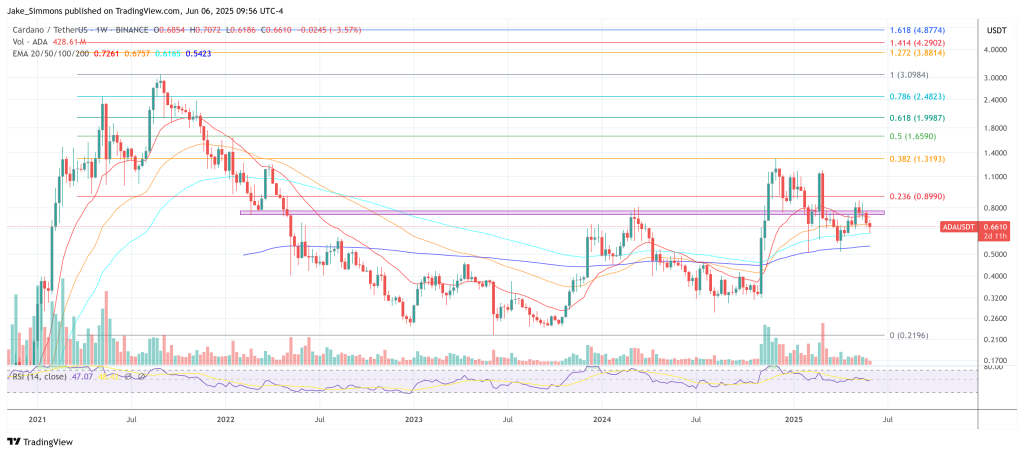
Cardano price
ADA price, 1-week chart | Source: ADAUSDT on TradingView.com
Featured image created with DALL.E, chart from TradingView.com
Editorial Process for bitcoinist is centered on delivering thoroughly researched, accurate, and unbiased content. We uphold strict sourcing standards, and each page undergoes diligent review by our team of top technology experts and seasoned editors. This process ensures the integrity, relevance, and value of our content for our readers.

Jake Simmons has been a Bitcoin enthusiast since 2016. Ever since he heard about Bitcoin, he has been studying the topic every day and trying to share his knowledge with others. His goal is to contribute to Bitcoin's financial revolution, which will replace the fiat money system. Besides BTC and crypto, Jake studied Business Informatics at a university. After graduation in 2017, he has been working in the blockchain and crypto sector. You can follow Jake on Twitter at @realJakeSimmons.

Cryptos en tendance

Lectures associées

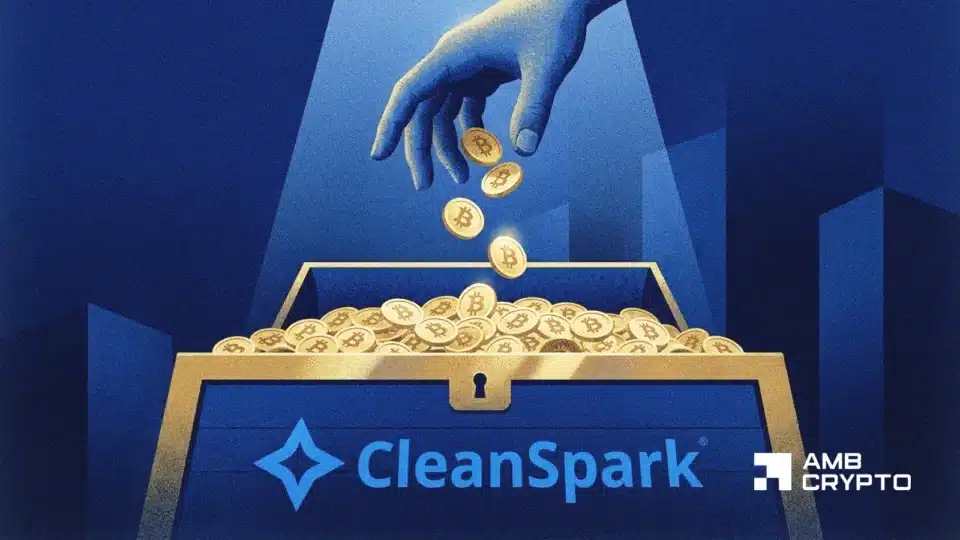
Tout sur l'ajout de 454 Bitcoins par CleanSpark et ce que cela signifie

L'entreprise cotée en bourse CleanSpark a ajouté 454 Bitcoins à son trésor, portant son total à 13 924 BTC, d'une valeur de 897,1 millions de dollars. En 2026, l'entreprise a vendu 258 BTC et en a acquis 1 171. Son action a progressé d'environ 28% depuis le début de l'année, tandis que le prix du Bitcoin a baissé de 42%. Par ailleurs, le New Hampshire examine une proposition permettant à un emprunteur lié à CleanSpark d'acheter des Bitcoins avec jusqu'à 100 millions de dollars d'obligations. D'autres sociétés ont également accru leurs réserves en juin et juillet. Les entreprises publiques ont ajouté près de 9 000 BTC en juin, Strategy et Strive étant les principaux acheteurs. En juillet, Strive, American Bitcoin Corp., Boyaa Interactive et OranjeBTC ont poursuivi leurs acquisitions. Cependant, un revirement notable est survenu : Strategy, le plus grand détenteur institutionnel de Bitcoin, a vendu 3 588 BTC pour environ 216 millions de dollars, invoquant une gestion active de son bilan et non une vision baissière. En parallèle, les ETF sur Bitcoin ont enregistré des entrées de 510,7 millions de dollars et des sorties de 475,3 millions de dollars en juillet. En résumé, CleanSpark a renforcé ses réserves de BTC, suivant une tendance générale d'accumulation par les entreprises publiques, malgré la vente stratégique importante de Strategy.

ambcryptoIl y a 48 mins

Tout sur l'ajout de 454 Bitcoins par CleanSpark et ce que cela signifie

ambcryptoIl y a 48 mins

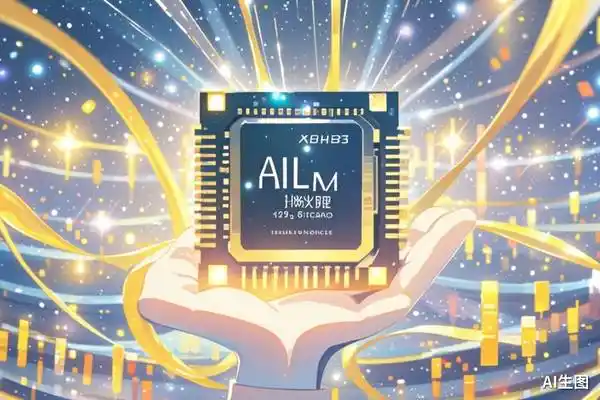
SK Hynix fuit la Corée du Sud

SK Hynix, un leader sud-coréen de la mémoire (HBM), a réalisé une introduction en bourse record de 26,5 milliards de dollars sur le Nasdaq, malgré une rentabilité exceptionnelle (77 % de marge nette au T1 2024). Cette démarche ne vise pas principalement à lever des fonds, mais à corriger sa sous-évaluation chronique sur la Bourse de Séoul, où son P/E était d'environ 8 fois, contre plus de 23 fois pour son concurrent américain Micron. Cet écart, connu sous le nom de "Korea Discount", est dû à la moindre liquidité et à l'accès limité aux capitaux mondiaux du marché sud-coréen. En se listant aux États-Unis, SK Hynix cherche à obtenir une valorisation reflétant mieux son rôle dominant dans l'ère de l'IA, où il détient 56,4 % du marché mondial des HBM, composants essentiels pour les GPU d'Nvidia. Cette migration vers le Nasdaq est aussi une nécessité stratégique face aux investissements colossaux requis par l'IA. La future génération HBM4 nécessitera des puces logiques en nano-fabrication, impliquant des coûts de R&D et de production exponentiels. Pour financer cette course technologique face à Micron et Samsung, SK Hynix a besoin d'accéder au plus grand bassin de capitaux mondiaux, plus tolérant au risque et offrant un meilleur effet de levier financier. Ainsi, SK Hynix ne "fuit" pas la Corée, où ses usines restent implantées, mais déplace le siège de sa valorisation vers le centre mondial du capital technologique. Cette décision illustre comment, dans la compétition mondiale de l'IA, l'efficacité du capital est devenue une arme aussi cruciale que l'innovation technologique.

marsbitIl y a 2 h

SK Hynix fuit la Corée du Sud

marsbitIl y a 2 h

8 billions de yuans, la seconde plus grande introduction en Bourse de l’histoire arrive

Un moment historique : SK Hynix, leader mondial de la mémoire, a fait ses débuts au Nasdaq le 10 juillet, avec une capitalisation boursière atteignant 8 300 milliards de yuans. Son introduction en bourse de 26,5 milliards de dollars est la deuxième plus importante de l'histoire, derrière SpaceX. Née en 1983 du groupe Hyundai, l'entreprise, alors au bord de la faillite, a été reprise par SK Group en 2011. Son pari sur la mémoire HBM (High Bandwidth Memory), développée dès 2013, a porté ses fruits avec l'essor de l'IA. Aujourd'hui, elle détient 58% du marché HBM et est un fournisseur clé pour NVIDIA. Le cycle du marché est exceptionnel : au premier trimestre 2026, SK Hynix a affiché une marge opérationnelle de 72%. Ses bénéfices records permettent des primes annuelles substantielles pour ses employés. Cette super-cycle, porté par la demande en calcul pour l'IA, devrait durer jusqu'en 2028. Cette dynamique profite aussi aux acteurs chinois. ChangXin Technology, le premier fabricant de DRAM de Chine, entrera en Bourse le 16 juillet, avec une valorisation potentielle de 3 000 milliards de yuans. Yangtze Memory a également initié son processus d'introduction en bourse. Bien que des écarts technologiques persistent avec les leaders mondiaux, l'ascension des champions chinois de la mémoire est en marche, marquant une nouvelle phase dans la course mondiale aux semi-conducteurs.

marsbitIl y a 2 h

8 billions de yuans, la seconde plus grande introduction en Bourse de l’histoire arrive

marsbitIl y a 2 h

Trading

Spot

Articles tendance

Comment acheter ADA

Bienvenue sur HTX.com ! Nous vous permettons d'acheter Cardano (ADA) de manière simple et pratique. Suivez notre guide étape par étape pour commencer votre parcours crypto.Étape 1 : Création de votre compte HTXUtilisez votre adresse e-mail ou votre numéro de téléphone pour ouvrir un compte sur HTX gratuitement. L'inscription se fait en toute simplicité et débloque toutes les fonctionnalités.Créer mon compteÉtape 2 : Choix du mode de paiement (rubrique Acheter des cryptosCarte de crédit/débit : utilisez votre carte Visa ou Mastercard pour acheter instantanément Cardano (ADA).Solde :utilisez les fonds du solde de votre compte HTX pour trader en toute simplicité.Prestataire tiers :pour accroître la commodité d'utilisation, nous avons ajouté des modes de paiement populaires tels que Google Pay et Apple Pay.P2P :tradez directement avec d'autres utilisateurs sur HTX.OTC (de gré à gré) : nous offrons des services personnalisés et des taux de change compétitifs aux traders.Étape 3 : stockage de vos Cardano (ADA)Après avoir acheté vos Cardano (ADA), stockez-les sur votre compte HTX. Vous pouvez également les envoyer ailleurs via un transfert sur la blockchain ou les utiliser pour trader d'autres cryptos.Étape 4 : tradez des Cardano (ADA)Tradez facilement Cardano (ADA) sur le marché Spot de HTX. Il vous suffit d'accéder à votre compte, de sélectionner la paire de trading, d'exécuter vos trades et de les suivre en temps réel. Nous offrons une expérience conviviale aux débutants comme aux traders chevronnés.

1.2k vues totalesPublié le 2024.12.10Mis à jour le 2026.06.02

Comment acheter ADA

Discussions

Bienvenue dans la Communauté HTX. Ici, vous pouvez vous tenir informé(e) des derniers développements de la plateforme et accéder à des analyses de marché professionnelles. Les opinions des utilisateurs sur le prix de ADA (ADA) sont présentées ci-dessous.

活动图片