Crypto Groups Urge Congress To Support Blockchain Regulatory Certainty Act To Protect Developers

bitcoinistPublié le 2025-06-06Dernière mise à jour le 2025-06-06

Résumé

A group of eight crypto policy organizations has urged US Congress leaders to support a recently re-introduced bill to protect...

Trusted Editorial content, reviewed by leading industry experts and seasoned editors. Ad Disclosure

A group of eight crypto policy organizations has urged US Congress leaders to support a recently re-introduced bill to protect software developers by including it in market structure legislation.

Crypto Policy Groups Seek Software Developers’ Protection

On Thursday, eight crypto policy organizations shared a joint statement calling for the inclusion of the Blockchain Regulatory Certainty Act (BRCA) in market structure legislation, seeking to offer a safe harbor for software developers and infrastructure providers.

H.R. 3533 was first introduced in 2023 by Republican Representative Tom Emmer and has now been reintroduced on May 21, 2025, as a bipartisan effort, with Democratic Representative Ritchie Torres as a co-sponsor.

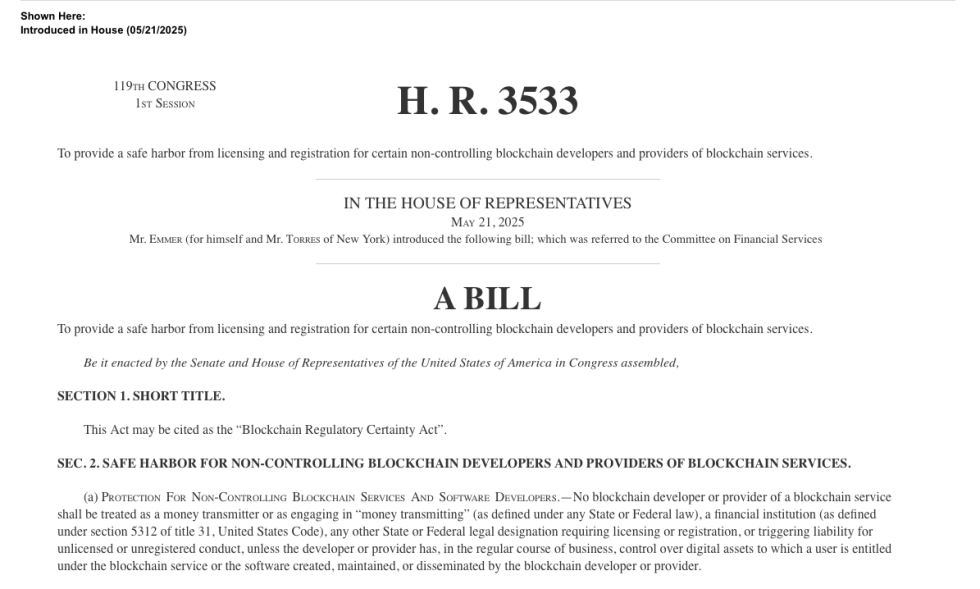
The BRCA is “critical for protecting software developers,” as it proposed that no blockchain developer or provider of a blockchain service “shall be treated as a money transmitter or as engaging in ‘money transmitting’, (…), unless the developer or provider has, in the regular course of business, control over digital assets to which a user is entitled under the blockchain service or the software created, maintained, or disseminated by the blockchain developer or provider.”
crypto

Excerpt from the Blockchain Regulatory Certainty Act. Source: Congress.Gov

The policy groups’ statement affirmed that developers creating peer-to-peer, non-custodial software and infrastructure providers who facilitate decentralized networks have “little in common” with traditional finance institutions. As such, they should not be treated as the same.

“The BRCA acknowledges this reality and ensures that when software developers or blockchain service providers do not control or custody customer funds, they are not inappropriately required to register as ‘money transmitting businesses’ or liable for failing to do so,” the joint statement reads.

A policy lead told journalist Eleanor Terret that “it’s critically important that we don’t treat open-source developers like traditional financial institutions,” adding, “The BRCA draws that line clearly and protects innovation.”

Congress Urged To Provide CLARITY

The crypto coalition, comprised of the DeFi Education Fund, Coin Center, Solana Policy Institute, The Digital Chamber, Blockchain Association, Crypto Council for Innovation, Paradigm, and Bitcoin Policy Institute, urged lawmakers to support the BRCA’s inclusion in the Digital Asset Market Clarity Act of 2025.

We strongly encourage the House of Representatives to include the BRCA in the Digital Asset Market Clarity Act of 2025, and ensure that innovators across America can safely build financial infrastructure here – at home.

The bill, also known as the CLARITY Act, was introduced on May 29 by French Hill, Chairman of the House Financial Services Committee. The bipartisan legislation aims to establish a regulatory framework for crypto assets in the US, providing the long-awaited clarity and protection for the industry.

“Our bill brings long-overdue clarity to the digital asset ecosystem, prioritizes consumer protection and American innovation, and builds off our work in the 118th Congress,” Hill stated. As Terret reported, the Financial Services Committee has scheduled a markup for the CLARITY Act for June 10, 2025, alongside multiple other bills.

The DeFi Education Fund, which has previously advocated for the protection of software developers, concluded on X that “Congress has an opportunity to protect developers of non-custodial peer-to-peer software protocols from being unreasonably targeted for regulation.”
crypto, Bitcoin, BTC, BTCUSDT

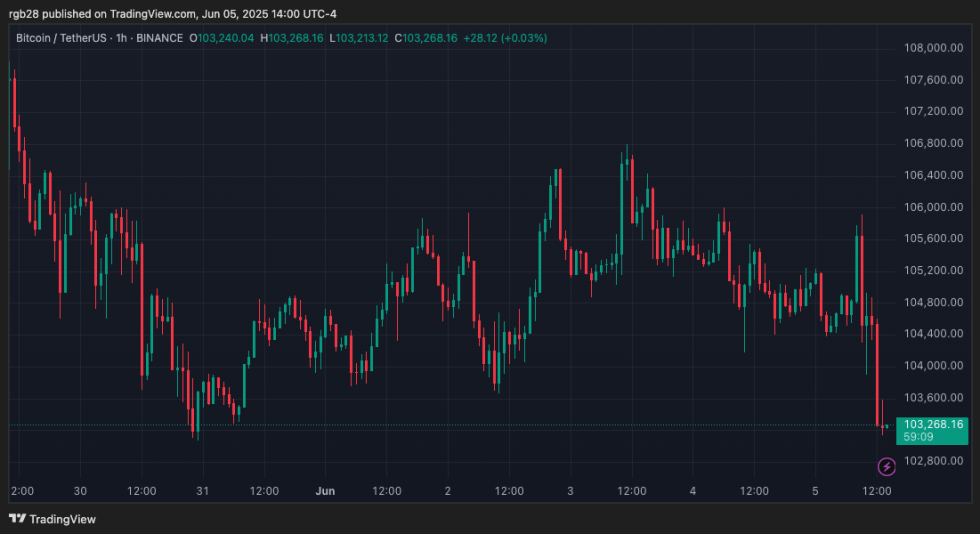
Bitcoin (BTC) trades at $103,266 in the one-week chart. Source: BTCUSDT on TradingView
Featured Image from Unsplash.com, Chart from TradingView.com
Editorial Process for bitcoinist is centered on delivering thoroughly researched, accurate, and unbiased content. We uphold strict sourcing standards, and each page undergoes diligent review by our team of top technology experts and seasoned editors. This process ensures the integrity, relevance, and value of our content for our readers.

Rubmar is a crypto enthusiast who likes learning and improving constantly. She enjoys reporting on the latest news and developments in the crypto industry. Rubmar also enjoys scrapbooking, crafting, simulation games, and watching football.

Lectures associées

SK Hynix fuit la Corée du Sud

SK Hynix, un leader sud-coréen de la mémoire (HBM), a réalisé une introduction en bourse record de 26,5 milliards de dollars sur le Nasdaq, malgré une rentabilité exceptionnelle (77 % de marge nette au T1 2024). Cette démarche ne vise pas principalement à lever des fonds, mais à corriger sa sous-évaluation chronique sur la Bourse de Séoul, où son P/E était d'environ 8 fois, contre plus de 23 fois pour son concurrent américain Micron. Cet écart, connu sous le nom de "Korea Discount", est dû à la moindre liquidité et à l'accès limité aux capitaux mondiaux du marché sud-coréen. En se listant aux États-Unis, SK Hynix cherche à obtenir une valorisation reflétant mieux son rôle dominant dans l'ère de l'IA, où il détient 56,4 % du marché mondial des HBM, composants essentiels pour les GPU d'Nvidia. Cette migration vers le Nasdaq est aussi une nécessité stratégique face aux investissements colossaux requis par l'IA. La future génération HBM4 nécessitera des puces logiques en nano-fabrication, impliquant des coûts de R&D et de production exponentiels. Pour financer cette course technologique face à Micron et Samsung, SK Hynix a besoin d'accéder au plus grand bassin de capitaux mondiaux, plus tolérant au risque et offrant un meilleur effet de levier financier. Ainsi, SK Hynix ne "fuit" pas la Corée, où ses usines restent implantées, mais déplace le siège de sa valorisation vers le centre mondial du capital technologique. Cette décision illustre comment, dans la compétition mondiale de l'IA, l'efficacité du capital est devenue une arme aussi cruciale que l'innovation technologique.

marsbitIl y a 1 h

SK Hynix fuit la Corée du Sud

marsbitIl y a 1 h

8 billions de yuans, la seconde plus grande introduction en Bourse de l’histoire arrive

Un moment historique : SK Hynix, leader mondial de la mémoire, a fait ses débuts au Nasdaq le 10 juillet, avec une capitalisation boursière atteignant 8 300 milliards de yuans. Son introduction en bourse de 26,5 milliards de dollars est la deuxième plus importante de l'histoire, derrière SpaceX. Née en 1983 du groupe Hyundai, l'entreprise, alors au bord de la faillite, a été reprise par SK Group en 2011. Son pari sur la mémoire HBM (High Bandwidth Memory), développée dès 2013, a porté ses fruits avec l'essor de l'IA. Aujourd'hui, elle détient 58% du marché HBM et est un fournisseur clé pour NVIDIA. Le cycle du marché est exceptionnel : au premier trimestre 2026, SK Hynix a affiché une marge opérationnelle de 72%. Ses bénéfices records permettent des primes annuelles substantielles pour ses employés. Cette super-cycle, porté par la demande en calcul pour l'IA, devrait durer jusqu'en 2028. Cette dynamique profite aussi aux acteurs chinois. ChangXin Technology, le premier fabricant de DRAM de Chine, entrera en Bourse le 16 juillet, avec une valorisation potentielle de 3 000 milliards de yuans. Yangtze Memory a également initié son processus d'introduction en bourse. Bien que des écarts technologiques persistent avec les leaders mondiaux, l'ascension des champions chinois de la mémoire est en marche, marquant une nouvelle phase dans la course mondiale aux semi-conducteurs.

marsbitIl y a 1 h

8 billions de yuans, la seconde plus grande introduction en Bourse de l’histoire arrive

marsbitIl y a 1 h

Le premier à profiter de la vague Robinhood Chain, c'est Arbitrum, en hausse de près de 20%

L'ARB, le jeton d'Arbitrum, a augmenté de près de 20% en une semaine, devenant l'un des L2 les plus performants. Cette hausse est principalement tirée par le lancement de « Robinhood Chain », un Layer 2 RWA (actifs du monde réel) construit par Robinhood sur la technologie Arbitrum Orbit. Le mécanisme clé est le « Arbitrum Expansion Plan » (AEP), une règle établie il y a un an et demi. Il stipule que les chaînes indépendantes utilisant Orbit mais ne se réglant pas sur Arbitrum One/Nova (par exemple, directement sur Ethereum) doivent reverser 10% de leurs revenus nets au trésor d'ArbitrumDAO. Robinhood Chain est la première grande chaîne à déclencher significativement ce mécanisme de partage des revenus. Bien que les données initiales de Robinhood Chain (35 000 adresses, TVL de 2,5 milliards de dollars) soient impressionnantes, les redevances actuelles pour Arbitrum sont encore minimes (environ 14 700 dollars de revenus). Le marché anticipe donc la future valorisation potentielle de ce modèle de « loyer », s'inspirant du cas similaire mais plus mature d'Optimism et de son OP Stack. Cependant, des doutes subsistent quant à la pérennité de ce flux pour Arbitrum. Des analystes soulignent le précédent de Base, qui quitte l'OP Stack, et notent que Robinhood Chain, dont les revenus pour les séquenceurs approchent déjà ceux d'Arbitrum, pourrait éventuellement suivre la même voie et s'aligner directement sur Ethereum à l'avenir.

marsbitIl y a 3 h

Le premier à profiter de la vague Robinhood Chain, c'est Arbitrum, en hausse de près de 20%

marsbitIl y a 3 h

Trading

Spot
活动图片