Saylor Responds To Bitcoin Proof Of Reserve Demand — And Shocks Everyone

bitcoinistPublié le 2025-05-27Dernière mise à jour le 2025-05-27

Résumé

When Michael Saylor stepped onto a side-stage at the Bitcoin 2025 conference on May 26, the audience expected the usual...

Trusted Editorial content, reviewed by leading industry experts and seasoned editors. Ad Disclosure

When Michael Saylor stepped onto a side-stage at the Bitcoin 2025 conference on May 26, the audience expected the usual boosterism from the man who has converted a software company into a de-facto Bitcoin holding vehicle. Instead they received a meticulous, almost scathing deconstruction of the industry’s favorite transparency meme: on-chain proof-of-reserves.

Why A Bitcoin Proof Of Reserves Is A Bad Idea

The spark came from Blockware Solutions head analyst Mitchell Askew. Identifying himself as “a huge fan of everything you’ve done,” Askew asked whether Strategy planned to publish on-chain addresses so that outsiders could verify its multibillion-dollar hoard. Saylor did not hedge.

“Yeah, proof-of-reserves. It’s an interesting thing,” he began. “People learn stuff from FTX and Mt. Gox, but I’m not sure they learn the things that the institutional community needs to learn going forward.” His contention is two-pronged: first, today’s PoR implementations are positively dangerous; second, even a “perfect” PoR would be insufficient because it omits liabilities—the other half of solvency.

Saylor’s rhetorical opener was vivid. Publishing institutional wallets, he said, resembles “publishing the address and the bank accounts of all your kids and the phone numbers of all your kids and then thinking somehow that makes your family better.” What many retail users praise as radical transparency is, for him, an “attack vector for hackers, nation-state actors, every type of troll imaginable.”

He invited the audience to run a thought experiment with generative AI: “Go to the AI, put it in deep-think mode, and then ask it what are the security problems of publishing your wallet… It will write you a book. It will be fifty pages of security problems.”

The issue is structural, Saylor argued. Once a public entity doxes its cold storage, every subsequent movement of coins becomes visible, allowing adversaries to deduce treasury timing or exploit change-address heuristics. “The current conventional, insecure proof-of-reserves … actually dilutes the security of the issuer, the custodians, the exchanges, and the investors.”

Assets Without Liabilities Are A Bitcoin “Parlor Trick”

Even assuming an airtight method for proving assets, PoR as currently practiced ignores the creditor side of the balance sheet. “It’s proof of assets that is insecure, and it is not proof of liabilities… So you own $63 billion worth of Bitcoin—do you have a hundred billion dollars of liabilities?” He hammered the point with institutional caricature: “Institutional investors would laugh at me if I said, ‘Here’s a wallet that has $72 billion… Don’t you worry your pretty little head about liabilities.’”

To satisfy the capital-markets audience he courts, Saylor laid out a different standard: “You want an institutional-grade proof of assets and proof of liabilities with them netted out. And the best practice is not to publish the wallet. The best practice… would be to have a Big Four auditor that checks to make sure you actually have the Bitcoin, then checks to make sure the company hasn’t rehypothecated or pledged the Bitcoin… Then you have to wash it through a public company where the CFO signs, then the CEO signs, then the chairman and all the outside directors are civilly and criminally liable for it.”

Related Reading: 2,000MW Of Pakistan’s Extra Electricity Now Reserved For Bitcoin Rigs

Why elevate auditor attestation over cryptographic proofs? Because, Saylor said, jail concentrates the mind. “You wonder why people trust US companies? Because of Sarbanes-Oxley, because you go to jail if you lie.” In his view, the threat of prison constitutes a stronger deterrent than any public Merkle tree snapshot.

The corporate cadence he described is familiar to securities lawyers but rarely discussed at Bitcoin meet-ups: quarterly Form 10-Qs, the annual Form 10-K, blackout periods that forbid capital-markets activity until those filings clear. “If a company can’t file a 10-K it means its auditors won’t sign off on its books, which means it maybe isn’t solvent.” By contrast, missing a self-imposed PoR deadline carries no statutory bite.

A Solution For The Future?

Saylor did concede a hypothetical future in which Strategy might participate. “At some point, I can see implementing some kind of proof-of-reserves if you can come up with a zero-knowledge proof that blinds everybody from being able to track the underlying wallets.” Even then, governance hurdles remain: custodians, exchanges, auditors, risk managers, officers and directors would all have to sign off, and the method would still have to mesh with GAAP audit scopes.

Where many advocates cite collapsed exchanges as evidence that more on-chain data is required, Saylor flips the lesson. “Don’t do business with shaky offshore exchanges run by juvenile tweakers. And if you’re a crypto person, hold your own crypto.” PoR, in his telling, is a distraction from basic counterparty discipline.

The principle applies equally to corporate treasuries, he continued. Strategy’s own Bitcoin, today distributed across multiple regulated custodians, is inaccessible except through documented, multi-signatory workflows. “It’s okay at a small level, but really [PoR] isn’t God’s gift. And I think people give too much credence to it on X.”

At press time, BTC traded at $108,656.
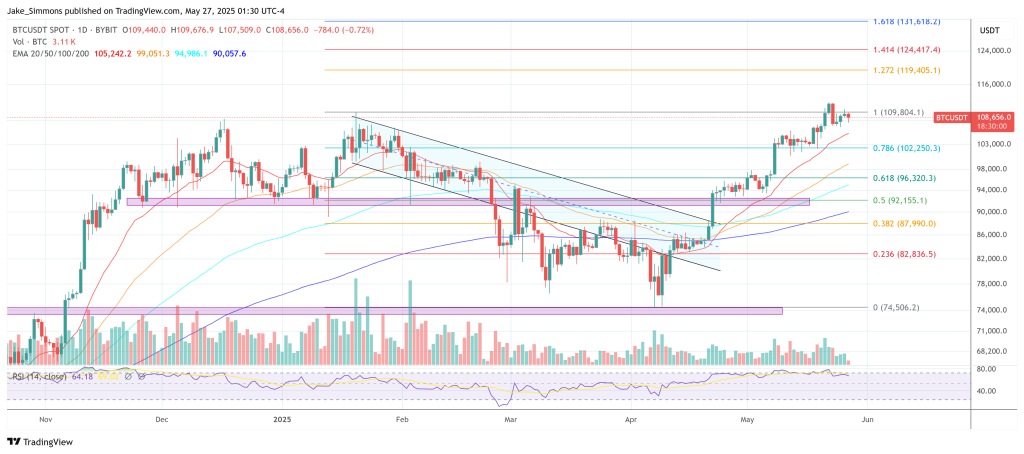
Bitcoin price
BTC price, 1-day chart | Source: BTCUSDT on TradingView.com
Featured image from YouTube, chart from TradingView.com
Editorial Process for bitcoinist is centered on delivering thoroughly researched, accurate, and unbiased content. We uphold strict sourcing standards, and each page undergoes diligent review by our team of top technology experts and seasoned editors. This process ensures the integrity, relevance, and value of our content for our readers.

Jake Simmons has been a Bitcoin enthusiast since 2016. Ever since he heard about Bitcoin, he has been studying the topic every day and trying to share his knowledge with others. His goal is to contribute to Bitcoin's financial revolution, which will replace the fiat money system. Besides BTC and crypto, Jake studied Business Informatics at a university. After graduation in 2017, he has been working in the blockchain and crypto sector. You can follow Jake on Twitter at @realJakeSimmons.

Lectures associées

Le concours de trading WEEX TradFi est lancé avec un prize pool de 50 000 USDT, premières arrivées, premières servies, recevez 5 US pour chaque position ouverte

Le marché cryptographique traverse actuellement un ajustement cyclique, mais WEEX échappe à la malédiction traditionnelle grâce à l'explosion de la tokenisation des actifs TradFi (finance traditionnelle). La plateforme offre désormais un accès seamless à un vaste univers d'actifs incluant actions (comme NVIDIA, Apple, Tesla), ETF, matières premières (or, pétrole) et même des parts tokenisées de pré-IPO (OpenAI, Anthropic). Pour célébrer cela, WEEX lance un « Tournoi de Trading TradFi » du 9 au 23 juillet, avec un prize pool de 50 000 USDT. Les récompenses incluent : un bonus de 200 USDT pour les nouveaux utilisateurs après un dépôt et des trades spécifiques, des récompenses échelonnées jusqu'à 50 USDT selon le volume de trading (à partir de 5 000 USDT), et un bonus universel de 5 USDT pour toute première position sur contrat TradFi. Les bonus sont cumulables. WEEX TradFi brise les barrières traditionnelles : utilisation de l'USDT pour un règlement instantané, trading fractionné dès 5$, et trading 24h/24 et 7j/7 sur les dérivés. Cela permet aux utilisateurs de diversifier leur portefeuille au-delà du crypto, de couvrir des risques et de saisir des opportunités macroéconomiques à tout moment, le tout depuis une seule interface. Participez au tournoi et explorez la fusion entre Web3 et la finance traditionnelle : https://www.weex.com/zh-CN/events/promo/tradfi

marsbitIl y a 15 mins

Le concours de trading WEEX TradFi est lancé avec un prize pool de 50 000 USDT, premières arrivées, premières servies, recevez 5 US pour chaque position ouverte

marsbitIl y a 15 mins

Changer de chaîne et repartir de zéro : une recette pour un « renversement de destin » ?

Récemment, plusieurs projets ont annoncé leur migration vers de nouvelles blockchains publiques. Contrairement aux précédents changements motivés par la tendance ou la sécurité, ces projets combinent désormais la migration avec une transformation de leur activité, équivalant à une nouvelle tentative entrepreneuriale. Base et Arbitrum sont devenus des destinations privilégiées pour ces projets en quête de regain de croissance. Par exemple, Sophon (anciennement sur ZKsync) a migré vers Base pour réduire ses coûts opérationnels de plusieurs millions de dollars et se recentrer sur les applications grand public. Moonbeam, une parachaine importante de Polkadot, a transféré son token GLMR vers Base pour pivoter vers les réseaux d'agents IA décentralisés. Secret Network, un projet phare de Cosmos, prévoit de migrer vers Arbitrum pour explorer l'intersection entre l'infrastructure de confidentialité et l'IA, une annonce qui a entraîné une chute de 30% de son token en 24 heures. Ces projets, à l'origine des blockchains autonomes, cherchent désormais des cas d'utilisation concrets liés à l'IA et à la consommation de masse. Cette tendance souligne les difficultés des écosystèmes comme Polkadot et Cosmos, qui voient des projets clés les quitter. Cependant, la migration est rarement une solution miracle. Des cas comme celui du NFT y00ts, passé de Solana à Polygon puis à Ethereum, ou de Synthetix, qui est revenu sur Ethereum après des déploiements multichaînes complexes, montrent les limites de cette stratégie. Dans le climat actuel du marché, plus rationnel et intégré à la finance traditionnelle, les récits porteurs sont moins nombreux et les utilisateurs plus critiques. Les blockchains elles-mêmes sont en difficulté. La compétition ne se résume plus à attirer des projets, mais à offrir de véritables utilités et à fidéliser les utilisateurs. Ainsi, bien qu'une migration puisse parfois apporter un souffle nouveau, elle a rarement le pouvoir de "changer radicalement la destinée" d'un projet.

链捕手Il y a 25 mins

Changer de chaîne et repartir de zéro : une recette pour un « renversement de destin » ?

链捕手Il y a 25 mins

Transaction volume doubles in June: the x402 ecosystem continues to expand, and the content monetization narrative faces a critical test.

x402 connaît une croissance rapide en juin, avec un volume de transactions doublé par rapport à mai, principalement porté par le service de routage d'IA BlockRun. L'écosystème s'élargit avec l'intégration de nouveaux fournisseurs de services comme Apify (extraction de données web) et Exa (moteur de recherche IA), ainsi que le lancement de Hacks par Seal, une plateforme permettant de créer et monétiser des automatisations d'API. Le protocole a réalisé des mises à jour techniques majeures : les "Builder Codes" pour le suivi et le partage de revenus, et le "règlement par lots" pour permettre des micro-paiements fréquents et peu coûteux, essentiels pour l'IA. L'adoption par les géants du web est un développement clé. AWS a intégré x402 pour la monétisation du trafic IA sur ses serveurs edge. Surtout, Cloudflare a ouvert les candidatures pour sa "Passerelle de monétisation de contenu", permettant de facturer l'accès aux ressources hébergées via x402. Ce cas d'usage pourrait transformer le modèle économique du web en faisant payer les robots et agents IA pour le contenu qu'ils consomment, compensant ainsi les coûts des éditeurs. Cependant, Matthew Prince, PDG de Cloudflare, souligne que la capacité de traitement des blockchains actuelles reste un défi technique à surmonter pour atteindre l'échelle nécessaire. Bien que le routage d'IA (BlockRun) et la vente de données de qualité soient des pistes validées, c'est la monétisation du contenu à grande échelle, testée avec Cloudflare, qui a le potentiel de faire de x402 une infrastructure incontournable du web.

Foresight NewsIl y a 51 mins

Transaction volume doubles in June: the x402 ecosystem continues to expand, and the content monetization narrative faces a critical test.

Foresight NewsIl y a 51 mins

Trading

Spot
活动图片