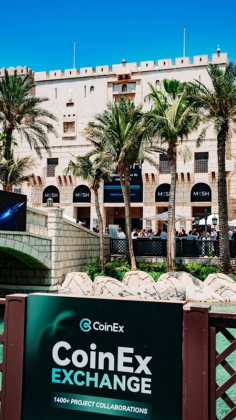
At this year’s TOKEN2049 Dubai, CoinEx, a leading global cryptocurrency exchange, made a remarkable return as a Platinum Sponsor, showcasing its strong platform capabilities. This event became a key gathering for the crypto industry, drawing blockchain professionals and crypto enthusiasts from around the world.
 During the conference, Jeff Ko, Chief Analyst at CoinEx Research, gave an exclusive interview to Bitcoinist, sharing insights on global crypto market trends, future investment strategies, and CoinEx Research’s perspectives on the industry.
Bear Market Opportunities & Investment Strategy
Bitcoinist: “With the market still in a consolidation phase, how does CoinEx define ‘opportunities in the bear’? Do you advise focusing on infrastructure or emerging narratives?”
Jeff Ko: “At CoinEx, we view bear markets not as downturns to be feared, but as strategic windows for accumulation, innovation, and long-term positioning. ‘Opportunities in the bear’ refer to both stable yield strategies and value-driven investments that align with fundamental progress rather than short-term speculative narratives.”
He continued, “From a user strategy perspective, CoinEx provides a suite of tools to help users navigate market uncertainty, including flexible savings, staking, and mining campaigns for trending assets. These tools provide relatively stable returns and allow users to stay engaged while preserving capital during quieter market phases.”
Jeff Ko emphasized the importance of staying invested, especially for long-term investors. “Dollar-cost averaging (DCA) into Bitcoin has consistently proven to be one of the most resilient strategies for weathering volatility and capturing upside when the market recovers.”
He also noted that while emerging narratives like Restaking, DePIN, and AI integration may spark innovation, they often face execution risks and adoption bottlenecks. “In the long run, we focus more on infrastructure projects with real products, market traction, and revenue models. These projects typically demonstrate higher survivability during market downturns and often emerge as the foundational pillars during the next bull cycle.”
CoinEx Capital’s Investment & Incubation Strategies
Bitcoinist: “Can you share any notable investment or incubation stories by CoinEx Capital or your ecosystem partners during the bear cycle? What value logic guided these decisions?”
Jeff Ko: “As part of the ViaBTC Group, CoinEx leverages the collective strength of ViaBTC Capital to drive ecosystem growth, particularly in bear market conditions, when long-term value creation takes precedence over short-term speculation. Our capital arm not only provides funding but also offers multi-dimensional support across product, technology, liquidity, marketing, and partnerships, helping early-stage teams scale sustainably.”
He shared a recent investment and incubation case involving Coffer Network, a BitcoinFi-native self-custodial wallet solution. “Coffer addresses a critical gap in the Bitcoin ecosystem by enabling users, especially whales, to safely access DeFi yield opportunities without compromising on custody or liquidity. The team behind Coffer has deep experience in Bitcoin infrastructure, and their solution directly responds to the increasing demand for capital efficiency and composability within the Bitcoin ecosystem.”
Jeff Ko pointed out, “CoinEx’s investment decisions typically consider a few key factors, including the overall ability and experience of the team, especially in terms of technology and market demand. We also focus on whether the project fits market needs, particularly the intersection of emerging areas and real-world applications. Moreover, we assess the potential role the project could play in the broader ecosystem, ensuring our support can create value across multiple levels.”
Jeff Ko concluded, “This focus on collaborative value creation rather than passive funding has allowed us to form strong partnerships with projects that share our vision for long-term ecosystem development.”
Liquidity Reconstruction and Global Capital Shift
Bitcoinist: “How do you view the reconstruction of global liquidity in crypto? Are we witnessing a shift in liquidity centers amid capital flight and geopolitical risks—possibly toward the Middle East or Asia?”
Jeff Ko: “We must keep in mind that the ample liquidity seen during the previous cycle, driven by QE, a low inflation and zero-interest-rate environment, is now a thing of the past.
Speaking of the shifting liquidity centers, Asia’s share of global crypto activity is undoubtedly significant, reflected by the flow of centralized exchanges, trading volume and institutional adoption, but regulatory heterogeneity and geopolitical risks temper its emergence as a dominant liquidity center. The Middle East’s potential as a liquidity center is growing, but it remains secondary to established hubs like North America and Asia due to scale and infrastructure constraints. In short, we think North America remains the primary liquidity center due to regulatory frameworks and institutional investment. Shifts toward Asia or the Middle East are incremental rather than transformative.“
Jeff Ko summarized, “The reconstruction of liquidity in the crypto market is not a zero-sum game, and traditional finance and crypto markets will coexist and complement each other.”
About CoinEx
Established in 2017, CoinEx is an award-winning cryptocurrency exchange designed with users in mind. Since its launch by the industry-leading mining pool ViaBTC, the platform has been one of the earliest crypto exchanges to release proof-of-reserves to protect 100% of user assets. CoinEx provides over 1400 coins, supported by professional-grade features and services, for its 10+ million users across 200+ countries and regions. CoinEx is also home to its native token, CET, incentivizing user activities while empowering its ecosystem.
To learn more about CoinEx, visit: Website | Twitter | Telegram | LinkedIn | Facebook | Instagram | YouTube

Related Posts