Bitcoin Mining Difficulty Rose 35% In 2025, Data Shows

bitcoinistPublished on 2025-12-27Last updated on 2025-12-27

Abstract

In 2025, Bitcoin mining difficulty increased by 35%, rising from 109.8 trillion hashes at the start of the year to 148.2 trillion. This growth was driven by a significant expansion in the network's computing power, with the 7-day average hashrate climbing from 795.7 TH/s to 1,070.3 TH/s, peaking at a record 1,151.6 TH/s in October. Although both hashrate and difficulty have declined since then, they remain substantially higher than January levels. The increase in difficulty is a direct response to the rising hashrate, as the network automatically adjusts to maintain a 10-minute block time. Meanwhile, Bitcoin's price has been volatile, recently consolidating around $87,300 after briefly surpassing $89,000.

On-chain data shows the year 2025 saw Bitcoin mining become notably harder for miners as Difficulty witnessed net growth of 35%.

Bitcoin Difficulty Has Crossed 148 Trillion Hashes

2025 is coming to a close, and it was a year where Bitcoin miners significantly expanded their facilities. According to data from Blockchain.com, the network Hashrate, a measure of the total amount of computing power connected by the miners, has seen its 7-day average value go from 795.7 terahashes per second (TH/s) at the start of the year to 1070.3 TH/s today.
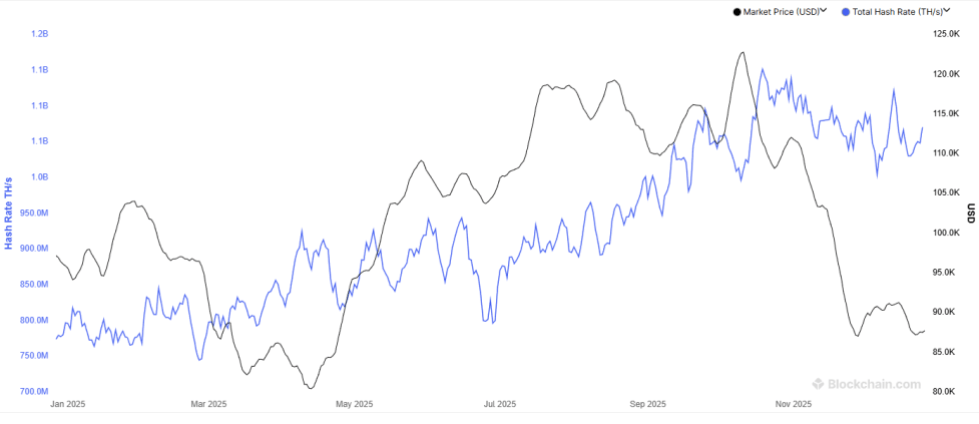
How the BTC Hashrate changed in the past year | Source: Blockchain.com

During this phase of growth, the Hashrate set multiple new records, with the final all-time high (ATH) of 1,151.6 TH/s coming in October. Since then, the metric has slowed down, but even with the decline to the current level, it remains about 34.5% up since January 1st.

Bitcoin miner revenue mostly comes from the block subsidy, which remains fixed in BTC value outside of Halving events, so miners tend to be dependent on growth in the price for a boost in their income. This is why the Hashrate usually follows the price trend.

From the chart, it’s visible that the Hashrate’s ATH came right after the top in the cryptocurrency and the pullback in the metric since then has also come alongside a drawdown in the price. Miners have been more resilient than the asset, however, as BTC is down year-to-date, while the Hashrate is still up notably.

Growth in the Bitcoin Hashrate always results in an increase in another metric, called the Difficulty. The Difficulty is a feature baked into the blockchain’s code, controlling how hard miners would find it to discover the next block on the network.

It automatically changes its value about every two weeks, based on how miners performed since the last adjustment. Satoshi set a standard block time of 10 minutes for the network to follow; if miners take an average period faster than this to add blocks, the chain increases the Difficulty.

The exact degree of the upward adjustment is always just enough to counteract the speed increase of the miners. In other words, it balances out the jump in the Hashrate.

As miners were in a phase of growth this year, Bitcoin had to repeatedly elevate its Difficulty, setting new ATHs in the process.

The trend in the BTC Difficulty over the last twelve months | Source: Blockchain.com

Since setting a new record above 155 trillion hashes in October, the Bitcoin Difficulty has also witnessed a decline. Even so, the metric at its current value of about 148.2 is still 35% up compared to the 109.8 trillion hashes level from the start of the year.

The growth in the Difficulty has been pretty similar to that in the Hashrate, a natural consequence of the former reacting to the latter.

BTC Price

Bitcoin saw recovery above $89,000 earlier, but it seems the rally couldn’t last as the asset is already back at $87,300.

Looks like the price of the coin has been consolidating in recent days | Source: BTCUSDT on TradingView

Related Questions

QWhat was the net growth in Bitcoin mining difficulty in 2025 according to the data?

AThe net growth in Bitcoin mining difficulty in 2025 was 35%.

QWhat is the current value of the Bitcoin network's 7-day average hashrate, and how does it compare to the start of the year?

AThe current 7-day average hashrate is 1,070.3 TH/s, which is an increase of about 34.5% from the 795.7 TH/s recorded at the start of the year.

QWhat is the purpose of the Bitcoin Difficulty metric and how often does it adjust?

AThe Bitcoin Difficulty is a feature in the blockchain's code that controls how hard it is for miners to discover the next block. It automatically adjusts approximately every two weeks based on the miners' performance to maintain a standard block time of 10 minutes.

QWhat was the all-time high (ATH) for the network hashrate in 2025 and when was it set?

AThe all-time high (ATH) for the network hashrate in 2025 was 1,151.6 TH/s, which was set in October.

QHow did the price of Bitcoin behave after briefly recovering above $89,000, as mentioned in the article?

AAfter briefly recovering above $89,000, the rally couldn't last and the price of Bitcoin fell back to $87,300, indicating a period of consolidation.

Related Reads

RWA Weekly Report|Private Credit Surges Nearly 40%; Bipartisan Senate Inclined to Adjust GENIUS Stablecoin Yield Rules (1.7-1.13)

RWA Weekly Report: Private Credit Surges Nearly 40%; Bipartisan Senate Support to Adjust GENIUS Act Stablecoin Yield Rules (Jan 7–13) The on-chain value of Real World Assets (RWA) grew to $20.81 billion, a 6.23% weekly increase, though broader RWA valuations dropped sharply due to statistical adjustments. Private credit saw a 39% surge, reaching $3.2 billion, while U.S. Treasuries and commodities remained core holdings. Stablecoin user addresses increased, though total market cap slightly declined. Key developments include a new U.S. crypto market draft that prohibits interest payments for merely holding stablecoins, though rewards for trading and staking remain allowed. The bipartisan Senate is considering amendments to the GENIUS Act, potentially limiting which institutions can offer yields. South Korea lifted a nine-year ban on corporate crypto investments, allowing firms to allocate up to 5% of net assets to cryptocurrencies. Notable funding rounds included Rain’s $250 million raise and VelaFi’s $20 million Series B. Cathie Wood suggested the U.S. might directly purchase Bitcoin for national reserves. Meanwhile, Coinbase may withdraw support for the CLARITY Act if it restricts stablecoin rewards. Projects like Ondo Finance and MSX (MyStonks) are advancing tokenized assets, with MSX reducing RWA trading fees to enhance user adoption.

marsbit50m ago

RWA Weekly Report|Private Credit Surges Nearly 40%; Bipartisan Senate Inclined to Adjust GENIUS Stablecoin Yield Rules (1.7-1.13)

marsbit50m ago

Trading

Spot
Futures

Hot Articles

Discussions

Welcome to the HTX Community. Here, you can stay informed about the latest platform developments and gain access to professional market insights. Users' opinions on the price of BTC (BTC) are presented below.

活动图片