World Liberty proposes using 5% of treasury to boost its stablecoin

cointelegraphPublicado a 2025-12-18Actualizado a 2025-12-18

Resumen

World Liberty Financial, backed by the Trump family, has proposed allocating 5% of its WLFI token treasury—worth approximately $120 million—to expand the supply of its USD1 stablecoin. The goal is to increase adoption and competitiveness in the stablecoin market by forming new CeFi and DeFi partnerships. The team argues that a larger USD1 circulation would drive demand for WLFI-governed services and strengthen the ecosystem. The proposal is currently under community vote, with initial responses showing slight opposition. USD1, launched in March, is the seventh-largest USD-pegged stablecoin with a $2.74 billion market cap, but still trails significantly behind competitors like PayPal’s PYUSD.

Trump family-backed World Liberty Financial has proposed using 5% of the project’s WLFI token treasury to grow the supply of its stablecoin USD1.

The proposal was posted to the World Liberty Financial governance forum on Wednesday, with the team highlighting the importance of increasing USD1 supply to keep up with “an increasingly competitive stablecoin landscape.”

The proposal outlines that the additional supply would help spread “USD1 use cases across select high-profile CeFi & DeFi partnerships,” with increased adoption helping to create more “value capture” opportunities in the WLFI ecosystem.

“As USD1 grows, more users, platforms, institutions, and chains integrate with World Liberty Financial infrastructure. This increases the scale and influence of the network governed by WLFI holders,” the team said.

“More USD1 in circulation leads to more demand for WLFI-governed services, integrations, liquidity incentives, and ecosystem programs,” it added.
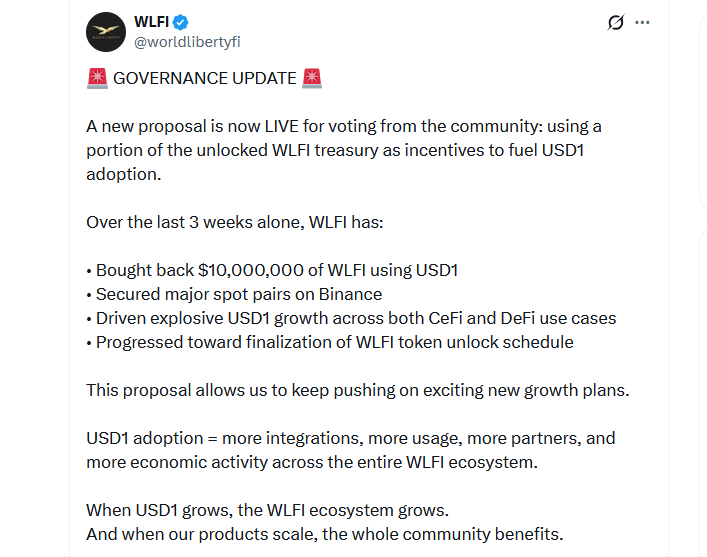
Source: World Liberty Financial

World Liberty Financial’s WLFI token started trading on exchanges in September. Leading up to the launch, the project indicated that 19.96 billion of the total WLFI supply would be allocated to the treasury. At current prices, that total sum is worth almost $2.4 billion, with a 5% unlock equating to around $120 million.

The team outlined three potential voting options in the proposal: for, against or abstain. The vote is now live, but it is not explicitly clear how the voting is taking place.

Related: Binance mulls new US strategy, CZ potentially reducing stake: Report

The reaction to the proposal is currently mixed, with “against” slightly edging out those who indicate they support the proposal.
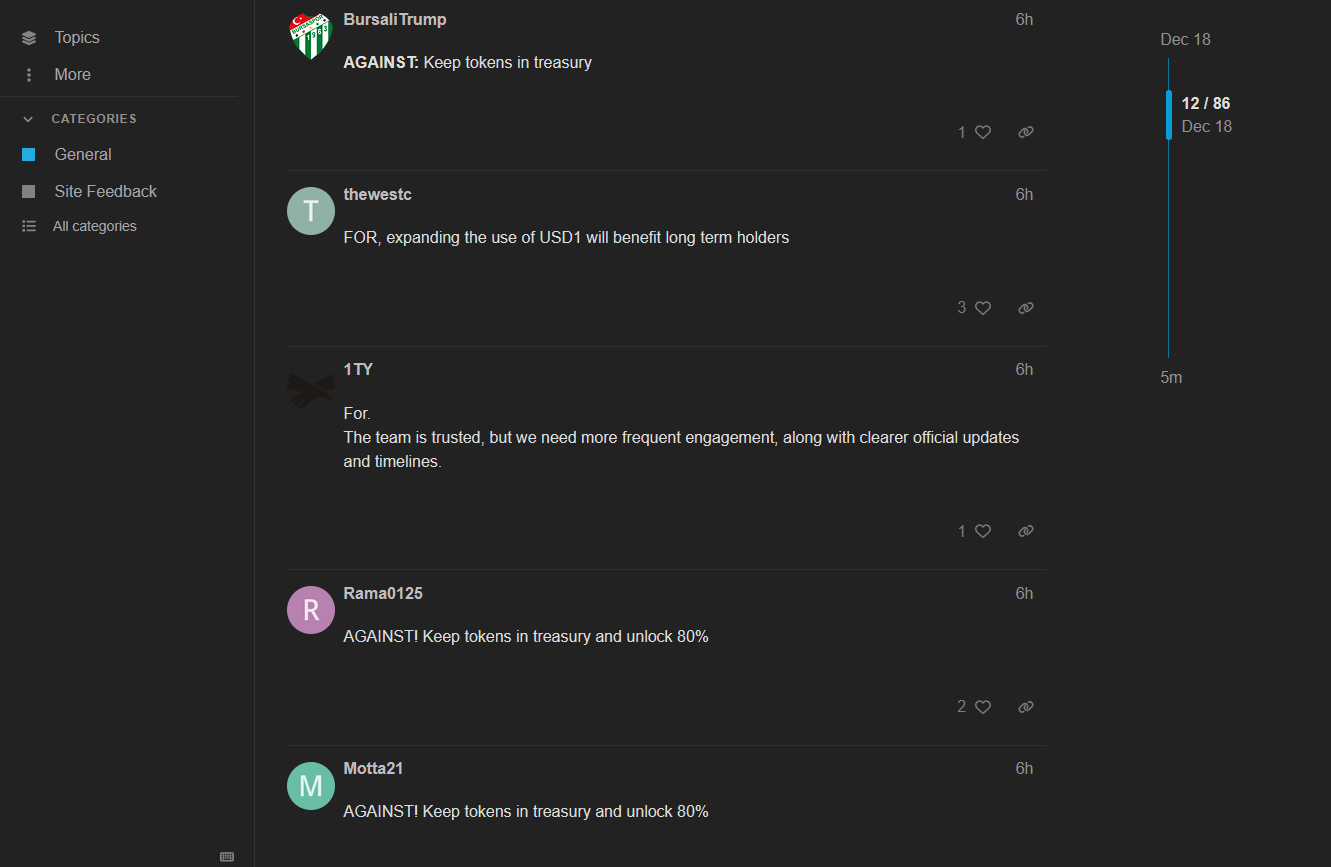
Community responses to the proposal. Source: World Liberty Financial

The project’s stablecoin launched in March and has a market cap of $2.74 billion according to CoinGecko data, making it the seventh-largest USD-pegged stablecoin on the market.

The 5% treasury unlock may help spur growth of the asset; however, it has a lot of catching up to do if it wants to displace competitors, with sixth-placed PYUSD from PayPal having a market cap $1.1 billion larger than USD1.

Magazine: Big questions: Would Bitcoin survive a 10-year power outage?
Lecturas Relacionadas

Bajando las expectativas para el próximo ciclo alcista de BTC

**Resumen del artículo: "Bajar las expectativas para el próximo ciclo alcista de BTC" por Alex Xu** El autor, que tenía a Bitcoin como su mayor activo, ha reducido progresivamente su exposición durante el actual ciclo alcista: eliminó el apalancamiento a 70k y redujo su posición de un 100% a un 30% entre 100k-120k. Recientemente, vendió más a 78k-79k, argumentando una revisión a la baja de las expectativas para el próximo máximo alcista. Las razones principales son: 1. **Narrativa de adopción agotada:** El impulso de adopción masiva (de minorista a institucional vía ETFs) parece agotado. El siguiente paso, la adopción por bancos centrales o fondos soberanos importantes, se ve muy difícil a corto plazo. 2. **Coste de oportunidad:** El autor ha identificado otras oportunidades de inversión en empresas atractivas. 3. **Contracción del ecosistema crypto:** La mayoría de modelos de negocio Web3 (SocialFi, GameFi, DePIN) no han funcionado. Solo DeFi genera valor, pero se contrae por la falta de activos nativos de calidad, lo que reduce la base de usuarios y holders de BTC. 4. **Problemas del mayor comprador:** MicroStrategy, el mayor tenedor corporativo, enfrenta un coste de financiación creciente (11.5% para su préstamo perpetuo), lo que podría ralentizar su ritmo de compra y ejercer presión vendedora. 5. **Competencia del oro tokenizado:** El oro tokenizado ha cerrado la brecha en portabilidad y divisibilidad, erosionando la ventaja competitiva de BTC como "oro digital". 6. **Problema de seguridad:** La reducción de la recompensa por minado (halving) amenaza la seguridad de la red, ya que las nuevas fuentes de ingresos por fees (como las inscripciones) no han podido dar solución. Conclusión: El autor mantiene una posición significativa en BTC y espera que suba, pero es menos optimista sobre su potencial alcista. Vender en la reciente subida fue una decisión táctica. Si sus razones para ser bajista se invalidan, estaría abierto a recomprar, aceptando si se equivoca y el precio sube.

marsbitHace 17 hora(s)

Bajando las expectativas para el próximo ciclo alcista de BTC

marsbitHace 17 hora(s)

Trading

Spot
Futuros
活动图片