Why Does the Automated Market Maker (AMM) Mechanism Fail in the Prediction Market Field?

marsbitPublicado a 2026-04-14Actualizado a 2026-04-14

Resumen

The article explores why Automated Market Makers (AMMs), particularly the x*y=k model popularized by Uniswap, fail in prediction markets despite their success in decentralized finance (DeFi). AMMs excel in DeFi by enabling permissionless liquidity provision and continuous trading for tokens that fluctuate indefinitely. However, prediction markets involve binary outcomes where assets settle to either $1 or $0 at expiration. This structural difference causes inherent flaws: liquidity providers (LPs) inevitably suffer losses as pools automatically rebalance toward the losing side upon settlement—making "impermanent loss" permanent. Additionally, AMMs distort price discovery for probability-based markets due to slippage and low liquidity. Early prediction platforms like Polymarket and Augur experimented with AMMs but abandoned them for Central Limit Order Books (CLOBs), which better handle precise probabilistic pricing and binary settlements. The article concludes that while AMMs revolutionized token swaps, their mechanics are mismatched for prediction markets, requiring alternative infrastructure that accommodates binary outcomes and mandatory settlement.

Author: Melee

Compiled by: AididiaoJP, Foresight News

In July 2017, Hayden Adams was laid off by his employer Siemens, where he worked as a mechanical engineer. His college roommate Karl Floersch was working at the Ethereum Foundation at the time and often told him about smart contracts. Adams had previously paid no attention. Now unemployed and looking for something to do, he decided to listen.

The Birth of the Automated Market Maker (AMM)

Floersch recommended a blog post by Vitalik Buterin about running an on-chain exchange using a mathematical formula instead of an order book. The principle was not to match buyers and sellers, but to allow traders to exchange with a pool of assets, with the price automatically set based on the ratio of tokens in the pool. No working version existed at the time. Adams took it on as a learning project, received a $65,000 grant from the Ethereum Foundation, and launched Uniswap in November 2018.
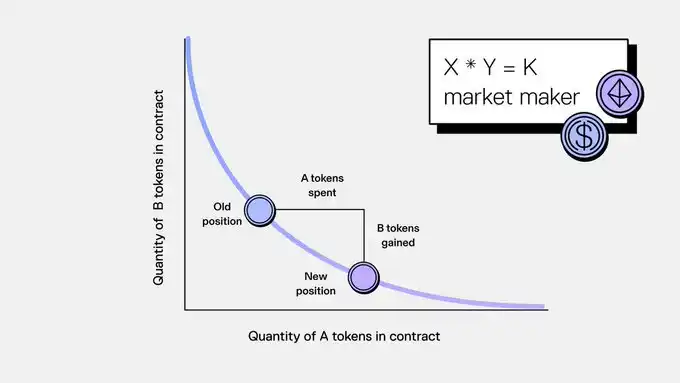
Its formula was deceptively simple: x * y = k.

Two tokens are placed in a pool, and the product of their quantities remains constant. When someone buys one token, they must deposit the other token, changing the ratio within the pool and adjusting the price accordingly. No order book, no matching engine, no professional market makers needed. Anyone can deposit tokens into the pool and earn fees from every transaction.

The automated market maker thus became the cornerstone of decentralized finance. Uniswap, Curve, Balancer, and dozens of other protocols handle billions of dollars in trading volume. On-chain order books are slow and expensive, and traditional market makers have no interest in tokens with only two hundred holders. Automated market makers allow anyone to create a liquid market for any asset at any time. Before AMMs, listing a new asset required permission and infrastructure. After AMMs, all you need is a liquidity pool.

The benefits were obvious. So, prediction markets naturally tried to adopt them too.

Automated Market Makers and Prediction Markets

Prediction markets face the same cold-start problem as token markets. You need liquidity before people are willing to trade, and you need traders before people are willing to provide liquidity. Little known is that Robin Hanson had proposed an automated market making solution for prediction markets years earlier in his 2002 Logarithmic Market Scoring Rule.

He thought he had theoretically solved the cold-start problem. However, in practice, the solution suffered from the same fundamental issue that every subsequent attempt to automate liquidity for prediction markets encountered: the formula couldn't distinguish between perpetually fluctuating tokens and equity certificates that expire.

Prediction market outcomes are binary. They ultimately settle to one or zero. In a token swap pool, both assets can fluctuate indefinitely, and the AMM formula works precisely because neither token is designed to go to zero.

Early Polymarket used an AMM based on the logarithmic market scoring rule. Augur also experimented with similar schemes. If automated liquidity pools worked for token swaps, they should, in theory, work for election betting too.

They didn't.

Why AMMs Fail in Prediction Markets

When a prediction market event settles, one side is worth one dollar, the other zero. For anyone providing liquidity to the pool, the mathematical outcome is nearly brutal. As the market moves towards settlement, the pool automatically rebalances towards the losing side.

Impermanent Loss

What decentralized finance traders call "impermanent loss" becomes completely "permanent" here. Every market settles, and every pool will eventually hold a pile of worthless shares.

In regular DeFi pools, trading fees can offset impermanent loss over time.
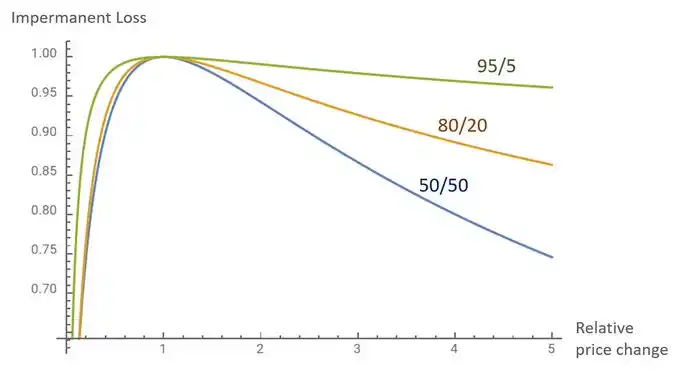
But in prediction markets, the loss is a structural certainty. The only question is how much the liquidity provider loses. Protocols have tried to persuade users to deposit assets into these pools through liquidity mining, reward programs, and various incentive structures. All of these are just different ways to subsidize users to lose money at a slower rate.

Price Discovery

Then there is the issue of price discovery. AMMs price assets based on the pool ratio and a fixed formula. For tokens, the "correct price" is a moving target, and a formula-driven approximation is sufficient. Prediction market prices are supposed to represent probabilities. The slippage introduced by the constant product curve distorts the signal, especially in low-liquidity markets, where a single trade can swing the implied probability by several basis points.

Is the Central Limit Order Book (CLOB) Better Than AMMs?

Polymarket realized this early on. In late 2022, the platform migrated from a logarithmic market scoring rule-based AMM to a central limit order book. AMMs were designed for continuous token swaps across a price range. Prediction markets require precise probability pricing on binary outcomes with known terminal values. They are entirely different problems.

The characteristics that made AMMs revolutionary for tokens—permissionless market creation, instant liquidity bootstrapping, no reliance on professional market makers—are exactly what prediction markets desperately need. The problem is that the specific mechanism, the constant function formula built for token swaps, breaks down when faced with the reality of binary outcomes and inevitable settlement.

The challenge for prediction markets is to replicate these effects with infrastructure that reflects how these markets actually settle.


Preguntas relacionadas

QWhat is the core mathematical formula behind the Automated Market Maker (AMM) mechanism introduced by Uniswap?

AThe core mathematical formula is x * y = k, where x and y represent the quantities of two tokens in the pool, and k is a constant product.

QWhy do AMMs fail in the prediction market space according to the article?

AAMMs fail in prediction markets because these markets involve binary outcomes that eventually settle to $1 or $0, causing structural and certain losses for liquidity providers, unlike in token swaps where both assets can fluctuate indefinitely and fees can offset impermanent loss.

QWhat did early prediction market platforms like Polymarket and Augur experiment with?

AEarly platforms like Polymarket used an AMM based on Robin Hanson's Logarithmic Market Scoring Rule, and Augur also experimented with similar automated liquidity solutions.

QWhat is the key difference between token trading and prediction markets that makes AMMs unsuitable for the latter?

AToken trading involves assets designed to never go to zero and allows for continuous price fluctuations, while prediction markets have binary outcomes that definitively settle to $1 or $0, making AMM-induced losses certain rather than 'impermanent'.

QWhat solution did Polymarket eventually adopt to address the limitations of AMMs?

APolymarket migrated from an AMM based on the Logarithmic Market Scoring Rule to a Central Limit Order Book (CLOB) to better handle precise probability pricing and binary settlement in prediction markets.

Lecturas Relacionadas

Director ejecutivo de HIVE: Los GPU para IA generan 10 veces más ingresos por hora que las granjas de minería

El CEO de HIVE Digital Technologies, Frank Holmes, ha presentado datos que demuestran que su clúster de 504 GPUs Nvidia B200, utilizado para infraestructura de IA, genera aproximadamente 2.90 dólares por hora por GPU. En contraste, sus operaciones de minería de Bitcoin producen solo unos 0.12 dólares por hora, una diferencia de más de 20 veces en este indicador clave. Esta brecha de rentabilidad fundamenta la estrategia de HIVE: priorizar inversiones en el negocio de IA, de mayores ingresos, mientras mantiene sus significativas operaciones mineras. En el año fiscal 2026, HIVE alcanzó una tasa de hash promedio de 22.2 EH/s y minó 2,885 BTC. Los ingresos totales fueron de 297.8 millones de dólares, con un crecimiento del 158%. Su división de IA/HPC, BUZZ, contribuyó con 19.5 millones. La compañía está construyendo un ambicioso centro de datos de IA de 320 MW en Toronto, que albergará más de 100,000 GPUs y se espera que genere unos 360 millones de dólares en ingresos recurrentes anuales una vez operativo a finales de 2027. HIVE no está sola en esta transición; otras mineras como MARA, Hut 8 y Terawulf también están redirigiendo recursos energéticos hacia contratos de IA/HPC debido a la mayor rentabilidad y a la presión en los márgenes de la minería de Bitcoin. El objetivo inmediato de HIVE es multiplicar por diez sus ingresos anuales por IA/HPC.

cryptonews.ruHace 36 min(s)

Director ejecutivo de HIVE: Los GPU para IA generan 10 veces más ingresos por hora que las granjas de minería

cryptonews.ruHace 36 min(s)

"Cada día sin reglas claras es una pérdida de capital": Grayscale se dirige al Senado por la Ley CLARITY

La empresa Grayscale Investments, la mayor plataforma de inversión en activos digitales del mundo, ha instado públicamente al liderazgo del Senado de EE.UU. a llevar a votación el proyecto de ley CLARITY Act antes del receso parlamentario de agosto. En una carta abierta, el director jurídico de Grayscale, Craig Salm, pidió a los líderes del Senado que actúen, subrayando que la industria cripto estadounidense ha operado durante años sin un marco regulatorio integral, en un entorno de "regulación mediante aplicación coercitiva". El CLARITY Act, resultado de meses de trabajo bipartidista, busca establecer reglas claras para el mercado, definir las jurisdicciones de los reguladores CFTC y SEC, y reforzar la competitividad de EE.UU. Grayscale advierte que cada día de retraso provoca la fuga de talento, innovación y capital hacia jurisdicciones como Singapur o Abu Dabi, que ya cuentan con marcos regulatorios definidos. La aprobación de la ley también permitiría un mayor desarrollo de fondos cotizados (ETF) y otros productos de inversión regulados en criptoactivos. El proyecto ya ha sido aprobado por el Comité Bancario y debatido en audiencias. Grayscale reconoce la agenda cargada del Senado, pero solicita urgentemente una votación previa al receso de agosto para proporcionar la certeza regulatoria que el sector demanda. La petición se produce en medio de un intenso debate político sobre el proyecto. Aunque ha recibido apoyo, también enfrenta críticas de algunos reguladores estatales, como la Fiscal General de Nueva York, que teme que limite la capacidad para combatir fraudes, y de bancos importantes que pieren normas más estrictas para los stablecoins.

cryptonews.ruHace 38 min(s)

"Cada día sin reglas claras es una pérdida de capital": Grayscale se dirige al Senado por la Ley CLARITY

cryptonews.ruHace 38 min(s)

Grayscale cree que la llegada de 3.000 bóvedas on-chain con activos por valor de más de 7.000 millones de dólares será el próximo gran avance en el ámbito de las criptomonedas

Las stablecoins y los activos tokenizados ya han comenzado a transformar el sistema financiero tradicional. Ahora, Grayscale prevé que los "vaults" o almacenes en cadena de bloques serán la próxima innovación criptográfica en alcanzar la corriente principal. Estos vaults agrupan fondos de inversores y los asignan a estrategias generadoras de rentabilidad, administradas por gestores profesionales llamados curadores. Su estructura se asemeja a las Obligaciones de Crédito Colateralizado (CLO) tradicionales, pero con una diferencia clave: utilizan contratos inteligentes en redes como Ethereum, Base y Solana en lugar de intermediarios. Esto ofrece transparencia en tiempo real, puede reducir costos administrativos y aumentar la liquidez. Actualmente, el mercado es pequeño: más de 3,000 vaults mantienen activos por unos $7 mil millones, gestionados por 57 curadores, con un 79% en estrategias de stablecoins. En comparación, el mercado global de CLO ronda los $1.5 billones. El principal obstáculo para el crecimiento es la incertidumbre regulatoria, especialmente en EE.UU., donde la discreción de los curadores podría atraer la atención de los reguladores. A pesar de esto, Grayscale cree que los vaults tienen un potencial significativo para convertirse en productos de inversión principales para activos digitales, siempre que la industria logre combinar la eficiencia de los contratos inteligentes con el cumplimiento de los estándares financieros tradicionales.

cryptonews.ruHace 39 min(s)

Grayscale cree que la llegada de 3.000 bóvedas on-chain con activos por valor de más de 7.000 millones de dólares será el próximo gran avance en el ámbito de las criptomonedas

cryptonews.ruHace 39 min(s)

Trading

Spot
活动图片