Valuation at $1.25 Billion Post-SPAC Listing, Securitize to Issue "Real Equity" On-Chain Stocks

marsbitPublicado a 2025-12-19Actualizado a 2025-12-19

Resumen

Securitize, a leading RWA (Real World Assets) platform, plans to launch native on-chain equity products by Q1 2026. Unlike synthetic or beneficiary tokenized stock models, Securitize will issue legally recognized shares directly on the blockchain, recorded on the issuer’s official cap table. Token holders will possess full shareholder rights, including dividends and voting. Valuing at $1.25 billion post-SPAC merger (ticker: SECZ), Securitize has already tokenized over $3 billion in assets through partnerships with major institutions like BlackRock (notably its $1.7B BUIDL fund), Apollo, KKR, and VanEck. Its investor base includes Coinbase, Morgan Stanley, BlackRock, and ARK Invest. The company aims to bridge TradFi and DeFi through compliant, regulated digital securities infrastructure, positioning itself as a key player in the institutional adoption of on-chain finance.

Author | DingDang (@XiaMiPP)
On December 17, the RWA platform Securitize announced plans to launch native on-chain stock products in the coming months, targeting the first quarter of 2026. Unlike most "stock tokenization" solutions on the market, Securitize will directly issue real, regulated shares on the blockchain, simultaneously recording them in the issuer's official share register; its tokens represent full shareholder rights, including dividends, proxy voting, and more.

On October 28 this year, Securitize disclosed that it would go public through a SPAC merger, with a post-merger valuation estimated at $1.25 billion and a stock ticker of SECZ. As a key player in the tokenized money market fund space, Securitize has partnered with traditional asset management institutions such as BlackRock, Apollo, KKR, Hamilton Lane, and VanEck, with cumulative tokenized assets exceeding $3 billion.

Amid the ongoing hype around the RWA narrative, Securitize, with its frequent moves, has become a market focus. Odaily Planet Daily will analyze it from a business perspective to help readers gain a deeper understanding of the company's layout and prospects.

Native On-Chain Stocks: Not "Price Mapping," but Legally Recognized Shares

To understand the importance of Securitize's product approach, it must first be placed within the overall structure of the current stock tokenization track. Most existing stock tokenization platforms can be broadly categorized into two mainstream models.

The first is the synthetic model. Early examples like Mirror Protocol and Synthetix fall into this category, where tokens track stock prices through derivative structures or oracle mechanisms, providing only price exposure without involving any real shares. Such products lack shareholder rights, carry counterparty risk and pricing deviations, and are essentially derivatives rather than equity.

The second is the beneficial interest model. For example, MSX typically involves the platform or a third-party custodian holding the real shares (usually 1:1 backed), issuing tokens that represent beneficial interests or claims to these shares. Holders gain economic exposure (such as price movements, possibly including dividend pass-through) but are not direct legal owners; the official share register records the custodian, not the token holder.

Different from these two paths, Securitize is attempting a third model—the native on-chain stock model. What Securitize plans to issue will be shares recognized in law as real stock, directly natively issued on the blockchain and simultaneously recorded in the issuing company's official share register. Token holders possess full shareholder rights, including dividends, proxy voting, etc. More crucially, Securitize itself, as an SEC-registered transfer agent, ensures that token holders are the direct legal owners, not holding indirectly via an intermediary or SPV. In other words, these assets are neither price trackers nor "IOUs" from a custodian.

However, it is undeniable that the complexity of the native on-chain stock model is significantly higher than that of synthetic or beneficial interest schemes. It must not only solve the problems of on-chain issuance and instant settlement but also simultaneously comply with securities regulations, corporate law, transfer agent systems, and a series of traditional financial rules, achieving seamless integration with existing financial infrastructure. In practical terms, this means higher compliance costs, longer development cycles, and each step being exposed to regulatory and institutional friction.

In contrast, the advantages of synthetic or beneficial interest schemes are obvious: faster implementation, lighter structure, lower costs, and easier compatibility with 24/7 trading and DeFi. The path chosen by Securitize aims not to "circumvent regulation" but to attempt, within the system, to truly eliminate the long-standing structural gap between the traditional financial system and the on-chain system.

It is under this choice that Securitize's position in the RWA track becomes clearer.

Securitize is Becoming One of the "Standard Answers" for RWA Infrastructure

Securitize was founded in November 2017 by Carlos Domingo and Jamie Finn, headquartered in San Francisco, California, USA. The company focuses on using blockchain technology to transform traditional financial assets (such as stocks, funds, bonds, private equity, etc.) into compliant digital securities.

This positioning directly determined Securitize's partners and business form. Securitize's most well-known case is providing tokenization services for BlackRock's BUIDL money market fund. To date, the fund size has exceeded $1.7 billion, making it the largest tokenized money fund product in the current RWA market.

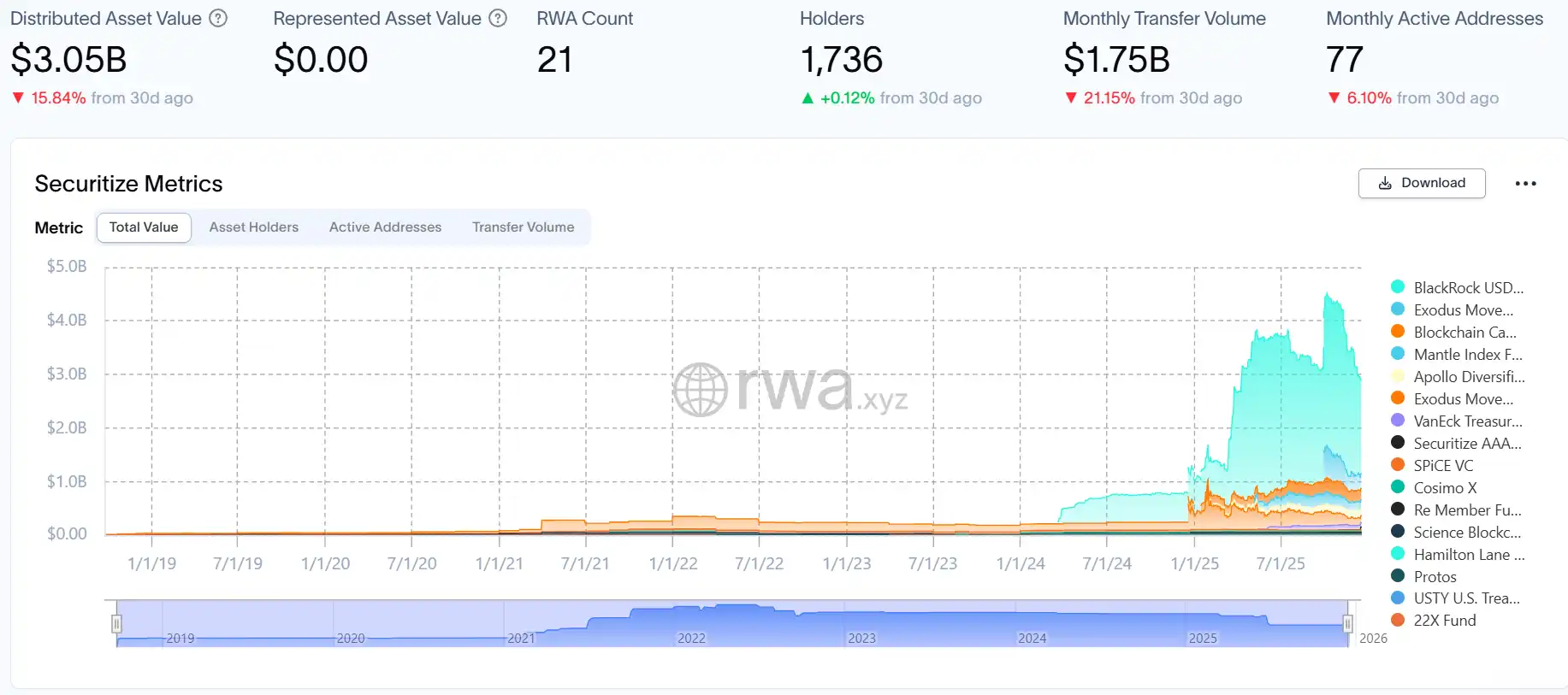
In addition, Securitize has partnered with several traditional asset management institutions such as Apollo, KKR, Hamilton Lane, and VanEck. Official data shows that its cumulative tokenized assets have exceeded $3 billion. If the early days of RWA were more about "conceptual feasibility," then Securitize's business has begun to enter the verification stage of "institutional feasibility."
This "bridge" positioning is also clearly reflected in Securitize's financing and shareholder structure.

Public information shows that Securitize has raised approximately $122 million to $147 million through multiple rounds of private equity financing. Early investors mostly came from the crypto industry itself, including Coinbase, Ripple, etc. As the RWA narrative gradually clarified, its shareholder structure also changed significantly, with traditional financial giants such as Morgan Stanley and BlackRock entering one after another. The number of investors exceeds 50, and it has also received significant holdings from Cathie Wood's ARK Invest.

This process from "crypto circle recognition" to "Wall Street endorsement" is not accidental but a natural result of its business path and institutional choices.

Under This Logic, Moving Towards the Capital Market is Not Surprising

Securitize announced on October 28 that it would go public through a merger with the special purpose acquisition company (SPAC) Cantor Equity Partners II, Inc. After the transaction is completed, the company's valuation is expected to reach $1.25 billion, and it plans to trade under the ticker symbol SECZ.

Cantor Equity Partners II, Inc. (NSDQ:CEPT) is sponsored by a company under the financial services giant Cantor Fitzgerald, with its head being Brandon Lutnick, son of the U.S. Secretary of Commerce. Notably, Twenty One, the third-largest bitcoin reserve company, also went public through a merger with another SPAC under Cantor Fitzgerald, showing the group's continued layout in the crypto asset space.

To support the listing and public market operations, Securitize has also strengthened its compliance and governance capabilities, announcing the appointment of former PayPal digital assets legal head Jerome Roche as General Counsel, preparing for future continuous disclosure and regulatory communication on Nasdaq.

Conclusion

Returning to Securitize itself, as a leading project in the RWA track, the market's earliest expectation for it might have been just when it would issue a token. But judging from today's progress, this expectation itself might just be the inertial thinking of the crypto market.

What Securitize is ultimately moving towards is not a narrative stage centered around a token, but a larger structure composed of capital markets and regulatory systems. But this choice itself is not surprising. Because from the beginning, the role it has played has been closer to a bridge connecting TradFi and DeFi.

In this sense, Securitize's development path may reflect the profound transformation that the RWA narrative is undergoing, moving from imagination to reality, from concept to institution. How far this path can go depends not only on the expansion speed of a single company but also on whether the traditional financial system is truly willing to reserve a realistic space for "native on-chain assets."


Preguntas relacionadas

QWhat is the key difference between Securitize's planned on-chain stock product and existing stock tokenization models?

ASecuritize's native on-chain stock represents a direct, legally recognized share of ownership recorded on the company's official cap table, granting holders full shareholder rights like dividends and voting. This differs from synthetic models (which are just price-tracking derivatives) and beneficial interest models (where a custodian holds the real shares and issues an IOU token).

QWhat major traditional asset management firms has Securitize partnered with for its tokenization services?

ASecuritize has partnered with major traditional asset managers including BlackRock, Apollo, KKR, Hamilton Lane, and VanEck.

QHow is Securitize planning to become a publicly traded company and what is its expected valuation?

ASecuritize is planning to go public through a merger with a Special Purpose Acquisition Company (SPAC) called Cantor Equity Partners II, Inc. The combined company is expected to have a valuation of $1.25 billion and trade under the ticker symbol SECZ.

QWhat is the estimated total value of assets that Securitize has tokenized so far?

ASecuritize has cumulatively tokenized assets worth over $3 billion.

QWhat specific, large-scale product is Securitize most known for in the RWA market?

ASecuritize is best known for providing the tokenization services for BlackRock's USD Institutional Digital Liquidity Fund (BUIDL), which, with over $1.7 billion in assets, is the largest tokenized money market fund in the RWA market.

Lecturas Relacionadas

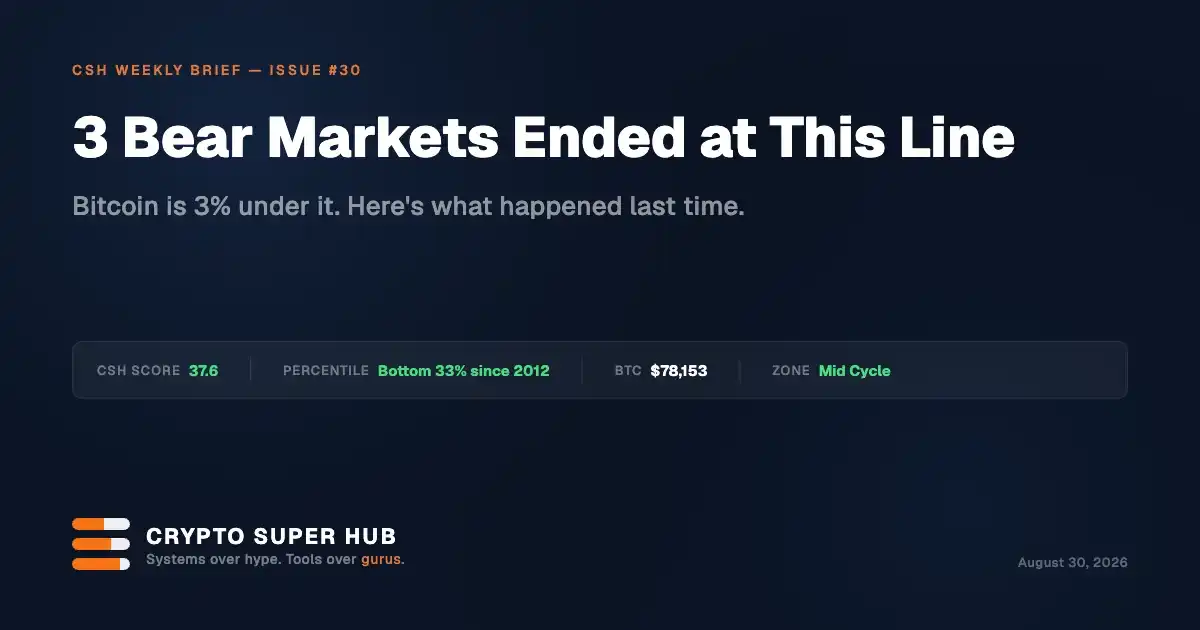
Un aumento del 22% en una semana se acerca a la 'línea divisoria entre el toro y el oso'. Revisando las señales clave que pusieron fin a los tres últimos mercados bajistas de Bitcoin

**Resumen del Artículo: El Bitcoin se Acerca a la "Línea Divisoria de Toros y Osos", ¿Señal de Fin del Mercado Bajista?** El Bitcoin ha experimentado una subida semanal del 22,8%, su mayor ganancia desde marzo de 2023, acercándose críticamente a su media móvil de 50 semanas (alrededor de $81,000), un nivel históricamente clave. **Análisis Histórico de una Señal Clave:** El artículo revisa datos desde 2012 y encuentra que las tres últimas grandes caídas (mercados bajistas) terminaron de la misma manera: con el primer cierre semanal por encima de la media de 50 semanas tras tocar fondo. Esto ocurrió en 2015, 2019 y 2023. En cada caso, el precio no volvió a cerrar por debajo de esa línea en los seis meses siguientes, y subió fuertemente (55% a 141%) en el año posterior. **La Excepción y el Contexto Actual:** Solo hubo una "falsa señal" en abril de 2022, que fue rechazada rápidamente. La diferencia clave, según el indicador CSH Score del autor, es que las verdaderas recuperaciones partieron de niveles de "capitulación" (CSH Score bajo), mientras que la falsa ocurrió con el activo aún caro (CSH Score alto). Actualmente, el CSH Score es 37.6, subiendo desde un mínimo de 20.6, lo que se asemeja más al patrón de un fondo real que al de 2022. **Advertencias y Perspectiva:** Sin embargo, el autor señala dos factores de cautela: 1. Esta caída ha sido la más superficial históricamente (53% vs. 75-83% anteriores). 2. Si el mínimo fue el 1 de julio, el movimiento actual hacia la media de 50 semanas es mucho más rápido que en ciclos anteriores. **Conclusión y Plan del Autor:** La señal definitiva (cierre semanal *y sostenido* por encima de la media de 50 semanas) aún no se ha confirmado. El autor mantiene una perspectiva neutral (50/50), la más alcista desde el pico del mercado. Su plan de inversión sistemático, basado en el CSH Score, dejó de comprar automáticamente cuando el indicador superó 30. Si cae por debajo de 30, reanudará las compras; si cae bajo 20, aumentará la posición. Si Bitcoin confirma un cierre sostenido por encima de la media clave, cambiará su postura a claramente alcista. La próxima decisión sobre tasas de interés de la Fed y los datos de empleo de EE.UU. serán catalizadores importantes para determinar si el precio es rechazado o confirma una ruptura decisiva.

marsbitHace 26 min(s)

Un aumento del 22% en una semana se acerca a la 'línea divisoria entre el toro y el oso'. Revisando las señales clave que pusieron fin a los tres últimos mercados bajistas de Bitcoin

marsbitHace 26 min(s)

Tras 10 semanas de pausa, ¿Strategy volverá finalmente al modo "comprar, comprar y comprar"?

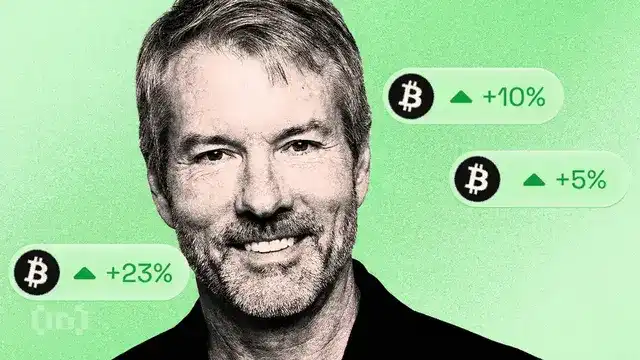
Tras una pausa de 10 semanas sin comprar bitcoin (BTC), Michael Saylor, de MicroStrategy, ha sugerido a través de redes sociales que la empresa podría retomar sus adquisiciones. Los analistas interpretan esto como una señal, basándose en varios cambios financieros clave. En primer lugar, MicroStrategy ha equilibrado su posición de deuda y efectivo. La compañía cuenta con unos 6.690 millones de dólares en efectivo frente a una deuda convertible de 6.710 millones, lo que reduce el riesgo de venta forzosa de activos. A pesar de obtener 3.280 millones de dólares en financiación en agosto, estos fondos se destinaron a reservas para dividendos y no a comprar bitcoin. En segundo lugar, el precio de las acciones preferentes de la empresa (STRC) se acerca a su valor nominal de 100 dólares, tras haber caído por debajo. Cuando el precio estaba bajo, MicroStrategy utilizaba recursos, incluso procedentes de ventas de bitcoin, para recomprar acciones y mantener el precio, una presión que ahora disminuye. Saylor publicó un gráfico mostrando las 840,447 bitcoins en posesión de la empresa, valoradas en 65.720 millones de dólares. Aunque sus publicaciones no son anuncios oficiales, el próximo informe semanal de la empresa, previsto para el 31 de agosto, podría confirmar nuevas compras. En julio, Saylor también declaró que "bitcoin había ganado", pero las compras se congelaron durante cinco semanas más, por lo que los mercados esperan ver acciones concretas.

marsbitHace 28 min(s)

Tras 10 semanas de pausa, ¿Strategy volverá finalmente al modo "comprar, comprar y comprar"?

marsbitHace 28 min(s)

Solana supera una maldición de 10 meses en medio del influjo de inversiones institucionales

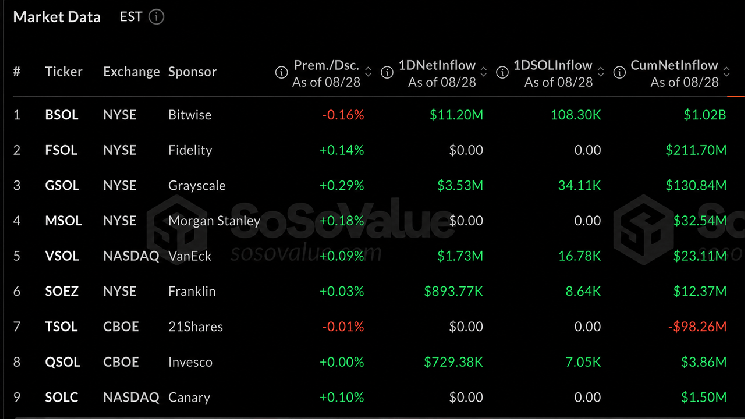
Solana ha superado su racha de 10 meses consecutivos de caídas, registrando en agosto un aumento de aproximadamente el 46% y acercándose a los 106 dólares. Este repunte, impulsado por la entrada de inversión institucional, ha situado su capitalización de mercado cerca de los 61.000 millones de dólares. Los ETF estadounidenses sobre Solana han atraído un flujo neto de unos 1.340 millones de dólares desde su lanzamiento en octubre de 2025. Además, gigantes como Charles Schwab y Goldman Sachs han anunciado planes de integrar o invertir en Solana, ampliando su acceso a inversores minoristas e institucionales. Paralelamente, la red ha aprobado una propuesta de gobernanza, "La Doble Desinflación", que duplicará su tasa anual de reducción de emisiones al 30%, limitando la futura oferta de tokens. La red también ha manejado un tráfico récord, con 4.200 millones de transacciones en julio. Próximas actualizaciones, como Transaction V1 (prevista para el 9 de septiembre) y la reducción de costes de almacenamiento de datos, buscan mejorar su capacidad y accesibilidad. Aunque SOL aún está un 63,5% por debajo de su máximo histórico, septiembre será clave para determinar si este crecimiento es sostenible, dependiendo de la adopción de estas mejoras técnicas y del comportamiento del mercado tras el reciente repunte agravado por liquidaciones de posiciones cortas.

cryptonews.ruHace 1 hora(s)

Solana supera una maldición de 10 meses en medio del influjo de inversiones institucionales

cryptonews.ruHace 1 hora(s)

Trading

Spot
活动图片