Turning $50 into a Million at 18 by Tracking Wallets

marsbitPublicado a 2025-12-30Actualizado a 2025-12-30

Resumen

In February 2024, the author lost $80 twice trading meme coins before realizing their flawed approach. They restarted with $50 using wallet tracking strategies and grew it to over $1 million by February 2025. Initially, the author bought meme coins based on narratives and social hype, which was unreliable. They shifted to tracking "smart money" movements—wallets of insiders, KOLs, market makers, and project teams—to identify opportunities before pumps. Key methods included: - Tracking influential KOLs' wallets, turning $50 into $5,000 in a month. - Monitoring groups of coordinated traders (e.g., turning $4,000 into $600,000 on $ROCKY). - Following new wallets, project wallets, and large holders (e.g., earning $110,000 in minutes on $BARRON). - Observing market maker wallets for entry and exit signals (e.g., 50x gains on $HOOD). The author emphasizes strict risk management: no more than 5% per trade, avoiding large positions to prevent detection, and adhering to a disciplined plan. They credit their success to data-driven decisions, not emotions or hype. This journey highlights the importance of adapting strategies, learning from losses, and respecting the market. The author shares this as a personal milestone and inspiration for others.

Written by: Ugo

Compiled by: Luffy, Foresight News

In February 2024, I entered the world of Meme coin trading with $80 and lost everything—a devastating experience I went through twice.

It was then that I realized I hadn't figured out how this market works and had been using the wrong approach all along.

Later, I re-entered the market with $50, but this time I employed a wallet tracking strategy. In less than a year, by February 2025, that $50 had grown to over $1 million.

Early Pitfalls

My previous logic for buying Meme coins was simple: "This coin has a fun meme, great promotional content, and a clean website—let's buy it."

Admittedly, this method occasionally made some money, but most of the time, it was pure gambling. You had no solid basis or objective reason to determine how high the price could go.

To achieve consistent profits, you need a way to access key information before the trend starts, rather than following the crowd after the price has already surged.

I used to obsess over rumors on X (formerly Twitter) and Telegram groups: "This coin will definitely hit a $100 million market cap this week, just wait and see." Later, I learned that most of these messages were from paid shills or people who had already accumulated 15% of the token supply at low prices. You rush in excitedly, only to end up as the bag holder.

If your profit-taking targets aren't based on real information, your actions are merely responding to others' interests rather than truly following market trends.

Turning the Tide with Wallet Tracking

I quickly realized that my previous approach was missing a critical element. I would watch top traders and wonder, "How do they predict the market so well, while I can't?" So I had to find a solution.

Wallet tracking completely changed my perspective on trading. I stopped guessing market tops and bottoms, stopped chasing narratives, and stopped being led by hype on X. Instead, I focused on one thing: where the smart money was flowing.

Every major market move originates not on social media but in a small number of wallets. These wallets could belong to project teams, large holders, early institutional investors, insiders, KOLs, industry experts, market makers, or newly created anonymous addresses.

My success wasn't due to luck in a single trade but to repeatedly capturing replicable market patterns.

At that moment, it all clicked: I didn't need to be smarter than the entire market, nor did I need to rely on subjective judgments or market hype. I just needed to focus on data, analyze fund movements, and execute my trading strategy decisively.

From then on, my goal became crystal clear: build a trading system that reacts solely to the movements of smart money, not to rumors.

My Practical Wallet Tracking Methods

Tracking KOL Wallets

When I started in February 2024, wallet tracking was straightforward. Back then, people rarely changed wallet addresses frequently.

All you had to do was find the hidden wallet addresses of influential KOLs and follow their moves. That was it.

They accumulated at low prices → hyped it up → the price surged 10x instantly.

Using this method, I turned $50 into $5,000 in the first month. The next month, $5,000 became $30,000.

For example, on February 24: A project team launched a token specifically for a KOL. This industry heavyweight quietly accumulated the token using multiple hidden wallets when its market cap was only $20,000. I followed his lead and bought in at a $30,000 market cap. He then aggressively promoted it on Telegram and X, and the token's market cap instantly soared to $400,000. I took partial profits at this level.

Later that day, the market cap climbed to $1 million, and I cashed out again. In just a few hours, my initial investment had multiplied about 30 times.

At that time, my capital was small, so I had no concerns about liquidity and could exit cleanly.

Tracking Conspiracy Group Wallets

A few months later, I shifted from tracking individual KOLs to monitoring the wallets of conspiracy groups (small manipulation teams). As people started changing wallet addresses more frequently, tracking a group of people with aligned actions became far more reliable than following a single wallet. For instance, 10 different wallets, all part of the same circle, executing identical moves simultaneously.

This kind of signal gave me much more confidence than a single wallet ever could.

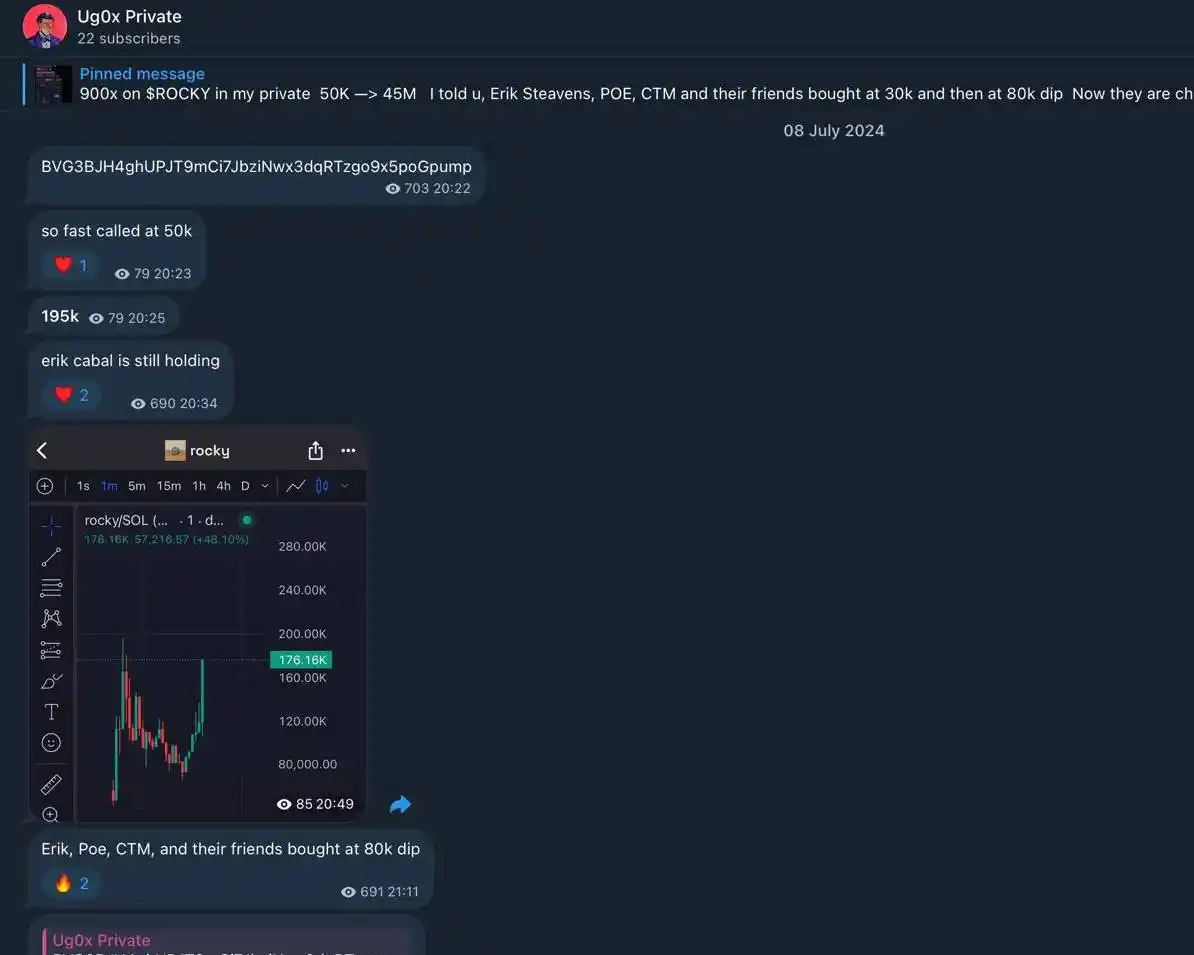
July 8, 2024, was a perfect example with the $ROCKY token. At that time, Erik Steavens, POE, DOGEN, and CTM were all quietly buying between a $10,000 and $80,000 market cap.

Seeing this signal, I knew it wasn't a coincidence—they were planning a pump.

I bought 2.8% of the circulating supply at a $40,000 market cap.

Over the next few days, these大佬联合发力拉盘 (big players jointly drove up the price), and the token's market cap skyrocketed to $45 million.

I took profits between $2 million and $10 million market cap, exiting on average around $6 million.

This trade multiplied my initial investment by 150 times. Although holding until the peak would have yielded 1100x, I strictly followed my exit plan and was more than satisfied with my first six-figure profit.
Tracking New Wallets, Project Team Wallets, and Large Holder Wallets

By January 2025, the crypto market was buzzing with activity, but wallet tracking had become more challenging. To stay ahead of insider information, I had to constantly refine my methods and adapt.

The key to tracking these insiders' wallets was finding their new wallets that had just withdrawn funds from centralized exchanges like Binance. This required precisely tracing fund transfers between multiple Binance addresses and their timestamps. Though time-consuming, it was absolutely worth it.

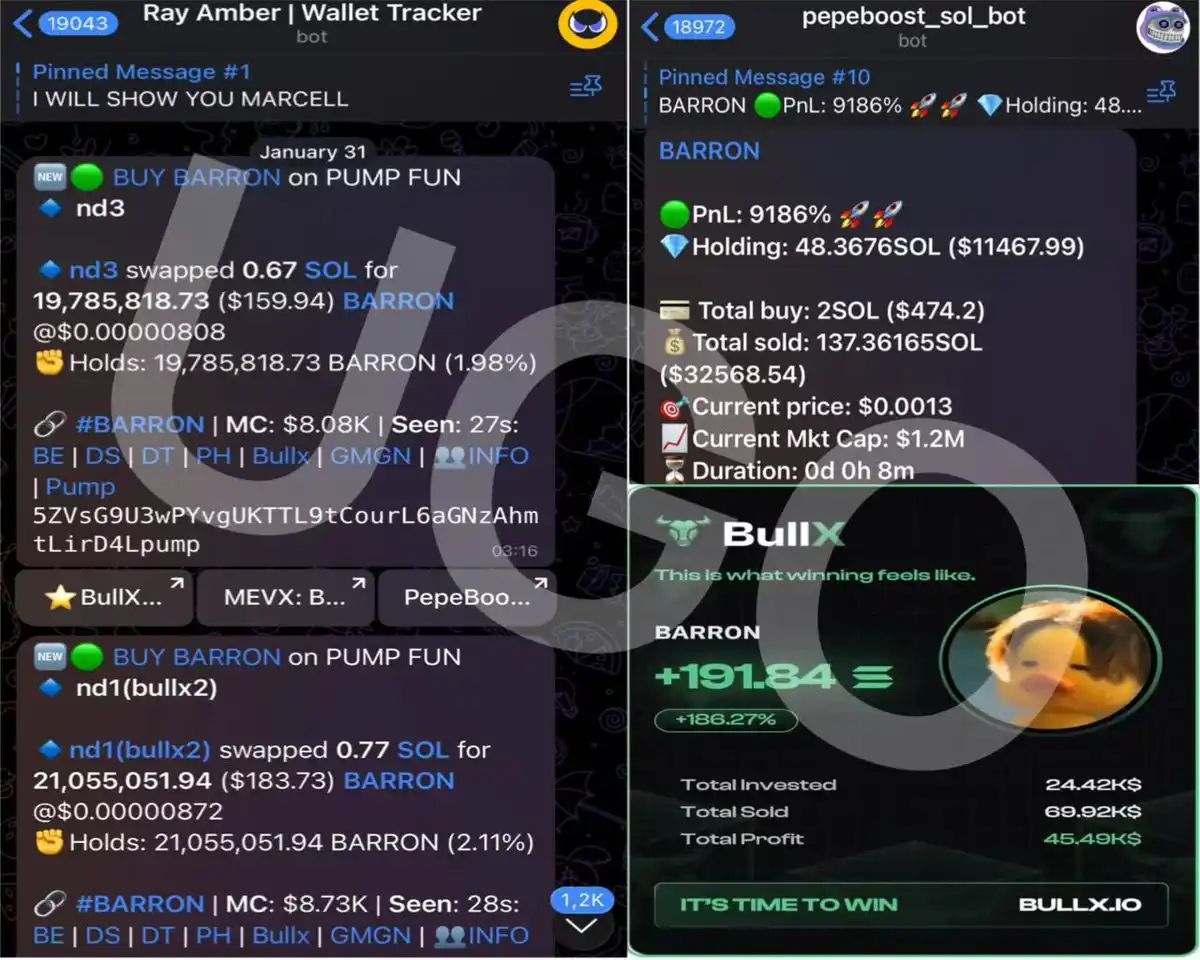
For example, I was closely monitoring Marcell's wallet movements, so I saw his newly funded wallets daily. On January 31, he personally launched and accumulated a large position in the $BARRON token.

I built my position across three wallets between a $15,000 and $25,000 market cap. About three minutes later, Marcell started posting to hype and pump the token. I quickly took profits between a $1 million and $2.5 million market cap.

This was one of my fastest trades ever: an initial investment of $1,300 turned into over $110,000. (The trading platform BullX showed my buy amount as $24,000 because I later added to my position during dips in this wallet, maximizing the profit.)
Tracking Market Maker Wallets

Market maker wallets are addresses controlled directly by the token project team, primarily used to manipulate prices for the benefit of the team or the token itself.

Common manipulation tactics include: placing large buy/sell orders to trigger stop-loss orders and scalp retail traders, or dumping the price by 30% in minutes to cause panic selling, allowing new investors to buy in low.

However, market makers often transfer tokens between wallets shortly after launch. If these wallets aren't newly created or are easily identifiable, we can directly track the project team's movements and precisely catch their every new token launch opportunity.

I did exactly this with the $HOOD token on January 31, 2025.

This project team launched a new token roughly every month. They completed their large accumulation around a $2 million market cap, and I bought in decisively at this level, getting in before top KOLs started hyping. Hours later, I took profits between an $80 million and $120 million market cap, netting about a 50x return on this trade.

Simultaneously, during breaks from managing my initial position's exit, I also leveraged the market maker's large sell-offs to re-enter heavily, making 40% to 70% gains in just minutes.

My total profit for the day was a staggering $152,000. Until the ASTER token trade in September of the same year, January 31st remained my most profitable trading day.

My Ironclad Trading Rules

I always strictly adhere to capital management rules. For example, the capital allocated to any single trade never exceeds 5% of my total portfolio. I also adjust my risk exposure flexibly based on the quality of the opportunity and my confidence level.

When trading with a wallet tracking strategy, you must never use large positions. If the target you're tracking detects your presence, they can easily turn around and rug pull you.

You also need to learn to think from their perspective—understand their interests, operational habits, and timing—to minimize the risk of being rug pulled and achieve consistent profitability.

Of course, I strictly follow my trading plan and never let emotions dictate decisions. I rarely struggle with this aspect because I started learning forex trading at 14, so discipline is deeply ingrained.

That said, I've also experienced several painful lessons of profit drawdowns. But these setbacks didn't break me; instead, they fueled my determination. Driven by this不甘 (reluctance to accept defeat), I studied even harder, continuously honing my trading edge.

Finally

I'm writing this article not to boast. On one hand, I want it to serve as a diary to look back on in five years and see how far I've come. On the other hand, I hope to inspire and help more people understand: as long as you are willing to actively seek change and put in the effort, there is always a way to achieve your goals.

I must clarify one point: I never use these tracking techniques against friends or people close to me. Everything I do is purely to understand the underlying logic of the market and then go with the flow.

I am also very grateful to those I track, and to the project teams who genuinely work hard. I always approach trading with reverence and without hostility. I am also sincerely thankful for all the friends I've met on this journey who have helped me tremendously. Thank you all, and thank heaven for its blessings.


Criptos en tendencia

Preguntas relacionadas

QWhat was the key strategy the author used to turn $50 into over $1 million in less than a year?

AThe author used a wallet tracking strategy, focusing on following the money flow of 'smart money' such as KOLs, insider groups, project teams, and market maker wallets to make trades.

QWhat common mistake did the author make initially when trading meme coins?

AThe author initially bought meme coins based on subjective factors like whether the meme was funny, the promotional content was good, or the website looked clean, which was akin to gambling without solid data.

QHow did tracking 'conspiracy groups' (coordinated insider wallets) improve the author's trading success?

ATracking multiple wallets from a coordinated group provided stronger and more reliable signals than following a single wallet, as it indicated a planned pump operation, leading to higher confidence and larger gains.

QWhat is one of the author's strict money management rules when using the wallet tracking strategy?

AThe author never risks more than 5% of their total portfolio on a single trade and adjusts risk exposure based on the quality of the opportunity and their confidence level to avoid being targeted and exploited.

QWhy does the author emphasize the importance of tracking new wallets or wallets that have just withdrawn from exchanges like Binance?

ATracking new wallets or recent withdrawals from centralized exchanges helps identify fresh capital movements from insiders, providing early signals for new token launches or pump operations before public promotion.

Lecturas Relacionadas

Por qué el Bitcoin se mantiene en $64,000 tras la dura pausa de la Fed

Bitcóin cierra julio cerca de los 64.000 dólares tras una volátil reacción a la decisión de la Fed de mantener las tasas sin cambios, aunque sin indicar un pronto aflojamiento monetario. Esto ha provocado una rotación de capital hacia los ETF de Bitcoin, que registraron una entrada neta de 32,1 millones de dólares, mientras que los fondos de Ethereum experimentaron salidas. El mercado de criptomonedas, con una capitalización de unos 2,29 billones de dólares, se mantiene en un rango lateral, con Bitcoin encontrando soporte en 63.000-63.500 dólares y resistencia en 66.000 dólares. La Fed mantuvo su tasa clave, pero tres miembros votaron a favor de un aumento, señalando una postura más dura de lo esperada. En este entorno macroeconómico incierto, los inversores institucionales parecen favorecer a Bitcoin como activo principal, aunque persiste el interés selectivo en activos como Solana. Mientras, la aprobación de la ley CLARITY en EE.UU. se retrasa hasta después del receso de agosto. Para el último día de julio, el enfoque estará en los datos macro de EE.UU. El escenario base para Bitcoin es la consolidación entre 63.000 y 66.000 dólares, con su ruptura superior dependiendo de nuevos flujos institucionales. La estabilidad por encima de 63.000 dólares para BTC, el mantenimiento de Ethereum sobre 1.860 dólares y las entradas continuas en ETF son claves para una posible base de recuperación en la segunda mitad del año.

cryptonews.ruHace 12 min(s)

Por qué el Bitcoin se mantiene en $64,000 tras la dura pausa de la Fed

cryptonews.ruHace 12 min(s)

Parker Lewis responde por qué bitcoin sigue siendo el mejor dinero

El influyente analista de Bitcoin, Parker Lewis, critica las estrategias de marketing de corporaciones que actúan como tesorerías cripto. Advierte que la venta de "crédito digital" mediante acciones preferentes perpetuas distorsiona la esencia de la criptomoneda. Lewis enfatiza que Bitcoin no genera rendimiento fiduciario por diseño y que las promesas de dividendos son riesgosas, dependiendo de nuevos inversores. Destaca el riesgo de estos derivados, señalando que el mercado de acciones preferentes perpetuas es minúsculo comparado con el crédito global, lo que demuestra que los grandes actores evitan estos riesgos, trasladándolos a minoristas. Rechaza la idea de que Bitcoin es "demasiado volátil", argumentando que la volatilidad es una consecuencia natural de la adopción masiva de un activo con oferta fija e inelástica. En lugar de comprar derivados corporativos como acciones de MicroStrategy, recomienda adquirir Bitcoin directamente, considerándolo más seguro. Lewis alerta que este enfoque distrae de la verdadera amenaza: la rápida devaluación del dinero fiduciario. Ilustra la inflación real con su "Índice Ribeye", mostrando un aumento del 90% en el precio de un filete desde 2020, muy superior a las cifras oficiales. Concluye que la estrategia más prudente es la posesión directa de Bitcoin y el control total de las claves privadas, protegiendo así los ahorros de la inflación y los riesgos sistémicos de los derivados corporativos.

cryptonews.ruHace 13 min(s)

Parker Lewis responde por qué bitcoin sigue siendo el mejor dinero

cryptonews.ruHace 13 min(s)

Arrestados participantes en esquema fraudulento con XRP, que robaron 9 millones de dólares a 71 inversores

El periódico surcoreano "Chosun" informa que la Policía Metropolitana de Seúl detuvo a tres personas acusadas de operar una plataforma de inversión fraudulenta utilizando XRP. Según las autoridades, entre el 16 y el 23 de octubre, el grupo recaudó aproximadamente 3,4 millones de XRP (equivalentes a unos 9 millones de dólares) de 71 inversores, tras lo cual cerró el sitio web y desapareció. Los sospechosos promovían el sitio Fxrpntwork.com a través de blogs, artículos en línea y vídeos de YouTube, prometiendo la garantía del capital y un rendimiento mensual del 1,5% al 1,8%. Instruyeron a los inversores a transferir XRP desde intercambios surcoreanos a través de plataformas extranjeras y luego a carteras controladas por el grupo. La policía advirtió a los inversores que verifiquen fuentes oficiales antes de transferir activos a carteras o plataformas no verificadas, destacando el peligro de dejarse engañar por información no contrastada en YouTube u otras plataformas. Los estafadores copiaron el branding de "Flare Network" y "FXRP" para que su plataforma pareciera legítima. Ripple advierte que tales esquemas suelen imitar nombres, logotipos y sitios web de organizaciones confiables para crear una falsa apariencia de seguridad. Este caso ilustra cómo las promesas de rendimiento garantizado siguen siendo una señal común de fraude en criptomonedas. Las autoridades surcoreanas congelaron activos virtuales por valor de 17.300 millones de wons tras detectar el esquema, y el análisis de carteras reveló transferencias adicionales por 27.300 millones de wons, lo que sugiere que podría haber más víctimas y cómplices sin identificar.

cryptonews.ruHace 16 min(s)

Arrestados participantes en esquema fraudulento con XRP, que robaron 9 millones de dólares a 71 inversores

cryptonews.ruHace 16 min(s)

Trading

Spot

Artículos destacados

Cómo comprar O

¡Bienvenido a HTX.com! Hemos hecho que comprar O1 exchange (O) sea simple y conveniente. Sigue nuestra guía paso a paso para iniciar tu viaje de criptos.Paso 1: crea tu cuenta HTXUtiliza tu correo electrónico o número de teléfono para registrarte y obtener una cuenta gratuita en HTX. Experimenta un proceso de registro sin complicaciones y desbloquea todas las funciones.Obtener mi cuentaPaso 2: ve a Comprar cripto y elige tu método de pagoTarjeta de crédito/débito: usa tu Visa o Mastercard para comprar O1 exchange (O) al instante.Saldo: utiliza fondos del saldo de tu cuenta HTX para tradear sin problemas.Terceros: hemos agregado métodos de pago populares como Google Pay y Apple Pay para mejorar la comodidad.P2P: tradear directamente con otros usuarios en HTX.Over-the-Counter (OTC): ofrecemos servicios personalizados y tipos de cambio competitivos para los traders.Paso 3: guarda tu O1 exchange (O)Después de comprar tu O1 exchange (O), guárdalo en tu cuenta HTX. Alternativamente, puedes enviarlo a otro lugar mediante transferencia blockchain o utilizarlo para tradear otras criptomonedas.Paso 4: tradear O1 exchange (O)Tradear fácilmente con O1 exchange (O) en HTX's mercado spot. Simplemente accede a tu cuenta, selecciona tu par de trading, ejecuta tus trades y monitorea en tiempo real. Ofrecemos una experiencia fácil de usar tanto para principiantes como para traders experimentados.

560 Vistas totalesPublicado en 2026.06.19Actualizado en 2026.06.29

Cómo comprar O

Cómo comprar PROS

¡Bienvenido a HTX.com! Hemos hecho que comprar Pharos (PROS) sea simple y conveniente. Sigue nuestra guía paso a paso para iniciar tu viaje de criptos.Paso 1: crea tu cuenta HTXUtiliza tu correo electrónico o número de teléfono para registrarte y obtener una cuenta gratuita en HTX. Experimenta un proceso de registro sin complicaciones y desbloquea todas las funciones.Obtener mi cuentaPaso 2: ve a Comprar cripto y elige tu método de pagoTarjeta de crédito/débito: usa tu Visa o Mastercard para comprar Pharos (PROS) al instante.Saldo: utiliza fondos del saldo de tu cuenta HTX para tradear sin problemas.Terceros: hemos agregado métodos de pago populares como Google Pay y Apple Pay para mejorar la comodidad.P2P: tradear directamente con otros usuarios en HTX.Over-the-Counter (OTC): ofrecemos servicios personalizados y tipos de cambio competitivos para los traders.Paso 3: guarda tu Pharos (PROS)Después de comprar tu Pharos (PROS), guárdalo en tu cuenta HTX. Alternativamente, puedes enviarlo a otro lugar mediante transferencia blockchain o utilizarlo para tradear otras criptomonedas.Paso 4: tradear Pharos (PROS)Tradear fácilmente con Pharos (PROS) en HTX's mercado spot. Simplemente accede a tu cuenta, selecciona tu par de trading, ejecuta tus trades y monitorea en tiempo real. Ofrecemos una experiencia fácil de usar tanto para principiantes como para traders experimentados.

543 Vistas totalesPublicado en 2026.06.22Actualizado en 2026.06.29

Cómo comprar PROS

Qué es VERONA

I. Introducción al Proyecto VERONA es una blockchain construida para todos, en cualquier lugar, a través de la abstracción de la cadena. Utilizando su capa de Abstracción Generalizada, VERONA se distingue por integrar funcionalidades complejas de blockchain, como cuentas, firmas e interoperabilidad, directamente a nivel de protocolo. Este enfoque permite interactuar con aplicaciones de blockchain sin necesidad de entender las tecnologías subyacentes.1) Información Básica Nombre: VERONA (VERONA)III. Enlaces Relacionados Enlace al sitio web oficial: https://xion.burnt.com/ Libro Blanco: https://xion.burnt.com/whitepaper.pdf Exploradores: https://explorer.burnt.com/ Redes Sociales: https://x.com/burnt_xion Nota: La introducción del proyecto proviene de los materiales publicados o proporcionados por el equipo oficial del proyecto, que es solo para referencia y no constituye asesoramiento de inversión. HTX no se hace responsable de ninguna pérdida directa o indirecta resultante.

579 Vistas totalesPublicado en 2026.06.22Actualizado en 2026.06.22

Qué es VERONA

Discusiones

Bienvenido a la comunidad de HTX. Aquí puedes mantenerte informado sobre los últimos desarrollos de la plataforma y acceder a análisis profesionales del mercado. A continuación se presentan las opiniones de los usuarios sobre el precio de A (A).

活动图片













