TRM Labs Hits Unicorn Status With $1B Valuation as $MAXI Explodes

bitcoinistPublicado a 2026-02-04Actualizado a 2026-02-04

Resumen

Blockchain intelligence firm TRM Labs has achieved unicorn status with a $1 billion valuation, signaling a maturation in crypto's "sanitization phase." This development, backed by major institutions like JPMorgan, Visa, and Citi, indicates traditional finance is investing heavily in blockchain compliance infrastructure. Historically, improved compliance leads to increased institutional capital flow, reducing systemic risk and encouraging a rotation into high-beta, speculative assets. Capital is already shifting towards high-volatility opportunities, exemplified by the presale success of Maxi Doge ($MAXI), which has raised $4.5 million. The project leverages a 'leverage culture' narrative, targeting traders with gamified experiences, holder-only trading competitions, and a treasury fund. Built on Ethereum, it offers staking rewards and aims to capitalize on the returning appetite for risk. On-chain activity suggests whale accumulation at the current presale price of $0.0002785, indicating smart money bet on its asymmetric risk-reward potential ahead of a public listing.

Trusted Editorial content, reviewed by leading industry experts and seasoned editors. Ad Disclosure

Quick Facts:

  • ➡️ TRM Labs achieving a $1B valuation signals institutional readiness to enter the crypto market, reducing systemic risk perception.
  • ➡️ Improved compliance infrastructure historically correlates with increased capital flows into risk-on assets and high-beta tokens.
  • ➡️ Maxi Doge ($MAXI) has raised over $4.48 million, capitalizing on this risk rotation with a ‘leverage culture’ narrative.
  • ➡️Smart money accumulation often precedes retail FOMO, suggesting whales are positioning for the next volatility cycle.

Blockchain intelligence firm TRM Labs has officially cemented its status as a ‘unicorn.’

The firm reached a $1 billion valuation following its latest funding round, but the number matters less than the signal. It proves the “sanitization phase” of crypto is maturing.

With heavy hitters like JPMorgan, Visa, and Citi already on the cap table, this valuation spike confirms one thing: traditional finance (TradFi) is paying big money to police the blockchain.

To the average retail trader, forensic firms sound like a buzzkill. More oversight, less Wild West. But history suggests a different outcome (and it’s bullish). When compliance infrastructure solidifies, institutional capital finally feels safe enough to enter.

And when the ‘adults’ enter the room with safety rails, liquidity cascades downstream. Lower systemic risk doesn’t kill volatility; it encourages a rotation into high-beta assets.

Call it the barbell effect. Massive capital flows into boring compliance infrastructure on one end, and high-octane speculative assets on the other. As regulatory fears fade, traders return to the charts hungry. We’re already seeing it happen, capital isn’t just parking in Bitcoin anymore; it’s hunting for volatility.

That rotation is clear in the presale sector, where liquidity is flowing toward projects embracing the aggressive ‘up-only’ culture. This is where Maxi Doge ($MAXI) comes in.

Buy $MAXI here.

Maxi Doge Capitalizes on the Return of ‘Leverage Culture’

While TRM Labs builds the police station, traders are heading back to the casino. Maxi Doge ($MAXI) is catching that wave.

The project diverges from the standard ‘cute animal’ formula by targeting a specific vibe: the gym-bro trader obsessed with leverage, gains, and ‘never skipping leg day.’ It frames the bull market as a physical grind, appealing to the grit needed to survive volatility.

The market response has been loud. According to official presale data, Maxi Doge has raised exactly $4.5M, signaling real demand for a narrative that mixes meme virality with trading utility. The project introduces holder-only trading competitions and a ‘Maxi Fund’ treasury to sustain liquidity, a structure attempting to fix the fragmentation typical in low-cap assets.
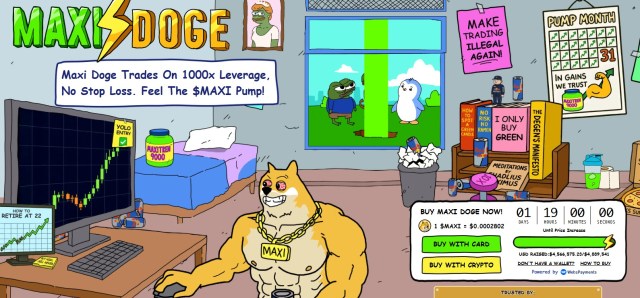
By gamifying the experience, $MAXI positions itself less as a token and more as a derivative of retail conviction.

For traders tired of low-volatility chop, the appeal lies in the project’s unapologetic focus on ‘pump’ mechanics. The tokenomics include a dynamic staking APY from a 5% allocation pool, giving traders yield while they wait for price action.

At the current presale price of $0.0002785, early buyers are effectively betting that the ‘meme supercycle’ will outperform the sanitized infrastructure plays.

Explore the $MAXI ecosystem.

Whale Wallets Signal Accumulation in Pre-Market Rounds

Smart money often moves first. On-chain activity around Maxi Doge ($MAXI) suggests high-net-worth players are positioning before the public listing.

Typically, whales wait for deep liquidity on DEXs to minimize slippage. Jumping in this early suggests a conviction that the $0.0002785 entry price offers an asymmetric risk-reward ratio compared to legacy memes. If TRM Labs represents the institutional ceiling, these whales are betting $MAXI is the retail floor.

Plus, the project’s technical foundation on Ethereum (ERC-20) ensures compatibility for future DeFi integrations. While the ‘Leverage King’ branding is funny, the underlying structure allows for serious capital deployment.

With daily automatic smart contract distribution for stakers, the protocol incentivizes holding through the volatility, a mechanism designed to counteract the ‘jeet’ (rapid selling) behavior that plagues lesser coins.

Buy your $MAXI here.

This article is for informational purposes only and does not constitute financial advice. Cryptocurrencies, particularly presale tokens, are high-risk assets. Always perform your own due diligence.

Editorial Process for bitcoinist is centered on delivering thoroughly researched, accurate, and unbiased content. We uphold strict sourcing standards, and each page undergoes diligent review by our team of top technology experts and seasoned editors. This process ensures the integrity, relevance, and value of our content for our readers.

patrubogdan

Follow

Full Profile

Related Posts

Quale criptovaluta comprare oggi in base alle condizioni di mercato: Il superciclo dei Layer 2 su Bitcoin

El mercado de las criptomonedas a la baja hoy: ¿qué está pasando?

B. Riley Cuts Price Targets Across Digital Asset Treasury Companies as LiquidChain Momentum Builds

Bitcoin in fase di stallo: i movimenti delle balene e il caso Bitcoin Hyper

Meilleure prévente crypto : où le capital se positionne avant le marché

XRP actualité : le marché réagit aux derniers signaux autour de Ripple et à l’émergence de nouveaux acteurs

Preguntas relacionadas

QWhat valuation did TRM Labs achieve in its latest funding round and what does this signify for the crypto market?

ATRM Labs achieved a $1 billion valuation, signifying that traditional finance (TradFi) institutions are heavily investing in blockchain compliance infrastructure. This signals a maturing 'sanitization phase' of crypto, reducing systemic risk perception and encouraging institutional capital to enter the market.

QHow does the article link improved compliance infrastructure to capital flows?

AThe article states that improved compliance infrastructure, as evidenced by TRM Labs' funding, historically correlates with increased capital flows into risk-on assets and high-beta tokens. It creates a 'barbell effect' where capital moves into both compliance tools and high-volatility speculative assets.

QWhat is the name of the meme token mentioned and how much has it raised in its presale?

AThe meme token mentioned is Maxi Doge ($MAXI). It has raised over $4.48 million (approximately $4.5M) in its presale.

QWhat specific market culture is Maxi Doge ($MAXI) attempting to capitalize on?

AMaxi Doge ($MAXI) is capitalizing on the return of 'leverage culture,' targeting a 'gym-bro trader' vibe obsessed with gains and volatility. It frames the bull market as a physical grind and embraces an aggressive 'up-only' narrative.

QWhat on-chain activity suggests 'smart money' or whales are interested in Maxi Doge ($MAXI)?

AOn-chain activity shows whale wallets are participating in the pre-market presale rounds. This early accumulation by high-net-worth players, who typically wait for deeper liquidity, suggests a conviction that the current price offers an asymmetric risk-reward ratio ahead of a public listing.

Lecturas Relacionadas

La aspiradora robot lleva 20 años compitiendo ferozmente, ¿por qué el 90% de los hogares chinos aún sigue observando?

A pesar de 20 años de desarrollo, más del 90% de los hogares chinos aún desconfían de los robots aspiradores. El problema central no es la capacidad de limpieza, sino la falta de confianza en que el robot pueda manejar de forma fiable y autónoma un entorno doméstico dinámico y desordenado. Los usuarios se preocupan por problemas comunes: el robot puede esparcir excrementos de mascotas, enredarse en cables, chocar contra muebles bajos o objetos transparentes, atascarse en umbrales o dejar áreas sin limpiar. La industria se ha centrado en competir por parámetros técnicos (más potencia de succión, más funciones), pero no ha resuelto estos problemas fundamentales de experiencia que generan más trabajo para el usuario. DJI, el líder mundial en drones, ha entrado en el mercado con el ROMO 2, aplicando su experiencia en percepción espacial, evitación de obstáculos y control de movimiento. Su enfoque se basa en tres pilares: que el usuario tenga que "re-limpiar" menos áreas, "rescatar" menos al robot de atascos y realizar menos "mantenimiento" de la máquina y su estación base. El ROMO 2 utiliza sensores avanzados y algoritmos para identificar y evitar mejor objetos pequeños, transparentes o bajos, reduciendo la necesidad de preparar el suelo antes de cada uso. Supera obstáculos de hasta 8,5 cm. Un brazo mecánico extensible y un sistema de IA que identifica tipos de suciedad le permiten limpiar de forma más inteligente alrededor de patas de muebles o manejar mezclas de residuos secos y húmedos. Su estación base está diseñada para una limpieza automática más completa, con el objetivo de minimizar la necesidad de limpieza manual y los malos olores. El artículo argumenta que la próxima fase de la industria debe centrarse en construir confianza, no en incrementar especificaciones. La confianza se gana cuando el robot demuestra que puede funcionar en un hogar real con mínima intervención humana. DJI, con su reputación de marca y capacidades técnicas, podría estar redefiniendo la competencia hacia la experiencia del usuario y la fiabilidad, planteando la pregunta de si puede llegar a ser un "momento iPhone" para los robots aspiradores.

marsbitHace 8 min(s)

La aspiradora robot lleva 20 años compitiendo ferozmente, ¿por qué el 90% de los hogares chinos aún sigue observando?

marsbitHace 8 min(s)

Los superricos acumularon efectivo récord en febrero, 4 meses después el S&P 500 alcanza máximos históricos, ¿quién se equivocó?

En febrero, los fondos de inversión en el mercado monetario de EE.UU. alcanzaron un récord histórico de aproximadamente 8,25 billones de dólares, y Warren Buffett acumuló una reserva de efectivo de 381.700 millones de dólares antes de su jubilación, lo que generó rumores de que los superricos estaban abandonando el mercado de valores. Sin embargo, en junio, la situación ha cambiado: el S&P 500 ha alcanzado nuevos máximos, superando por primera vez los 7600 puntos el 2 de junio. Mientras tanto, el tamaño de los fondos del mercado monetario ha disminuido a 7,87 billones de dólares el 10 de junio, lo que indica que el dinero está fluyendo de regreso al mercado de valores. Según cálculos, desde 2022, el rendimiento total del S&P 500 ha sido del 42 %, mientras que el de los fondos monetarios solo del 18 %, evidenciando el alto costo de refugiarse en efectivo durante la volatilidad. Aunque algunos inversores han destinado parte de su capital a activos alternativos como arte, bienes raíces y fondos de cobertura, los grandes bancos como Goldman Sachs y Morgan Stanley han aumentado sus objetivos para el S&P 500, respaldados por el crecimiento impulsado por la IA. No obstante, advierten sobre riesgos como la concentración excesiva en acciones tecnológicas y el deterioro financiero de los consumidores.

marsbitHace 11 min(s)

Los superricos acumularon efectivo récord en febrero, 4 meses después el S&P 500 alcanza máximos históricos, ¿quién se equivocó?

marsbitHace 11 min(s)

Los modelos lingüísticos más avanzados comienzan a ser controlados como uranio enriquecido

El viernes pasado, la administración estadounidense emitió una orden de control de exportaciones que prohibía a cualquier ciudadano extranjero acceder a los modelos de IA Fable 5 y Mythos 5 de Anthropic. Esto llevó a la empresa a desconectar globalmente estos modelos, recién lanzados, al no poder verificar en tiempo real la nacionalidad de los usuarios. Por primera vez, una entidad de inteligencia en forma de bits se incluye en un marco de control similar al del uranio enriquecido. Históricamente, los controles se aplicaban a objetos físicos o fórmulas (por ejemplo, centrifugadoras o algoritmos). Sin embargo, Fable 5 es un conjunto de parámetros digitales, infinitamente replicable y sin fronteras físicas. Lo que realmente se controla es la "densidad de capacidades" que estos parámetros condensan: habilidades de generación de código, razonamiento y conocimiento multidisciplinar. La analogía es clara: así como el uranio natural no está controlado pero su versión enriquecida sí, las capacidades de IA, dispersas en bibliotecas de código abierto, son libres, pero su concentración en un único punto de acceso las convierte en un objetivo de restricción. Este evento prefigura tres posibles desarrollos en la próxima década: 1) La institucionalización de la revisión de capacidades de los modelos, con listas y umbrales que activarían controles automáticos. 2) La expansión y difuminación de la jurisdicción, donde las leyes estadounidenses podrían aplicarse extraterritorialmente a usuarios globales. 3) Una bifurcación tecnológica, con un camino de modelos cerrados (avanzados pero con riesgo de desconexión) y otro de modelos abiertos o locales (más fiables por no estar sujetos a esos riesgos). El episodio revela una crisis más profunda: la falta de un régimen de propiedad intelectual para la "inteligencia" digital. Legalmente, los modelos se venden como un servicio revocable. Las empresas que los integran en sus procesos productivos asumen un riesgo enorme, ya que su inversión queda desprotegida frente a una posible desconexión. El mundo digital podría dividirse permanentemente, donde la utilidad y claridad de propiedad de un modelo lleguen a ser más importantes que su mera superioridad técnica puntual.

marsbitHace 31 min(s)

Los modelos lingüísticos más avanzados comienzan a ser controlados como uranio enriquecido

marsbitHace 31 min(s)

Trading

Spot
Futuros
活动图片