Top Audit Expert Warns: All DeFi is Unsafe, Withdraw Now!

marsbitPublicado a 2026-05-28Actualizado a 2026-05-28

Resumen

A leading DeFi security expert has issued a stark warning: all DeFi is now unsafe. Manuel Aráoz, founder of major security audit firm OpenZeppelin, stated on X that he is advising friends and family to withdraw funds from major protocols like Aave, MakerDAO, and Compound. The core reason for this drastic shift is the rise of AI. Aráoz argues that AI-powered coding agents can now identify and exploit smart contract vulnerabilities at an exponentially faster rate. This turns DeFi's transparency into a liability, providing a vast training dataset for attackers. The fundamental asymmetry of security—where defenders must patch every flaw, but attackers need only find one—is being catastrophically unbalanced by AI. Recent months provide chilling evidence. April saw massive exploits, including a $280 million loss at Drift Protocol and a $292 million theft from Kelp DAO. The trend continued into May with multiple high-value attacks on protocols like THORChain, Verus, Echo Protocol, and StakeDAO, demonstrating vulnerabilities across both on-chain code and off-chain management. AI acts as a force multiplier for hackers, enabling near-instantaneous vulnerability scanning, automated exploit script generation, and sophisticated social engineering. The recent development of ultra-powerful AI models like Anthropic's Mythos—so advanced its public release was delayed over security fears—signals even greater threats ahead. The article concludes that the risk-reward calculus for DeFi partic...

Original | Odaily Planet Daily(@OdailyChina)

Author | Azuma(@azuma_eth)
“I believe all DeFi is now unsafe.”

This assertion left by OpenZeppelin founder Manuel Aráoz on X yesterday, like a depth charge, once again rocked the already stagnant DeFi market.
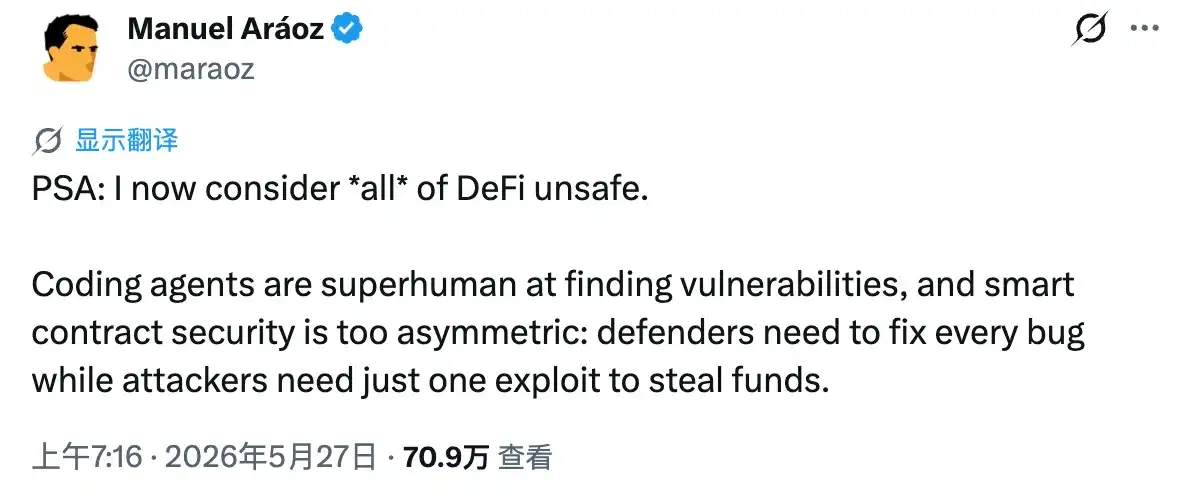
Manuel even stated that he has started advising friends and family to withdraw funds from major DeFi protocols, including blue-chip protocols like Aave, MakerDAO, and Compound, which were once considered low-risk.

This is not alarmism from an outsider. On the contrary, Manuel himself is one of the core builders of the DeFi security system, and OpenZeppelin is one of the industry's most mainstream security auditing firms. Its contract libraries, security standards, and audit frameworks have permeated nearly the entire DeFi world.

The reason for Manuel's complete shift in attitude lies in AI. Manuel pessimistically believes that the ability of AI Coding Agents to identify and exploit smart contract vulnerabilities is increasing exponentially.

This means that issues which previously required top-tier white-hat teams weeks to discover might now be scanned by AI in minutes; where hackers once needed long-term study of protocol logic, attack paths can now be analyzed automatically by AI; the "open and transparent" nature of DeFi, once an advantage, has now become the best training corpus for attackers.

Manuel also raised a more fatal problem: Smart contract security is essentially an extremely asymmetric game — the defense must patch all vulnerabilities, while the attacker only needs to find one to steal funds. As AI begins to exponentially enhance attack efficiency, this asymmetry is rapidly becoming unbalanced.

The Cold Reality: DeFi Has Become a Cash Cow for Hackers

Looking back at DeFi security incidents over the past few months, you'll find that Manuel's concerns are not exaggerated.

April was almost the worst month in DeFi's history.

  • On April 1st, April Fool's Day, Drift Protocol lost $280 million due to manager privilege hijacking and multi-signature execution vulnerabilities (details in "An April Fool's Joke? Drift Protocol Hacked for Over $280M, Potentially Becoming Solana Ecosystem's Second-Largest DeFi Heist").
  • Subsequently, on April 19th, Kelp DAO lost $292 million due to a bridge protocol breach (details in "DeFi Hacked Again for $292M, Is Even Aave Unsafe Now?"). The hacker later escaped via lending protocols like Aave, casting the shadow of bad debt and its cascading effects over the entire DeFi sector.

Entering May, incidents not only didn't decrease but further proliferated.

  • On May 15th, THORChain was attacked. A newly joined node operator exploited a vulnerability in the GG20 Threshold Signature Scheme (TSS), reconstructed the vault private key, and directly executed outbound transactions, causing over $10 million in losses.
  • On May 18th, Verus's bridge protocol was attacked. The attacker forged cross-chain import payloads, bypassed verification to extract assets from the Ethereum reserve, stealing approximately $11.58 million.
  • On May 19th, Echo Protocol on Monad was attacked due to a private key leak. The attacker minted 1,000 eBTC (worth $76.7 million) and extracted funds via Curvance using a previously tested attack path.
  • On May 24th, StablR, a compliant stablecoin issuer under the MiCA regulatory framework, was attacked. The hacker profited over $2.8 million by minting EURR and USDR, causing EURR and USDR to depeg.
  • On May 25th, the SquidRouter module was attacked, resulting in approximately $3 million in assets stolen from 86 Gnosis Safe wallets.
  • On May 27th, the StakeDAO deployer private key was leaked on Arbitrum. The attacker minted about 5.45 trillion vsdCRV and exchanged part of it for 43.7 ETH to escape.

The frequently occurring security incidents have sounded the alarm. DeFi seems to be collapsing across the board, from on-chain code to off-chain management.

AI Has Become the Hackers' Nuclear Weapon

Why has the DeFi offense-defense dynamic suddenly accelerated towards collapse this summer? Beyond the evolution of traditional hacking techniques, the rapid advancement of AI large language models is becoming the ultimate factor tipping the balance.

In the past, finding a complex smart contract vulnerability (especially those involving cross-chain, multi-layer nesting, or extremely hidden reentrancy logic) required top hackers weeks or even months of code review. However, with the maturity of AI agents possessing ultra-long context, strong logical reasoning, and autonomous tool-calling capabilities, this has changed fundamentally.

  • Second-Level Scanning and Global "Zero-Day" Vulnerability Mining: Attackers only need to feed the open-source codebase to the new generation of AI reasoning models. The AI can, within seconds, deduce hundreds of extreme interaction scenarios like a seasoned security expert, accurately pinpointing edge cases missed by human auditors during fatigue.
  • Automated Attack Script Generation: AI can not only discover vulnerabilities but also automatically write, test, and deploy the "hacker smart contracts" used to extract funds.
  • Perfect Orchestration of Off-Chain DevOps and Social Engineering: AI can impersonate perfect developers for phishing or monitor DeFi teams' GitHub commit logs around the clock. Once a team uploads code containing sensitive information or unverified fixes, the AI will launch an attack within seconds—far faster than any human security team's response time.

In this security warfare augmented by AI, hackers, armed with AI, possess nearly infinite ammunition and second-level attack speed. DeFi, however, is constrained by slow-paced governance voting, multi-signature confirmations, and lagging security audits, making it difficult to mount a corresponding defensive response.

Last month, Anthropic, the AI development company behind Claude, officially announced its next-generation model, Mythos (details in "Anthropic Creates the Most Powerful AI Model Ever, But Dares Not Release It..."). This is the first model in human history to break the hundred-trillion parameter threshold (in contrast, mainstream models currently range from hundreds of billions to one trillion parameters), with a staggering training cost of $10 billion.

However, due to Mythos's specialized capabilities in cybersecurity (Anthropic disclosed that using Mythos, they identified thousands of zero-day vulnerabilities in just a few weeks), Anthropic even dares not publicly release the model directly, for fear of malicious use by hacking groups. Instead, they plan to first allow leading large companies to test and preemptively patch potential vulnerabilities through a "Glasswing" initiative.

With the DeFi security situation already so severe at this stage, it's hard to imagine what new threats the industry's security defenses will face once Mythos is publicly released.

The Biggest Problem: Risk-Reward Ratio Has Long Been Unbalanced

For ordinary DeFi participants, liquidity providers (LPs), and whales, the most important question now is to sit down and calculate.

For a long time, the reason users chose to deposit funds into DeFi was to pursue annualized yields several times higher than those in traditional finance. During bull markets or the frenzy of liquidity mining, yields of 10%, 20%, or even higher were enough to cover people's psychological expectations for "potential technical risks."

But today, this underlying logic has long been shaken and even overturned. The risk-reward ratio of DeFi is already unbalanced. On the reward side, as the market enters a game of limited players and safety margins thicken, the real yields of most mainstream, relatively reliable DeFi protocols have fallen back to single-digit ranges. On the risk side, users' principal is exposed to a black box that could be breached by AI at any moment and emptied by a flash loan in an instant. Once a protocol is hacked, token prices plummeting to zero and liquidity pools being drained often happen within minutes, with no legal recourse, insurance, or central bank to provide coverage.

The risk of losing 100% of principal to chase roughly 5% annualized yield is clearly not a good deal.

Manuel's words may be somewhat absolute, but they tear off DeFi's last fig leaf. In the face of the reality where hackers have made AI a conventional weapon and security incidents continue to erupt in the industry, if you are not prepared for the psychological expectation of losing 100% of your principal for a certain yield, then "withdrawing funds as soon as possible and realizing profits" might be the most rational and risk-control-principled choice in the current market cycle.


Preguntas relacionadas

QAccording to the article, what is the main reason Manuel Aráoz gives for his statement that all DeFi is unsafe?

AThe main reason is the exponential enhancement of AI Coding Agents in identifying and exploiting vulnerabilities in smart contracts, making it easier and faster for attackers to find and exploit flaws.

QWhat does the article highlight as the fundamental asymmetry in smart contract security?

AThe fundamental asymmetry is that defenders must fix all vulnerabilities to be secure, while attackers only need to find a single vulnerability to steal funds.

QWhy is the AI model 'Mythos' from Anthropic mentioned as a particular concern in the context of DeFi security?

AMythos is a concern because it has demonstrated a powerful specialization in cybersecurity, being able to identify thousands of zero-day vulnerabilities in a short time, which could be weaponized by hackers if publicly released.

QWhat is the article's conclusion about the risk-reward ratio for users participating in DeFi protocols currently?

AThe article concludes that the risk-reward ratio is imbalanced. The potential risk of losing 100% of principal now outweighs the relatively low single-digit percentage annual yields offered by many protocols.

QWhich two major DeFi protocols were specifically mentioned as examples from which Manuel Aráoz is advising friends and family to withdraw funds?

AAave and Compound were specifically mentioned as examples of previously considered low-risk blue-chip protocols from which he advises withdrawal.

Lecturas Relacionadas

Resumen Semanal de Financiación | Crypto.com obtiene 400 millones de dólares de inversión, los sectores CeFi y de stablecoins siguen atrayendo capital

**Resumen Financiero Semanal: Cripto y IA Acaparan Grandes Inversiones** La semana pasada, los mercados de capitales de cripto y IA experimentaron una actividad significativa. En el sector cripto, se registraron 17 rondas de financiación, sumando más de 812 millones de dólares, mostrando una concentración de capital en transacciones grandes. El titular principal fue la ronda de 400 millones de dólares para el exchange **Crypto.com**, respaldada por Citadel Securities, valorando la empresa en 200.000 millones. Otras operaciones destacadas en finanzas centralizadas (CeFi) e infraestructura incluyeron 135 millones para el bróker API **Alpaca** y 70 millones para la plataforma bancaria transfronteriza **Flex**. El sector de **infraestructura y herramientas** recaudó fuertes sumas, con proyectos enfocados en pagos con stablecoins y liquidación, como **Cyclops** (20 millones) y **Pact Labs** (7 millones liderados por Tether). **Glacis Labs**, una plataforma de liquidación, levantó 6,8 millones. La **IA y la robótica** dominaron las megainversiones fuera del ámbito cripto. **Fireworks**, servicio en la nube para IA, recaudó 1.500 millones con respaldo de NVIDIA. En robótica, **Walden Robotics** (separada de Toyota) y la china **逐际动力 (Climber Robotics)** completaron rondas de 300 y casi 200 millones, respectivamente, para el desarrollo de robots humanoides. Otras áreas con actividad fueron DeFi, mercados de predicción y AI+Web3, con rondas menores. Además, se reportaron varias adquisiciones estratégicas, como la de MoonPay sobre la startup de depósitos Glide. En general, el capital continúa fluyendo hacia segmentos maduros como CeFi, stablecoins e infraestructura de trading en cripto, mientras que la IA y la robótica atraen apuestas masivas de capital riesgo para su comercialización.

marsbitHace 1 hora(s)

Resumen Semanal de Financiación | Crypto.com obtiene 400 millones de dólares de inversión, los sectores CeFi y de stablecoins siguen atrayendo capital

marsbitHace 1 hora(s)

¿El mercado bajista más moderado? Los bajistas del BTC cierran posiciones, ARK y Bitwise colectivamente son optimistas

**Resumen:** El 20 de julio, BTC se mantenía cerca de 75.000 USD, mientras que ETH retrocedía a 1.900 USD tras acercarse a los 2.000 USD. El mercado altcoin se mostraba mayormente débil. En las últimas 24 horas, se liquidaron 116 millones de USD en contratos, principalmente posiciones cortas (62.7 millones). El índice de miedo se sitúa en 35, indicando un sentimiento de pánico. Las perspectivas de diversas instituciones y analistas sugieren un posible punto de inflexión. **Polymarket** indica una probabilidad del 33% de que BTC caiga por debajo de 50.000 USD este año. **ARK Invest** señala señales de agotamiento de los vendedores, como el aumento de la ofente en manos de "hodlers" a largo plazo y del suministro en pérdidas (~54%). **Bitwise** describe esta caída como el "mercado bajista estructuralmente más suave" registrado, con una corrección del ~50% desde máximos, menor que en ciclos anteriores. Destaca que los inversionistas institucionales están comprando en la baja y que la base de cada ciclo es más alta. El análisis técnico de **Bit** sugiere que el mínimo de la onda C podría haberse formado, con un rango de soporte clave entre 59.000 y 70.000 USD. Sin embargo, **Glassnode** advierte que si BTC no logra superar con fuerza los 66.000 USD, el riesgo de un techo local aumenta. El analista **Darkfost** resalta la intensa zona de soporte entre 59.000 y 70.000 USD, donde se ha intercambiado el 50% del suministro circulante. Finalmente, el trader **Doctor Profit** anunció haber cerrado todas sus posiciones cortas (reportando grandes ganancias) y haber comenzado a comprar BTC spot desde los 64.000 USD, su primera compra para largo plazo desde septiembre de 2025. Argumenta que el consenso del mercado que espera mínimos más bajos en septiembre/octubre podría estar equivocado, y que el fondo del ciclo podría llegar antes de lo esperado, citando también avances regulatorios e institucionales como motivos estructurales para su cambio de postura.

Foresight NewsHace 1 hora(s)

¿El mercado bajista más moderado? Los bajistas del BTC cierran posiciones, ARK y Bitwise colectivamente son optimistas

Foresight NewsHace 1 hora(s)

Evolución del orden en la era de la IA y Web3: Las dimensiones competitivas y los caminos de exploración de m&W

La humanidad está evolucionando de la mejora de la productividad a la reconfiguración de las relaciones de producción. La rápida evolución de los Agentes de IA está liberando una capacidad productiva sin precedentes. En este contexto, la colaboración a largo plazo entre humanos y agentes de IA requiere la construcción de relaciones de confianza, la evaluación de contribuciones complejas y mecanismos de distribución de valor justos y sostenibles. Mientras que Web3 ha sentado bases técnicas para la desconfianza en activos e identidades, la era de los Agentes de IA exige un nuevo sistema de orden que aborde crédito, colaboración e incentivos económicos. El artículo analiza el enfoque de m&WDAO, que propone EcoFi (Finanzas/Orden del Ecosistema), un modelo que busca conectar activos cognitivos humanos, capacidades de ejecución de agentes de IA y mecanismos económicos on-chain. Se exploran y contrastan varias direcciones existentes: * **Colony**: Enfocado en gobernanza y colaboración organizacional humana basada en contribución (reputación). * **SingularityNET (ASI)**: Centrado en la creación de un mercado abierto para el intercambio y composición de servicios de IA. * **Gitcoin Passport / Verax**: Especializados en infraestructura de verificación de identidad y resistencia a sybil. * **Farcaster / Lens Protocol**: Orientados a redes sociales y de información descentralizadas con identidad propia. Frente a estos enfoques, m&W busca una integración más profunda, proponiendo una evolución en tres etapas: 1. **m&W 1.0 - Anclaje de Crédito**: Selección de nodos de alta calidad ("Builders") y sedimentación de sus contribuciones en activos de crédito no transferibles (SBT). 2. **m&W 2.0 - Economía Colaborativa**: Implementación del protocolo EcoFi, donde el crédito se conecta con tareas reales, utilizando una verificación híbrida (IA + juicio humano + arbitraje) para tareas no estructuradas y creando un ciclo de retroalimentación valor-crédito. 3. **m&W 3.0 - Orden Inteligente**: Evolución hacia una economía de agentes, donde el historial de crédito humano sirve como base de confianza para que sus "gemelos digitales" (Agentes de IA) participen autónomamente en la red económica. El camino presenta desafíos significativos como el arranque frío por el filtrado estricto, el equilibrio entre verificación por IA y gobernanza humana, y la estabilidad del modelo económico del token ($CMW). La misión final de m&W no es ser otra plataforma de IA, sino explorar los cimientos de un nuevo orden productivo para la economía colaborativa humano-IA, utilizando blockchain para establecer credibilidad, reglas y un marco económico sostenible.

链捕手Hace 1 hora(s)

Evolución del orden en la era de la IA y Web3: Las dimensiones competitivas y los caminos de exploración de m&W

链捕手Hace 1 hora(s)

China arrasa con puntajes perfectos en la IMO 2026, el Shanghai High School barre con el oro, GPT-5.6 revive el momento AlphaGo

¡China arrasa en la IMO 2026 con puntuación perfecta y la inteligencia artificial alcanza un hito! El equipo chino se ha proclamado campeón absoluto en la 67ª Olimpiada Internacional de Matemáticas (IMO) celebrada en Shanghái, logrando una hazaña histórica. Consiguieron el primer puesto por equipos con 232 puntos, superando por 25 puntos al segundo clasificado. Todos sus miembros obtuvieron medalla de oro. Tres estudiantes, Deng Leyan y Zhang Bolun de la Escuela Secundaria Shanghái, y Liu Che de la Escuela Secundaria Afiliada a la Universidad Normal del Este de China, lograron la puntuación perfecta de 42 puntos. Estados Unidos y Rusia completaron el podio. Este es el 26º título por equipos para China desde 1989. Destaca que, por primera vez, la IMO se celebró en una escuela secundaria (la Escuela Secundaria Shanghái), institución que acumula ya 20 oros olímpicos. La noticia va más allá del éxito humano. Se reporta que la inteligencia artificial, específicamente el modelo GPT-5.6 Pro, resolvió por sí solo los seis problemas de la IMO 2026 en su primer intento, sin intervención humana. Si se confirma, este logro marcaría un punto de inflexión: la IA pasaría de encontrar soluciones mediante búsqueda computacional a generar demostraciones perfectas a la primera, un dominio que hasta ahora parecía exclusivo de las mentes matemáticas más brillantes. OpenAI ofreció una suscripción anual de ChatGPT Pro a todos los ganadores de la medalla de oro. Fuentes: Sitio oficial de la IMO 2026 y publicaciones en redes sociales.

marsbitHace 2 hora(s)

China arrasa con puntajes perfectos en la IMO 2026, el Shanghai High School barre con el oro, GPT-5.6 revive el momento AlphaGo

marsbitHace 2 hora(s)

Trading

Spot
活动图片