TON Enters the Telegram Era: The On-Chain Experiment of Super Apps is Unfolding

marsbitPublicado a 2026-05-08Actualizado a 2026-05-08

Resumen

The TON token recently surged nearly 120% in 4 days, approaching $3. This rally is primarily driven by Telegram founder Pavel Durov's announcement that Telegram will become the core driver of the TON network, replacing the TON Foundation and serving as its largest validator. This move signals a fundamental shift: Telegram is no longer just supporting TON from a distance but is formally taking over its governance and operations. This changes TON's valuation narrative from being a crypto project with Telegram's user base to becoming the foundational blockchain infrastructure for Telegram's future commercial ecosystem—transitioning from a crypto narrative to an internet-platform-level story. TON's recent technical upgrades focus on 10x faster speeds, 6x lower fees, and near-instant confirmations. These optimizations target Telegram's internal high-frequency, micro-transaction scenarios like tipping, bot services, and Mini App purchases. The goal is to enable seamless, near-zero-cost transactions for its nearly 1 billion users, making blockchain usage almost invisible—akin to platforms like WeChat Pay. TON's path is unique: it already has a massive user base and is building the blockchain system to serve it, aiming to onboard users into Web3 without them realizing it. The vision is to integrate wallet, payment, bot, and Mini App functionalities into a closed loop within Telegram, positioning TON as the value-exchange infrastructure for a super-app. In essence, this surge refl...

Author: Climber, CryptoPulse Labs

Recently, the TON token has experienced consecutive increases, rising approximately 120% over 4 days and approaching the $3 mark. The primary reason behind this surge is the public endorsement by Pavel Durov, the founder of Telegram.

He stated that Telegram will replace the TON Foundation, becoming the core driving force behind TON, and will serve as the largest validator for the TON network. Meanwhile, the TON network has also been continuously advancing technical upgrades, such as announcing a 10x increase in network speed performance and a 6x reduction in transaction fees.

On the surface, this appears to be a round of technical upgrades and narrative revival for TON. However, what the market is truly reassessing is not TON itself, but the fact that Telegram has begun, for the first time, to fully embark on a comprehensive on-chain transformation in a real sense.

I. Telegram Takes the Helm: TON's Valuation Logic Begins to Shift

Over the past few years, TON has occupied a very unique position. It is deeply intertwined with Telegram, yet the two have always maintained a certain distance.

The reason is quite simple. Early on, Telegram launched the Gram fundraising plan, which ultimately faced regulatory intervention from the U.S. SEC, forcing the project to be terminated. The community subsequently took over the project, gradually evolving into the current TON ecosystem.

Therefore, for a long time, although Telegram continued to support TON—including gradually integrating its wallet, bots, mini-apps, and advertising system with TON—it never truly assumed the role of the official driver of TON publicly.
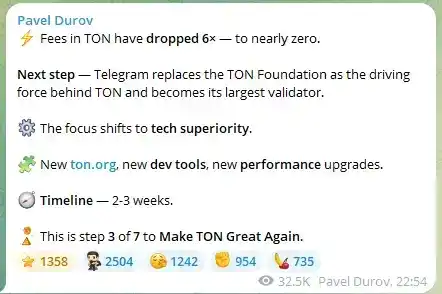
Pavel Durov's recent statements fundamentally alter market expectations. Particularly, the key points of Telegram replacing the TON Foundation and becoming the largest validator directly clarify that Telegram is now beginning to participate directly in the underlying governance and network operation of TON.

This is no longer just ecosystem support; it signifies Telegram formally reclaiming dominant control over TON's roadmap.

This shift is crucial because, in the past, the biggest question the market had about TON was not its technical capability but whether Telegram would truly go all-in on TON. Now, this question has a clear answer.

Simultaneously, this also means TON's valuation logic is changing. Previously, the market priced TON essentially as a public chain with Telegram's traffic support. But now, the market is beginning to reassess TON, as it is likely becoming the on-chain infrastructure within Telegram's future commercial ecosystem.

The difference between the two is significant. The former still belongs to the Crypto narrative, while the latter is beginning to enter the narrative of an internet-platform scale. This is also why TON's recent rise is not merely driven by sentiment but resembles a round of long-term expectation restructuring.

II. TON Reconstructs the Internet Payment Structure

Examining TON's recent rounds of upgrades closely reveals that its optimization direction is actually very clear: faster speed, lower fees, shorter confirmation times, and transaction fees approaching zero.

On the surface, these upgrades are optimizing chain performance, but what they are truly serving is not traditional DeFi but the large-scale payment application scenarios within Telegram.

Because Telegram itself has nearly 1 billion users, it inherently generates a vast amount of high-frequency, small-value transaction demand. Examples include content tipping, bot services, mini-app purchases, cross-border transfers, and digital goods consumption, among others.

These scenarios share a common need: users require extremely low costs and prioritize high speed.

If a payment takes tens of seconds to wait or incurs fees of several dollars, the entire user experience deteriorates significantly. Traditional blockchains have been particularly ill-suited for this type of scenario in the past.
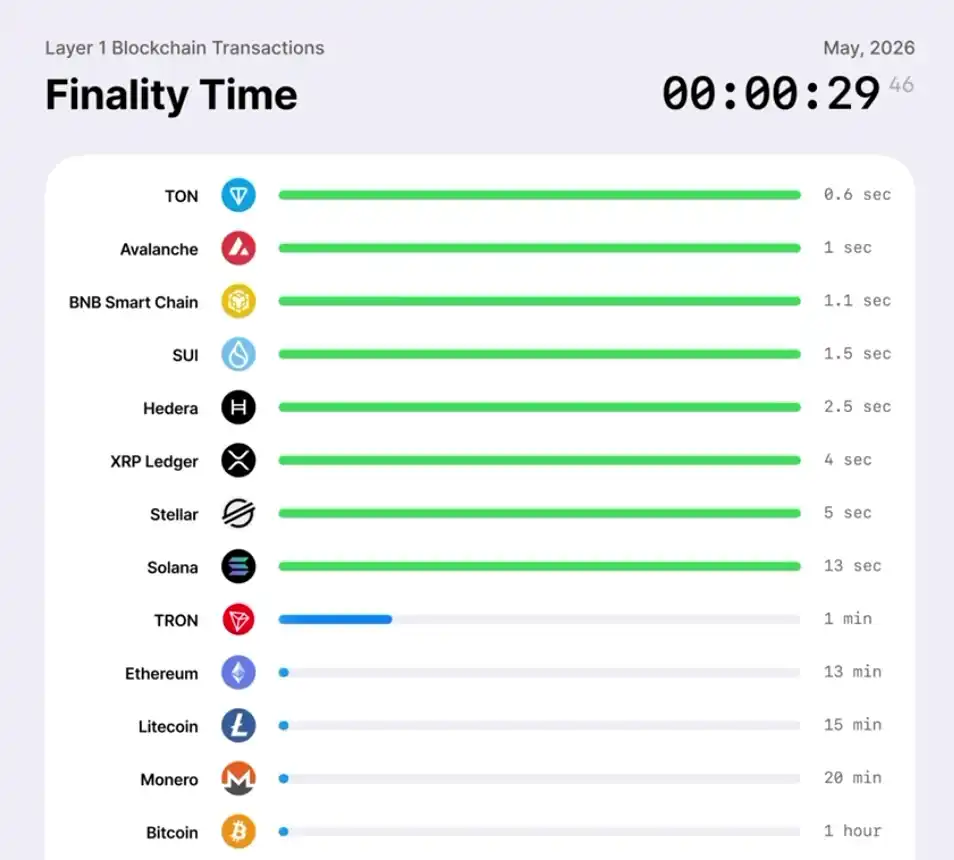
Therefore, TON's recent emphasis on fixed low fees and sub-second confirmations essentially revolves around redesigning blockchain for internet product experience. In other words, TON is attempting to solve a problem that Crypto has long failed to address: how to enable ordinary users to utilize on-chain systems almost imperceptibly.

This shift in logic is actually increasingly approaching the model of WeChat Pay.

Users don't need to understand blockchain, nor do they need to understand wallets, gas, or validation mechanisms. They only need to complete tipping, payments, purchases, transfers, and subscriptions, with all underlying settlements handled by TON.

This suggests that what TON truly aims to achieve may not be competition in the traditional L1 sense. What it is genuinely competing for is the global internet payment gateway.

Additionally, there is another crucial change. The logic of many public chains in the past has been: first build the infrastructure, then find users. But TON is the complete opposite. It first possesses a massive user base and then begins constructing the on-chain system.

Therefore, TON's challenge has never been how to get users into Web3, but rather how to enable users to complete on-chain actions without even realizing they are entering Web3. This represents a completely different development path.

III. TON's Future Blueprint: The On-Chain Transformation of Super Apps

Looking at all of TON's recent actions together, it becomes apparent that Telegram is gradually forming a complete closed loop. Functions that were originally separate—such as wallet, payments, bots, mini-apps, and on-chain settlements—are now gradually being integrated by TON.
This also signifies that TON is no longer just an independent public chain; it is becoming the infrastructure for value circulation within Telegram. The true significance of this lies in the fact that, for the first time, the crypto industry is approaching the on-chain transformation of super applications.

Because over the past decade, the crypto industry has always lacked a genuine mass-market entry point. Most public chains have been striving to attract users into the crypto world, but Telegram itself already possesses global-scale traffic.

Especially in markets like the Middle East, Russia, Eastern Europe, Southeast Asia, and Latin America, Telegram often functions not merely as a messaging tool but also as a community platform, commercial platform, payment tool, and more.

Therefore, TON's true strategic focus is not DeFi but rather global digital commercial scenarios.

Areas such as low-cost cross-border payments, the creator economy, on-chain micro-payments, and similar directions are likely the true sources of large-scale growth for TON in the future.

Of course, this path is not easy. TON's ecosystem remains in its early stages, with many applications still lingering in phases like mini-games, airdrops, and short-term traffic acquisition. Additionally, after Telegram's renewed deep involvement with TON, it may once again face regulatory pressure in the future.

Nevertheless, the market has now begun to realize one thing: TON's competitors may never have been traditional L1s, but rather the global internet payment systems.

Conclusion

This round of TON's rise is not essentially the market speculating on a simple upgrade. What truly drives the repricing of capital is the growing awareness that the world's first on-chain ecosystem with a genuine super-app entry point may have already begun to take shape.

And this time, Pavel Durov is no longer just an observer. Telegram is finally preparing to take the field itself.


Criptos en tendencia

Preguntas relacionadas

QAccording to the article, what was the main reason for the recent significant price surge of the TON token?

AThe primary reason for TON's recent price surge was Telegram founder Pavel Durov's public announcement that Telegram will become the core driver behind the TON network, replacing the TON Foundation and becoming its largest validator.

QHow has Pavel Durov's statement fundamentally changed the market's perception of TON's valuation logic?

AHis statement shifted TON's valuation logic from being a crypto-native public chain with Telegram's traffic support to potentially becoming the on-chain infrastructure for Telegram's future commercial ecosystem, moving from a crypto narrative to an internet platform-level narrative.

QWhat specific user needs is TON's recent technical optimization targeting, and what payment system is this approach compared to?

ATON's recent optimizations (faster speeds, lower fees, sub-second confirmation, near-zero costs) target the need for low-cost, high-speed, small-value transactions within Telegram (e.g., tipping, Bot services). This approach is compared to systems like WeChat Pay, aiming for users to use the on-chain system almost without awareness.

QWhat key advantage does TON possess compared to many other public blockchains regarding its development path?

AUnlike other blockchains that build infrastructure first and then seek users, TON already possesses a massive user base (Telegram's near 1 billion users) first, and is now building the on-chain system around that existing traffic.

QWhat does the article suggest is the true long-term competitor for TON, and what is its ultimate envisioned role?

AThe article suggests TON's true competitor is not traditional Layer 1 blockchains, but the global internet payment system. Its ultimate envisioned role is to become the on-chain value circulation infrastructure for the Telegram super-app, enabling global digital commercial scenarios like low-cost cross-border payments and the creator economy.

Lecturas Relacionadas

Aún no llega la computadora cuántica, pero ya es un problema el 1,1 millón de bitcoins de Satoshi Nakamoto

Un problema de 1,1 millones de bitcoins de Satoshi surge antes de que lleguen los ordenadores cuánticos. Una herramienta de prueba de conocimiento cero permite migrar fondos de carteras modernas antes de un ataque cuántico, en tan solo 243 ms. Sin embargo, los antiguos bitcoins extraídos antes de 2012, incluidos aproximadamente 1,1 millones de BTC pertenecientes a Satoshi Nakamoto almacenados en direcciones P2PK, no pueden ser rescatados con esta técnica. Estas direcciones antiguas carecen de una ruta de derivación jerárquica (HD), lo que las hace criptográficamente inaccesibles para la solución. Esto plantea un dilema político, no técnico, para la comunidad Bitcoin. Se discuten cuatro opciones, todas problemáticas: 1) No actuar y permitir el robo, desestabilizando el mercado; 2) Congelar coercitivamente los fondos (como sugiere la propuesta BIP-361), violando el principio de propiedad; 3) Limitar severamente los retiros de direcciones vulnerables para ralentizar una venta masiva; o 4) Redistribuir forzosamente los fondos "abandonados" mediante un hard fork, rompiendo la inmutabilidad del libro mayor. El mercado ya está reaccionando a esta incertidumbre de gobernanza. Instituciones como Jefferies han reducido su exposición a Bitcoin citando este riesgo, a pesar de que los ordenadores cuánticos prácticos aún no existen. El verdadero peligro inmediato no es el hardware cuántico, sino la crisis de fe dentro de la comunidad sobre cómo proteger el valor de Bitcoin sin traicionar sus principios fundamentales de propiedad y código inquebrantable.

marsbitHace 10 min(s)

Aún no llega la computadora cuántica, pero ya es un problema el 1,1 millón de bitcoins de Satoshi Nakamoto

marsbitHace 10 min(s)

¿Dónde está el campo de batalla principal del próximo mercado alcista? La respuesta se esconde en estos dos tipos de activos

**¿Cuál será el foco de la próxima carrera alcista en criptomonedas? La respuesta está en estos dos tipos de activos.** El mercado de criptomonedas muestra signos de tocar fondo, con Bitcoin subiendo y fondos ETF entrando nuevamente. La narrativa central del próximo ciclo alcista será la **convergencia de las finanzas tradicionales y las finanzas en cadena (on-chain)**, impulsada por casos de uso reales como stablecoins, tokenización de activos, operaciones 24/7 y liquidación instantánea. Esta convergencia crea oportunidades de inversión en dos frentes: 1. **Aplicaciones nativas de criptofinanzas con ingresos reales**: Como **Hyperliquid (HYPE)**, una cadena de derivados cuyo volumen incluye ya activos tradicionales. Su ventaja reside en un modelo de negocio sostenible (con ingresos recurrentes) y una economía de token sólida, donde el 99% de los ingresos se usa para recomprar y quemar HYPE. 2. **Empresas tradicionales maduras que adoptan infraestructura cripto**: Ejemplificado por **Robinhood (HOOD)**, que acaba de lanzar su propia blockchain (Robinhood Chain) para operar con acciones tokenizadas y DeFi en 120 países. Su escala y compromiso real le dan una ventaja significativa sobre los meros proyectos piloto. En resumen, los mayores ganadores de la próxima fase serán aquellos proyectos y empresas que estén impulsando activamente la fusión de ambos mundos, aprovechando las ventajas de la tecnología blockchain para transformar los mercados financieros globales.

Foresight NewsHace 13 min(s)

¿Dónde está el campo de batalla principal del próximo mercado alcista? La respuesta se esconde en estos dos tipos de activos

Foresight NewsHace 13 min(s)

El camino lleno de obstáculos de Clarity: el proyecto de ley de criptomonedas en la lucha por un compromiso bipartidista en EE.UU.

Los legisladores estadounidenses buscan avanzar la ley Clarity, una legislación bipartidista para estructurar el mercado de criptoactivos, pero el camino está lleno de obstáculos. Tras un acuerdo inicial en el Comité Bancario del Senado en enero, vetado por el CEO de Coinbase, el proyecto se reanudó en mayo tras un compromiso sobre los rendimientos ("yield"). Sin embargo, los demócratas condicionan su apoyo a la inclusión de fuertes cláusulas éticas para los funcionarios electos, una demanda no resuelta que llevó a una votación partidista en el Comité Agrícola. En julio, los republicanos presionan para una votación en el pleno del Senado, pero las divisiones persisten. Temas como la protección al consumidor, el financiamiento ilícito y las exenciones para desarrolladores generan desacuerdos tanto entre partidos como dentro del Partido Republicano. Aunque existe consenso sobre la necesidad de una ley de estructura de mercado, el compromiso político es difícil. Reuniones recientes con la Casa Blanca buscan un lenguaje ético aceptable, pero algunos senadores demócratas son escépticos. Los objetivos a corto plazo de la comunidad cripto incluyen una acción simbólica en el Senado antes del receso de agosto, sentar las bases para una posible ley en 2026 y trabajar en un marco de compromiso que combine ética, rendimientos y otros aspectos clave. A pesar del terreno difícil, el proceso legislativo tradicional continúa.

marsbitHace 22 min(s)

El camino lleno de obstáculos de Clarity: el proyecto de ley de criptomonedas en la lucha por un compromiso bipartidista en EE.UU.

marsbitHace 22 min(s)

Para comprar medicamentos para adelgazar en investigación, un grupo de estadounidenses aprende a pagar con Bitcoin

Un director de marketing estadounidense de 49 años, que antes consideraba Bitcoin sin valor fundamental, aprendió a usarlo para comprar 20 frascos de un fármaco chino para bajar de peso aún en fase de investigación, retatrulutida, ahorrando miles de dólares. Este caso, reportado por Bloomberg, ilustra un mercado emergente donde consumidores comunes, sin experiencia previa en cripto, usan Bitcoin para adquirir péptidos no aprobados por la FDA, como análogos de semaglutida o tirzepatida. Estos compuestos se venden en línea como "químicos de investigación", evadiendo sistemas de pago tradicionales que rechazan su alto riesgo regulatorio. Datos de Chainalysis muestran que los pagos con cripto a vendedores grises de péptidos alcanzaron 32 millones de dólares en el primer trimestre de 2026, con una tasa anual proyectada superior a 100 millones. No obstante, este volumen es pequeño dentro de un mercado negro estimado entre 10,000 y 30,000 millones. La conexión es más profunda que el pago: comunidades de DeSci, biohacking y cripto se solapan, como se vio en un evento en un bar de Nueva York donde un experto inyectó péptidos ante una audiencia entusiasta. Sin embargo, este nicho de uso para las criptomonedas podría reducirse si la FDA avanza en regular y permitir la producción legal de algunos péptidos en EE.UU., como proponen algunas autoridades para desplazar la demanda del mercado negro.

marsbitHace 32 min(s)

Para comprar medicamentos para adelgazar en investigación, un grupo de estadounidenses aprende a pagar con Bitcoin

marsbitHace 32 min(s)

Trading

Spot

Artículos destacados

Cómo comprar ERA

¡Bienvenido a HTX.com! Hemos hecho que comprar Caldera (ERA) sea simple y conveniente. Sigue nuestra guía paso a paso para iniciar tu viaje de criptos.Paso 1: crea tu cuenta HTXUtiliza tu correo electrónico o número de teléfono para registrarte y obtener una cuenta gratuita en HTX. Experimenta un proceso de registro sin complicaciones y desbloquea todas las funciones.Obtener mi cuentaPaso 2: ve a Comprar cripto y elige tu método de pagoTarjeta de crédito/débito: usa tu Visa o Mastercard para comprar Caldera (ERA) al instante.Saldo: utiliza fondos del saldo de tu cuenta HTX para tradear sin problemas.Terceros: hemos agregado métodos de pago populares como Google Pay y Apple Pay para mejorar la comodidad.P2P: tradear directamente con otros usuarios en HTX.Over-the-Counter (OTC): ofrecemos servicios personalizados y tipos de cambio competitivos para los traders.Paso 3: guarda tu Caldera (ERA)Después de comprar tu Caldera (ERA), guárdalo en tu cuenta HTX. Alternativamente, puedes enviarlo a otro lugar mediante transferencia blockchain o utilizarlo para tradear otras criptomonedas.Paso 4: tradear Caldera (ERA)Tradear fácilmente con Caldera (ERA) en HTX's mercado spot. Simplemente accede a tu cuenta, selecciona tu par de trading, ejecuta tus trades y monitorea en tiempo real. Ofrecemos una experiencia fácil de usar tanto para principiantes como para traders experimentados.

842 Vistas totalesPublicado en 2025.07.17Actualizado en 2026.06.02

Cómo comprar ERA

Discusiones

Bienvenido a la comunidad de HTX. Aquí puedes mantenerte informado sobre los últimos desarrollos de la plataforma y acceder a análisis profesionales del mercado. A continuación se presentan las opiniones de los usuarios sobre el precio de ERA (ERA).

活动图片