
The Second Half of Macro Influencer Fu Peng's Career

marsbitPublicado a 2026-04-21Actualizado a 2026-04-21

Resumen

Fu Peng, a prominent Chinese macroeconomist and former chief economist of Northeast Securities, has joined Hong Kong-based digital asset management firm Bitfire Group (formerly New Huo Group) as its chief economist. This move, announced in April 2026, triggered an 11% surge in Bitfire's stock price. Fu, known for his accessible macroeconomic commentary and large social media following, will focus on integrating digital assets into global asset allocation frameworks, particularly combining FICC (fixed income, currencies, and commodities) with cryptocurrencies for institutional clients. His career includes roles at Lehman Brothers and Solomon International, with significant influence gained through public communication. However, in late 2024, Fu faced temporary social media bans after a controversial private speech at HSBC on China's economic challenges, though he denied regulatory sanctions. He later left Northeast Securities citing health reasons. Bitfire, a licensed virtual asset manager serving high-net-worth clients, seeks to build trust and attract traditional capital through Fu’s expertise and credibility. The partnership represents a strategic shift for both: Fu enters the crypto sector after a traditional finance peak, while Bitfire aims to leverage his macro framework for institutional adoption. Outcomes remain uncertain regarding capital inflows and compatibility within corporate structure.

Author: BitalkNews

On the morning of April 20, 2026, the stock price of New Huo Group suddenly surged, rising more than 11% during the session.

What triggered this market movement was a piece of news that simultaneously ignited the financial and crypto circles: Fu Peng, former chief economist of Northeast Securities, officially joined New Huo Group as chief economist.

The news was first disclosed by Tencent News' "First Line," and New Huo Group subsequently confirmed it. Fu Peng himself also stated to the media: "It is mainly about combining FICC and C businesses."

Among them, FICC refers to fixed income, foreign exchange, and commodities, while C refers to cryptocurrency. His main work after joining will be to incorporate digital assets into the global asset allocation framework, providing macro research and asset allocation support for New Huo's institutional clients.

This is the first time he has reappeared in the public eye with an official position nearly a year after leaving Northeast Securities. For him, this is not just a change of employer but more like a restart of his career narrative.

The first half reached the pinnacle in the traditional financial system but was interrupted by controversy and illness; the second half is chosen in Hong Kong, in the crypto track, at the intersection where traditional finance and digital assets are slowly merging.

The Path of an Atypical Chief

In 2004, Fu Peng joined Lehman Brothers and later served as the head of global macro hedge strategy design at Solomon International Investment Group, responsible for currency, commodity, and major asset linkage analysis, for nearly four years.

He returned to China at the end of 2008 and worked at institutions such as Shandong High-Tech Investment, CIFCO, Galaxy Futures, Galaxy Securities, and Essence Securities.

In February 2020, he joined Northeast Securities as chief economist. His approach in this role differed from most of his peers: he made self-media his main battlefield.

He often used analogies and metaphors to explain economic logic, with a performance-style flair. His Weibo account, "Fu Peng's Financial World," has accumulated over 4 million followers, while his Douyin (TikTok) followers have reached 1.485 million. On Xiaohongshu and Bilibili, he has 355,000 and 773,000 followers, respectively.

In 2024, he published "Witnessing the Countercurrent," using a three-layer framework of "politics/distribution—macro—assets" to explain changes in global asset logic after 2016.

This approach gave him high recognition in the financial circle, making him an analyst who could present complex macro logic in an accessible way to ordinary investors.

The Consequences of a Speech

In late November 2024, Fu Peng was invited to give a year-end speech at an internal HSBC Private Wealth Planning event in Shanghai. The content covered China's declining demand, shrinking middle-class income,加剧的消费分化, and his judgment that current stimulus policies could not replicate the effects of the 2008 measures.

The recording and transcript were widely circulated online, removed from multiple platforms, and his WeChat and short video accounts were banned for nearly half a year.

Rumors emerged that he was canceled due to regulatory talks. Fu Peng publicly responded, directly criticizing HSBC, sharing chat records, and stating, "A lawyer's letter is already on the way, waiting for your apology."
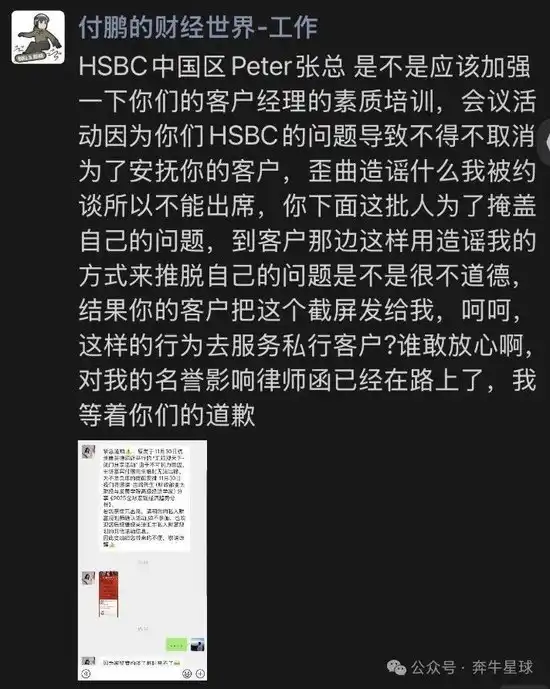
Northeast Securities also stated: There has been no recent regulatory discussion. HSBC responded that it was "looking into the relevant situation." After that, the matter quietly faded from public discussion, with no further progress, eventually ending without resolution.

During the account ban, Fu Peng's channels for public expression were significantly reduced.

On April 30, 2025, he officially resigned from Northeast Securities, explaining externally: He had just undergone two major surgeries and needed to rest for more than half a year.

Predictive Ability and Boundaries

Among Fu Peng's fan base, there are many stories about his accurate predictions, covering the 2008 financial crisis, the recovery of the Japanese stock market, and the turning point of China's real estate cycle. Since 2016, he has consistently emphasized de-globalization and changes in interest rate trends, with parts of his framework later validated to some extent.

However, his prediction record is not consistent. There have been clear deviations in short-term exchange rates and specific policy windows, with some judgments criticized as overly pessimistic or significantly inaccurate due to policy interventions. He himself admits that macro research focuses on structural variables, not next quarter's data. This is both a methodological explanation and a preventive clarification for short-term inaccuracies.

What he provides is a framework for interpreting the world, not a stable, reproducible prediction tool. Describing him as a prophet who gets everything right is a misinterpretation.

One of his major advantages is his ability to express complex macro logic in an accessible manner while maintaining relatively independent judgment. This allows his influence to reach a broader audience, and this characteristic is precisely what New Huo Group needs most.

Why Choose New Huo

Theoretically, Fu Peng had more than one option for his comeback. Traditional securities firms would welcome him back, and the role of chief economist is familiar to him, but he chose New Huo.

The space in traditional finance is narrowing. For someone who spoke so bluntly in the HSBC speech, returning to the system would mean something he likely understands better than anyone.

His skill set was never limited to traditional assets; FICC has always been his forte. After institutionalization, the connection between crypto assets and macro logic has become increasingly evident. Interest rate cycles, dollar liquidity, geopolitical risk premiums—these variables affect both traditional and digital assets.

There is also a more practical factor: a comeback requires a suitable stage.

New Huo Group is licensed in Hong Kong, listed on the Hong Kong stock exchange, and operates within a compliance framework. At the same time, its size and stage provide enough flexibility to allow a strong-minded individual to build a new research system. This is a completely different situation from playing a fixed role in a mature large institution.

Why New Huo Needs Him

New Huo Group currently positions itself as a digital asset management institution for high-net-worth clients. It holds Hong Kong SFC Type 1, 4, and 9 licenses and a TCSP trust license, making it one of the较早实现全牌照虚拟资产管理的机构 in Hong Kong.

In 2025, Weng Xiaoqi became CEO, launched the Bitfire Premium service, acquired a majority stake in the Japanese licensed exchange BitTrade, exited the retail market, and focused on family offices, listed companies, and institutional clients. At the end of March 2026, the company was renamed New Huo Group Holdings Limited, with the English name Bitfire Group.

Financially, total revenue for the 2025 fiscal year was HKD 8.661 billion, a year-on-year increase of over 450%, but growth was mainly driven by low-margin crypto OTC trading volume. The company整体依然亏损. Management has designated 2026 as the year for profitability, with significant pressure.

The compliance framework is in place, and growth numbers are impressive, but what New Huo truly lacks at this stage is not流量, but trust.

The clients it serves—family office partners, financial executives of listed companies, private investors with substantial wealth—do not lack information or data. What they lack is a narrative framework that can make them comfortable with digital assets and a professional image from the traditional financial world.

Weng Xiaoqi stated this logic quite bluntly: "Fu Peng's profound global macro research capabilities and precise market liquidity insights will become the company's top strategic brain... helping clients accurately grasp certainty in the era of 'FICC+C.'"

Fu Peng's background in international investment banking and hedge funds, his independent public persona, and his million-level influence constitute a recognizable professional signal for traditional wealthy individuals evaluating whether to allocate more funds to digital assets.

This is a transaction where both sides get what they need.

A Beginning Without a Conclusion

On one side is a person who emerged from the traditional financial system, experienced highs, controversies, and a forced interruption, now seeking a space to continue expressing and contributing. On the other side is a company striving to transition from a trading platform to an institutional service provider, attempting to establish a language more easily understood by traditional capital.

Can the appeal of macro narratives translate into real institutional capital inflows? How long can Fu Peng's independent style last within the framework of a listed company?

Will the trust of traditional wealthy clients in digital assets ultimately be built on framework认同, or will it still require further regulatory developments? These questions will take time to answer.

Preguntas relacionadas

QWhat is the immediate market reaction to Fu Peng joining Xinhua Group, and what was the stock performance?

AXinhua Group's stock price surged by over 11% during the morning session on April 20, 2026, following the announcement of Fu Peng's appointment as Chief Economist.

QWhat are Fu Peng's main responsibilities at Xinhua Group, particularly regarding FICC and C?

AFu Peng's primary role is to integrate digital assets into the global asset allocation framework, providing macro research and asset allocation support for institutional clients, with FICC referring to fixed income, currencies, and commodities, and C referring to cryptocurrencies.

QWhy did Fu Peng leave his previous position at Northeast Securities, and what was the public reason given?

AFu Peng left Northeast Securities in April 2025, with the public explanation being that he needed to recuperate for over six months after undergoing two major surgeries.

QWhat incident led to Fu Peng's social media accounts being suspended, and how did he respond?

AHis accounts were suspended after a speech at a HSBC private wealth event in late 2024, where he discussed sensitive economic issues. He publicly criticized HSBC, threatened legal action, and shared chat records demanding an apology.

QWhy does Xinhua Group need someone like Fu Peng, and what does his appointment signify for their business strategy?

AXinhua Group needs Fu Peng to build trust with high-net-worth and institutional clients by providing a credible macro narrative for digital assets, leveraging his traditional finance background and public influence to attract traditional capital into the crypto space.

Lecturas Relacionadas

Operador veterano relata: ¿Cómo operar con las expectativas erróneas del mercado?

**Resumen en español europeo:** Un trader experimentado explica cómo operar basándose en las "expectativas erróneas" del mercado, tomando como ejemplo una operación reciente de venta en corto del índice Nasdaq (NQ). El caso se desencadenó tras la publicación de datos débiles de inflación (IPC) en EE.UU. Inicialmente, el mercado reaccionó con optimismo, haciendo subir el Nasdaq, asumiendo que un IPC bajo conduciría a un relajamiento general de las tasas de interés, incluidos los tipos a largo plazo ("relajamiento del denominador"). Sin embargo, el trader identificó una falla clave en esta cadena de expectativas del mercado: mientras que las tasas de interés a corto plazo bajaron, las tasas reales a largo plazo (como la del bono a 30 años) alcanzaron máximos de 20 años. Este escenario de "relajamiento a corto plazo pero negativa a largo plazo" no apoya la valoración de acciones tecnológicas, que dependen de financiación a largo plazo barata para su crecimiento. La metodología central presentada consiste en no limitarse a los datos mismos, sino analizar tres capas: 1. **Expectativa del dato:** ¿Cuál era el consenso? 2. **Expectativa de transmisión:** ¿Cómo se supone que el dato afecta a otras variables del mercado (política monetaria, tasas, crédito)? 3. **Expectativa de valoración de activos:** Dado lo anterior, ¿cómo debería repreciarse un activo? El autor argumenta que el "error" más común y explotable ocurre en la segunda capa: el mercado asume que un mecanismo de transmisión anterior sigue siendo válido cuando ya no lo es. En este caso, asumió que un IPC débil relajaría todas las tasas, pero la nueva realidad macroeconómica impide que las tasas a largo plazo bajen. El trader actuó vendiendo en corto el NQ (más sensible a las tasas largas) en lugar del S&P 500 (ES), y estructuró la operación en varias entradas. Define que la mejor oportunidad surge cuando las "variables rápidas" (como el precio del activo) se han recuperado, pero las "variables lentas" (como las condiciones de financiación subyacentes) se niegan a hacerlo, creando una discrepancia entre el precio y su lógica causal implícita. La ventaja (alpha) no proviene necesariamente de tener información mejor, sino de tener un "modelo de reacción" más actualizado que el del consenso del mercado.

marsbitHace 14 min(s)

Operador veterano relata: ¿Cómo operar con las expectativas erróneas del mercado?

marsbitHace 14 min(s)

Opinión: La relación de cobertura entre la deuda estadounidense y el mercado de valores ha fallado, el BTC como activo de riesgo soporta una doble presión

Durante las últimas dos décadas, la relación de cobertura entre los bonos del Tesoro estadounidense y las acciones, donde uno subía cuando el otro caía, se ha roto. Ahora, ambos caen simultáneamente, eliminando el "amortiguador" clave en las carteras de inversión. Bitcoin, como activo de riesgo en el extremo de la curva, soporta una doble presión. La correlación negativa entre el S&P 500 y la rentabilidad de los bonos a 10 años ha alcanzado su nivel más bajo desde 1996 (-0,69), lo que indica un movimiento sincronizado sin precedentes en 30 años. Este cambio se debe a que la inflación, y especialmente su volatilidad, se ha convertido en el factor dominante del mercado, perjudicando tanto a bonos como a acciones, a diferencia de cuando el crecimiento económico era el principal motor. Los inversores buscan ahora seguridad sin riesgo de duración, optando por efectivo en dólares y letras del Tesoro a corto plazo, mientras venden bonos a largo plazo. El rendimiento del bono a 30 años superó el 5%, reflejando un déficit creciente, mayores pagos de intereses y una demanda extranjera decreciente. Bitcoin es ahora tan sensible a las condiciones macroeconómicas como el dólar o el oro. Se ve perjudicado por el aumento de los rendimientos libres de riesgo (que elevan su costo de oportunidad) y por la disminución de la aversión al riesgo (que reduce la financiación para posiciones especulativas). Los factores que sustentan su lógica a largo plazo (como la emisión fija frente a la deuda soberana en expansión) lo perjudican a corto plazo en el entorno actual. Para que los bonos recuperen su papel tradicional de cobertura, la volatilidad inflacionaria debe ceder, permitiendo que los riesgos de crecimiento vuelvan a ser dominantes y que la Fed tenga margen para relajar la política. Hasta entonces, en un mercado donde la clase de activos más profunda ya no absorbe los impactos, los activos que no generan rendimiento, como Bitcoin, quedan más expuestos.

marsbitHace 17 min(s)

Opinión: La relación de cobertura entre la deuda estadounidense y el mercado de valores ha fallado, el BTC como activo de riesgo soporta una doble presión

marsbitHace 17 min(s)

Resumen Semanal de Financiación | Crypto.com obtiene 400 millones de dólares de inversión, los sectores CeFi y de stablecoins siguen atrayendo capital

**Resumen Financiero Semanal: Cripto y IA Acaparan Grandes Inversiones** La semana pasada, los mercados de capitales de cripto y IA experimentaron una actividad significativa. En el sector cripto, se registraron 17 rondas de financiación, sumando más de 812 millones de dólares, mostrando una concentración de capital en transacciones grandes. El titular principal fue la ronda de 400 millones de dólares para el exchange **Crypto.com**, respaldada por Citadel Securities, valorando la empresa en 200.000 millones. Otras operaciones destacadas en finanzas centralizadas (CeFi) e infraestructura incluyeron 135 millones para el bróker API **Alpaca** y 70 millones para la plataforma bancaria transfronteriza **Flex**. El sector de **infraestructura y herramientas** recaudó fuertes sumas, con proyectos enfocados en pagos con stablecoins y liquidación, como **Cyclops** (20 millones) y **Pact Labs** (7 millones liderados por Tether). **Glacis Labs**, una plataforma de liquidación, levantó 6,8 millones. La **IA y la robótica** dominaron las megainversiones fuera del ámbito cripto. **Fireworks**, servicio en la nube para IA, recaudó 1.500 millones con respaldo de NVIDIA. En robótica, **Walden Robotics** (separada de Toyota) y la china **逐际动力 (Climber Robotics)** completaron rondas de 300 y casi 200 millones, respectivamente, para el desarrollo de robots humanoides. Otras áreas con actividad fueron DeFi, mercados de predicción y AI+Web3, con rondas menores. Además, se reportaron varias adquisiciones estratégicas, como la de MoonPay sobre la startup de depósitos Glide. En general, el capital continúa fluyendo hacia segmentos maduros como CeFi, stablecoins e infraestructura de trading en cripto, mientras que la IA y la robótica atraen apuestas masivas de capital riesgo para su comercialización.

marsbitHace 1 hora(s)

Resumen Semanal de Financiación | Crypto.com obtiene 400 millones de dólares de inversión, los sectores CeFi y de stablecoins siguen atrayendo capital

marsbitHace 1 hora(s)

¿El mercado bajista más moderado? Los bajistas del BTC cierran posiciones, ARK y Bitwise colectivamente son optimistas

**Resumen:** El 20 de julio, BTC se mantenía cerca de 75.000 USD, mientras que ETH retrocedía a 1.900 USD tras acercarse a los 2.000 USD. El mercado altcoin se mostraba mayormente débil. En las últimas 24 horas, se liquidaron 116 millones de USD en contratos, principalmente posiciones cortas (62.7 millones). El índice de miedo se sitúa en 35, indicando un sentimiento de pánico. Las perspectivas de diversas instituciones y analistas sugieren un posible punto de inflexión. **Polymarket** indica una probabilidad del 33% de que BTC caiga por debajo de 50.000 USD este año. **ARK Invest** señala señales de agotamiento de los vendedores, como el aumento de la ofente en manos de "hodlers" a largo plazo y del suministro en pérdidas (~54%). **Bitwise** describe esta caída como el "mercado bajista estructuralmente más suave" registrado, con una corrección del ~50% desde máximos, menor que en ciclos anteriores. Destaca que los inversionistas institucionales están comprando en la baja y que la base de cada ciclo es más alta. El análisis técnico de **Bit** sugiere que el mínimo de la onda C podría haberse formado, con un rango de soporte clave entre 59.000 y 70.000 USD. Sin embargo, **Glassnode** advierte que si BTC no logra superar con fuerza los 66.000 USD, el riesgo de un techo local aumenta. El analista **Darkfost** resalta la intensa zona de soporte entre 59.000 y 70.000 USD, donde se ha intercambiado el 50% del suministro circulante. Finalmente, el trader **Doctor Profit** anunció haber cerrado todas sus posiciones cortas (reportando grandes ganancias) y haber comenzado a comprar BTC spot desde los 64.000 USD, su primera compra para largo plazo desde septiembre de 2025. Argumenta que el consenso del mercado que espera mínimos más bajos en septiembre/octubre podría estar equivocado, y que el fondo del ciclo podría llegar antes de lo esperado, citando también avances regulatorios e institucionales como motivos estructurales para su cambio de postura.

Foresight NewsHace 2 hora(s)

¿El mercado bajista más moderado? Los bajistas del BTC cierran posiciones, ARK y Bitwise colectivamente son optimistas

Foresight NewsHace 2 hora(s)

Trading

Spot
活动图片